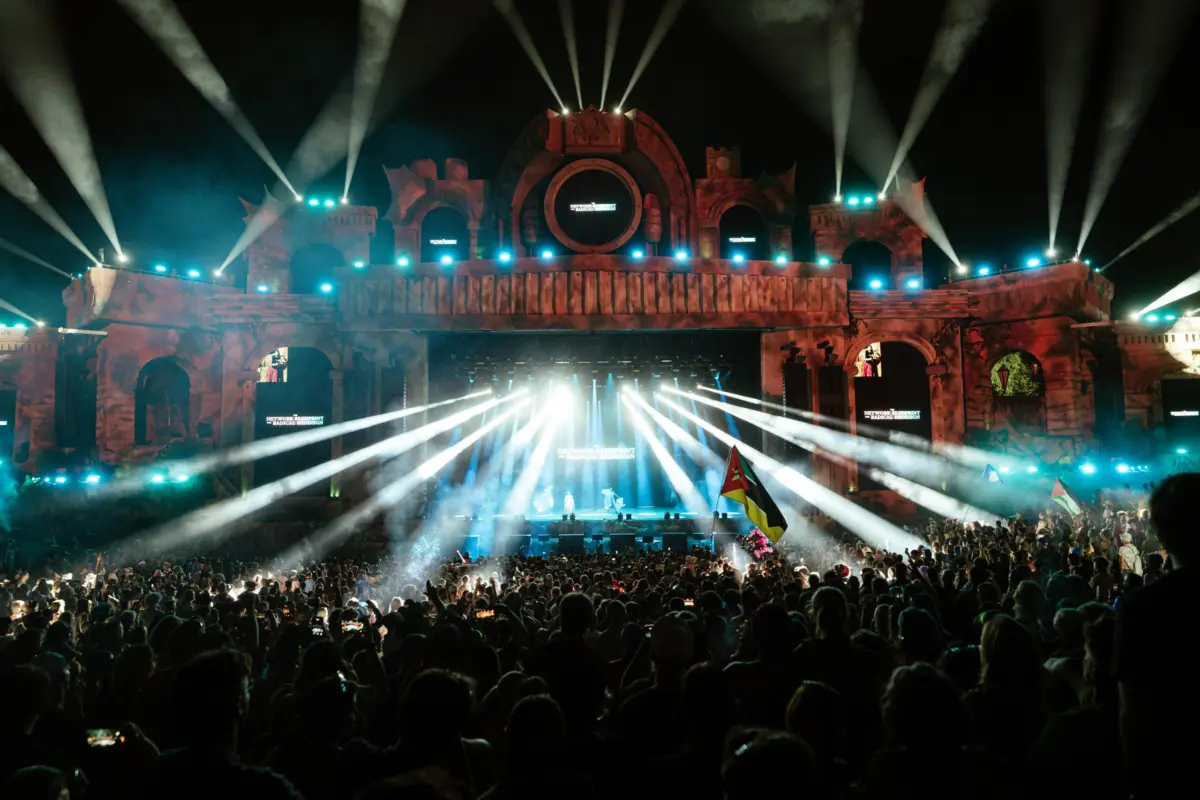
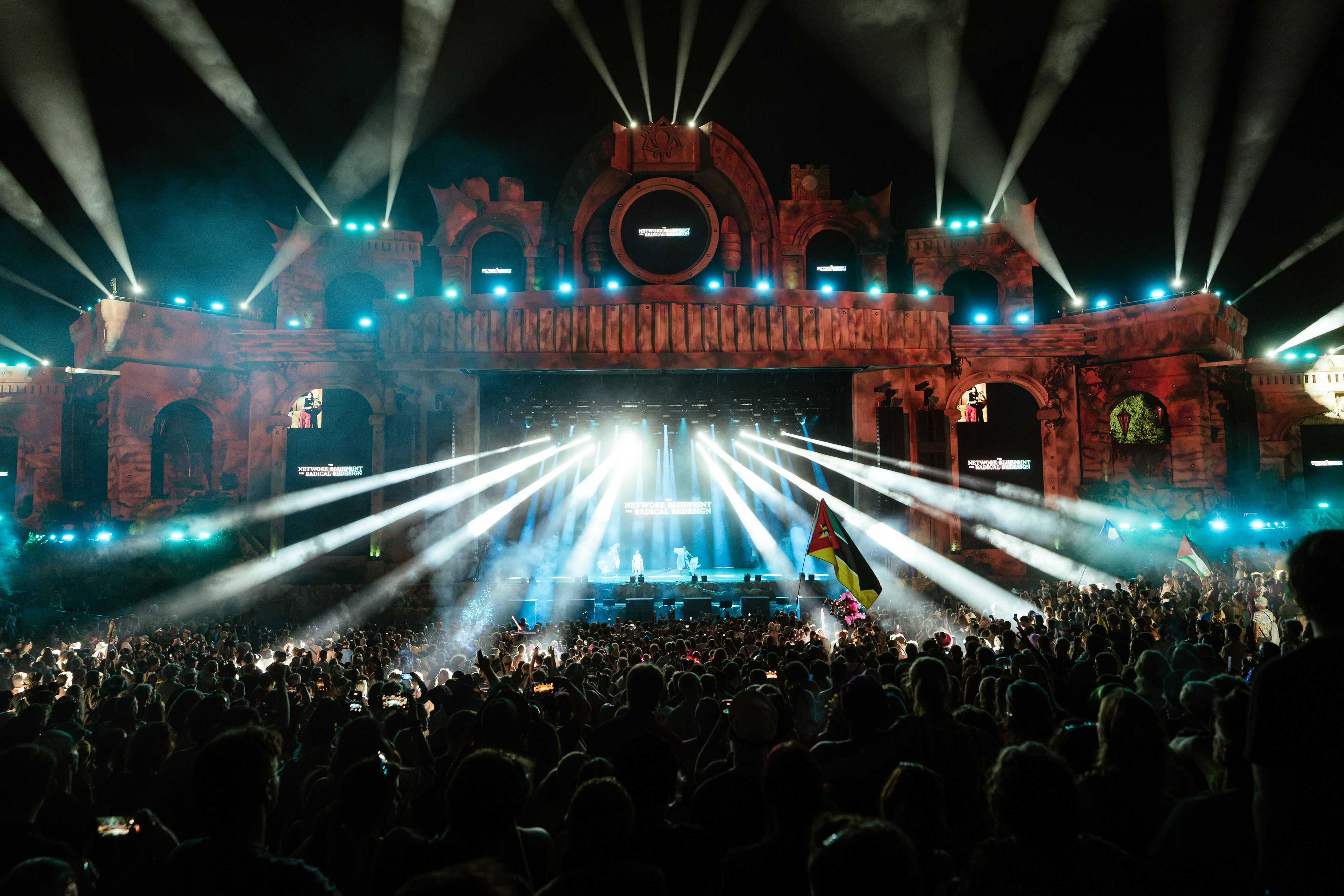
For fifteen years, the Matterly Estate nestled in the undulating folds of the South Downs has undergone an extraordinary annual metamorphosis. Every summer, for one week only, a family-owned farm and natural amphitheatre are comprehensively overwritten by the citizens of Boomtown—a labyrinthine, fictional cityscape first brought to life in 2009. What began as a humble gathering rooted in free-party traditions and underground countercultures has swelled into a monolith of immersive theatre, radical world-building, and musical diversity.
In 2026, the festival reached a historic milestone with Chapter Five: Radical Redesign, welcoming a sold-out crowd of 77,000 attendees—the largest capacity in its history. This installment marked a major turning point: the full-scale physical expansion of the festival back across its multi-valley footprint following years of pandemic-induced downsizing. Spanning over 500 artists across eight distinct districts, twelve main stages, and countless hidden venues, Boomtown 2026 functioned not merely as a music festival, but as a living, breathing socio-political experiment. Balancing cutting-edge zero-emission infrastructure, complex theatrical narratives concerning corporate greed and ecological collapse, and an uncompromising commitment to artistic freedom, Boomtown proved that it is far more than an ordinary party. It is an evolving blueprint for what a communal society might look like when built from the ground up.
Detailed Chronology: The Evolution of a Fictional Metropolis
The Genesis and Early Years
When co-founders Chris Rutherford and Luke Mitchell initially launched Boomtown, the landscape of mainstream festival spaces suffered from a glaring lack of opportunities for alternative genres and artistic countercultures. Drawing on their backgrounds in underground party scenes and a shared passion for world-building, the pair sought to forge an environment grounded in creativity, connection, celebration, and mutual respect for oneself, others, and the planet.
The inaugural chapter, Boomtown Begins, unfolded over three days at The Speech House Hotel in Gloucestershire. According festival lore, an explorer named Nickolas Boom discovered gold in the hills, only to unearth a lion-guarded temple built into the mountainside by a lost tribe from the stars. This temple housed remarkable treasures intended as an offering for the tribe’s eventual return. Respecting this tradition, Boom founded a small township and port with a portion of the tribute, promising secrecy. The community soon swelled with circus troupes and exotic beings, celebrating their fortune annually with music and dancing.
By its second year, the growing community relocated to the Stowe Landscape Gardens in Buckinghamshire, where external forces attempted to impose state control over the lawless enclave. By 2011, the scale of the event outgrew the garden space, prompting a permanent move to the Matterly Estate—a site boasting a rich history of open-air events. Here, the festival expanded into a four-day operation as the overarching storyline evolved: Boom was captured by hostile external forces, and the sacred treasure was stolen. As the years progressed, the narrative grew increasingly intricate, incorporating democratic shifts, time travel, revolutionary uprisings, and invasive technology alongside an expanding, diverse musical line-up.
The Pandemic Reset and Radical Redesign
When the COVID-19 pandemic halted the live events industry, Boomtown was forced into a hiatus. The festival emerged from its forced dormancy in 2022 with The Gathering, operating on a significantly reduced footprint. Pre-pandemic, the festival had spanned twelve distinct districts split between "Hilltop" and "Downtown." Post-lockdown constraints forced organizers to dial operations back, cutting districts by nearly half and eliminating longstanding main stages to keep activities contained within the Downtown area.
"We had to reduce the festival down into a much smaller footprint because the infrastructure didn’t exist," co-founder Luke Mitchell explained following Boomtown 2026. "It was just impossible to build the festival in the same way. But it was never the version that was truest to Boomtown… so we always knew that we wanted to build it back out again into multiple valleys."
Four years later, that expansion materialized with Chapter Five: Radical Redesign. Designed to make citizens question contemporary living structures, inherited conveniences, and power dynamics, the 2026 edition pushed the festival back out across its full historical canvas, re-engaging the natural amphitheatre of the Matterly Estate in its most ambitious configuration to date.
Supporting Context & Metrics: Infrastructure, Sustainability, and Scale
Running an immersive city of 77,000 citizens requires staggering logistical orchestration. The 2026 line-up deployed over 500 acts across eight districts, twelve main stages, and numerous hidden environments. Among the most anticipated returns was The Lion’s Den, reinstated after a seven-year hiatus within its own natural concave acoustic pocket. Down the winding Hippie Highway, attendees navigated the rustic whimsy of Oldtown and the 1920s-era hedonism of Copperwood Heights, which overlooks the central valley and the zero-emission HYDRO XL stage.
The Power of Clean Energy: HYDRO XL
A standout technical achievement of Boomtown 2026 was the massive expansion of the HYDRO XL stage, which received a 150% capacity increase to accommodate 20,000 citizens. Engineered in partnership with clean-power specialists GeoPura, the stage operated entirely on hydrogen fuel cells, completely eliminating diesel generators and their associated noise pollution.
Engineers on-site revealed that the hydrogen power units operated with roughly one megawatt of capacity sitting in reserve—enough to power a crowd four times the size of the 20,000-capacity stage. Against the backdrop of a visibly parched landscape suffering from regional drought conditions, the tangible deployment of zero-emission energy proved that festival sustainability initiatives can underpromise and over-deliver, rather than resorting to superficial greenwashing.
Social Networking and Behavioral Tracking
To foster deeper interpersonal connections during lulls between performances, organizers engineered an interactive social tracking system. Citizens collected and passed physical cards denoting specific behavioral roles based on their interactions. Acts of leadership earned a "Pioneer" card, while creative contributions warranted a "Visionary" card. Scanning these tokens into the official Boomtown app allowed participants to track their social reach, gamifying social consciousness and encouraging active recognition of positive community contributions.
Official Statements & Perspectives
The immense cognitive load of directing a living city of tens of thousands weighs heavily on its creators. Reflecting on the conclusion of the 2026 festival, Luke Mitchell confessed to the lingering psychological toll:
"I have been in so much anxiety for months, and it wasn’t until everyone left on Monday afternoon that I felt my nervous system could even vaguely regulate itself."
Addressing the challenges of scale and crowd circulation following years of downsizing, Mitchell noted the careful calculus required to balance high-production stagecraft with the interstitial spaces between venues:
"Understanding how dancefloors feel, and making sure that they’re inviting and feel held, is important. But actually, in equal measure, the gaps between the dancefloors are just as important… It’s the elements between it all that matter."
Mitchell also addressed ongoing debates regarding musical curation. While some early veterans lamented a perceived shift away from the heavy drum-and-bass dominance of previous eras, Mitchell emphasized that deliberate genre diversification is vital for long-term cultural sustainability and safety:
"We came from an underground scene, and although it has evolved into the mainstream… we made so many mistakes with waste, noise, and security over the years. This year in particular, we made sure that there was no dominant style. There was a mixture, which meant that we had the most diverse audience that we’ve ever had."
Festival regulars echoed the sentiment that despite operational evolutions, the beating heart of Boomtown remains untouched. Rachel June, a three-year attendee, observed:
"The festival itself has this core that’s remained, where it’s all about the people, art, creativity, and music. The togetherness and community have stayed the same… Everything around you is oozing with what life could be if we all got along."
Narrative Integration and Theatrical Climax
Unlike conventional music festivals where storytelling acts as mere window dressing, Boomtown integrates socio-political critique directly into its physical architecture and improvisational street theatre. Throughout the week, attendees navigated factional disputes, such as the ideological clash in Copperwood Heights between The Liquidians—who championed water conservation and resource protection—and The Von Vanderhausens, who prioritized unbridled hedonism.
This narrative tension mirrored real-world anxieties surrounding ecological collapse, corporate exploitation, and runaway capitalism. From steampunk outlaws in Area 404 warning of billionaire-led plots to abandon Earth as a "single-use planet," to satirical sound-bath meditations on corporate burnout, the festival continually juxtaposed escapist revelry with existential awareness.
The theatrical climax arrived on Sunday night at the Lion’s Den. While acts like Vengaboys, EVE, FCUKERS, Scissor Sisters, and Faithless delivered electrifying performances—culminating in a surprise back-to-back set by Chase & Status and Flowdan—the overarching narrative reached its dramatic peak.
As the fictional ruling class of billionaires attempted to siphon the estate’s remaining power to launch a rocket off the Matterly Estate (and off Earth), a fleet of drones illuminated the night sky. In a stunning twist, the rocket projection dissolved into the visage of a masked-fox vigilante associated with "Bill Tops." Over the public address systems, a final message echoed across the valley:
"We have taken over mission control. We have reclaimed your hoarded wealth. We will redistribute everything, equally, to every district. This is our world. Utopia belongs to us."
Future Outlook: Looking Ahead to Chapter Six
As citizens packed their belongings and walked out through the gates on Monday morning, caked in Matterly dust and carrying the psychological residue of an immersive week, the horizon shifted toward the future.
Reflecting on the timeline required to refine major site alterations, Luke Mitchell outlined the operational strategy for the festival’s upcoming iterations:
"Whenever we do a shift around the site or make a big change, it takes around two years to tweak everything and really get it right. So the big focus will be tweaking everything to get it right for next year. The tap is always on when it comes to public safety and welfare. That’s always top priority. There will also be a big push on how we become more sustainable from an environmental perspective, and we will continue to step forward in the way that we express creatively as well."
Boomtown occupies a singular space in the global festival landscape—a distinctly eccentric, fiercely independent manifestation of British underground counterculture. By maintaining its commitment to radical inclusivity, environmental innovation, and transformative storytelling, the festival continues to prove that it is much more than a temporary playground. As preparations begin for Chapter Six, Boomtown remains an enduring testament to the power of collective imagination and community resilience. Until next time, Boomtown.