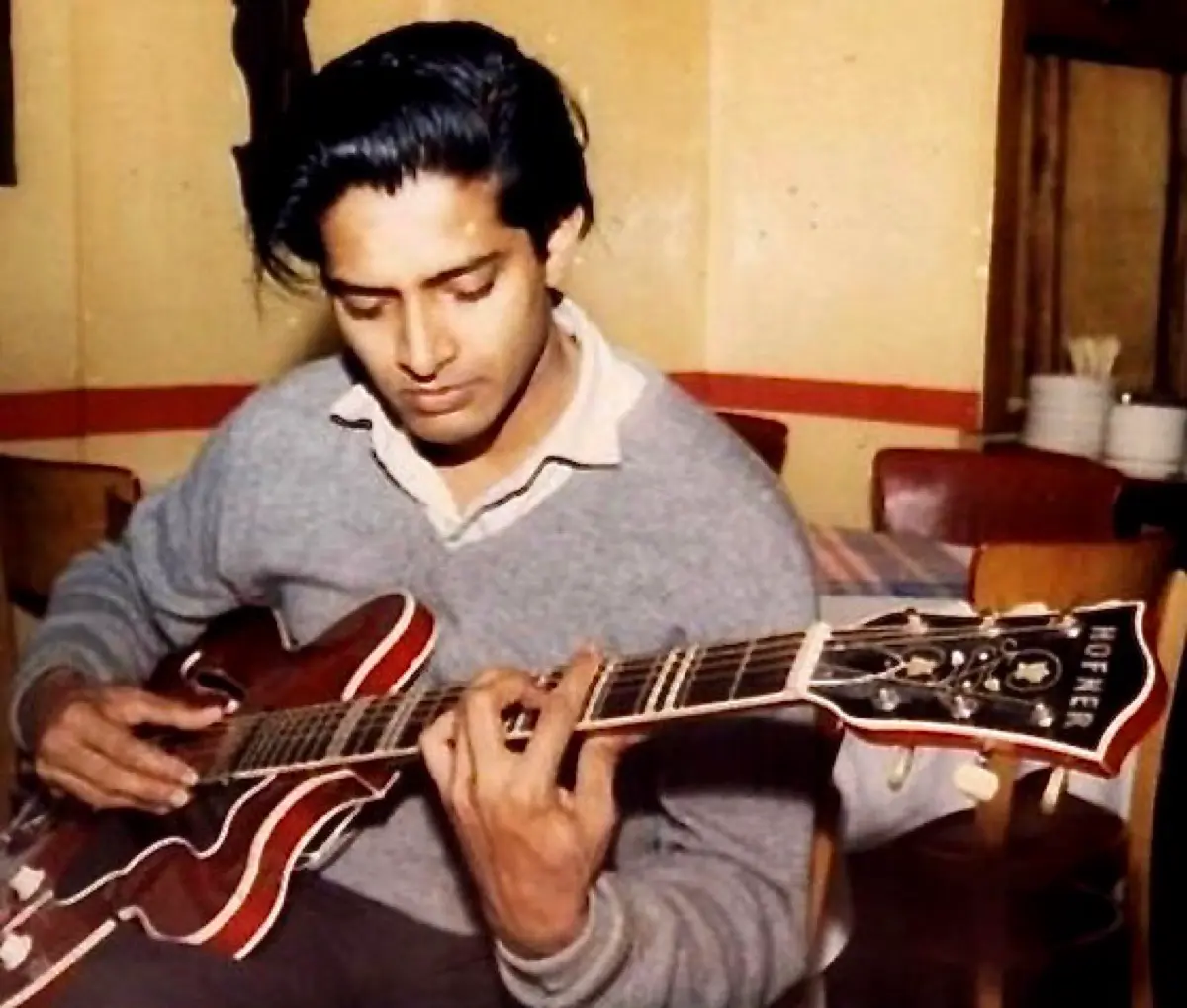

In the annals of modern jazz history, few stories are as rich in cross-cultural synthesis, unheralded genius, and resilience as that of Amancio D’Silva. Hailed as a virtuoso jazz guitarist of the late 1960s and a pioneer of what many critics term "Indo-Jazz," D’Silva carved out a distinct artistic niche that fused the modal improvisational frameworks of Indian classical music with the swinging, harmonic sophistication of Western bebop and post-bop. Yet, for D’Silva himself, such restrictive genre labels miss the point: his music has always been an expression of jazz in its infinite variety, anchored deeply in the human heart rather than the academic head.
Though his performance career was tragically cut short by a near-fatal stroke in 1991—silencing his beloved red Fender Stratocaster, which now rests quietly in the corner of his Hampshire home alongside a CD player—D’Silva’s footprint on British and international jazz remains indelible. His groundbreaking 1969 debut album, Integration, earned high praise from contemporary critics who drew direct parallels between his distinct cultural lens on the guitar and the pioneering gypsy jazz of Django Reinhardt.
Beyond his solo output, D’Silva was a central figure in a golden era of British jazz exploration, collaborating with luminaries such as Joe Harriott, Stan Tracey, John Mayer, and Ian Carr. When illness forced him away from the spotlight, he seamlessly transitioned into a mentor, shaping the next generation of musicians at London’s Jenako Arts and the Krishnamurti International School. Today, as his original vinyl releases fade into rare collector’s items and out-of-print treasures, D’Silva’s life offers a profound lens through which to examine the evolution of jazz, the importance of emotional authenticity over technical acrobatics, and the enduring power of artistic friendship.
Detailed Chronology: From Bombay’s Jazz Yatra to the British Underground
Roots in Bombay and Early Inspirations
Amancio D’Silva’s relationship with the guitar began in his childhood, blossoming during a surprisingly vibrant Bombay jazz scene in the 1950s and 1960s. In an era when international jazz icons regularly toured the subcontinent, Bombay played host to a continuous stream of global talent. Every few months, the city would erupt in a "jazz week," welcoming legendary ambassadors of the genre. D’Silva vividly recalls the awe-inspiring visits of Duke Ellington, Paul Desmond, and Dave Brubeck to the annual festival known as the Jazz Yatra (Jazz Pilgrimage).
By the age of 25, D’Silva’s exceptional talent had already built him a stellar reputation locally, drawing the attention of jazz aficionado and royalty alike. The Maharani of Jaipur, a passionate patron of the arts, stepped in as his benefactor. As D’Silva fondly recounts, her support was transformative: "I wrote a song on my first record. I called it Jaipur. . . She was a very good benefactor. She bought me a good guitar and she bought a lot of jazz records so I could hear the music."
Musically, D’Silva’s formative years were heavily shaped by the revolutionary electric guitar work of Charlie Christian. Reflecting on Christian’s brief yet seismic impact, D’Silva notes: "He was the first person to play on the electric guitar. Benny Goodman’s brother-in-law discovered him and Benny Goodman had him in his band playing hits like Flying Home and Seven Come Eleven. He was only in the limelight for two years then he got TB and died." Following in Christian’s footsteps, D’Silva drew inspiration from a pantheon of melodic improvisers, including Wes Montgomery, Johnny Smith, Barney Kessel, Jim Hall, and Kenny Burrell—players who prioritized emotional resonance and fluid phrasing over mere flashiness.
The Twist of Fate and the British Migration
D’Silva’s relocation to England was set in motion by a nearly tragic family emergency. He had married Joyce, a British teacher working in India, and the couple welcomed a son, Stephano. Shortly after birth, Stephano fell gravely ill, prompting the family to fly to Britain in search of specialized, life-saving medical treatment. Fortunately, the intervention was successful, and Stephano made a full recovery, eventually growing up to become an accomplished guitarist in his own right.
Choosing to remain in England, D’Silva was introduced to the burgeoning British jazz scene through a mutual friend who connected him with theater director Jonathan Miller. Miller, in turn, introduced the young guitarist to Denis Preston, a visionary producer responsible for orchestrating some of the most daring cross-cultural collaborations in British jazz history. Through Preston, D’Silva found himself rubbing shoulders with pioneers like Joe Harriott, Stan Tracey, and violinist John Mayer, laying the groundwork for the Indo-Jazz fusion movement.
The 1969 Breakthrough and Critical Acclaim
The year 1969 proved to be a watershed moment in D’Silva’s career. It marked the release of his debut album, Integration – Introducing Amancio D’Silva (Columbia/EMI), which immediately turned heads across the critical establishment. Writing in Jazz Monthly, critic Don Locke captured the unique essence of D’Silva’s artistry:
"Just as Reinhardt was a gypsy playing his special brand of jazz, so Amancio D’Silva is an Indian playing his special brand of jazz, and in each case the music is distinctive and successful to the same degree…"
What set D’Silva apart—beyond his fluid, lyrical guitar tone—was his prowess as a composer. Unlike many sidemen of the era who relied entirely on standard repertoires, D’Silva’s landmark recordings featured predominantly original compositions that seamlessly blended Eastern modal colors with Western swing and bebop harmonic structures. Later that same year, he teamed up with Joe Harriott to record Hum Dono, further cementing his reputation as a vital voice in modern jazz. This was followed in 1971 by Reflections, a celebrated collaboration with pianist Stan Tracey, and Dream Sequence in 1972 with the cosmic jazz outfit Cosmic Eye.
Mentorship, Illness, and Later Life
Though D’Silva’s promising performance career was ultimately derailed by sudden illness—culminating in a near-fatal stroke in 1991—his commitment to the music never wavered. Unable to perform on his red Fender Stratocaster for several years, he channeled his expertise into education, nurturing the next generation of talent.
Much of this educational work took place at Jenako Arts, a vibrant cultural center in East London that served as an essential melting pot for jazz and traditional artists from Africa, Asia, and South America throughout the 1980s. He later continued passing on his mastery to young minds at the Krishnamurti International School at Brockwood Park, close to his home in Hampshire. Today, supported by his wife Joyce of over 30 years—who lovingly preserves his rare, out-of-print albums on the settee—D’Silva continues a steady, courageous recovery, remaining a revered elder statesman of British jazz.
Supporting Context & Metrics: The Anatomy of a Rare Discography
To understand the rarity and historical weight of Amancio D’Silva’s recorded output, one must look closely at his official discography. Today, none of these original LPs remain in print, transforming his catalog into highly sought-after artifacts for international jazz collectors and archivists.
- Integration – Introducing Amancio D’Silva (1969, Columbia/EMI SX6322/SCX6322)
- Joe Harriott/Amancio D’Silva Quartet: Hum Dono (1969, Columbia SX6354)
- Various: Jazz Explosion (1969, Columbia SLJS1)
- Amancio D’Silva/Stan Tracey: Reflections (1971, Columbia SCX6465)
- Cosmic Eye: Dream Sequence (1972, Regal Zonophone/EMI SLRZ 1030)
The scarcity of these pressings underlines a broader historical oversight: brilliant, trans-cultural experiments from the late sixties and early seventies frequently slipped through the cracks of commercial music publishing. Yet, within these grooves lies a masterclass in cross-genre dialogue.
D’Silva’s collaborative network reads like a who’s who of British jazz royalty. Aside from Harriott and Tracey, D’Silva maintained a long-standing musical partnership with horn player Ian Carr and bassist Dave Green, both of whom featured prominently across the vast majority of his sessions. These relationships were forged not merely in the recording studio, but through rigorous rehearsals and mutual artistic respect.
Official Statements & Reflections
Memories of Joe Harriott: Extra-Terrestrial Genius
Among the many luminaries D’Silva worked with, none commands a deeper sense of awe than the late Jamaican-born alto saxophonist Joe Harriott. When speaking of Harriott, D’Silva’s demeanor shifts to one of profound reverence. With a serious expression, he reflects: "Joe was not from this planet."
D’Silva recalls the astonishing work ethic and intuitive genius that defined Harriott’s bands. While the ensemble would spend an entire week meticulously rehearsing intricate arrangements ahead of a gig, Harriott himself would typically arrive merely 15 minutes before showtime. He would lock himself away to focus entirely on the music, then step onto the stage to deliver a flawless, transcendent performance—playing as though he had practiced alongside the group every single day of the week. In the recording studio, Harriott possessed the uncanny ability to nail complex material to absolute perfection in a single take.
Yet, this vision of an almost extra-terrestrial musical intellect is balanced by memories of Harriott’s profound warmth and humanity. Rejecting the notion that Harriott was abrasive or aloof, D’Silva emphasizes: "He was so good with children . . . with his own and mine. Some people thought he was hostile. No way!"
Enduring Bonds: The Strength of Friendship
The value of true companionship is often tested in times of severe adversity. For D’Silva, the stroke he suffered in 1991 proved to be a crucible that revealed the steadfast loyalty of his peers. Pianist Stan Tracey, his collaborator on the 1971 masterwork Reflections, emerged as a pillar of strength. Their musical partnership evolved into an enduring personal friendship that weathered the highs of the London jazz scene and the lows of health crises alike.
Future Outlook: Lessons from a Pioneer for Modern Jazz
As the contemporary music landscape continues to grapple with the commercial pressures of hyper-technical perfectionism and genre-blending algorithms, Amancio D’Silva’s perspective offers a timely and vital critique. Looking at the modern British jazz scene, D’Silva acknowledges that there is no shortage of technically gifted young players emerging today. However, his praise comes with a cautionary philosophical caveat.
In an era where instrumental speed and theoretical complexity often threaten to overshadow emotional narrative, D’Silva warns against the drift toward clinical detachment:
"Technically today we are miles ahead, but . . . no feeling. Why do they have to go play jazz? These people are playing classical music. Jazz is something from the heart."
This critique cuts to the core of what made D’Silva’s own work—and that of his contemporaries like Harriott and Tracey—so enduring. For D’Silva, jazz has never been an intellectual exercise designed to showcase dexterity; it is a visceral, deeply personal medium of storytelling rooted in cultural identity and emotional truth.
As music historians work to unearth and reissue lost masterpieces of the 20th century, the legacy of Amancio D’Silva stands as a beacon. It reminds us that true innovation does not stem from technical arms races, but from the courageous fusion of diverse cultural backgrounds, profound personal empathy, and an unwavering commitment to playing straight from the heart.