
Date: July 22, 2026
Source: Da Vinci Classics / Cultural Arts Desk
Executive Overview
In a landmark release that bridges centuries of musical obscurity and modern performance scholarship, the Czech-German period-instrument ensemble Rýnský has delivered the first-ever complete, comprehensive recording of Ignazio Albertini’s Sonatinae XII Violino Solo. Published posthumously in Vienna in 1692, this collection represents the sole surviving legacy of a brilliantly gifted, yet tragically short-lived, violinist-composer who operated at the crossroads of Italian brilliance and Central European counterpoint.
Distributed internationally by Da Vinci Classics on both physical compact disc and high-resolution digital formats—complete with extensive musicological annotations and supporting digital platform materials—this recording is far more than a routine addition to the early music catalog. It is an archaeological recovery of profound artistic significance.
Led by Baroque violin specialist Vojtěch Jakl and backed by a richly textured, expanded basso continuo section, Ensemble Rýnský has captured the mercurial spirit of late-seventeenth-century Habsburg court music. The release offers contemporary listeners a rare window into an era when the solo violin was rapidly evolving from a folk-adjacent novelty into a vehicle for profound emotional expression and pyrotechnic display. As early music specialists dissect the nuances of this release, it becomes abundantly clear that Albertini’s twelve sonatas are not merely historical curiosities, but vital tectonic plates in the evolution of Western classical music.
Detailed Chronology: From the Habsburg Court to the Digital Age
To understand the magnitude of Ensemble Rýnský’s new recording, one must retrace a historical trajectory marked by brilliance, sudden violence, and centuries of quiet oblivion.
The Viennese Milieu (c. 1670–1685)
Ignazio Albertini’s biography reads like a cinematic thriller set against the opulent backdrop of Baroque Vienna. Active during the latter half of the seventeenth century, Albertini was part of a vibrant ecosystem of Italian expatriate musicians who brought the passionate, idiomatic flair of the Italian violin school—pioneered by figures like Marco Uccellini and Biagio Marini—into the courts of Central Europe.
Vienna under Emperor Leopold I was a melting pot of cultural exchange. The Habsburg court was obsessed with music, employing Italian virtuosi alongside local Bohemian and German kapellmeisters. Albertini carved out a formidable reputation as a violinist of breathtaking dexterity. However, the glittering facade of the Viennese court masked a volatile environment. In 1685, Albertini’s life was cut tragically short under mysterious and violent circumstances, leaving behind a vacuum where his music might easily have vanished into the ether.
The Posthumous Publication of 1692
Fortunately, Albertini’s artistic footprint did not die with him in 1685. Seven years later, in 1692, a collection of twelve solo violin sonatas bearing his name was published posthumously in Vienna. This single publication preserved his entire surviving compositional output.
Unlike the orchestral suites or sacred motets that dominated court archives, these sonatas were intimate, highly concentrated expressions of the violin’s capabilities. They required an instrument capable of agile shifting, double-stopping, and expressive rhetorical pacing. For centuries, however, the Sonatinae XII remained locked away in rare book collections and academic libraries, studied by a handful of musicologists but rarely heard in their entirety on the modern concert stage.
The Modern Revival and Ensemble Rýnský (2024–2026)
The journey from archival manuscript to a definitive, modern recording took years of meticulous preparation. The Czech-German Ensemble Rýnský, renowned for their rigorous approach to historical performance practice, recognized that Albertini’s works demanded a fresh, holistic perspective. Rather than treating the twelve sonatas as isolated pedagogical exercises, the ensemble approached them as a grand architectural cycle.
Over a grueling series of recording sessions in acoustically sympathetic European venues, Vojtěch Jakl and his colleagues mapped out the interpretive contours of the collection. The culmination of this multi-year effort arrives with the July 2026 release via Da Vinci Classics, introducing the world to an uninterrupted, high-definition traversal of Albertini’s complete surviving oeuvre.
Supporting Context & Metrics: The Mechanics of Early Baroque Virtuosity
To fully appreciate the achievement of Ensemble Rýnský, one must examine the musical architecture, stylistic synthesis, and performance practices embedded within Albertini’s Sonatinae XII Violino Solo.
The Stylistic Synthesis: Italy Meets Central Europe
Albertini’s music occupies a fascinating stylistic liminal space. He was unmistakably Italian by training, inheriting the improvisatory freedom, soaring lyricism, and affective rhetoric (affetti) of the Venetian and Roman schools. Yet, his immersion in the Viennese musical ecosystem exposed him to the dense, rigorous contrapuntal traditions of Central Europe.
In the Sonatinae XII, this cross-pollination manifests as a thrilling tension between unbridled virtuosity and intellectual rigor:
- Rhetorical Freedom: Movements frequently begin with recitative-like declamations that mimic the human voice, compelling the listener to hang onto every micro-shift in intonation and dynamic shading.
- Contrapuntal Density: Unlike simpler dance suites of the period, Albertini frequently weaves intricate polyphonic textures using double and triple stops, creating the illusion of a multi-voiced ensemble emanating from a single violin.
- Architectural Variety: The collection avoids monotony by pairing contrasting movements—slow, mournful laments flow seamlessly into fleet-footed, joyous gigues or tripartite variations.
The Performance Apparatus: Baroque Violin and Expanded Basso Continuo
A critical factor in the success of the Da Vinci Classics recording is the instrumental configuration chosen by Ensemble Rýnský.
| Performance Element | Specification & Implementation |
|---|---|
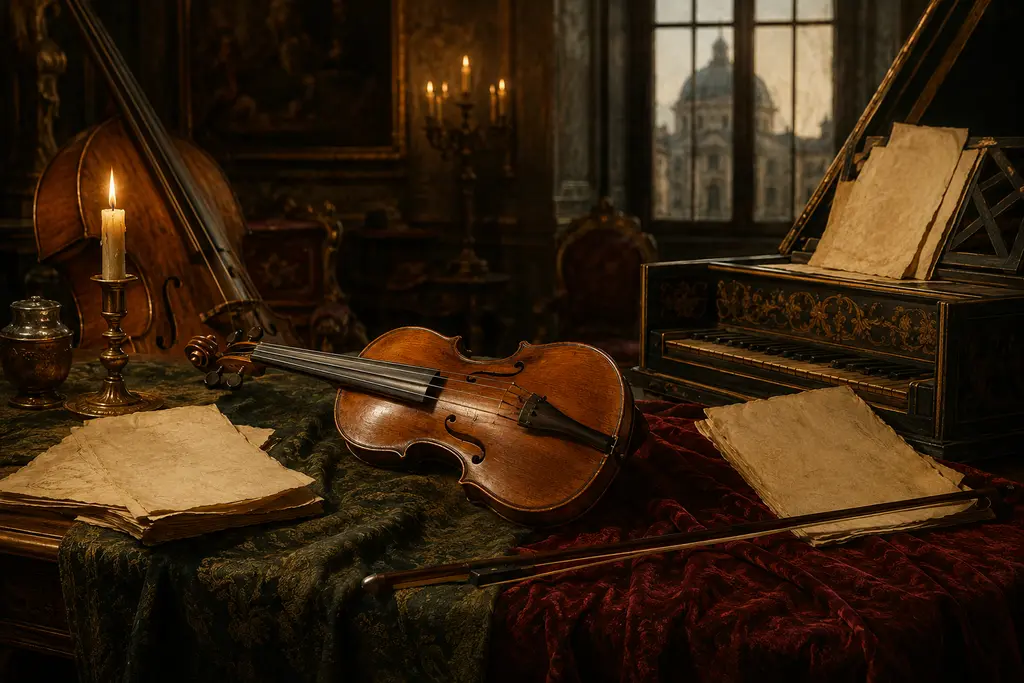
| Lead Instrument | Baroque violin played by Vojtěch Jakl, featuring period-appropriate gut strings and a historical bow, yielding a warm, vocal timbre free of modern metallic tension. |
| Basso Continuo Foundation | An expanded, highly varied continuo group that dynamically shifts instrumentation across the twelve sonatas. |
| Continuo Instruments | Utilization of harpsichord, chamber organ, theorbo, and baroque cello, creating shifting textural palettes that prevent acoustic fatigue. |
| Pitch & Temperament | Performed at historical pitch ($A = 415text Hz$) utilizing historical meantone or well-temperaments to preserve the distinct harmonic colors of each key area. |
By expanding the basso continuo beyond a standard harpsichord-and-cello pairing, the ensemble unlocks subtle harmonic shadings that enrich Albertini’s modal explorations. The theorbo adds a shimmering plucked resonance to the bassline, while the chamber organ grounds the sacred undertones inherent in many of the slow movements.
Official Statements & Critical Perspectives
The release of Sonatinae XII Violino Solo has generated significant buzz within the international early music community. Critics and ensemble members alike have weighed in on the profound implications of this recording.
In an official statement accompanying the release, representatives for Da Vinci Classics emphasized the label’s ongoing commitment to unearthing overlooked historical masterworks:
"In Ignazio Albertini, we find a missing link in the genealogy of the violin repertoire. Da Vinci Classics is immensely proud to partner with Ensemble Rýnský to bring this music out of the academic shadows and into the ears of contemporary listeners. This is not merely a historical document; it is a visceral, emotionally arresting artistic statement that demands a central place in the Baroque canon."
Vojtěch Jakl, speaking on behalf of Ensemble Rýnský regarding the interpretive challenges of the score, noted:
"Albertini’s music does not yield its secrets easily. The notation is a map, but the performer must supply the breath, the rhetoric, and the emotional blood. Because we are dealing with his entire surviving output, we felt a profound responsibility to give each sonata its own distinct character while ensuring the overarching arc of the collection could be heard. Working with an expanded, colorful basso continuo allowed us to paint these masterpieces with a vibrancy that we believe honors both his Italian roots and his Viennese context."
Musicological commentators have similarly praised the release for its scholarly rigor and artistic vitality, pointing out that recordings of complete minor-master collections of the pre-Corelli era remain exceedingly rare in the commercial market.
Future Outlook: Implications for Early Music Scholarship and Performance
The launch of Sonatinae XII Violino Solo by Da Vinci Classics and Ensemble Rýnský opens up several vital avenues for future musicological research, live performance curation, and acoustic exploration.
1. Re-evaluating the Pre-Corelli Violin Canon
For decades, mainstream histories of the Baroque violin have treated Arcangelo Corelli’s Opus 5 (published in 1700) as the definitive dawn of modern violin literature. Albertini’s collection, appearing eight years prior, challenges this linear narrative. By demonstrating how advanced violin technique and complex polyphony were already flourishing in Vienna during the 1680s, this recording encourages historians to decentralize Rome and Bologna, recognizing the Habsburg court as an equally potent incubator for instrumental innovation.
2. Impact on Live Programming
Ensemble Rýnský’s comprehensive traversal is expected to inspire other period-instrument ensembles to incorporate Albertini into their live concert repertoires. Chamber music series specializing in seventeenth-century repertoire now have a definitive reference recording, making it feasible to program multi-sonata blocks or perform the entire cycle across festival residencies.
3. Digital Accessibility and Educational Outreach
True to Da Vinci Classics’ modern distribution model, the physical CD is supplemented by extensive digital assets, including high-resolution booklet essays, source material references, and behind-the-scenes insights. This hybrid release strategy ensures that university music departments, conservatory students, and independent scholars can access the contextual materials necessary to study Albertini’s stylistic idiosyncrasies firsthand.
Conclusion
Ignazio Albertini’s journey from a violent, abrupt demise in 1685 to a celebrated digital and physical release in 2026 is a testament to the enduring power of great art to outlast its creator. Thanks to the meticulous scholarship and virtuosic execution of Vojtěch Jakl and Ensemble Rýnský, alongside the curatorial vision of Da Vinci Classics, the Sonatinae XII Violino Solo have finally found the champion they have deserved for over three centuries. This release is an essential acquisition for aficionados of Baroque music and a triumphant reclamation of a forgotten master’s voice.