
Executive Overview
In the history of Western classical music, few compositions are as intensely autobiographical, psychologically probing, and structurally revolutionary as Hector Berlioz’s Symphonie Fantastique. Written in 1830—a turbulent era marked by the height of European Romanticism—the five-movement orchestral work shattered traditional symphonic conventions. At the heart of this masterpiece lies a groundbreaking compositional device that Berlioz termed the idée fixe (French for "fixed idea").
Far more than a simple recurring melody, the idée fixe functions as a musical embodiment of obsessive psychological states. It represents a specific person, emotion, and fixation: Berlioz’s agonizing, unrequited love for the Irish Shakespearean actress Harriet Smithson. By weaving this single, malleable musical phrase through every movement of the symphony, Berlioz anticipated the cinematic leitmotif techniques of Richard Wagner and modern film score composers by decades.
This article explores the mechanics of the idée fixe, examines how Berlioz brilliantly mutated a single melody to reflect shifting psychological landscapes across three key movements of Symphonie Fantastique, and evaluates the enduring legacy of this technique in contemporary music composition and musicological study.
Detailed Chronology: The Genesis of an Obsession and a Masterpiece
To understand the idée fixe, one must first understand the man who conceived it and the real-life drama that fueled every measure of the score. The genesis of Symphonie Fantastique is a tale of artistic passion intersecting with psychological turmoil.
1827: The Catalyst in Paris
In September 1827, a young, ambitious, and deeply eccentric French composer named Hector Berlioz attended a performance of Shakespeare’s Hamlet at the Odéon Theatre in Paris. The company was English, and playing the role of Ophelia was Harriet Smithson, an actress of striking beauty and dramatic intensity. Berlioz was instantly, overwhelmingly captivated.
Though Smithson did not speak French and was initially entirely unaware of Berlioz’s existence, the composer fell into a state of profound infatuation. He flooded her with letters, declarations of love, and proposals of marriage—all of which went unanswered. Smithson viewed the intense young Frenchman as an unstable stalker and actively avoided him.
1829–1830: Translating Agony into Orchestration
Unable to win her affections through conventional means, Berlioz channeled his despair, frustration, and vivid imagination into his art. He conceived of an expansive, programmatic orchestral work that would trace the hallucinatory visions of an artist suffering from lovesickness.
Rather than relying on standard classical forms, Berlioz structured the piece around a narrative program detailing an artist’s descent into opium-induced nightmares, execution, and a demonic witches’ sabbath. Crucially, the woman who haunted his waking life and tortured his dreams had to be present throughout. Thus, the idée fixe was born—a musical portrait of Harriet Smithson that transforms as the artist’s mental state deteriorates.
1830: Premiere and Post-Premiere Paradox
Symphonie Fantastique premiered on December 5, 1830, at the Paris Conservatoire, conducted by François-Antoine Habeneck. It was an immediate sensation, shocking and thrilling audiences with its unprecedented orchestral colors, narrative audacity, and emotional rawness.
In a bizarre twist of fate that reads like a Romantic novel, Harriet Smithson eventually heard the symphony, realized that the tormented artist depicted in the work was Berlioz, and understood the immense depth of his devotion. The two met, married in 1833, and—in a tragedy worthy of Shakespeare—ultimately separated years later due to Berlioz’s wandering eye and Smithson’s struggles with alcoholism and declining health. Yet, the immortalized version of her melodic archetype remains enshrined in music history forever.
Supporting Context & Metrics: Defining the Idée Fixe
To appreciate the structural genius of Symphonie Fantastique, one must analyze the technical definition of the idée fixe and how it compares to parallel musical traditions.
What is an Idée Fixe?
In music theory, an idée fixe is a recurring theme or character trait that undergoes various transformations throughout a multi-movement composition. Unlike a brief motif, an idée fixe is typically a fully formed, sweeping melody.

While the term is most famously associated with Berlioz, musicologists often compare it to other recurring thematic devices:
- The Leitmotif: Popularized later by Richard Wagner in his operatic works (such as Der Ring des Nibelungen), a leitmotif is a short, signature musical phrase associated with a specific person, object, idea, or emotion. While leitmotifs are modular and appear across different scenes to remind audiences of specific elements, Berlioz’s idée fixe operates on a grander symphonic scale, representing an evolving psychological obsession within a unified instrumental narrative.
- Reminiscence Motifs: Common in 19th-century opera, these are themes that return largely unchanged to remind the listener of a previous event or character. The brilliance of Berlioz’s idée fixe is that it does not remain unchanged; its evolution mirrors the protagonist’s fracturing psyche.
Structural Anatomy Across the Symphony
Spanning five movements rather than the traditional four of the Classical symphony, Symphonie Fantastique utilizes the idée fixe as its structural spine:
- Movement I ("Rêveries – Passions"): Introduction of the pure, longing melody.
- Movement II ("Un bal"): The melody transformed into an elegant, fleeting waltz.
- Movement III ("Scène aux champs"): A pastoral, reflective dialogue featuring solo flute and strings.
- Movement IV ("Marche au supplice"): The theme brutally interrupted by the guillotine’s blade.
- Movement V ("Songe d’une nuit du sabbat"): The melody degraded into a vulgar, mocking dance (Dies Irae context).
Reworking the Melody: Three Movements Examined
Berlioz’s mastery lies not merely in inventing a memorable tune, but in his psychological-musical metamorphosis of that tune. Here is a detailed breakdown of how the idée fixe is reworked across three pivotal movements of the symphony.
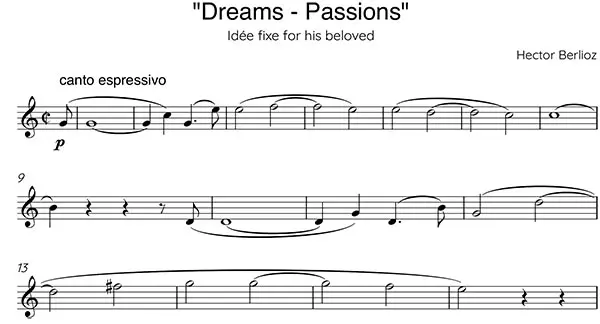
1. First Movement: "Rêveries – Passions" (Dreams, Passions)
- Context: The young artist catches a glimpse of his beloved and experiences a whirlwind of vague yearnings, religious consolation, and dark, boiling jealousy.
- The Presentation: This movement marks the debut of the idée fixe. Introduced by the violins and flutes in unison, the melody is expansive, yearning, and emotionally exposed. It features wide upward leaps followed by a gradual, sighing descent, perfectly capturing the breathlessness of sudden infatuation and romantic longing.
- Musical Function: It establishes the baseline emotional reality. To the listener, the melody feels noble, idealized, and pristine, mirroring how the young Berlioz initially perceived Harriet Smithson.
2. Second Movement: "Un bal" (A Ball)
- Context: The artist finds himself at a glittering, joyous social gathering—a bustling Parisian ball—yet he remains utterly consumed by thoughts of his beloved, unable to fully participate in the festivities.
- The Transformation: Berlioz adapts the idée fixe into a sparkling waltz written in a 3/8 time signature. While the underlying harmonic foundation remains recognizable, the rhythm is heavily decorated and syncopated to mimic the swirling motion of dancers in a ballroom.
- Psychological Insight: Despite the festive atmosphere, the intrusion of the idée fixe within the waltz rhythm reveals the protagonist’s fractured consciousness. Even amidst champagne and glittering gowns, he cannot escape the phantom of his unrequited love; the waltz feels breathless and unsettled rather than carefree.
3. Third Movement: "Scène aux champs" (Scene in the Fields)
- Context: Seeking solace in nature during a quiet summer evening in the countryside, the artist listens to two shepherds piping a rustic melody. He hopes for tranquility, but the deep-seated fear of loneliness and betrayal reignites his anxiety.
- The Transformation: Here, the tempo slows dramatically (adagio), and the meter shifts to 6/8. The idée fixe is stripped of its sweeping orchestral grandeur and is instead voiced intimately by a solo flute accompanied by murmuring violins.
- Psychological Insight: This reflective, fragile mood captures the protagonist’s internal dialogue. The solo instruments evoke vulnerability, loneliness, and a poignant mix of lingering hope and creeping dread that she will never love him back.
Official Statements and Expert Perspectives
Music educators and historians continue to emphasize the revolutionary nature of Berlioz’s compositional techniques.
Ben Dunnett, LRSM, founder of the Music Theory Academy and an experienced music educator, notes the enduring pedagogical value of Berlioz’s work:
"In his Symphonie Fantastique, Berlioz showed that he was a master of reworking a main melodic idea to capture an emotion—his unrequited love for Harriet—in various different scenes and settings. Whilst this concept is now mainly explored under سوق the title of leitmotifs, Berlioz’s work is extremely valuable to composers who want to develop their craft. The ability to be able to adapt a melodic idea to depict different emotions, moods and places is one that will always be of considerable value."
Musicologists frequently point out that Symphonie Fantastique served as a vital bridge between Beethovenian symphonic form and the programmatic tone poems of Franz Liszt and Richard Strauss. By anchoring an entire orchestral narrative to a psychological concept rather than strict formal structures (such as sonata-allegro form), Berlioz proved that instrumental music could tell deeply complex, narrative stories driven by internal human emotion.
Future Outlook: The Legacy of the Idée Fixe in Modern Composition
Nearly two centuries after its premiere in Paris, the influence of Berlioz’s idée fixe reverberates far beyond the classical concert hall.
The Evolution into Cinematic Scoring
The direct evolutionary descendant of the idée fixe is the modern film score leitmotif. When Hollywood composers such as John Williams (Star Wars, Harry Potter), Howard Shore (The Lord of the Rings), or Bernard Herrmann (Psycho, Vertigo) assign a specific melodic theme to a character, psychological state, or recurring motif, they are utilizing the exact psychological framework that Berlioz pioneered in 1830.
For instance, Herrmann’s obsessive, swirling string motifs in Alfred Hitchcock’s psychological thrillers trace their artistic lineage directly back to the feverish hallucinations of Berlioz’s artist.
Ongoing Academic Research and Performance
As contemporary orchestras seek to engage modern audiences through multimedia presentations, programmatic works like Symphonie Fantastique remain staples of the symphonic repertoire. Conductors and performers continue to explore new ways to highlight the psychological evolution of the idée fixe, examining how Berlioz’s orchestration—utilizing novel instrumental combinations, extended techniques, and dramatic dynamic shifts—prefigured modern orchestral scoring.
Ultimately, Hector Berlioz transformed personal heartbreak into an immortal blueprint for musical storytelling. The idée fixe stands as a testament to the power of music to map the labyrinthine corridors of the human mind, proving that an obsession, when harnessed by genius, can echo through the corridors of time.