
Executive Overview
In the canon of modern alternative rock, few records hold the monumental, generation-defining status of The Smashing Pumpkins’ 1995 double-album masterpiece, Mellon Collie and the Infinite Sadness. Decades after its release redefined the boundaries of 1990s counterculture—blending arena-sized heavy metal thunder with delicate orchestral arrangements and sweeping romanticism—the record has undergone a staggering metamorphosis.
At London’s prestigious Royal Festival Hall, frontman Billy Corgan, alongside collaborator James Lowe, unveiled a breathtaking, fully realized orchestral and operatic arrangement of the iconic opus. Captured in mesmerizing detail through the lens of photographer Burak Cingi, the evening transcended a traditional retrospective concert. It was a formal, high-art interrogation of a landmark recording, reimagining forty-two tracks of teenage angst, existential dread, and celestial beauty through the grand, imposing architecture of classical instrumentation.
This landmark performance highlights the ongoing evolution of rock music as a legitimate classical art form. By stripping away the distorted wall-of-sound electric guitars that defined the mid-90s landscape and replacing them with sweeping string sections, brass arrangements, and operatic vocal dynamics, Corgan and Lowe successfully proved that the structural integrity of Mellon Collie matches the masterworks of the classical tradition. For a packed house at the Southbank Centre, the evening was not merely a nostalgic trip down memory lane, but a profound cultural validation of a record that captured the frayed psyche of the twentieth-century fin de siècle.
Detailed Chronology: A Night at the Royal Festival Hall
The Arrival and Anticipation
The atmosphere surrounding the Southbank Centre in London ahead of the performance was thick with anticipation. Die-hard fans of The Smashing Pumpkins mingled with classical music enthusiasts, creating an eclectic crowd rarely seen at standard rock gigs. The iconic brutalist architecture of the Royal Festival Hall stood as a stark yet fitting backdrop for an evening dedicated to a record that constantly balanced industrial grit with ethereal beauty.
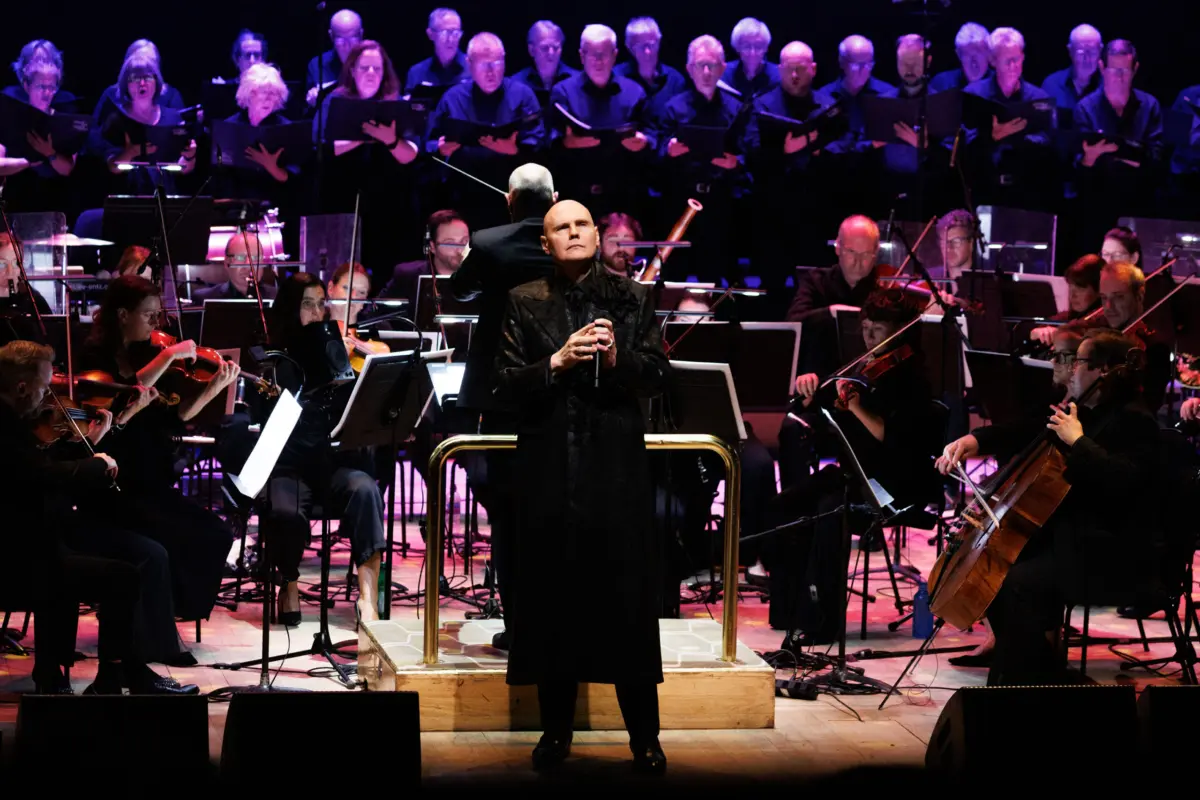
As the house lights dimmed, a palpable hush fell over the auditorium. Unlike a standard rock concert, there were no towering stacks of Marshall amplifiers or blinding wall-of-light rigs. Instead, the stage was set for a full orchestra, the music stands catching the muted glow of stage spotlights. James Lowe took his place at the conductor’s podium, eliciting a wave of respectful applause before Billy Corgan stepped into the center stage, greeted by a rapturous, standing ovation that lasted several minutes.
The Opening Movements: Setting the Cinematic Scale
The evening commenced with a sweeping, cinematic rendition of the album’s iconic title track, "Mellon Collie and the Infinite Sadness." Stripped of its original lo-fi piano warmth and expanded into a lush, multi-layered orchestral movement, the piece immediately established the ambitious sonic palette of the night. The absence of traditional rock instrumentation forced the audience to listen closer, uncovering intricate counter-melodies and emotional nuances buried within Corgan’s original compositions.
Transitioning seamlessly into the cascading rhythms of "Tonight, Tonight," the performance reached its first major emotional peak. Without the crashing drums and soaring distortion pedals of Jimmy Chamberlin and James Iha’s original recordings, the song took on the quality of a modernist tone poem. Corgan’s voice, remarkably preserved and dripping with dramatic vulnerability, soared above the swell of the string section. The visual composition of the stage—highlighted by Burak Cingi’s striking photography from the pit—emphasized the stark contrast between Corgan’s modern rock icon persona and the timeless solemnity of the symphony orchestra.
Navigating the Darker Depths
As the setlist progressed through the sprawling double-album’s labyrinthine tracklist, the arrangements grew progressively darker and more experimental. Songs like "Bullet with Butterfly Wings," traditionally a blistering anthem of anti-establishment rage ("Despite all my rage I am still just a rat in a cage"), underwent a radical transformation. Reimagined as a slow-burn, tension-heavy orchestral dirge, the track highlighted the underlying despair of the lyrics, shifting the focus from teenage rebellion to a mature, sobering meditation on institutional entrapment and personal disillusionment.
Midway through the performance, the production leaned heavily into the ambient, gothic soundscapes that populate the second half of the original 1995 release (Twilight Sadness). The integration of operatic vocal elements added an extra layer of theatricality. The orchestra navigated complex polyrhythms and dissonant harmonies during tracks like "XYU" and "Bodies," proving that Corgan’s compositions possess a structural complexity that easily rivals twentieth-century avant-garde classical music.
The Grand Finale and Emotional Resonance
The evening culminated in a breathtaking, multi-movement medley that drew heavily from the album’s most expansive and emotionally resonant moments, including "Porcelina of the Vast Oceans" and "By Starlight." As the final notes of the performance echoed against the acoustic paneling of the Royal Festival Hall, the audience erupted into a sustained, thunderous ovation. Corgan and Lowe stood side-by-side, acknowledging the orchestra and the enraptured crowd, cementing an evening that will long be remembered as a defining watermark in the modern performance history of alternative rock.
Supporting Context & Metrics: The Legacy of Mellon Collie
Commercial and Critical Reexamination
To understand the gravity of this orchestral performance at the Royal Festival Hall, one must contextualize the magnitude of Mellon Collie and the Infinite Sadness upon its initial release on October 24, 1995. Produced by Billy Corgan, Flood, and Alan Moulder, the double album debuted at number one on the US Billboard 200 and has since been certified diamond by the Recording Industry Association of America (RIAA), moving over 10 million copies in the United States alone.
| Metric / Milestone | Statistical Data / Fact |
|---|---|
| Initial Release Date | October 24, 1995 (Virgin Records) |
| Chart Performance | No. 1 on the US Billboard 200 |
| RIAA Certification | 10x Platinum (Diamond Status) |
| Grammy Nominations (1997) | 7 nominations, including Album of the Year |
| Track Count | 28 tracks across 2 CDs / 3 LPs |
| Core Collaborators (2026 Live) | Billy Corgan & James Lowe |
At the time of its release, critics were initially divided by its sheer audacity. Some outlets praised its sprawling ambition and emotional honesty, comparing its scope to The Beatles’ White Album or Pink Floyd’s The Wall, while others criticized its bloated runtime. However, the passage of time has been remarkably kind to the record. Today, it is universally recognized as a masterpiece of late-twentieth-century music, frequently appearing on critics’ lists of the greatest albums of all time.
The Shift Toward Orchestral Adaptation
The decision by Corgan and Lowe to translate Mellon Collie into an orchestral format is part of a broader, contemporary movement within rock music. Over the past decade, aging rock icons and alternative pioneers have increasingly sought out symphonic collaborations to validate their bodies of work within high-culture institutions.
However, unlike standard "rock band backed by a local orchestra" gimmicks, the Corgan-Lowe collaboration is a deep structural deconstruction. By rewriting the scores from the ground up, the creators stripped away the safety net of distorted guitars and high-volume amplification, leaving the core songwriting exposed. This transparency proved that underneath the slacker-rock aesthetic of the 1990s lay a deeply sophisticated, classical-leaning compositional mind.
Official Statements and Artistic Vision
Speaking behind the scenes at the Southbank Centre, Billy Corgan elaborated on the philosophy driving the orchestral reinterpretations. For Corgan, who has spent decades pushing the boundaries of what The Smashing Pumpkins can achieve—shifting from grunge to synth-pop, progressive rock, and avant-garde theater—Mellon Collie has always represented an unfinished conversation.
"When we wrote these songs in the mid-90s, we were operating under the constraints of what a rock band could physically play in a room or translate onto radio," Corgan explained. "Back then, the orchestrations on tracks like ‘Tonight, Tonight’ or ‘Porcelina’ were painted with a relatively narrow brush because we had to fit them inside a guitar-driven framework. Working with James Lowe on these arrangements has allowed us to finally open the doors wide and let these songs breathe in the architectural space they were always meant to inhabit."
James Lowe echoed these sentiments, emphasizing the rigorous academic and artistic process required to translate electric-heavy arrangements into sophisticated symphonic movements.
"You cannot simply hand a classical orchestra a rock chart and expect magic," Lowe stated during a pre-show symposium. "Every single frequency, counterpoint, and dynamic shift had to be meticulously mapped out. We approached this material with the same reverence one would accord to Mahler or Debussy. The emotional weight of Billy’s melodies is so heavy that the orchestra didn’t need to compete with it; they had to amplify it, cradle it, and sometimes challenge it."
Burak Cingi, whose stunning visual documentation of the evening captured the dramatic chiaroscuro of the event, noted the unique photographic energy of the performance. "Shooting a Smashing Pumpkins show is usually about capturing kinetic, sweaty energy, strobe lights, and flying hair," Cingi observed. "Tonight, it was about capturing stillness, concentration, and the immense architectural scale of the music. Billy under the spotlight at the Royal Festival Hall looked less like a rock star and more like a maestro conducting his own destiny."
Future Outlook: Where Does the Infinite Sadness Lead?
The resounding success of the Royal Festival Hall residency raises significant questions about the future trajectory of The Smashing Pumpkins’ catalog. As legacy acts grapple with how to present aging material to audiences weary of tired nostalgia tours, Corgan has once again positioned himself at the vanguard of artistic reinvention.
Industry analysts and musicologists are already speculating on the commercial viability of a broader international tour featuring the orchestral arrangements of Mellon Collie. Given the critical acclaim and high-profile nature of the London performances, there is mounting pressure to record and release the symphonic arrangements as a standalone live album. Such a release would not only satisfy a passionate fan base eager for pristine audio recordings of these unique arrangements, but also cement Corgan’s legacy as a serious composer capable of bridging the chasm between underground alternative rock and high classical art.
Furthermore, this pivot opens up intriguing possibilities for the rest of The Smashing Pumpkins’ massive catalog. If Mellon Collie and the Infinite Sadness can be successfully elevated to the classical stage, albums like Adore—with its ambient electronics and nocturnal atmospheres—or the sprawling, mythological rock opera Machina/the Machines of God could theoretically undergo similar symphonic metamorphoses.
Ultimately, the evening at London’s Royal Festival Hall served as a powerful reminder of the enduring resilience of great art. Thirty-one years after its inception, Mellon Collie and the Infinite Sadness refuses to remain a static artifact of 1990s nostalgia. Through the ambitious vision of Billy Corgan and James Lowe, and immortalized by the evocative imagery of Burak Cingi, the music has proven truly infinite—capable of expanding, evolving, and echoing majestically through the hallowed halls of high culture for generations to come.