
Executive Overview
The rapid integration of artificial intelligence into creative industries has sparked a fierce debate over the future of artistic pedagogy. In fields ranging from graphic design to creative writing, algorithms are frequently positioned as disruptive forces threatening to displace human professionals. However, in the realm of vocal training, a more nuanced reality is emerging.
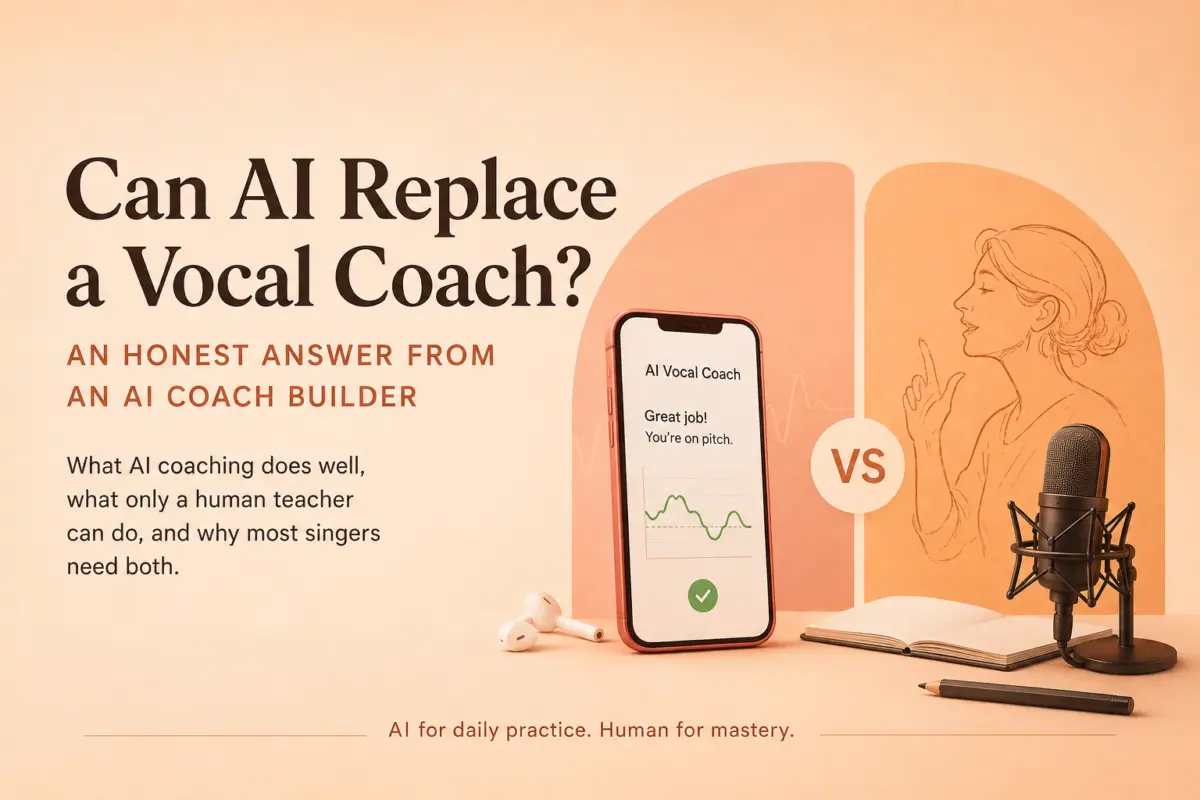
According to newly released empirical data and operational insights from digital music platform Singing Carrots, creators of a prominent AI vocal coach, the narrative of "AI versus Human" is fundamentally flawed. Rather than acting as a direct competitor to traditional vocal instructors, AI technology is carving out an entirely separate market niche: serving the massive, historically underserved population of aspiring singers who would otherwise practice without any guidance at all.
This investigative report examines the limits and capabilities of both human vocal pedagogy and algorithmic audio analysis. While human teachers remain irreplaceable for safeguarding vocal health, correcting physiological tension, and cultivating artistic interpretation, AI tools have demonstrated unprecedented efficacy in accelerating pitch accuracy and establishing structured daily practice routines.
The data suggests that the future of music education lies not in automation, but in a hybrid model where algorithms handle repetitive, objective drilling, freeing human educators to focus on the deeply subjective, physical, and artistic dimensions of the voice.
Detailed Chronology: The Evolution of Vocal Pedagogy and Music Tech
To understand where artificial intelligence fits into vocal training today, it is necessary to trace the historical progression of how humans have learned to sing.
+-----------------------------------------------------------------------------+
|                                  CHRONOLOGY                                 |
+-----------------------------------------------------------------------------+
|                                                                             |
|  [1] Classical Era to Late 20th Century: The Master-Apprentice Model         |
|      - Highly exclusive, costly, and dependent on localized access.         |
|      - Students rely entirely on periodic, face-to-face feedback.            |
|                                                                             |
|  [2] Late 1990s to 2010s: Static Digital Distribution                        |
|      - Rise of CDs, YouTube tutorials, and static vocal exercise apps.      |
|      - High accessibility, but zero interactive or personalized feedback.   |
|                                                                             |
|  [3] Late 2010s to Early 2020s: The Rise of Real-Time Pitch Analysis        |
|      - Real-time digital signal processing (DSP) visualizes pitch.          |
|      - Introduction of basic adaptive algorithms to tailor range.           |
|                                                                             |
|  [4] Mid-2020s (Present Day): Empirical Integration & Hybrid Pedagogy       |
|      - Publication of long-term user data validating AI practice loops.     |
|      - Industry shift toward combining daily AI drilling with human coaching. |
|                                                                             |
+-----------------------------------------------------------------------------+
The Master-Apprentice Era
For centuries, vocal training was defined by the traditional master-apprentice model. Originating in classical European conservatories, this approach required students to study under a master teacher who relied on acute auditory observations to diagnose physical tension, breath support issues, and acoustic imbalances. While highly effective, this model was inherently exclusive. It required geographical proximity to a qualified instructor, a significant financial investment, and a high baseline of confidence from the student.
The Era of Static Digital Distribution
With the advent of recorded media and, eventually, the internet, vocal pedagogy attempted to scale. The late 1990s and 2000s saw an explosion of "Learn to Sing" CD sets, instructional DVDs, and eventually, YouTube tutorial channels. While these resources democratized access to basic anatomical information and vocal warm-ups, they suffered from a critical, dangerous flaw: they lacked a feedback loop. Students practiced in isolation, unable to verify if they were executing exercises correctly, often leading to vocal strain or reinforced bad habits.
The Rise of Real-Time Pitch Analysis
In the 2010s, software developers began leveraging digital signal processing (DSP) to analyze human vocal input in real time. Visual pitch-tracking software allowed users to see their pitch accuracy mapped against target notes on a screen. This represented a major leap forward, turning passive listening into an interactive, cybernetic loop.
The Era of Algorithmic Integration
Today, platforms like Singing Carrots have integrated adaptive algorithms with real-time feedback systems. Rather than merely showing a pitch line, modern AI coaches dynamically adjust exercise parameters based on the singer’s current vocal state, comfortable range, and historical accuracy.
The publication of comprehensive user metrics in recent months has moved the conversation from theoretical speculation to empirical analysis, revealing exactly who is using these tools and how they affect the learning curve.
Supporting Context & Metrics: The Data-Driven Reality
The debate over the utility of AI in vocal training has long been dominated by subjective opinions. However, empirical data published by Singing Carrots from a seven-month study of users interacting with their AI vocal coach provides concrete metrics on how digital feedback impacts vocal development.
                  PITCH ACCURACY IMPROVEMENT OVER 4 WEEKS
                  ======================================

  Beginners         [==================================] +16.5%

  General Users     [============] +5.9%

                    +------------+------------+------------+------------+
                    0%           5%           10%          15%          20%
Key Performance Indicators (KPIs) and Technical Metrics:
- Pitch Accuracy Acceleration: Across the entire monitored cohort, users of the AI vocal coach saw an average improvement in pitch accuracy of +5.9 percentage points within a four-week period of regular use.
- The Beginner Leap: The impact was most pronounced among self-identified beginners. This subgroup experienced a dramatic +16.5 percentage point increase in pitch accuracy over the same four-week timeframe.
- Safety Thresholding (Range Adaptation): To prevent vocal strain, the underlying algorithm is designed to keep 91.5% of all customized exercises strictly within the user’s demonstrated comfortable vocal range. The system continuously recalibrates this range based on real-time pitch stability and hit-rate data.
- Economic Accessibility: While a qualified professional vocal teacher charges between $60 and $150 per hour—a price point that represents a significant financial barrier for the average hobbyist—an AI-driven application operates at a fraction of that cost, offering unlimited 24/7 access for a low monthly subscription.
Analyzing the "Beginner Leap"
The staggering +16.5% improvement among beginners highlights a critical psychological and pedagogical reality. Beginners are highly susceptible to performance anxiety; many are deeply uncomfortable singing in front of another human being, even a trained professional.
By removing the fear of immediate social judgment, the AI coach creates a low-stakes, high-frequency practice environment. The beginner can fail repeatedly, out of tune, in the privacy of their own home, until they build the fundamental neuromuscular coordination—and the confidence—necessary to seek out human instruction.
Official Perspectives: The Human-Machine Dichotomy
To evaluate the true boundaries of this technology, we must contrast the capabilities of artificial intelligence with those of a human vocal instructor. The division of labor between the two is stark and governed by biological and technological constraints.
+--------------------------------------------------------------------------------------+
|                         COMPARATIVE ANALYSIS OF PEDAGOGY                            |
+--------------------------------------------------------------------------------------+
| FEATURE                | HUMAN VOCAL TEACHER            | AI VOCAL COACH             |
+------------------------+--------------------------------+----------------------------+
| Core Strength          | Holistic artistry, physical    | Deliberate daily practice, |
|                        | diagnosis, emotional safety    | objective pitch feedback   |
+------------------------+--------------------------------+----------------------------+
| Availability & Cost    | $60–$150/hr; scheduled weekly  | Fraction of cost; 24/7     |
|                        | or bi-weekly                   | on-demand accessibility    |
+------------------------+--------------------------------+----------------------------+
| Diagnostic Scope       | Visual (posture, jaw, tension) | Acoustic only (pitch       |
|                        | and subjective auditory beauty  | accuracy, range tracking)  |
+------------------------+--------------------------------+----------------------------+
| Vocal Health Safeguard | High; can detect early signs   | Low; cannot detect strain, |
|                        | of fatigue, damage, or nodules | fatigue, or physical pain  |
+------------------------+--------------------------------+----------------------------+
What Only a Human Teacher Can Do
A human voice is not merely an instrument of pitch and duration; it is a complex physiological and emotional system. Algorithms process digital audio signals, but they are blind and deaf to the physical reality of the singer.
- Physical Diagnosis (The Posture-Jaw-Breath Axis): At least half of vocal technique is non-auditory. A human teacher uses visual observation to identify critical impediments to sound production, such as a locked jaw, elevated shoulders, tongue root tension, or poor diaphragmatic engagement. An AI coach only analyzes the resulting audio waveform; it cannot see that a note is on pitch only because the singer is dangerously straining their neck muscles to reach it.
- Nuance and Tone Color (Timbre vs. Pitch): Current consumer-grade algorithms can easily calculate fundamental frequency ($F_0$) down to the cent. However, they struggle to evaluate the aesthetic quality of timbre—the warmth, resonance, and "life" of a note. A human teacher instantly hears the difference between a sterile, technically accurate note and one that is rich, vibrant, and emotionally resonant.
- Vocal Health and Damage Prevention: Overuse, improper placement, and excessive subglottal pressure can lead to vocal fold nodules, polyps, or chronic hemorrhaging. A seasoned vocal teacher serves as a vital diagnostic filter, recognizing the subtle, husky acoustic signatures of vocal fatigue or damage long before the singer realizes they are hurting themselves.
"No responsible app should ever attempt to act as your primary vocal-health advisor. If you are experiencing pain, hoarseness, or chronic strain, you need an experienced human ear—and potentially a medical laryngologist—not an algorithm."
— Pedagogical Consensus
What AI Coaching Does Best
Conversely, human teachers are bound by the laws of physics, time, and economics. They cannot accompany a student home to supervise their daily practice sessions.
- The Cybernetic Feedback Loop: The human ear is notoriously poor at objective self-monitoring while singing, due to bone conduction and internal acoustic resonance. An AI coach provides an objective, real-time visual mirror of the pitch, instantly correcting the singer’s internal reference map.
- Unrivaled Patience and Availability: An AI coach does not experience fatigue, frustration, or scheduling conflicts. It is as attentive and objective at 11:00 PM on a rainy Tuesday as it is at 9:00 AM on a Saturday. It allows for the short, highly frequent sessions (10 to 20 minutes daily) that cognitive science shows are optimal for motor-skill acquisition.
The "AI vs. Nothing" Paradigm
For years, the vocal teaching community viewed digital singing tools with suspicion, fearing they would devalue the profession or steal students. However, real-world usage patterns reveal a completely different market dynamic.
The vast majority of people utilizing AI vocal coaches are not choosing between an app and a $100-an-hour private instructor. They are choosing between an app and nothing at all.
                       THE REAL VOCAL TRAINING LANDSCAPE
                       =================================

  Traditional Market:   [ High-Budget Students ] ----> Human Vocal Studio ($100+/hr)

  The "Empty Room":     [ Beginners / Hobbyists ] ---> AI Vocal Coach (Low Cost / Private)
                               |
                               v (Once confidence and basic pitch are built)
                        [ Transition to Human Lessons ]
These are individuals who sing along with the car radio, feel too intimidated to perform in front of friends, or simply cannot fit private lessons into their budgets or schedules. For this demographic, the AI coach serves as an entry point into music literacy. It populates the "empty practice room" where no human teacher was ever going to sit, building a pipeline of more confident, pitch-accurate singers who are far more likely to eventually seek out human instruction to refine their newly discovered skills.
Future Outlook: The Rise of Hybrid Vocal Training
As artificial intelligence and digital signal processing continue to mature, the relationship between technology and human vocal pedagogy will likely evolve into a highly collaborative, symbiotic partnership.
                      THE HYBRID TRAINING LOOP
                      ========================

        +--------------------------------------------------+
        |                                                  |
        |              HUMAN VOCAL TEACHER                 |
        |  - Diagnoses physical tension and posture        |
        |  - Teaches emotional delivery and artistry      |
        |  - Sets strategic technical goals                |
        |                                                  |
        +------------------------+-------------------------+
                                 |
                                 | Assigns homework & targets
                                 v
        +--------------------------------------------------+
        |                                                  |
        |                 AI VOCAL COACH                   |
        |  - Supervises daily 15-minute practice sessions   |
        |  - Tracks pitch accuracy & comfortable range     |
        |  - Prevents off-key drift between lessons       |
        |                                                  |
        +--------------------------------------------------+
The Metronome of the 21st Century
Just as instrumental teachers do not view the metronome or the tuner as threats to their livelihood, modern vocal teachers are beginning to adopt AI coaches as essential homework tools.
Historically, a vocal instructor had zero control over what their student did during the six days between weekly lessons. Students often practiced warm-ups incorrectly, reinforcing bad habits, or did not practice at all due to a lack of structure. By assigning structured daily drills through an AI app, teachers can ensure their students return to the studio with their pitch, agility, and vocal stamina already sharpened, allowing the in-person lesson to focus on higher-level artistry and physical refinement.
Technical Horizons and Limitations
While developers will continue to refine acoustic models—perhaps incorporating mobile-camera computer vision to detect basic shoulder or jaw tension—the core of vocal artistry will remain stubbornly human. Singing is a deeply emotional, communicative act rooted in shared human experience. An algorithm can calculate the perfect frequency of a vibrato, but it cannot understand the heartbreak, joy, or vulnerability that makes a performance unforgettable.
Ultimately, the singers who progress the fastest are those who reject the false dichotomy of human versus machine. By combining the objective, daily feedback of an AI coach with the subjective, holistic guidance of a master teacher, artists can unlock a faster, safer, and more accessible path to vocal mastery.