
Executive Overview
In the landscape of early music scholarship and performance, few rediscoveries carry the historical weight or artistic intrigue of Ignazio Albertini’s Sonatinae XII Violino Solo. Published posthumously in Vienna in 1692, this sole surviving collection by an elusive and tragic figure of the 17th-century Habsburg court has long captivated musicologists. Yet, despite its historical importance, a complete, dedicated recording of the entire twelve-sonata cycle has remained a rarity.
That silence has now been broken. Released by the esteemed Italian label Da Vinci Classics on July 22, 2026, a landmark recording features the Czech-German period-instrument ensemble Ensemble Rýnský, led by baroque violinist Vojtěch Jakl. Utilizing an expanded and dynamically varied basso continuo, the ensemble’s comprehensive traversal brings Albertini’s rare voice out of the archival shadows and into the modern acoustic light.
Available worldwide on physical CD and across major digital platforms—complete with extensive liner notes and supplementary digital materials—this release is much more than a routine addition to the early music catalog. It is a critical reassessment of a vital stylistic bridge. Albertini’s music captures a crucial transitional epoch in European music history, standing at the crossroads where the fiery, unbridled virtuosity of the Italian baroque met the rigorous, intellectually demanding contrapuntal traditions of Central Europe.
This article provides an in-depth exploration of the new recording, examining the historical and musicological significance of Albertini’s work, the performance practices employed by Ensemble Rýnský, the broader cultural landscape of 17th-century Vienna, and the future outlook for early music scholarship catalyzed by this major release.
Detailed Chronology: From the Habsburg Court to the 21st-Century Studio
To understand the magnitude of Ensemble Rýnský’s new recording, one must retrace the turbulent chronology of Ignazio Albertini’s life, the precarious survival of his oeuvre, and the painstaking journey of bringing these scores from 17th-century print shops to modern concert halls and recording studios.
The 17th Century: Virtuosity, Patronage, and Tragedy in Vienna
Ignazio Albertini (c. 1644–1685) remains an enigmatic figure. Active during the latter half of the seventeenth century, Albertini found employment in Vienna at the heart of the Habsburg Empire—a cosmopolitan cultural hub where Italian musicians, architects, and painters were routinely imported to enrich the imperial court.
Albertini was celebrated in his day as a formidable violinist, a virtuoso whose playing exemplified the expressive liberties and rhetorical devices popularized by Italian masters. However, his life was cut short under violent and mysterious circumstances. In 1685, Albertini was murdered in Vienna. The precise motives behind his assassination remain murky, though historical records hint at personal disputes or court intrigues common in the cutthroat environment of the imperial establishment.
Because of his sudden and violent death, much of Albertini’s compositional output was lost, scattered, or destroyed. Had it not been for the publication of his Sonatinae XII Violino Solo in 1692—seven years after his death—his name might have vanished entirely from music history. Published posthumously, this single collection stands as the sole monument to his creative genius, preserving a snapshot of a brilliant musical mind snuffed out prematurely.
The Modern Revival: From Archives to Ensemble Rýnský
For centuries, Albertini’s twelve sonatas were treated largely as academic curiosities—rare artifacts cited by music historians studying the evolution of violin technique, but rarely performed in their entirety. The immense technical demands of the writing, combined with the complexities of realizing an idiomatic 17th-century basso continuo, meant that performers typically cherry-picked individual movements rather than tackling the cycle as a cohesive artistic statement.
The turning point arrived when the Czech-German period-instrument ensemble Ensemble Rýnský turned its collective focus toward the repertoire of the pre-High Baroque. Recognizing the structural unity and expressive depth of the Sonatinae XII Violino Solo, the ensemble—under the artistic and violinistic leadership of Vojtěch Jakl—embarked on an exhaustive research and rehearsal process.
Collaborating with Da Vinci Classics, the ensemble entered the studio to record the complete cycle. The project required meticulous paleographic work to interpret the original 1692 print, balance the acoustics of the basso continuo section, and capture the improvisatory spirit that defines the Italian-Viennese violin school. The resulting album, released in July 2026, represents the culmination of years of dedication, elevating Albertini from a footnote in music history to a vividly realized auditory presence.
Supporting Context & Metrics: The Musicological Significance of Albertini’s Sonatinae
To appreciate why Ensemble Rýnský’s recording is a monumental achievement, one must examine the musical architecture, stylistic synthesis, and historical context of Albertini’s twelve sonatas.
Bridging Two Musical Worlds: Italy and Central Europe
The late seventeenth century was a period of intense stylistic cross-pollination. While Italy—particularly Venice, Rome, and Bologna—was the undisputed epicenter of violin innovation, cities like Vienna, Salzburg, and Prague were developing distinct regional idioms that favored dense counterpoint, programmatic elements, and structural experimentation.
Albertini’s Sonatinae embody this cross-cultural dialogue:
- The Italian Influence: Manifests in the virtuosic display, the exploitation of the violin’s upper register, expressive double-stops, and the use of recitative-like declamation that mimics the human voice. Albertini demands a high degree of expressive freedom (rubato) and rhetorical phrasing from the soloist.
- The Central European Influence: Appears in the rigorous contrapuntal framework, structural integration, and thematic development. Unlike some purely flamboyant Italian works that prioritized momentary shock value, Albertini’s sonatas maintain a tightly woven intellectual rigor, reflecting the prevailing tastes of the Habsburg imperial court.
Structural Design of the Sonatinae XII Violino Solo
Spanning twelve distinct sonatas, the collection is carefully paced to avoid monotony while maintaining a unified aesthetic. Each sonata possesses its own unique profile, shifting fluidly between contrasting sections of adagio contemplation and allegro motoric drive.
- The Solo Violin Role: The writing pushes the boundaries of the baroque violin. Without the safety net of a multi-voiced string texture, the solo violin must simultaneously carry the melodic line, imply harmonic progressions, and articulate rhythmic impetus.
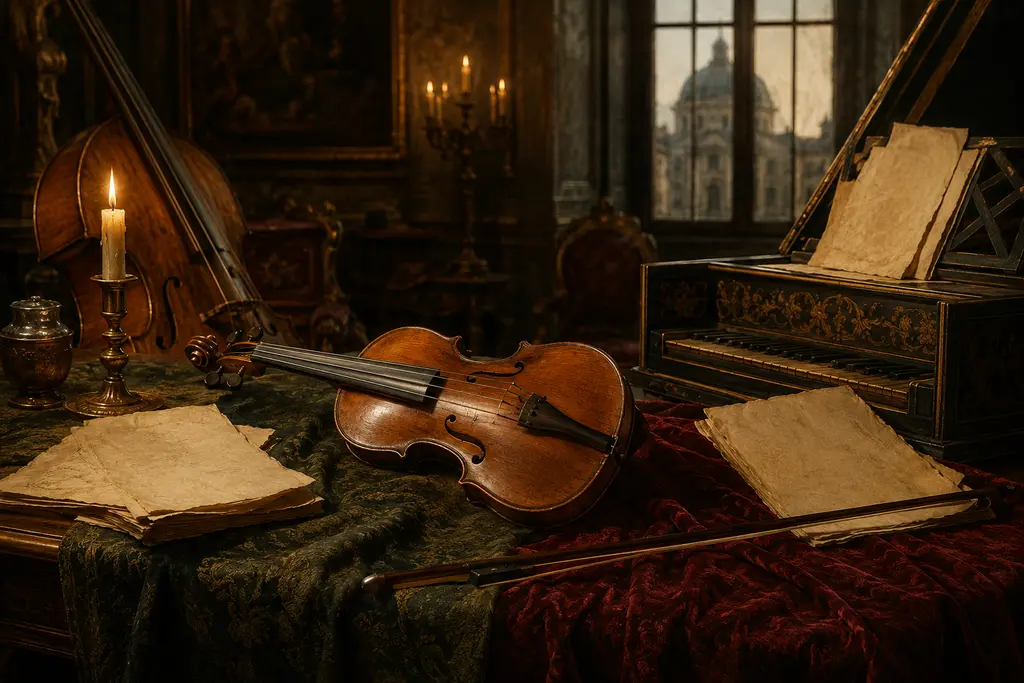
- The Basso Continuo Dimension: Ensemble Rýnský approaches the continuo not merely as a mechanical harmonic support, but as an active, conversational partner. By utilizing an expanded and varied basso continuo configuration—incorporating instruments such as the theorbo, baroque cello, and harpsichord/organ—the ensemble creates rich, shifting textural backdrops that complement the violin’s changing moods.
Quantitative and Technical Metrics of the Release
- Total Works Recorded: All 12 sonatas of the surviving 1692 publication.
- Release Formats: Dual availability via physical Compact Disc (CD) and high-resolution digital streaming/download platforms.
- Ensemble Composition: Period-instrument specialists led by baroque violinist Vojtěch Jakl.
- Primary Label: Da Vinci Classics, renowned for championing rare, under-recorded historical repertoire alongside contemporary classical works.
- Archival Companion: Digital release platform providing comprehensive musicological liner notes, historical essays, and related scholarly materials.
Official Statements and Artistic Perspectives
The gravity of this recording is best understood through the perspectives of the artists and producers who brought it to fruition. In promotional and liner material accompanying the Da Vinci Classics release, Ensemble Rýnský and representatives from the label have articulated their artistic vision.
Vojtěch Jakl on the Voice of Albertini
Vojtěch Jakl, leading the ensemble from the baroque violin, emphasized the distinct emotional weight of playing music written by a composer whose life ended in violence:
"When you play Albertini, you are engaging with a ghost from a very specific, high-stakes political and cultural moment in Vienna. His music does not politely knock on the door; it demands your full technical and emotional commitment. Every sonata in the 1692 collection feels like an exploration of the violin’s expressive soul. Our goal with Ensemble Rýnský was not simply to execute the notes with period-accurate instruments, but to let the underlying rhetorical power of the music breathe. These pieces are miniature dramas."
The Role of Ensemble Rýnský and the Basso Continuo
Scholars within Ensemble Rýnský noted the deliberate choice to expand the basso continuo group for this recording:
"The 17th-century continuo is often misunderstood as a rigid, standardized chordal accompaniment. In our traversal of Albertini, we wanted to demonstrate the vibrant color palette available to musicians in Vienna during the 1680s. By varying the instrumentation across the twelve sonatas—shifting textures between plucked strings, sustained bowed bass, and keyboard—we provide a dynamic acoustic framework that highlights the astonishing variety within Albertini’s formal structures."
Da Vinci Classics on Archival Stewardship
A spokesperson for Da Vinci Classics highlighted the label’s ongoing mission to unearth neglected masterpieces:
"At Da Vinci Classics, we believe that the history of classical music is vast, complex, and full of brilliant voices that were marginalized by chance or tragedy. Ignazio Albertini is a prime example. Publishing a rare, complete recording of the Sonatinae XII Violino Solo aligns perfectly with our commitment to bridging historical scholarship and contemporary listening. Ensemble Rýnský has delivered a masterclass in early music interpretation, and we are proud to make this milestone recording available to a global audience."
Future Outlook: The Impact on Early Music Scholarship and Performance
The release of Ensemble Rýnský’s recording of Ignazio Albertini’s Sonatinae XII Violino Solo is poised to trigger a ripple effect across the early music community, influencing concert programming, musicological research, and future performance practice.
Redefining the Pre-High Baroque Concert Repertoire
For decades, baroque violinists seeking to showcase 17th-century Italianate repertoire defaulted almost exclusively to established masters like Heinrich Ignaz Franz Biber (famous for his Mystery Sonatas), Johann Heinrich Schmelzer, or Arcangelo Corelli. Albertini’s complete sonatas offer a fresh, highly compelling alternative for concert programmers.
With Ensemble Rýnský providing a definitive recorded benchmark, concert organizers and period-instrument ensembles now have a fully realized template for performing the complete cycle live. Music critics anticipate that selections from the album will become staples of international early music festivals, breathing new life into chamber music programming.
Stimulating Further Musicological Research
The meticulous scholarship required to produce this recording has also thrown open doors for further academic inquiry. Musicologists are examining the intersections between Albertini’s surviving works and other contemporary Viennese manuscripts. Questions remain regarding:
- The exact circumstances of Albertini’s employment at the imperial court and his relationship with fellow court musicians.
- The degree to which his improvisational performance style influenced younger generations of violinists in the Habsburg domains.
- The dissemination and preservation of rare 17th-century prints through private collections and European libraries.
As digital archives continue to expand and ensembles like Ensemble Rýnský demonstrate the commercial and artistic viability of such niche repertoires, academic institutions and recording labels are likely to invest further resources into exploring the margins of early music history.
Conclusion: A Triumph of Archival Recovery
The July 2026 release by Da Vinci Classics stands as a triumph of artistic resurrection. Through the combined vision of Vojtěch Jakl and Ensemble Rýnský, the tragic silence that befell Ignazio Albertini in 1685 has finally been met with a vibrant, definitive sonic response.
By capturing the complex interplay between Italian virtuosity and Central European counterpoint across twelve remarkable sonatas, this recording secures Albertini’s rightful place in the pantheon of early baroque masters. For scholars, performers, and classical music enthusiasts alike, Sonatinae XII Violino Solo is an essential addition to the modern canon—a dazzling window into a bygone era of courtly splendor, instrumental innovation, and profound human expression.