
Executive Overview
In the sprawling landscape of urban public education, the arts are too often treated as a peripheral luxury rather than an essential cornerstone of academic and personal development. Budget constraints, administrative hurdles, logistical nightmares, and a lack of baseline resources frequently conspire to keep instrumental music programs out of reach for students in densely populated districts. Yet, every so often, a singular educator defies these systemic odds, proving that with vision, tenacity, and the right pedagogical tools, transformation is not only possible—it is explosive.
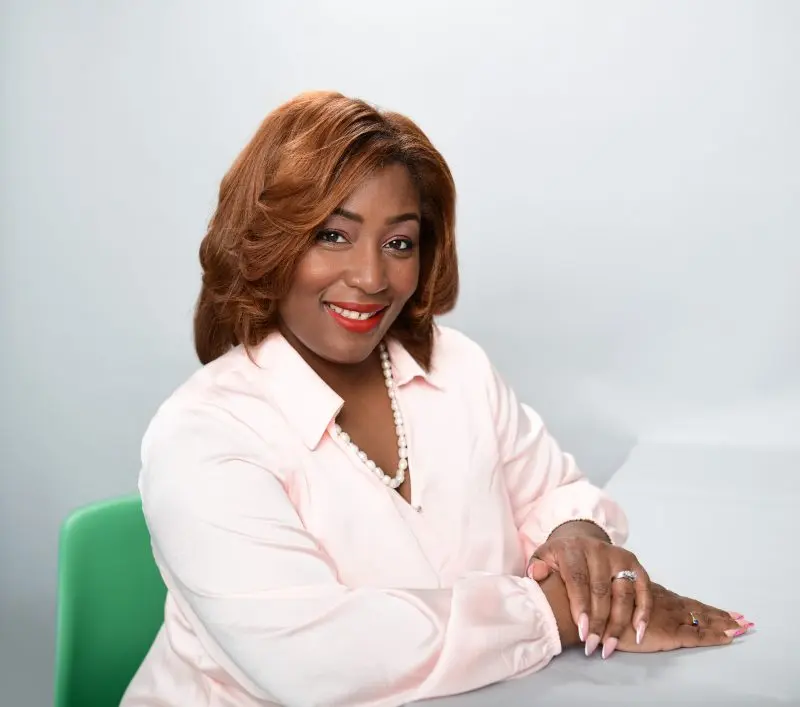
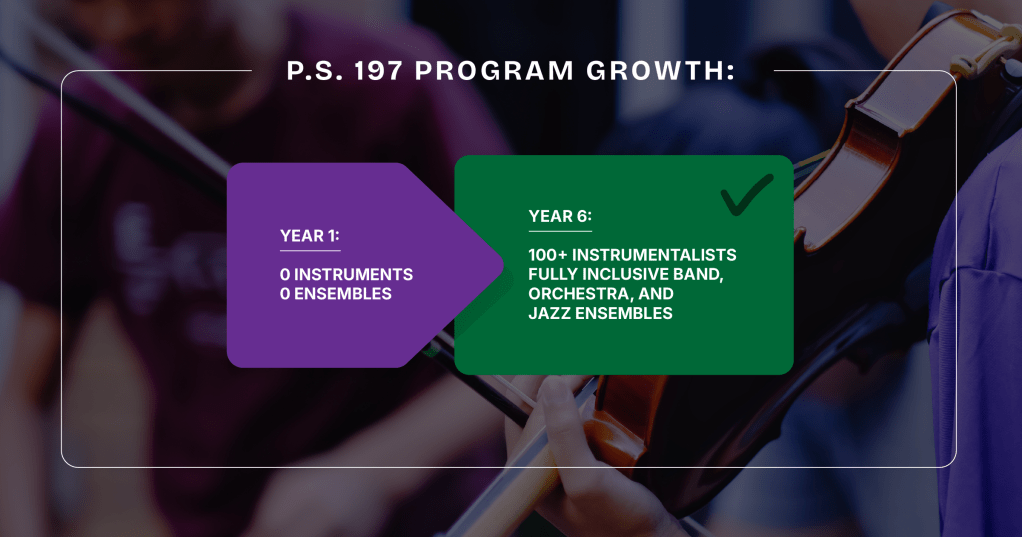
When Kimberly Rosenbaum stepped through the doors of P.S. 197, The King’s Highway Academy, in central Brooklyn six years ago, she faced a daunting mandate: build an instrumental music program entirely from scratch. At the time, the school possessed no band, no orchestra, and zero instrumental inventory. Today, that narrative has been entirely rewritten. P.S. 197 now boasts a flourishing fourth-grade band, a dynamic fifth-grade band, an energetic after-school string orchestra, and a thriving jazz band. Most importantly, the program achieves full inclusion, actively integrating students receiving special education who wish to participate in music-making.
Managing a school population that has surged to 1,200 total students across grades 3K through 5th grade is an immense operational feat. Rosenbaum teaches roughly 15 General Music sections while orchestrating small-group pull-out lessons during compressed 20-minute lunch and recess windows. To scale this ambitious curriculum without burning out, she needed an innovative approach to classroom management. By deploying MakeMusic as an automated digital teaching assistant, Rosenbaum has successfully transformed chaotic beginner rehearsals into focused, individualized clinics.
This comprehensive case study explores Rosenbaum’s journey from day one to a community of over 100 instrumentalists, examining the instructional strategies, bureaucratic workarounds, and universal accessibility measures that made this Brooklyn renaissance possible.
Detailed Chronology: The Evolution of P.S. 197’s Music Program
Year One: Laying the Foundation in a Vacuum
When Rosenbaum arrived at P.S. 197 six years ago, her first challenge was spatial and logistical. An empty music room lacked even the basic infrastructure required to support a modern school ensemble. There were no music stands, no method books, no brass, woodwind, or string instruments, and no historical precedent for instrumental education at the academy.
Rather than viewing the lack of inventory as a dead end, Rosenbaum treated it as a blank canvas. Working closely with school administration, she prioritized early advocacy, demonstrating to parents and stakeholders that instrumental music fosters cognitive growth, discipline, and emotional resilience. Slowly, through a combination of school funding allocations, grant writing, and community donations, instruments began to trickle in.

Years Two and Three: Scaling Up and Managing the Boom
As word spread about the fledgling music offerings, student interest skyrocketed, mirroring the overall growth of the school population to 1,200 students. Rosenbaum found herself stretched thin. Teaching approximately 15 General Music sections while simultaneously trying to launch band and orchestra cohorts meant she had to maximize every available minute of the school day.
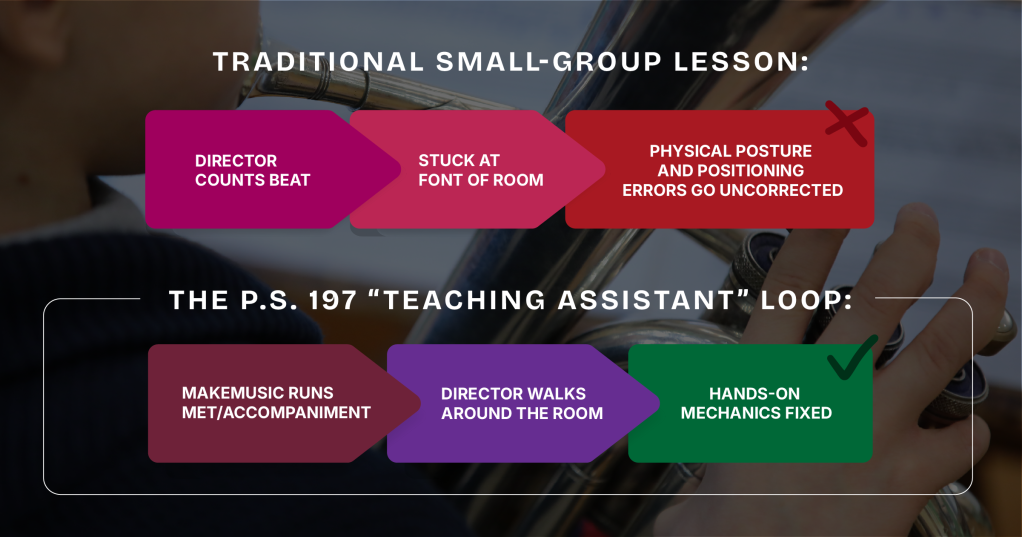
To capture instructional time, Rosenbaum instituted small-group pull-out lessons during 20-minute lunch and recess intervals. While efficient on paper, these compressed sessions presented a severe pedagogical bottleneck. Teaching a cohort of 10 beginner alto saxophone or brass players in a rapid 20-minute window can easily devolve into chaos. A traditional director is perpetually trapped at the front of the room—counting off beats aloud, waving a baton, and struggling to maintain collective momentum—leaving zero time to correct the individual physical mechanics of struggling students.
Years Four to Six: Automation and Program Maturity
To break through this instructional ceiling, Rosenbaum integrated MakeMusic into her daily teaching rhythm. By turning the software into an automated, interactive "conductor," she reclaimed her role as a hands-on clinician.
Today, P.S. 197’s music department is a multi-tiered operation. It features dedicated fourth- and fifth-grade bands, an after-school string orchestra that tackles sophisticated arrangements, and a jazz band that encourages improvisation and stylistic exploration. Crucially, this growth has occurred within an inclusive framework, ensuring that general education students, English Language Learners, and special education students all share the same musical stage.
Supporting Context & Metrics: Overcoming Logistical and Demographic Hurdles
The Operational Reality of Brooklyn Public Schools
Operating an instrumental music program in a New York City public school means navigating a complex maze of administrative regulations, procurement policies, and demographic realities. P.S. 197 serves a vibrant, highly diverse community in central Brooklyn. The student body includes a significant population of multi-lingual families and English Language Learners (ELL), creating unique communication and instructional challenges that standard music curricula fail to address.
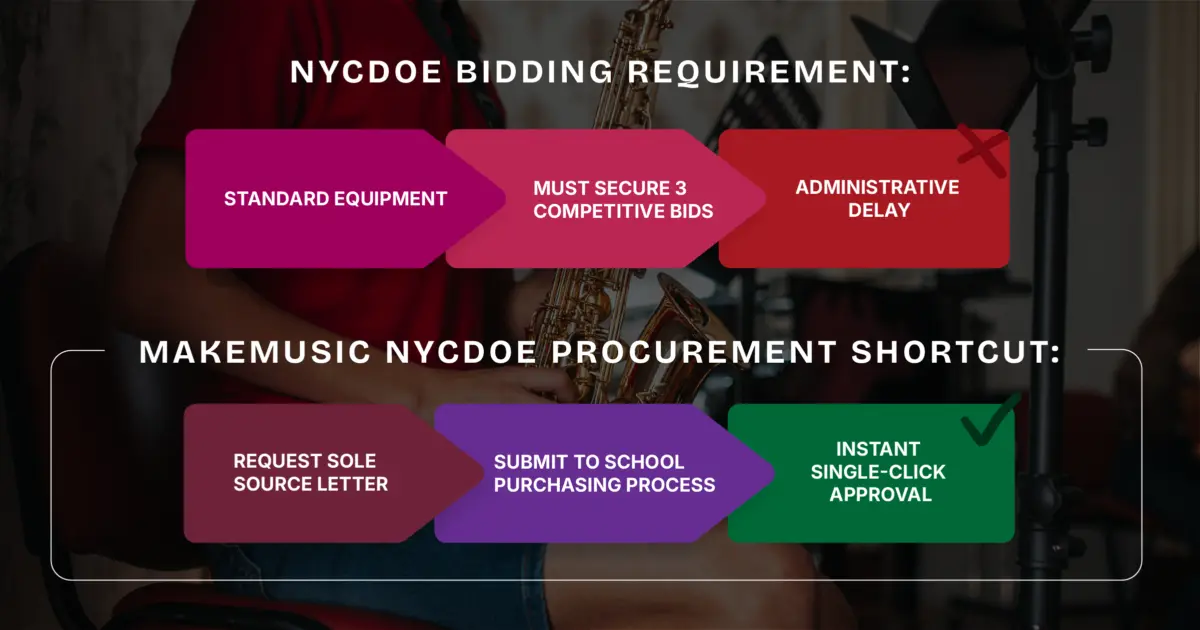
Furthermore, purchasing educational technology or supplemental software through the New York City Department of Education (NYCDOE) can often be an exhausting bureaucratic marathon. Standard procurement guidelines enforced via portals like FAMIS and ShopDOE frequently require educators to secure three competitive bids from different approved vendors before a purchase order can be approved. For a busy music teacher, this red tape can stall software adoption for months, effectively killing initiatives before they start.
The "Sole Source" Procurement Shortcut
Rosenbaum navigated this administrative roadblock by utilizing an under-utilized strategy available to NYCDOE educators: the Sole Source Vendor Letter.
Rather than embarking on a time-consuming search for three competing software vendors, Rosenbaum requested official documentation from MakeMusic confirming its unique status.
"MakeMusic provides a sole-source letter stating you can’t buy this tool anywhere else," Rosenbaum explains. "You give that letter to your purchasing secretary, and they don’t have to ask for three bids because there’s only one source. It’s one of my easiest purchases of the entire year."
This simple administrative hack transformed what is typically a weeks-long procurement nightmare into a streamlined, frictionless transaction, proving that mastering bureaucratic workflows is just as important to program survival as mastering musical scales.
Bridging Language and Ability Barriers Through Technology
In a school where many students are entering the system as English Language Learners, traditional English-only method books can alienate young musicians. Rosenbaum countered this barrier by strategically leveraging the digital architecture of her curriculum tools.
When teaching non-English speaking string or wind students, Rosenbaum deploys the Spanish-translated editions of Alfred Music’s Sound Innovations series directly inside the MakeMusic platform. This ensures that language comprehension never acts as a barrier to musical comprehension.
Additionally, the platform’s visual red/green note feedback engine provides young musicians with an intuitive, non-verbal practice partner at home. Students can instantly see whether they are hitting the correct pitches and rhythms without needing advanced English literacy, fostering immediate confidence and autonomy.
Official Statements & Pedagogical Insights
The success of P.S. 197’s music program ultimately rests on a philosophy of empowerment and student-centric design. In interviews reflecting on her methodology, Rosenbaum has consistently emphasized that educational technology should never replace the human element of teaching; rather, it should liberate the teacher to do what they do best.
Reflecting on how the software changed her approach during high-pressure small-group rehearsals, Rosenbaum notes:
"MakeMusic allows me to take a step away from being a conductor and lets me really focus on just being a teacher. They know the count-off is coming, the program takes them through, and I can go student-by-student down the line to fix hand position, embouchures, and instrumental positions while they play."
By automating the rhythm and tempo keeping via the software’s accompaniment engine, Rosenbaum eliminates the frantic multitasking that burns out so many elementary instrumental directors. She is no longer forced to choose between keeping the group together and correcting an improper hand posture on a flute or an incorrect embouchure on a trumpet. She can address both simultaneously.
Offering advice to fellow educators who may be hesitant to introduce digital practice tools to young or urban ensembles, Rosenbaum frames the decision through an ethical and philosophical lens of educational equity:
"MakeMusic isn’t a rigid curriculum; it’s a flexible tool. You’re giving students access to resources they wouldn’t otherwise have. When you give a kid an instrument and the right tools to practice, they just take off with it. Why wouldn’t you give them that opportunity?"
Future Outlook: Replicating the P.S. 197 Model
The transformation of P.S. 197, The King’s Highway Academy, serves as a powerful blueprint for urban music education nationwide. It shatters the myth that comprehensive instrumental programs are exclusive to well-funded suburban districts or elite magnet academies.
As school districts across the country grapple with fluctuating enrollments, shrinking arts budgets, and widening achievement gaps, Kimberly Rosenbaum’s work in Brooklyn highlights the vital intersection of human dedication and smart technological integration. By weaponizing administrative efficiency—such as sole-source procurement letters—and leveraging adaptive digital tools to support multi-lingual and special education learners, dedicated educators can scale their impact far beyond traditional classroom limits.
Looking ahead, Rosenbaum plans to continue expanding P.S. 197’s musical footprint, deepening community partnerships, and proving that when children are given the instruments, the guidance, and the digital scaffolding to succeed, they will not just meet expectations—they will soar past them. For music educators seeking to build resilient, high-participation programs from the ground up, the message from central Brooklyn is clear: the tools are available, the administrative paths can be cleared, and the next generation of instrumentalists is waiting for their cue.