
Executive Overview
In the rapidly evolving landscape of the modern music industry, independent artists face an unprecedented paradox: they have more access to data than ever before, yet they are frequently paralyzed by how to interpret and act upon it. Recognizing this critical industry bottleneck, music-marketing startup un:hurd Music has officially launched its most ambitious platform redesign to date: un:hurd Music 2.0.
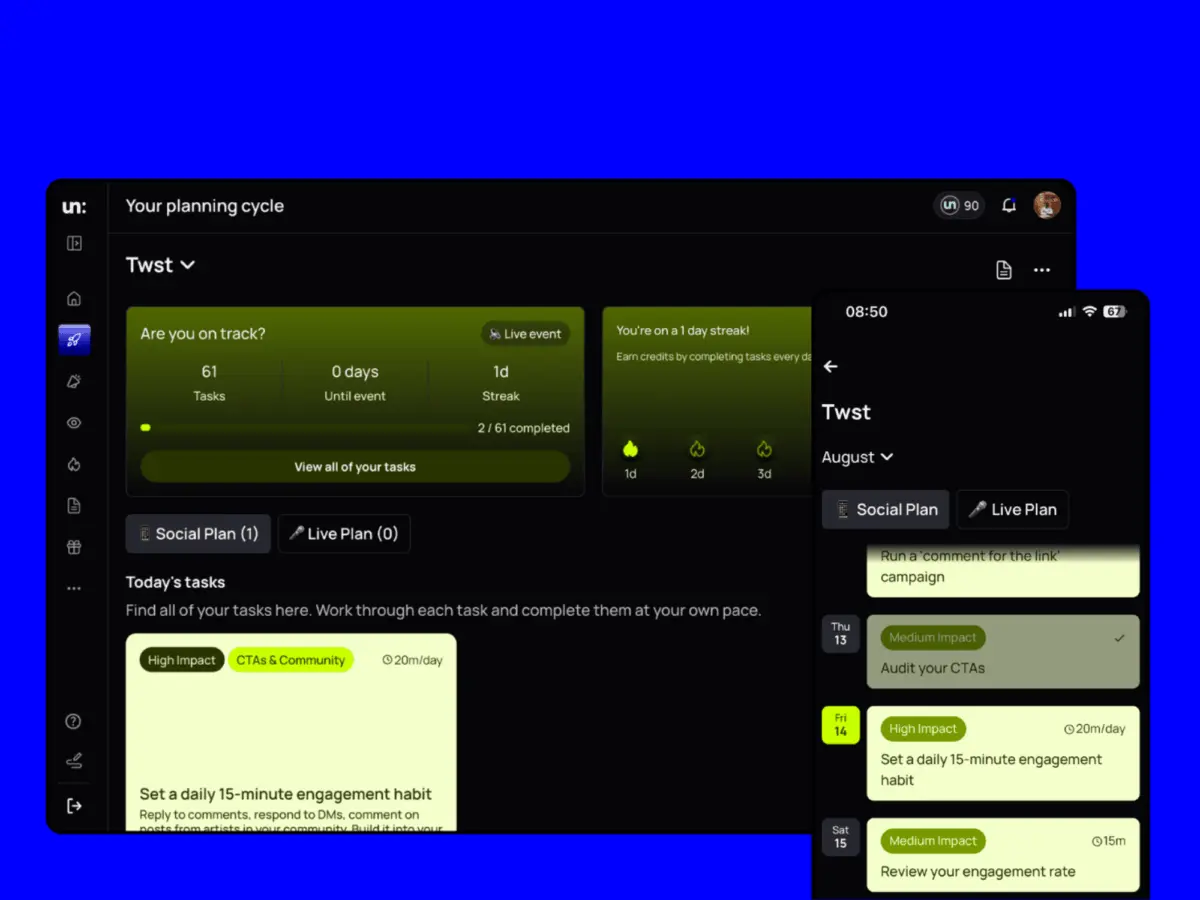
Available across both its web platform and dedicated mobile applications, this major update represents a fundamental philosophical shift for the company. Moving far beyond the traditional dashboard model that bombards creators with raw metrics, un:hurd 2.0 is engineered to bridge the gap between analytics and execution. The core ethos driving this release is simple yet revolutionary: transitioning from software that merely shows artists what their data looks like to intelligent tools that tell them what to do next.
This comprehensive upgrade impacts a global community of more than 200,000 independent musicians who rely on un:hurd to navigate the complexities of music promotion, audience building, and career management. By retiring legacy concepts like "release cycles" in favor of holistic "planning cycles," integrating context-aware artificial intelligence, and streamlining promotional workflows for playlists, ads, and live performances, un:hurd 2.0 positions itself not just as a marketing utility, but as an indispensable virtual manager for the modern DIY creator.
Detailed Chronology: The Evolution to Version 2.0
To understand the magnitude of un:hurd Music 2.0, one must examine the trajectory of the platform and the broader market forces that necessitated such a structural evolution.
The Problem with Data Overload
When un:hurd first burst onto the music-tech scene, its primary value proposition was democratizing access to professional marketing tools. Independent artists, historically priced out of major label PR campaigns and ad agencies, were suddenly given access to granular streaming analytics, audience demographics, and automated digital ad creation.
However, as the platform matured, feedback from its rapidly expanding user base highlighted a persistent friction point. Artists—creatives whose primary domain is songwriting, production, and performance—were spending hours staring at charts, graphs, and streaming milestones without a clear roadmap on how to leverage those insights. Knowing that a track gained 500 streams in a specific geographic market is interesting, but without actionable guidance, that data remains inert.
Conceptualizing Version 2.0
Development on the 2.0 update began with a complete reassessment of user workflows. The product and engineering teams at un:hurd asked a foundational question: How can we strip away analytical noise and replace it with direct, outcome-oriented execution?
The resulting updates were systematically rolled out across the platform’s ecosystem:
- The Death of "Release Cycles": Historically, music marketing software has been strictly tethered to the traditional album or single release cycle. un:hurd recognized that contemporary independent artists operate on fluid timelines that encompass live touring, brand partnerships, sync licensing opportunities, and ongoing community building. By officially replacing "release cycles" with "planning cycles," the platform has broadened its utility to support any career-focused milestone.
- Redesigning the "Insights" Engine: The analytics interface underwent a radical restructuring. Instead of leading with overwhelming statistical breakdowns, the new Insights tool prioritizes clear, human-readable summaries. These summaries are immediately followed by specific, system-recommended actions tailored to the artist’s current trajectory.
- Integrating Ethical, Tone-Preserving AI: While artificial intelligence has become a ubiquitous buzzword in music tech, un:hurd approached its implementation with caution. Version 2.0 introduces generative AI tools specifically designed to assist with administrative and promotional copywriting—such as drafting press releases, artist bios, and targeted pitches for brand partnerships and sync licensing. Crucially, the system is calibrated to reflect the artist’s unique tone of voice, preventing the generic, robotic prose often associated with early-generation AI tools.
- Visual and Functional Upgrades: Alongside backend logic changes, the platform’s user-facing components—including customized "fan hubs" for artists, advertising modules, and playlist-pitching utilities—received significant visual and performance enhancements to streamline the user experience.
Supporting Context & Metrics: The State of Independent Music Marketing
To fully appreciate the significance of un:hurd Music 2.0, it is vital to contextualize the current economic and operational realities facing independent creators.
The DIY Boom and Resource Scarcity
According to recent industry reports, tens of thousands of new tracks are uploaded to global digital streaming service (DMS) platforms every single day. The democratization of recording technology means that the barrier to entry for creating studio-quality music has never been lower. Consequently, the barrier to being heard has never been higher.
Independent artists make up the fastest-growing sector of the recorded music market, generating billions of dollars in collective revenue. Yet, unlike signed artists backed by major label ecosystems—which feature dedicated departments for radio promotion, playlist pitching, digital marketing, public relations, and sync licensing—DIY creators must wear every single one of these hats simultaneously.
The Cost of Fragmentation
Prior to platforms like un:hurd, an independent artist trying to run a comprehensive campaign had to juggle a fragmented suite of tools:
- Analytics Dashboards: Spotify for Artists, Apple Music for Artists, YouTube Creator Studio, and social media analytics suites.
- Advertising Platforms: Meta Ads Manager (Facebook/Instagram), TikTok Ads, and Google Ads, each with steep learning curves.
- Pitching Services: Various standalone submission portals for independent playlist curators, blogs, and sync agents.
- Administrative Tasks: Manually drafting press releases and electronic press kits (EPKs).
This fragmentation leads directly to "creative burnout," where artists spend more time managing software and marketing budgets than they do making music. un:hurd’s primary achievement has been consolidating these fragmented workflows into a single ecosystem. Version 2.0 takes this consolidation one step further by introducing cognitive simplification—acting not just as a central dashboard, but as an intelligent filter that tells the artist where to allocate their precious time and money.
Scale and Adoption
With over 200,000 artists already utilizing the platform, un:hurd occupies a powerful position within the music-tech ecosystem. Releasing an update of this magnitude to an active user base of that scale requires careful UX design and robust infrastructure stability. The overwhelmingly positive initial reception from beta testers and early adopters indicates that the platform has successfully hit a nerve, addressing a universal pain point that resonates from bedroom producers to touring indie bands.
Official Statements and Industry Perspective
While un:hurd Music positions its 2.0 update as a technical and philosophical leap forward, industry analysts and company representatives emphasize that the overarching mission remains anchored in artist empowerment.
In statements accompanying the rollout, un:hurd leadership underscored that the modern musician does not need more data; they need better direction.
"For too long, music technology has treated artists like data scientists, expecting them to comb through dense metrics to figure out their own marketing strategies," noted a representative close to the product development team. "With un:hurd 2.0, we are fundamentally flipping that script. Our software now looks at the data so the artist doesn’t have to—delivering clear, step-by-step actions that drive real career growth, whether they are dropping a new single, booking a live tour, or pursuing a sync licensing deal."
Industry commentators have pointed out that this shift mirrors broader technological trends across SaaS (Software as a Service) industries, where raw automation is rapidly being replaced by contextual intelligence. By moving away from rigid "release cycles" and embracing flexible "planning cycles," un:hurd is acknowledging that the modern music business is multidisciplinary. An independent artist today is simultaneously a content creator, a small business owner, a live event promoter, and a brand marketer. Software designed to support them must reflect that multifaceted reality.
Furthermore, the implementation of tone-sensitive AI has drawn praise from digital marketing experts. By ensuring that generated press releases and bio drafts maintain the artist’s authentic voice, un:hurd avoids the alienation often felt by fans when creators rely on transparently synthetic promotional materials.
Future Outlook: What un:hurd 2.0 Means for the Future of DIY Music
As un:hurd Music 2.0 becomes fully integrated into the daily routines of its 200,000+ users, the implications for the broader independent music sector are profound.
Bridging the Professional Divide
The traditional advantage of major record labels has never truly been capital alone; it has been expertise, strategy, and infrastructure. By encoding strategic planning and intelligent workflows into an accessible app, platforms like un:hurd are systematically eroding the operational moat that major labels once held over independent talent.
When an independent artist can use AI-assisted tools to draft a professional press release, receive automated, data-driven recommendations on where to spend their advertising budget, and seamlessly coordinate a multi-faceted campaign around a live tour rather than just a digital release, the playing field tilts noticeably toward equity.
The Road Ahead for un:hurd
Looking forward, the success of version 2.0 will likely pave the way for deeper integrations within the digital music supply chain. As streaming services, social media algorithms, and ticketing platforms continue to evolve at a breakneck pace, the need for agile, intelligent marketing companions will only intensify.
un:hurd Music has signaled that version 2.0 is not a static endpoint, but a foundational platform upon which future capabilities will be built. As the company continues to refine its machine-learning algorithms and expand its suite of promotional tools, it is setting a new benchmark for what independent artists should expect from the software powering their careers.
In an industry historically defined by gatekeepers and administrative friction, un:hurd 2.0 offers a clear blueprint for the future: one where technology serves as a clarifying lens rather than an overwhelming barrier, allowing the music itself to finally take center stage.