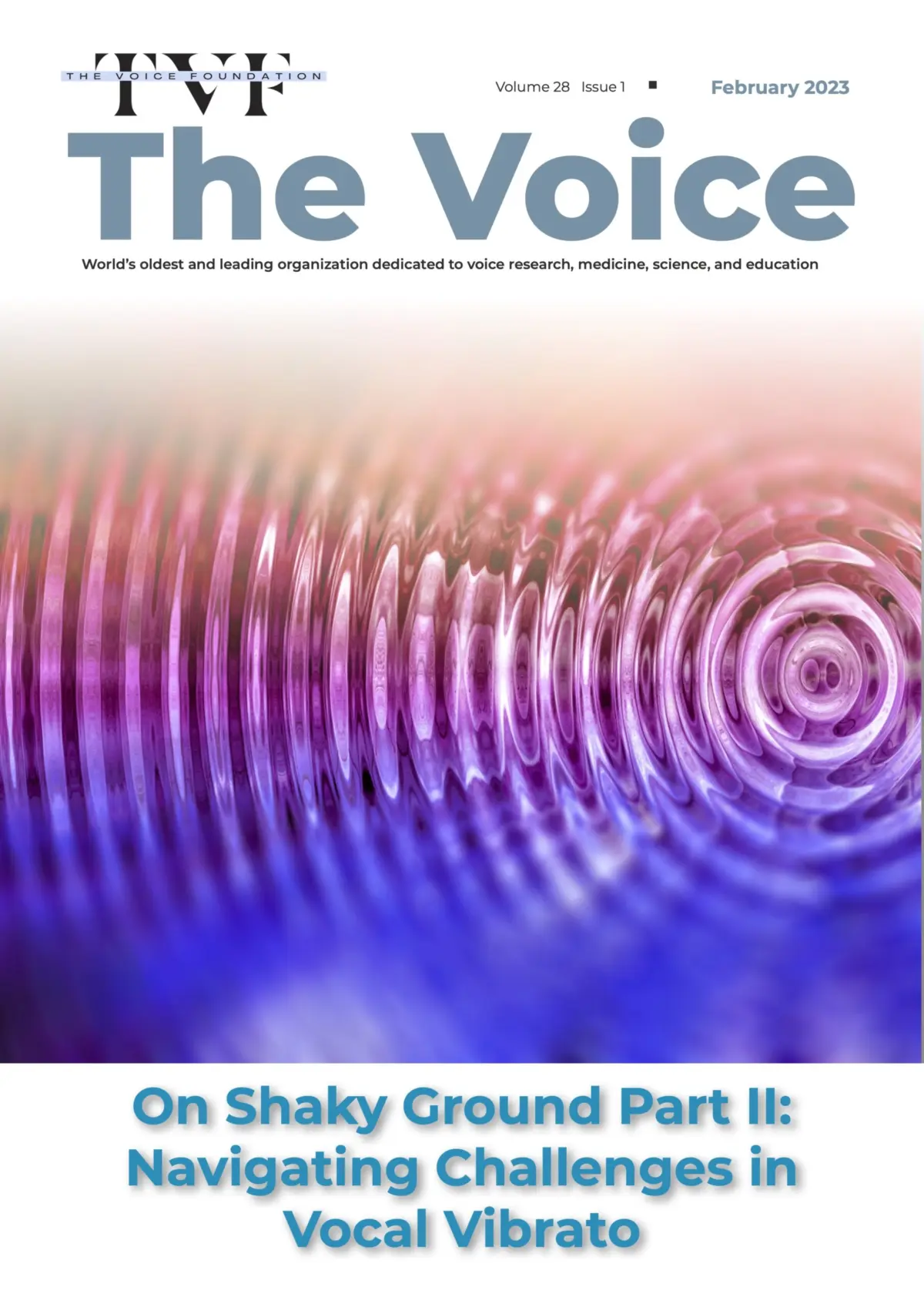

PHILADELPHIA, PA — In the ever-evolving landscape of vocal pedagogy, scientific research, and clinical voice therapy, few phenomena remain as captivating and debated as vocal vibrato. On February 24, 2023, The Voice Foundation—the world’s premier organization dedicated to the care, research, and education of the human voice—published its highly anticipated February 2023 Newsletter. Authored by Ian DeNolfo, the latest publication brings the vocal community’s attention back to a complex subject with the release of "On Shaky Ground Part II."
This installment builds upon ongoing clinical discussions and empirical investigations into how vibrato is produced, taught, rehabilitated, and perceived. By weaving together the disparate threads of academic research, practical voice pedagogy, and medical treatment strategies, the February 2023 issue serves as an indispensable resource for otolaryngologists, speech-language pathologists, vocal coaches, professional singers, and researchers alike.
Executive Overview
The human voice is perhaps our most dynamic instrument—capable of conveying profound emotional nuance, linguistic meaning, and artistic expression through subtle physiological adjustments. Central to the aesthetics of Western classical singing, musical theater, and various contemporary genres is vibrato: a slight, regular fluctuation in pitch and intensity. Yet, despite its ubiquity and aesthetic appeal, the underlying physiological and neurological mechanisms governing vibrato, as well as the challenges associated with its perturbation (such as excessive tremor, wobble, or a "straight tone"), continue to prompt rigorous scientific inquiry.
The Voice Foundation’s February 2023 Newsletter squarely addresses these complexities. Under the evocative title "On Shaky Ground Part II," the publication delves deeply into the multifaceted nature of vocal vibrato. Rather than examining the topic through a single lens, the issue adopts a tripartite approach:
- The Research Perspective: Examining electromyographic (EMG) studies, laryngeal kinematics, and acoustic analyses that map out how the neuromuscular system initiates and sustains vibrato.
- The Teaching Perspective: Analyzing how master voice teachers conceptualize, cultivate, and troubleshoot vibrato within studio environments without inducing vocal tension or fatigue.
- The Treatment Perspective: Exploring clinical interventions for pathological or dysfunctional vibrato irregularities, such as essential voice tremor or laryngeal dystonia, which can devastate a professional vocalist’s career.
By synthesizing these viewpoints, the February 2023 newsletter provides a holistic framework for understanding both the beauty and the biological fragility of the singing voice.
Detailed Chronology: The Evolution of Vocal Vibrato Research and Publication
To fully appreciate the significance of the February 2023 newsletter, it is essential to trace the historical and institutional trajectory that led to its publication. The Voice Foundation, founded by Dr. Robert H. Miller in 1969, has spent over half a century bridging the gap between artistic vocal traditions and hard medical science.
The Lead-Up to Part II
The publication of "On Shaky Ground Part II" did not occur in a vacuum; it represents the continuation of a dialogue initiated in previous symposia and newsletter editions regarding laryngeal stability, neuromuscular control, and vocal irregularities.
- Historical Precedents: For decades, voice scientists debated whether vibrato was primarily a purely involuntary neurological oscillation (akin to a physiological tremor of the laryngeal musculature) or a learned, highly coordinated neuromuscular gesture.
- The Interdisciplinary Shift: In the late 20th and early 21st centuries, advances in high-speed digital laryngeal stroboscopy, flexible laryngoscopy, and acoustic software allowed researchers to visualize vocal fold oscillation with unprecedented clarity. This technological leap revealed that healthy vibrato typically involves synchronized oscillations across the thyroarytenoid and cricothyroid muscles, operating at a frequency of approximately 5.5 to 7 oscillations per second.
- The Genesis of "On Shaky Ground": Recognizing a gap in how clinical professionals and pedagogues communicate about vibrato irregularities—such as a slow, wide "wobble" or a tight, narrow "bleat"—The Voice Foundation conceptualized the "On Shaky Ground" series. Part I established the baseline definitions and clinical parameters of unstable vocal oscillation, while Part II (released in February 2023) expanded into advanced pedagogical corrections and multi-disciplinary treatment modalities.
Supporting Context & Metrics: The Anatomy and Science of Vocal Tremor and Vibrato
To understand why the topics covered in the February 2023 newsletter are so critical to the vocal community, one must examine the underlying anatomy, physiology, and acoustic metrics associated with vocal modulation.
Physiological Foundations
Vocal vibrato is characterized by three primary acoustic parameters:

- Frequency Modulation (Pitch): Typically fluctuating by roughly a quarter to a half-step at a rate of 5.5 to 7 Hz.
- Intensity Modulation (Volume): A concurrent variation in amplitude that often accompanies the frequency shift.
- Timbral Modulation (Spectrum): Changes in overtones and harmonic structures as the vocal tract and vocal folds subtly adjust.
When these parameters function harmoniously, the result is a warm, resonant, and emotionally resonant sound. However, when the nervous system or laryngeal musculature experiences interference—whether due to muscular bracing, neurological conditions, or aging—the vibrato can destabilize.
Key Metrics in Vocal Stability Assessment
Voice clinics and research laboratories rely on several objective metrics to evaluate vibrato quality and diagnose pathology:
- Jitter: The cycle-to-cycle variation in fundamental frequency ($F_0$). While excessive jitter in a sustained vowel usually indicates pathology or roughness, controlled micro-variations are essential for natural vibrato.
- Shimmer: The cycle-to-cycle variation in amplitude.
- Tremor Amplitude and Frequency: Measured via accelerometer or acoustic analysis software to distinguish between artistic vibrato (stable rate, moderate extent) and pathological tremor (irregular rate, excessive extent, or directional instability).
The February 2023 issue highlights how modern diagnostic tools allow speech-language pathologists and laryngologists to differentiate between a singer struggling with technical coordination and a patient exhibiting signs of a true neurological voice disorder.
Perspectives Explored in the Newsletter
The core strength of the February 2023 publication lies in its tripartite examination of vibrato across research, pedagogy, and clinical treatment.
1. The Research Perspective: Decoding the Neuromuscular Pulse
From a scientific standpoint, "On Shaky Ground Part II" reviews the latest electrophysiological data concerning how the central nervous system commands the larynx. Researchers contributing to or cited within the discourse emphasize that vibrato is neither entirely autonomic nor entirely conscious. Instead, it sits at a complex intersection: a learned motor program executed through rhythmic neural firing patterns originating in the brainstem and modulated by cortical and cerebellar inputs.
The newsletter explores how disruptions in this delicate feedback loop—such as performance anxiety, fatigue, or neurological impingement—can cause the vibrato to widen uncontrollably into a wobble or narrow into a rigid straight tone. By mapping these neural pathways, researchers are moving closer to objective classifications of vocal health and efficiency.
2. The Teaching Perspective: Navigating Vibrato in the Voice Studio
For voice teachers and vocal pedagogues, the challenge often lies in troubleshooting vibrato issues without causing psychological or physical trauma to the student. A singer who develops a forced or absent vibrato can experience profound career anxiety.
The February 2023 newsletter addresses studio-tested strategies for addressing these issues:
- Addressing Muscular Bracing: Often, an absent vibrato (the dreaded "straight tone" or pressed phonation) stems from excessive isometric tension in the extrinsic laryngeal muscles, jaw, or tongue. Pedagogical approaches discussed emphasize release, optimal breath management, and laryngeal balancing.
- Correcting the "Wobble": Conversely, a slow, uncoordinated wobble is frequently the result of vocal fatigue, breath mismanagement, or an over-relaxation of the intrinsic muscles. Voice teachers are provided with frameworks to help students recalibrate their muscular engagement, shifting away from heavy, localized pressure toward dynamic, whole-body coordination.
3. The Treatment Perspective: Clinical Interventions for Vocal Pathologies
When vibrato irregularities cross the threshold from a technical habit into a clinical pathology—such as essential tremor of the voice or spasmodic dysphonia—pedagogical intervention alone is insufficient.
The treatment section of the newsletter outlines cutting-edge medical and speech-language pathology interventions:
- Voice Therapy Protocols: Targeted semi-occluded vocal tract (SOVT) exercises, resonance therapy, and neuromuscular re-education designed to stabilize laryngeal posture.
- Medical and Surgical Options: Collaboration with otolaryngologists regarding pharmacological treatments or botulinum toxin (Botox) injections for spasmodic and tremulous conditions, which can temporarily pacify hyperactive laryngeal muscles and restore functional phonation.
Official Statements and Institutional Impact
The Voice Foundation has long operated as a beacon of interdisciplinary collaboration, uniting artists and medical professionals under one roof. The release of the February 2023 newsletter underscores the organization’s ongoing commitment to disseminating peer-reviewed knowledge and practical insights to a global audience.
While specific editorial notes from Ian DeNolfo frame the issue, the broader implications of "On Shaky Ground Part II" resonate throughout the professional voice community. Leaders in laryngology and vocal pedagogy have repeatedly noted that breaking down the silos between medical science and artistic training is essential for the holistic care of the human voice.
By addressing vibrato—a feature that bridges art and anatomy—The Voice Foundation continues to foster a deeper appreciation for the complex physiological choreography required to produce artistic sound.
Future Outlook: Where Voice Science and Pedagogy Meet Next
As we look beyond the findings published in the February 2023 newsletter, the field of voice science stands on the precipice of remarkable technological and methodological advancements.
Emerging Trends in Vocal Research
- Artificial Intelligence and Acoustic Modeling: Researchers are increasingly utilizing machine learning algorithms to analyze acoustic recordings of voices in real time. AI models can detect minute irregularities in vibrato and tremor long before they become symptomatic to the human ear, paving the way for early detection of vocal pathologies.
- Advanced Neuroimaging: Functional magnetic resonance imaging (fMRI) and high-density electroencephalography (EEG) are providing unprecedented windows into how the brain coordinates complex singing tasks. Future studies building upon "On Shaky Ground Part II" will likely map out the exact cortical activation patterns associated with maintaining stable vibrato under high-stress performance conditions.
- Interdisciplinary Training Models: There is a growing movement toward integrating voice science directly into conservatory curricula. By educating young singers, actors, and speakers in the basic biomechanics and neurology of their instrument, the next generation of performers will be better equipped to prevent injuries and maintain vocal longevity.
Conclusion
The Voice Foundation’s February 2023 Newsletter, featuring "On Shaky Ground Part II," stands as a testament to the depth, complexity, and beauty of the human voice. By examining vibrato through the synchronized lenses of research, teaching, and clinical treatment, the publication provides a vital roadmap for anyone dedicated to the preservation and celebration of vocal artistry. As science and pedagogy continue to march hand-in-hand, resources like these ensure that the ground upon which vocal professionals stand remains ever more secure.
For further information on upcoming symposia, archival newsletters, and research grants, visit the official portal of The Voice Foundation.