
Executive Overview
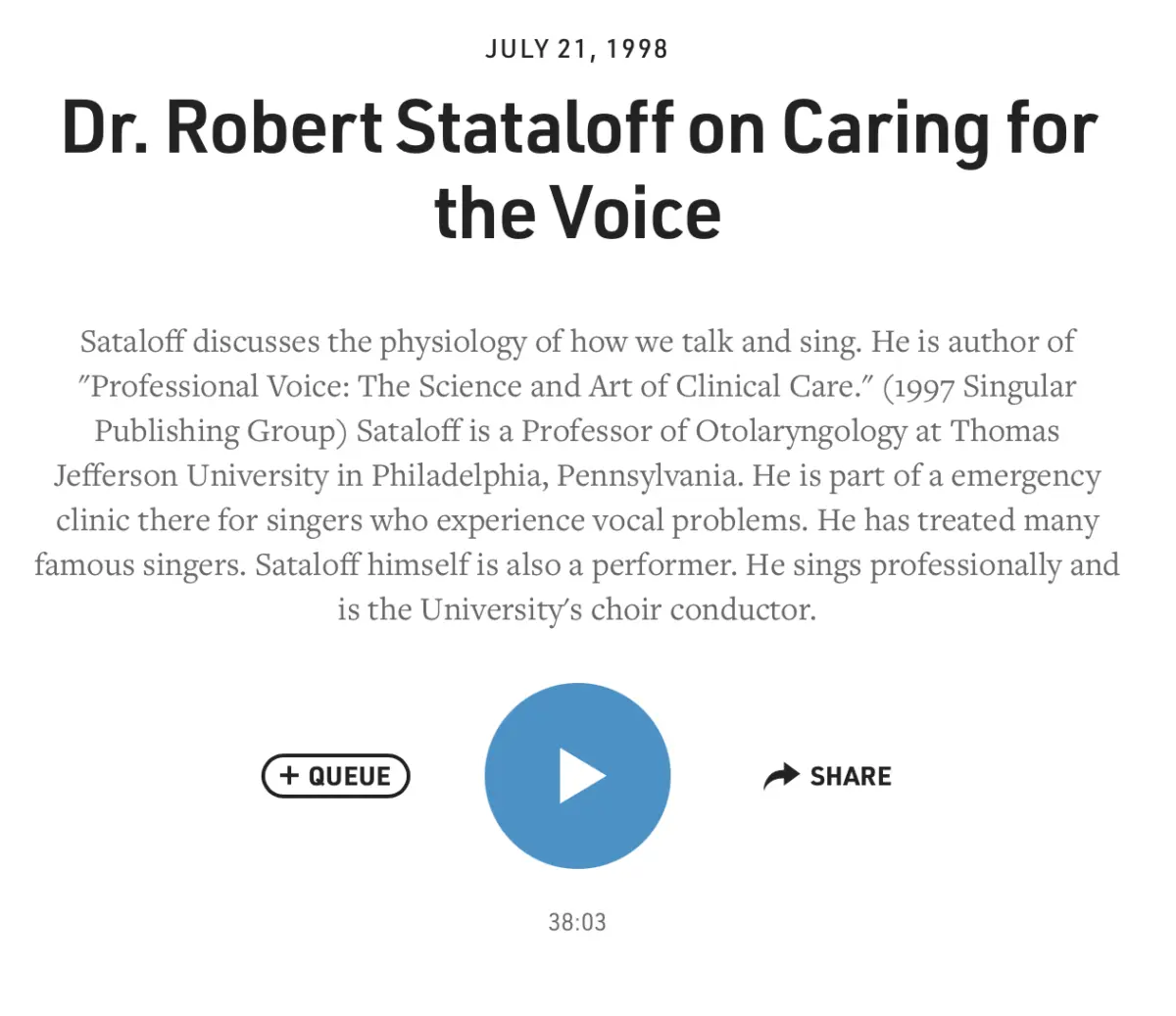
In the realm of vocal health, otolaryngology, and performing arts medicine, few names resonate with the authority and foundational impact of Dr. Robert Thayer Sataloff. Published in the archives of broadcast journalism and highlighted by organizations such as The Voice Foundation, a defining moment in public vocal education occurred in 1998 when Dr. Sataloff sat down with Terry Gross, the celebrated host of NPR’s Fresh Air.
This comprehensive retrospective examines that historic broadcast, exploring how a thirty-minute radio interview bridged the gap between complex medical science and public consciousness. At a time when the physiological mechanisms governing the human voice were largely understood only by elite performers, specialized physicians, and speech-language pathologists, Dr. Sataloff’s conversation with Gross democratized vocal science. He illuminated the fragility and resilience of the human larynx, demystified common vocal pathologies, and established a paradigm for how artists should treat their most vital instrument: the voice.
By reviewing the core tenets of the 1998 interview, we gain not only a historical perspective on the evolution of laryngology but also a timeless guide to vocal hygiene, medical diagnostics, and the psychological dimensions of vocal performance. This article delves into the structural components of that dialogue, contextualizes its significance within the broader timeline of voice science, and assesses its enduring legacy for contemporary singers, speakers, and medical professionals.
Detailed Chronology: The Evolution of Voice Science and the 1998 Milestone
To fully appreciate the weight of Dr. Sataloff’s 1998 appearance on Fresh Air, it is essential to trace the trajectory of voice science leading up to that cultural touchstone. For centuries, the human voice was treated as a black box. Singers and actors relied on empirical traditions, pedagogical folklore, and subjective sensations to train and preserve their instruments. If a performer lost their voice, the remedies ranged from superstitious folk cures to crude, invasive surgical interventions that often ended careers rather than saving them.
The Mid-to-Late 20th Century: The Birth of Laryngology
The modern era of voice care began to take shape in the mid-20th century with the advent of stroboscopy and high-speed photography, allowing medical professionals to actually visualize the vocal folds vibrating in real time. Pioneers in otolaryngology began to recognize that the voice was not merely produced by the larynx in isolation, but was the product of a complex, highly integrated physiological system involving the respiratory tract, the resonators (pharynx, oral cavity, nasal cavity), and the central nervous system.
By the 1970s and 1980s, institutions like The Voice Foundation—under the visionary leadership of figures including Dr. Sataloff—began formalizing multidisciplinary approaches to voice care. Otolaryngologists, speech-language pathologists, singing teachers, and voice scientists started collaborating to diagnose and treat vocal injuries with unprecedented precision.
The 1998 Fresh Air Broadcast
Against this backdrop of rapid scientific advancement, Dr. Robert Thayer Sataloff entered the studio of WHYY in Philadelphia to speak with Terry Gross in 1998. Gross, renowned for her probing, highly intelligent interview style, posed questions that bypassed superficial trivia and went straight to the physiological and psychological core of vocal production.
During the interview, Dr. Sataloff broke down complex anatomical concepts into accessible language for millions of listeners. He explained how vocal folds—delicate mucosal tissues measuring only about the size of a fingernail in adult females and slightly larger in adult males—collide hundreds to thousands of times per second during speech and singing. He detailed how these tissues must maintain a precise balance of hydration, elasticity, and tension to produce sound without self-destructing.
The interview served as a public awakening. Listeners who had previously viewed hoarseness as a mere inconvenience learned that persistent vocal fatigue could be the symptom of nodules, polyps, hemorrhages, or neurological disorders requiring immediate medical intervention. For professional vocalists listening to the broadcast, Dr. Sataloff provided validation: vocal injury was not a moral failing or a sign of poor technique, but an occupational hazard akin to a runner’s torn meniscus or a pianist’s carpal tunnel syndrome.

Supporting Context & Metrics: The Science of Sound and Injury
To understand the insights shared by Dr. Sataloff during his conversation with Terry Gross, one must examine the hard data, metrics, and physiological realities that govern the human voice. Voice science operates at the intersection of aerodynamics, acoustics, and myoelastic-aerodynamic theory.
The Mechanics of Vocal Fold Oscillation
When a person speaks or sings, air expelled from the lungs creates subglottic pressure beneath the closed vocal folds. Once this pressure overcomes the muscular closure of the folds, the tissues are blown apart, releasing a puff of air. Due to the Bernoulli effect and the elastic recoil of the tissue, the folds snap back together. This cycle repeats at frequencies ranging from roughly 80 Hz for a deep bass voice to over 1,000 Hz for a high soprano.
| Vocal Parameter | Typical Male Range | Typical Female Range | Physiological Implication |
|---|---|---|---|
| Fundamental Frequency ($F_0$) | 85 Hz – 180 Hz | 165 Hz – 255 Hz | Determines perceived pitch; higher frequencies require greater tissue tension and thinner mucosal margins. |
| Vocal Fold Length | 15 mm – 20 mm | 9 mm – 17 mm | Shorter folds naturally oscillate at higher baseline frequencies. |
| Phonatory Collision Forces | Varies with intensity | Varies with intensity | Excessive loudness and poor technique increase mucosal trauma, leading to swelling and lesions. |
The Impact of Hydration and Environment
One of the cornerstone principles emphasized by voice specialists like Dr. Sataloff is the critical role of hydration. Because the superficial layer of the lamina propria (Reinke’s space) relies on adequate fluid balance to remain pliable, systemic and topical dehydration dramatically alters vocal fold viscosity.
Research demonstrates that even a minor decrease in bodily hydration increases the threshold pressure required to initiate vocal fold vibration. This forces performers to work harder, increasing muscular tension and the risk of trauma. By explaining these biomechanical realities on national radio, Dr. Sataloff transformed hydration from a casual health tip into a non-negotiable professional requirement for voice users.
Prevalence of Vocal Pathologies in the Workforce
Voice disorders are not restricted to opera singers and rock stars. Teachers, sales professionals, trial attorneys, fitness instructors, and call center workers rely on their voices for their livelihoods. Epidemiological studies indicate that roughly 3% to 9% of the general population suffers from a voice disorder at any given time, and occupational voice users represent a disproportionately high percentage of clinical caseloads.
- Teachers: Experience voice problems at two to three times the rate of non-vocal professionals due to high background noise, poor classroom acoustics, and prolonged speaking durations.
- Singers: Face acute risks of vocal fold hemorrhage due to intense vocal loading, often exacerbated by upper respiratory infections, antihistamine use, and dry environments (such as airplane cabins and climate-controlled stages).
Official Statements and Expert Perspectives
The enduring relevance of Dr. Sataloff’s 1998 interview is reflected in the ongoing mission of organizations dedicated to voice research and education. Leaders in the field frequently cite the democratization of medical knowledge as a critical turning point in patient outcomes.
Reflecting on the integration of medicine and art, Dr. Sataloff has frequently noted in subsequent academic lectures and publications:
"The human voice is the most intimate and personal instrument we possess. For centuries, treating it was an art form isolated from rigorous science. By bringing otolaryngology, speech pathology, and vocal pedagogy together, we changed the paradigm from guessing about vocal injury to treating it with the same precision applied to any other vital human organ."
Terry Gross’s approach during the 1998 interview exemplified the journalistic responsibility required when handling specialized medical topics. By asking foundational questions—such as how psychological stress manifests in vocal tension, how smoking and reflux damage mucosal tissue, and why whispering can sometimes be more damaging to the vocal folds than normal speech—she allowed Dr. Sataloff to dismantle persistent urban legends surrounding voice care.
Industry bodies, including The Voice Foundation, continue to archive and distribute materials from this era to educate the next generation of otolaryngologists and performing artists. The foundation’s annual symposia regularly revisit the foundational principles articulated in broadcasts like Fresh Air, ensuring that clinical practice remains anchored in comprehensive patient education.
Future Outlook: The Next Era of Voice Care and Education
As we look toward the future of voice science, the insights shared by Dr. Robert Thayer Sataloff in 1998 serve as both a historical bedrock and a springboard for modern innovations. The landscape of voice care is currently undergoing a radical transformation driven by technological advancements, regenerative medicine, and telepractice.
Regenerative Medicine and Vocal Fold Scarring
One of the most stubborn challenges in laryngology has been the treatment of vocal fold scarring (sulcus vocalis or deep fibrosis). Unlike other tissues that heal without architectural disruption, the delicate layered structure of the vocal fold lamina propria is notoriously difficult to restore once damaged by surgery or severe trauma.
Current and future research focuses on tissue engineering, stem cell therapy, and biomaterial scaffolds. Investigators are developing injectable hydrogels that mimic the viscoelastic properties of healthy extracellular matrix, offering hope to performers who previously faced career-ending diagnoses due to irreversible scarring.
Artificial Intelligence and Early Diagnostics
Machine learning and acoustic analysis algorithms are increasingly being integrated into diagnostic workflows. By analyzing subtle micro-fluctuations in voice production (jitter, shimmer, and spectral characteristics), AI models can assist clinicians in detecting early-stage pathologies—such as nascent nodules or neoplastic growths—long before they become visible on standard stroboscopy.
Furthermore, wearable acoustic monitors are being developed to track daily vocal loading in high-risk professions. These devices provide real-time biofeedback to teachers and call center workers, warning them when they are approaching dangerous thresholds of vocal fatigue or abuse.
Telemedicine and Global Accessibility
The COVID-19 pandemic accelerated the adoption of telehealth in otolaryngology and speech-language pathology. While physical stroboscopy still requires an in-person visit, remote acoustic assessments, postural evaluations, and voice therapy sessions have democratized access to specialized care. Performers in remote areas can now consult with elite voice centers without traveling thousands of miles, mirroring the accessibility that radio broadcasts like Fresh Air first brought to the living rooms of millions in 1998.
Conclusion
The 1998 interview between Terry Gross and Dr. Robert Thayer Sataloff was far more than a routine segment on a public radio talk show; it was a cultural and scientific milestone that brought the intricate world of vocal health out of the surgical suite and into the public square. By explaining the delicate biomechanics of the human voice with clarity, compassion, and uncompromising scientific rigor, Dr. Sataloff empowered generations of speakers and singers to take charge of their vocal well-being.
As voice science marches into an era defined by regenerative medicine, artificial intelligence, and global telemedicine, the core message of that 1998 conversation remains unaltered: the human voice is a masterpiece of biological engineering that demands our utmost respect, scientific understanding, and proactive care. Archives preserved by institutions like The Voice Foundation ensure that foundational dialogues such as this continue to inspire, educate, and protect the voices of tomorrow.