
Executive Overview
For centuries, the written page of musical notation has served as the universal bridge between composer and performer. Yet, for many instrumentalists and vocalists, the act of sight-reading remains an intimidating hurdle. At the core of this challenge lies a fundamental cognitive bottleneck: note recognition. The instantaneous, subconscious translation of a graphical symbol on a staff into a physical muscular response or vocal pitch is the bedrock upon which all advanced musical literacy is built. Recognizing that even seasoned professionals can struggle with the speed and accuracy of this immediate decoding process, music educator, software engineer, and SightReadingMastery founder Evan R. Murphy engineered a definitive digital intervention.
Originally launched as a streamlined web utility in May 2015, the Note Recognition App was developed to democratize and accelerate the mastery of fundamental music reading skills. Eschewing the friction of traditional flashcards and static workbooks, this browser-based tool delivers interactive, dynamic practice directly to users across the globe. Over subsequent years, through iterative updates completed in late 2018, the platform evolved from a basic treble-clef-only prototype into a comprehensive, multi-clef training environment equipped with ledger-line support.
This comprehensive report examines the genesis, technological evolution, and pedagogical impact of the SightReadingMastery Note Recognition App. By analyzing the cognitive mechanics of sight-reading, the architectural flexibility of cross-platform design, and the continuous feedback loops that drove its development, we explore how digital tools are redefining modern music education.
Detailed Chronology: From Concept to Comprehensive Tool
The journey of the Note Recognition App is a textbook study in agile product development within the niche sector of digital music education. Understanding its maturation requires a detailed look at the milestones that shaped its current capabilities.
Phase 1: The Foundation and Initial Release (May 1, 2015)
In the spring of 2015, SightReadingMastery identified a critical gap in the digital learning market. While various desktop applications and rudimentary games existed for music theory drills, few offered a frictionless, zero-install experience dedicated entirely to the kinetic reflex of note identification. On May 1, 2015, Evan R. Murphy officially released the free online tool at sightreadingmastery.com/note-recognition/.
The initial iteration was purposefully minimalist. Built to target the absolute essentials of music literacy, the application focused exclusively on the treble clef. The primary design objective was speed: stripping away extraneous features to force the user’s brain to form immediate neural pathways between visual symbols and musical notes. However, this initial release carried notable constraints. Most critically, the beta application lacked support for the bass clef—alienating pianists, bassists, and low brass players—and completely omitted ledger lines, limiting its utility for advanced practitioners navigating extended registers.
Phase 2: Iterative Refinement and Mobile Optimization (2015–2018)
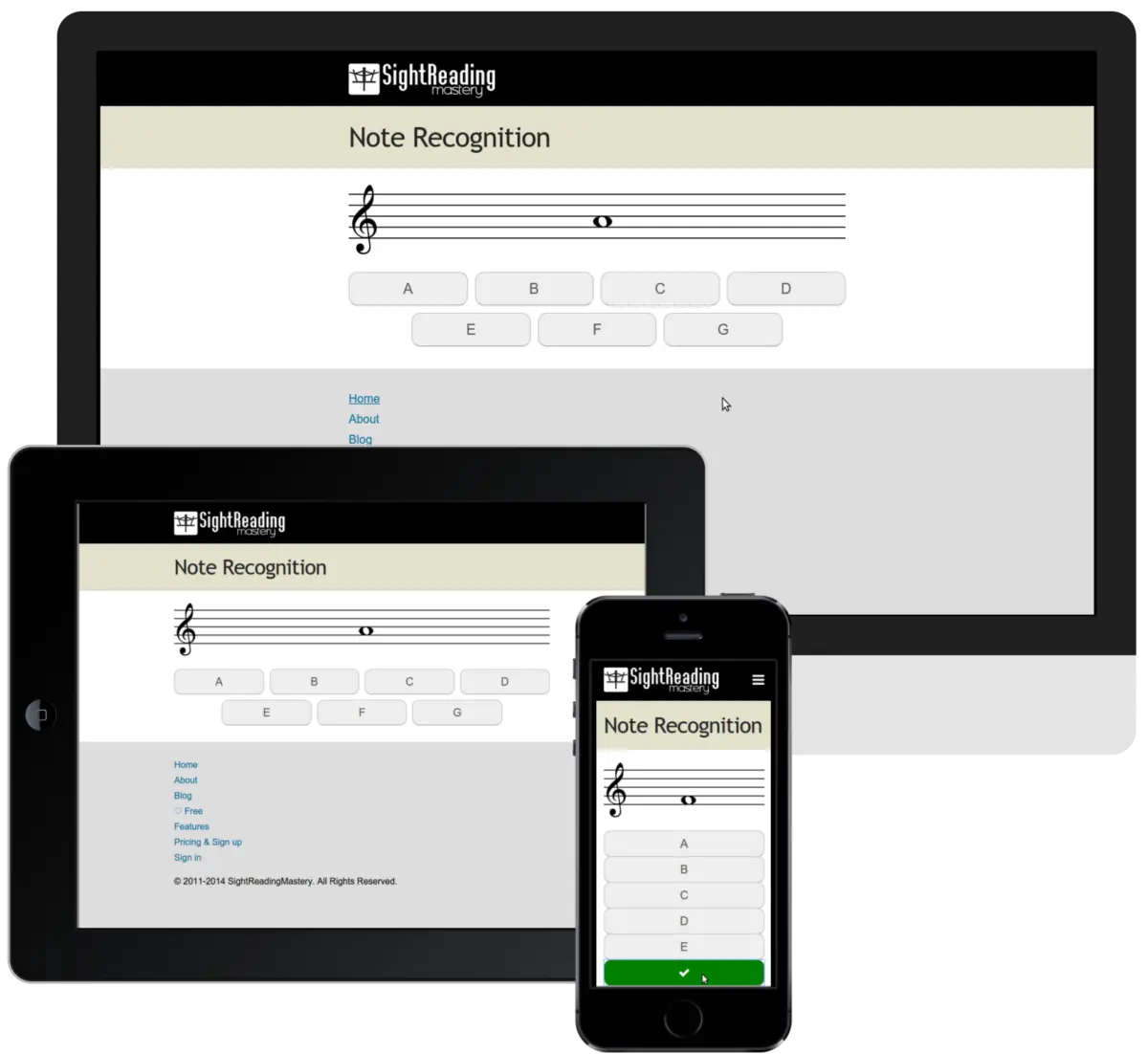
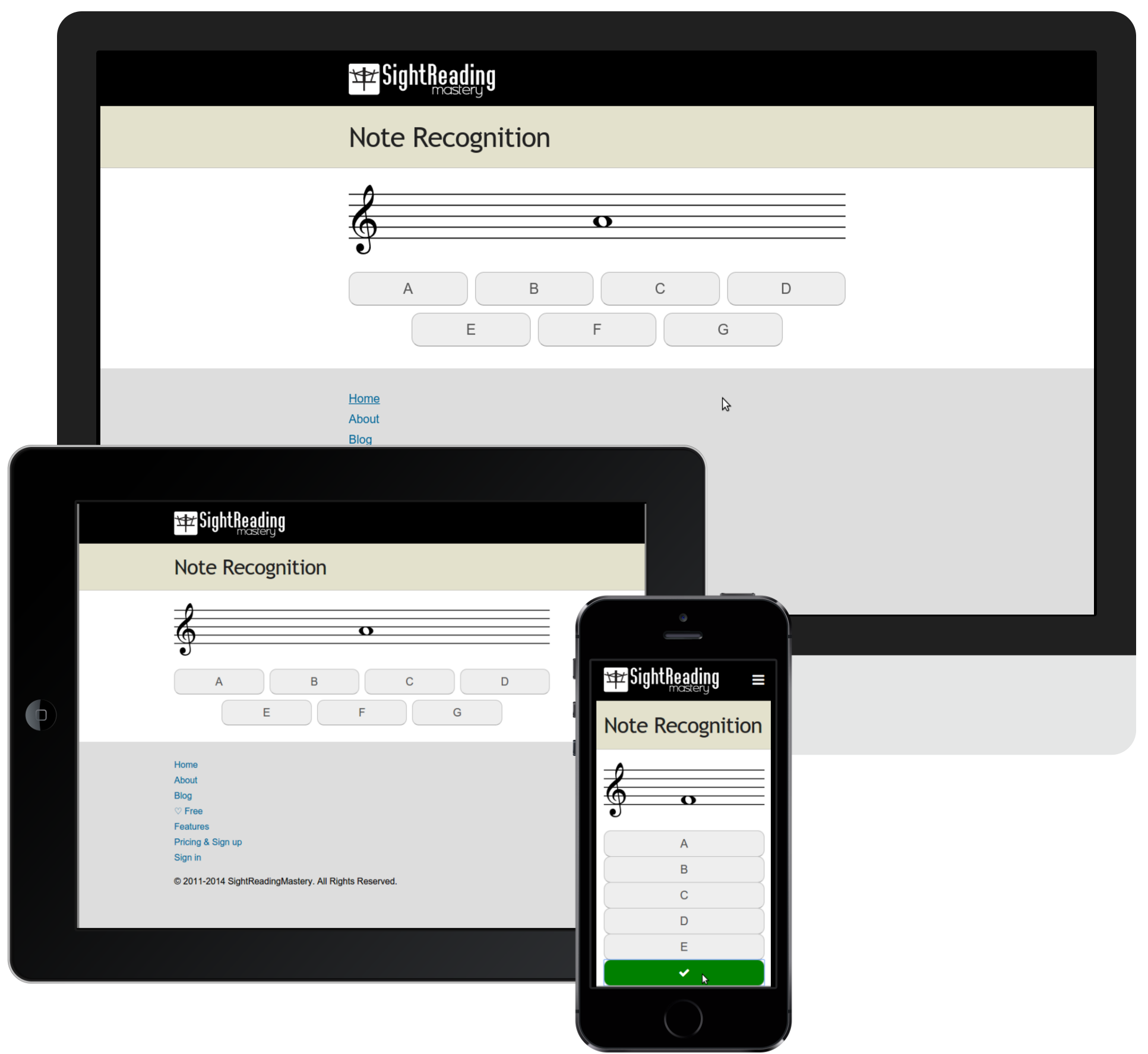
Recognizing that modern learners require ubiquitous access, the development team prioritized cross-device compatibility. Rather than forcing users into restrictive native app stores, the application was engineered using responsive web design principles. This ensured seamless rendering and touch-target optimization across desktop computers, tablets, and mobile smartphones. Musicians could now turn idle moments—such as commuting on public transit or waiting for a rehearsal to begin—into productive micro-training sessions for their sight-reading reflex.
Phase 3: The Major Overhaul and Feature Parity (September 2018)
The limitations noted at launch were systematically dismantled during a significant update cycle in late 2018. Following rigorous testing and community feedback, editorial updates on September 14 and September 23, 2018, marked a watershed moment for the software.
The development team successfully deployed two monumental features:
- Bass Clef Integration: Opening the platform to instruments outside the high register, making the tool fully viable for pianists and left-hand specialists.
- Ledger Line Support: Extending the training grid far beyond the standard five-line staff, thereby accommodating the demands of advanced sight-readers encountering extreme high and low pitches.
These updates transformed the application from a pedagogical novelty into an all-inclusive, scalable training environment suitable for musicians at every stage of their artistic journey.
Supporting Context & Metrics: The Cognitive Science of Sight-Reading
To fully appreciate the utility of the SightReadingMastery tool, one must examine the cognitive architecture of music reading. Sight-reading is not merely a visual-to-motor translation; it is a complex exercise in cognitive chunking, pattern recognition, and working memory management.
The Mechanics of Note Recognition
When a proficient reader scans a musical score, they do not process individual notes in isolation. Instead, they recognize familiar intervals, chord shapes, and scale fragments instantaneously—a process analogous to how literate adults read words by recognizing letter clusters rather than spelling out each phoneme. However, this advanced "chunking" relies entirely on the automated, subconscious mastery of individual note recognition.
If a student has to pause and mentally calculate every note—reciting "Every Good Boy Does Fine" or "FACE" up the staff—their cognitive working memory becomes overwhelmed. This bottleneck prevents them from processing rhythm, phrasing, dynamics, and expression. By drilling fundamental note identification for speed and accuracy, tools like the SightReadingMastery app help shift note recognition from conscious, effortful deliberation down to automated muscle memory.
Accessibility and Cross-Platform Metrics
The decision to release the tool as a free, web-based application rather than a paid, gated software package aligns with modern educational technology trends. Digital learning metrics consistently demonstrate that barriers to entry—such as paywalls, mandatory account creation, or software downloads—drastically reduce user retention and daily active usage.
By removing these obstacles, the application achieved widespread adoption among independent learners, K-12 music classrooms, and collegiate conservatory students alike. Its responsive layout ensures that visual clarity is maintained whether the user is squinting at a smartphone screen on a train or viewing the staff on a high-resolution desktop monitor during a theory lab.
Official Statements and Pedagogical Philosophy
At the heart of SightReadingMastery is its founder, Evan R. Murphy. A multi-faceted professional—active as a musician, private music teacher, and software engineer—Murphy approaches music education through both an artistic and a technical lens.
The Vision of Evan R. Murphy
Based in Seattle, Washington, where he resides with his wife Rebecca, Murphy launched SightReadingMastery in 2011 after recognizing a glaring deficiency in how students were taught to read music. While traditional instrumental lessons often focus heavily on technical mastery, repertoire building, and tone production, sight-reading is frequently relegated to an afterthought. Students are told to "practice reading more," yet they are rarely given systematic, methodical tools to build that specific muscle.
In outlining the philosophy behind the Note Recognition App, Murphy emphasized:

"Note recognition—the skill of identifying a note that appears on the staff—is fundamental to reading music. Even at advanced levels, improving the speed and accuracy of your note recognition will make you a better sight reader."
This statement underscores a core pedagogical truth: sight-reading proficiency is not an innate talent bestowed upon the musical elite, but a mechanical skill developed through deliberate, targeted practice. By breaking down the expansive art of reading a score into its most atomic component—the single note on a staff—Murphy created a digital ecosystem where focused, micro-dosed training yields macro-level performance improvements.
Future Outlook: The Evolution of Digital Music Pedagogy
As music education continues its rapid migration into the digital sphere, tools like the SightReadingMastery Note Recognition App point toward a more data-driven, accessible future. The transition from a treble-clef-only browser experiment in 2015 to a robust, multi-clef training suite with ledger lines by late 2018 demonstrates a responsiveness to user needs that legacy print media simply cannot match.
Where Do We Go From Here?
Looking forward, the integration of such foundational digital drills into broader musical curricula is accelerating. Future iterations of digital sight-reading tools are poised to incorporate advanced analytics—tracking reaction times down to the millisecond, identifying specific pitch weaknesses (such as persistent hesitation on high ledger-line notes in the bass clef), and adapting difficulty curves dynamically based on user performance.
Furthermore, as web audio APIs and pitch-detection algorithms mature, web-based applications are increasingly moving beyond simple visual-to-click interfaces. The logical evolution for platforms like SightReadingMastery involves real-time acoustic feedback—allowing musicians to practice note recognition not just by clicking a digital screen, but by playing acoustic instruments into a microphone and having the software instantly evaluate pitch accuracy and speed.
Conclusion
The SightReadingMastery Note Recognition App stands as a testament to the power of targeted software design in solving age-old pedagogical challenges. By stripping away the noise and focusing intensely on the micro-mechanics of staff reading, Evan R. Murphy has provided musicians worldwide with an invaluable resource. Whether used by a beginner struggling to differentiate lines from spaces or an advanced conservatory student pushing for lightning-fast reflex speeds across extreme ledger lines, this free online tool remains an essential companion in the pursuit of musical fluency.
Published originally on May 1, 2015; comprehensively updated and expanded following major platform enhancements on September 14, 2018, and September 23, 2018.