By Ian DeNolfo Executive Director, The Voice Foundation
Executive Overview
Voice science stands at a profound historical inflection point. Today, artificial intelligence (AI) and machine learning (ML) are fundamentally reshaping how researchers conduct laboratory studies, analyze acoustic datasets, and diagnose and manage patients in clinical settings.
This technological renaissance does not happen in a vacuum; rather, it builds upon more than five decades of interdisciplinary pioneering driven by The Voice Foundation. Founded in New York City in 1969 by Dr. Wilbur James Gould, the Foundation was established at a time when interdisciplinary care for the human voice was virtually nonexistent. Dr. Gould possessed the rare foresight to bring together physicians, scientists, speech-language pathologists, performing artists, and educators to share insights and advance the care of professional voice users.
From its first Annual Symposium—Care of the Professional Voice—in 1972, to decades of leadership under internationally renowned otolaryngologist, singer, and conductor Dr. Robert Thayer Sataloff (author of over 1,200 publications and 79 textbooks), the Foundation has continuously bridged the gap between art and science, the clinic and the stage.
Today, that bridge is being reinforced by algorithms. Through its flagship publication, the Journal of Voice—the premier peer-reviewed journal dedicated to voice science and medicine—The Voice Foundation has quietly witnessed, and actively published, the evolution of computational voice research for over thirty years. What began as experimental neural network applications in the mid-1990s has exploded into an exponential transformation, redefining how we understand vocal pathology, systemic health, and human-machine interaction.
A Detailed Chronology: Thirty Years of AI Research in Voice Science
Most observers assume that the integration of artificial intelligence into medicine is a recent phenomenon sparked by the generative AI boom of the early 2020s. Yet, the Journal of Voice has been publishing AI-driven research longer than most people realize.
The Genesis: 1994
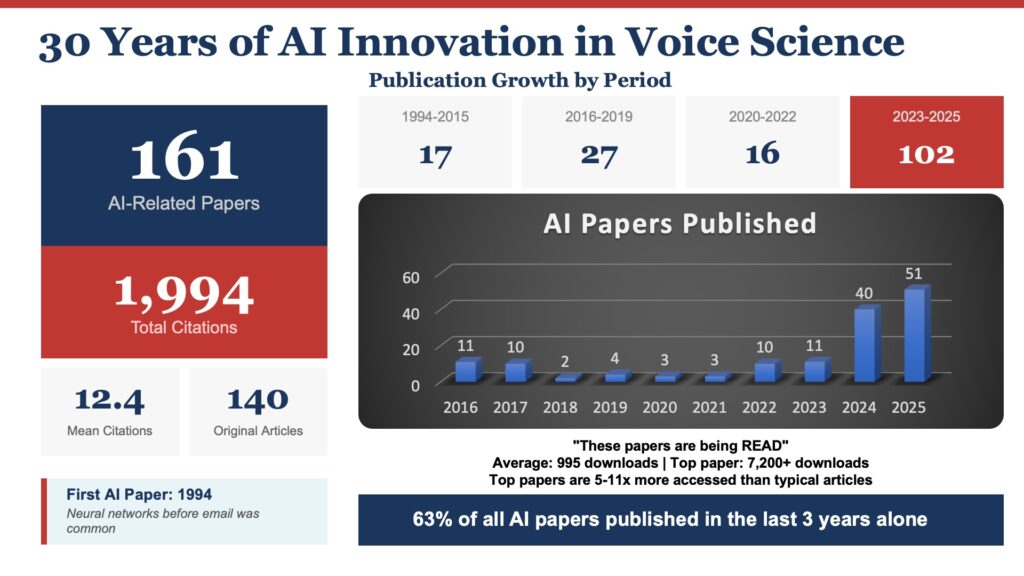
In 1994—thirty-one years ago, during the very infancy of the public World Wide Web, before the majority of academics had ever sent a professional email—the Journal of Voice published a paper by Rihkanen and colleagues titled "Spectral Pattern Recognition of Improved Voice Quality." This foundational study utilized early neural networks to analyze voice signals, proving that computational models could recognize subtle acoustic patterns long before modern computing power made deep learning ubiquitous.
For the next two decades, computational studies appeared steadily but incrementally as researchers wrestled with limited processing power and nascent analytical frameworks. The historical publication timeline of AI-related papers in the Journal of Voice illustrates a dramatic structural shift:
1994–2015 (The Foundations): 17 papers
2016–2019 (The Machine Learning Era): 27 papers
2020–2022 (The Deep Learning Acceleration): 16 papers
2023–2025 (The Exponential Surge): 102 papers
The 2025 Explosion
To contextualize the scale of recent growth, consider the output of a single year: in 2025 alone, the Journal of Voice published 51 AI-related papers. That single annual tally exceeds the total number of artificial intelligence papers published during the entire first twenty years of the journal’s computational history combined. This is no longer gradual academic progress; it is an exponential transformation that is permanently altering the scientific landscape.
Supporting Context & Metrics: Beyond Citations to Real-World Impact
Academic value is traditionally measured in citation counts, but the true value of these metrics lies in their translation to clinical utility. Voice professionals across the globe are not merely citing these works—they are actively reading, downloading, and applying them in their daily clinical practices.
Usage and Engagement Metrics
High Download Rates: The average AI-related paper published in the Journal of Voice has been downloaded nearly 1,000 times, significantly outpacing standard baseline engagement for specialized medical literature.
The Pandemic Sentinel: The journal’s most-accessed AI paper—a landmark study exploring machine learning for the detection of COVID-19 through vocal biomarkers—has amassed over 7,200 downloads, elevating its reach to eleven times the median for articles in its respective issue.
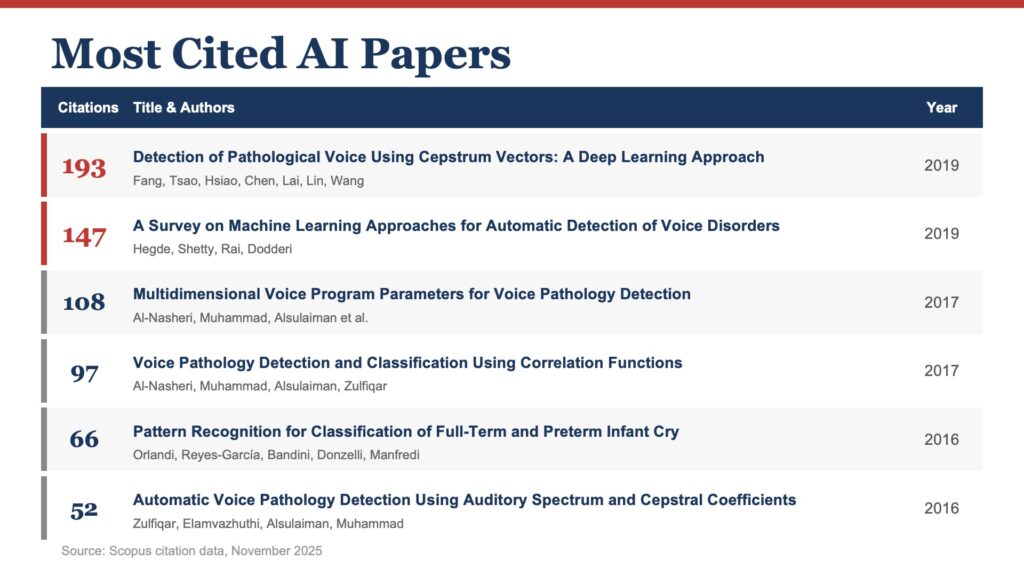
Seminal Citations: The two most-cited papers in this domain—Fang and colleagues’ deep learning study (193 citations) and Hegde’s machine learning survey (147 citations)—have each been downloaded nearly 5,000 times. These metrics prove that global clinicians, researchers, and speech-language pathologists are hungering for practical, computationally driven tools to advance patient care.
Landmark Research Reshaping the Field
1. Deep Learning for Voice Pathology Detection
Published in 2019, Fang and colleagues’ study, "Detection of Pathological Voice Using Cepstrum Vectors: A Deep Learning Approach," remains the most-cited AI paper in the journal’s history with 193 citations. This work empirically demonstrated that deep neural networks can detect laryngeal pathologies with staggering accuracy by analyzing acoustic features far too nuanced for the human ear to consciously perceive.
This was complemented by Hegde and colleagues’ comprehensive "Survey on Machine Learning Approaches for Automatic Detection of Voice Disorders" (147 citations), which successfully mapped the macro-landscape of machine learning in voice science. In 2017, Al-Nasheri and colleagues similarly laid vital groundwork with highly cited papers on Multidimensional Voice Program parameters (108 citations) and correlation functions (97 citations).
Over subsequent years, the architecture of these studies evolved rapidly. Chen and Chen (2022) advanced deep neural networks for voice classification; Fujimura pioneered the application of one-dimensional convolutional neural networks; and Cho and Choi pushed multi-modal boundaries by comparing CNN models for the automated evaluation of laryngoscopic images.
2. The Voice as a Digital Biomarker
Perhaps the most conceptually transformative breakthrough of the past decade is the recognition of the voice as a digital biomarker—a non-invasive, continuous window into systemic human health.
Groundbreaking studies published in the journal have detailed how automated voice analysis can track and predict the severity of neurological conditions such as Parkinson’s disease. For instance, Hemmerling and Wójcik-Pędziwiatr’s 2022 paper on predicting Parkinson’s severity from vocal signals secured 29 citations in a mere three years, accelerating the push toward point-of-care clinical applications.
Furthermore, recent systematic reviews have explored voice quality as an indicator for psychiatric conditions, including major depressive disorder and bipolar disorder. The systemic implications are profound: routine vocal screenings during standard telehealth check-ins could flag mental health shifts well before outward clinical symptoms peak, drastically reducing the burden on overstretched healthcare infrastructures.
3. AI Chatbots and Conversational Agents in Clinical Decision-Making
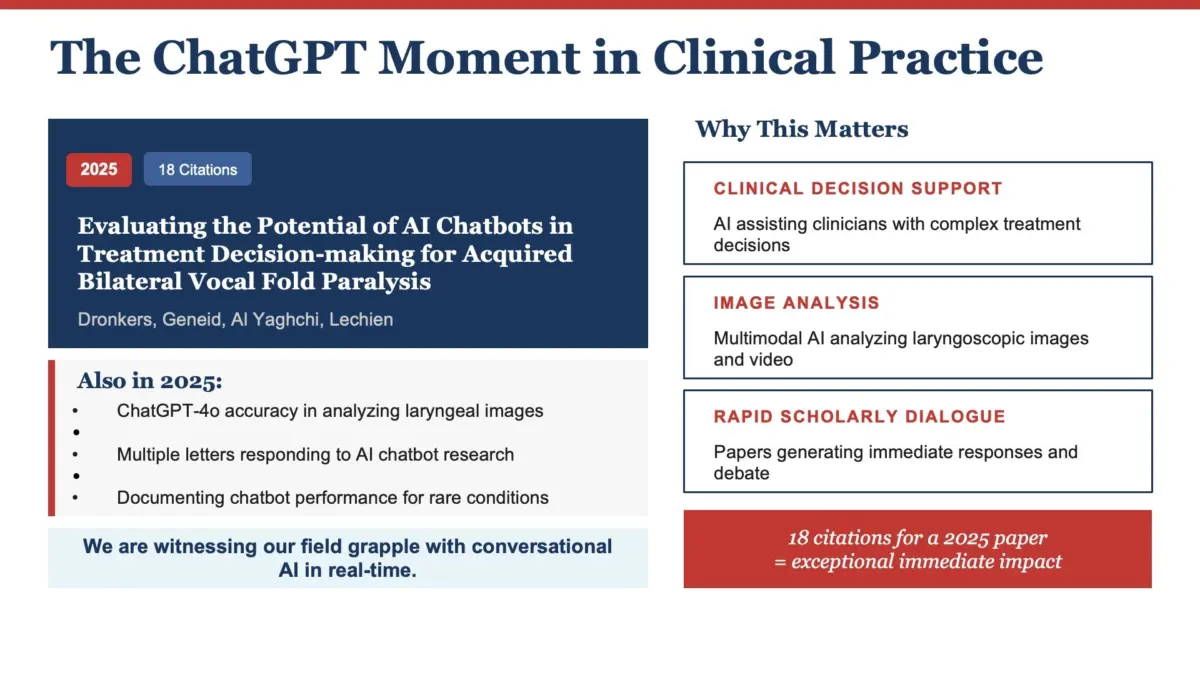
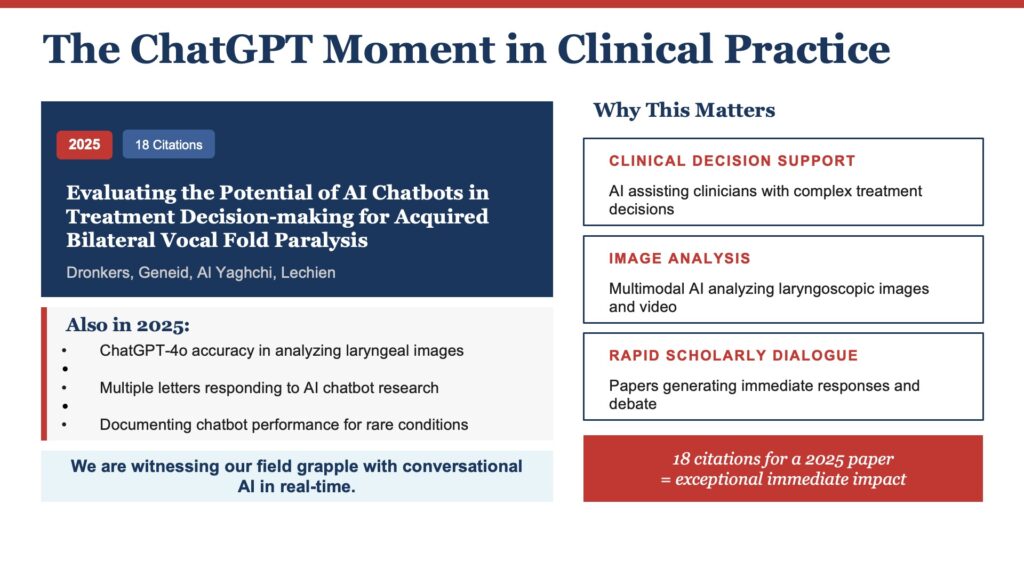
Reflecting the cutting edge of 2025 research, the journal has expanded its scope to examine the role of large language models and AI chatbots in clinical decision-making. A notable paper by Dronkers and colleagues, "Evaluating the Potential of AI Chatbots in Treatment Decision-making for Acquired Bilateral Vocal Fold Paralysis," captured immediate scholarly attention by accumulating 18 citations within months of publication.
This work sparked robust academic discourse, including multiple letters to the editor and investigative follow-ups evaluating ChatGPT-4o’s precision in assessing complex laryngeal images. The field is actively grappling in real time with the ethical, legal, and operational boundaries of conversational AI in medical practice.
Official Statements & Expert Perspectives
To navigate this seismic shift responsibly, leadership within The Voice Foundation and the broader scientific community have articulated clear frameworks for integrating these technologies without sacrificing human expertise.
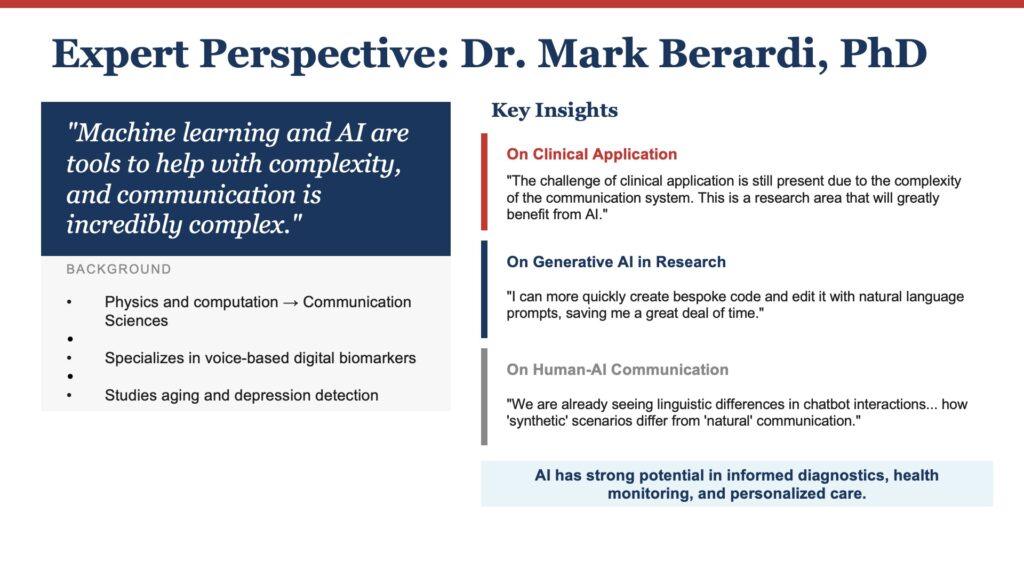
Dr. Mark Berardi: AI as a Tool for Complexity
Drawing from a background in physics and computational science, Dr. Mark Berardi views artificial intelligence not as a replacement for clinical intuition, but as an essential tool for managing multi-variable complexity.
"Machine learning and AI are tools to help with complexity, and communication is incredibly complex in its neurobiological and physiological processes. So I think the application is warranted," Dr. Berardi notes.
His current research targets voice-based digital biomarkers for aging and depression. While acquiring voice signals has become technologically frictionless, the primary hurdle remains the intricate nature of the human communication apparatus itself. However, this is precisely where machine learning excels.
On generative AI, Dr. Berardi offers a pragmatic, measured perspective. While it has not yet single-handedly rewritten foundational theory, it has shattered operational bottlenecks:
"I can now quickly create bespoke code and edit it with natural language prompts, dramatically streamlining our data processing pipelines."
Intriguingly, Dr. Berardi’s lab is also investigating human-AI communication dynamics—examining how humans subconsciously alter their linguistic patterns when speaking to chatbots versus people, and how "synthetic" environments like Zoom calls alter vocal biomarkers compared to face-to-face interaction. The science of voice, it seems, must now expand to decode human speech in conversation with machines.
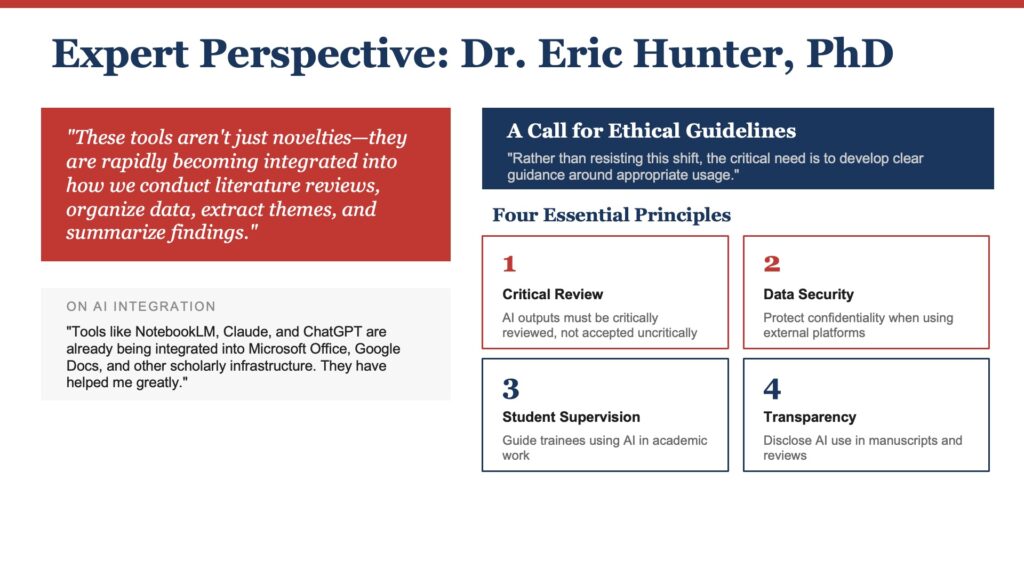
Dr. Eric Hunter: Embracing Change with Ethical Clarity
Dr. Eric Hunter focuses heavily on the institutional and academic realities of the AI revolution.
"These tools aren’t just novelties," Dr. Hunter observes. "They are rapidly becoming integrated into how we conduct literature reviews, organize data, extract themes from large bodies of text, and even summarize findings."
Large language models and AI-driven platforms are permanently embedding themselves into standard academic and publishing infrastructures—from manuscript preparation and automated peer-review assistance to advanced data parsing. Rather than fighting this tide, Dr. Hunter issues a vital call to action: the academic community must establish clear, standardized guidance on appropriate usage for both authors and reviewers.
Dr. Hunter outlines four foundational principles for scholarly AI integration:
Transparency: Full disclosure of AI assistance in literature synthesis, coding, or data processing.
Accountability: Absolute human ownership of final research conclusions, interpretations, and clinical assertions.
Data Integrity: Rigorous vetting of algorithmic training data to prevent systemic bias in voice pathology models.
Ethical Frameworks: Collaborative institutional guidelines that protect patient privacy and intellectual property.
"Our field will benefit most," Dr. Hunter concludes, "if we embrace the productivity these tools offer while also building a shared ethical framework for their responsible use."
A Global Research Community
The rapid acceleration of computational voice science is powered by a diverse, interconnected global ecosystem. The Journal of Voice serves as the central nexus for researchers spanning every inhabited continent.
Key contributors leading this charge include prolific authors such as Jérôme René Lechien (6 papers), Dimitar Deliyski (5 papers), Stephanie Zacharias (5 papers), and Ahmed Yousef (4 papers as first author), alongside luminaries like Paavo Alku, Leonardo Wanderley Lopes, and Maryam Naghibolhosseini (4 papers each). Their collective work, supported by scores of international laboratories, proves that the digital transformation of voice science is a shared global mission.
Future Outlook: The Path Forward for Voice Science
As The Voice Foundation looks toward the next fifty years, the Journal of Voice remains committed to serving as the primary platform for rigorous, boundary-pushing research. Yet, realizing the full potential of artificial intelligence requires coordinated action across three key pillars:
Mindful Engagement: Researchers and clinicians must master AI tools to manage systemic complexity, understanding both their immense computational power and their inherent limitations to amplify, rather than replace, human clinical judgment.
Collective Ethics: The establishment of universal ethical guidelines—answering Dr. Hunter’s call for shared governance—cannot be achieved by isolated institutions; it demands a unified global commitment.
Continuous Knowledge Sharing: The 161 AI-focused papers published in the journal to date represent merely the opening chapter. Every clinician, speech-language pathologist, and engineer possesses unique insights capable of driving the field forward.
An Extraordinary Moment
For hundreds of thousands of years, the human voice has served as our ultimate instrument of connection, emotional expression, and identity. It carries the distinct signatures of our thoughts, our health, and our very essence in ways that no other biological signal can match.
Now, for the first time in human history, we possess analytical tools sophisticated enough to truly decode that complexity—to uncover what the voice whispers about our neurological, physical, and psychological wellbeing long before symptoms manifest outwardly. We stand at the threshold of tools that can extend the reach of expert clinicians, democratize access to voice care in underserved regions, and save lives through early, non-invasive screening.
This is an extraordinary moment. The Journal of Voice and The Voice Foundation stand proudly at the center of this revolution. The next decade promises discoveries beyond our current imagination, and we look forward to charting that uncharted frontier together.
About the Author
Ian DeNolfo is Executive Director of The Voice Foundation, which publishes the Journal of Voice. A graduate of The Juilliard School and The Curtis Institute of Music, he formerly performed as a leading tenor at major opera houses worldwide before transitioning his career to arts administration and scientific leadership at The Voice Foundation.