
Executive Overview
In the modern landscape of houses of worship, the primary mission is rooted in radical hospitality, spiritual connection, and community inclusion. Yet, an invisible barrier frequently prevents a significant portion of the congregant population from fully participating in services: hearing loss. Across the globe, millions of individuals struggle to comprehend spoken sermons, prayers, and musical performances in large, reverberant sanctuary spaces. Traditional acoustic amplification—while beneficial for general sound reinforcement—often falls short for those dealing with auditory impairments, background noise, and architectural echo.
To bridge this profound communication gap, religious organizations are increasingly turning to advanced Assistive Listening Systems (ALS). However, the successful integration of these technologies requires far more than a simple hardware purchase; it demands a strategic, compassionate, and well-executed roadmap.
This comprehensive report explores the essential framework required for houses of worship to successfully deploy an Assistive Listening System. Drawing from industry best practices, expert consultations, and deployment strategies outlined by auditory technology leaders such as Listen Technologies and CCI Solutions, this article provides a rigorous, step-by-step analysis. Designed for clergy members, audio-visual (AV) directors, facility managers, and church board members, this guide details how to assess congregational needs, evaluate technical and financial options, train operational personnel, and foster widespread community awareness. Ultimately, implementing an ALS is not merely an operational upgrade; it is a profound declaration that every voice matters and every soul deserves to hear the message clearly.
Detailed Chronology: The Four-Step Implementation Framework
Successfully introducing an Assistive Listening System into a worship facility requires a methodical approach. Industry experts have established a proven four-phase chronological blueprint to guide leadership teams from initial conception to full operational integration.
Phase 1: Understanding and Quantifying Congregational Needs
The foundational error many facility committees make is purchasing audio hardware based solely on square footage or generalized industry standards, entirely bypassing the specific demographic profile of their congregation.
- Conducting a Comprehensive Needs Assessment: The implementation process must begin with listening to the congregation itself. Leadership should design and distribute a targeted survey addressing auditory experiences during services.
- Key Survey Metrics: Crucial questions must ascertain whether regular attendees experience difficulty hearing during sermons, whether they currently utilize hearing aids, and—critically—whether those hearing aids are equipped with telecoils (t-coils).
- Analyzing the Data: By aggregating this data, the AV team and leadership can determine the scale of the required deployment. For instance, a congregation with a high percentage of t-coil users will heavily benefit from loop systems, whereas facilities with diverse or transient visitor populations may lean toward FM or Wi-Fi-based receiver models.
Phase 2: Evaluating Technical and Financial Options
Once the specific demographic and acoustic needs are mapped, the focus shifts to hardware selection, budgetary alignment, and financial planning.
- Cost Estimation and Budgeting: Audio solutions vary widely in price depending on the technology chosen (e.g., Radio Frequency, Infrared, Induction Loops, or Wi-Fi streaming). Leadership must estimate the total cost of transmitters, receivers, neck loops, and charging stations.
- Leveraging Expert Consultations: Organizations do not need to navigate this complex technological landscape alone. Specialized AV integrators, such as CCI Solutions, offer dedicated assistance and free initial consultations to help facility boards accurately forecast expenses and integrate these costs into broader capital budgeting plans.
- Creative Fundraising and Grant Allocation: To offset the financial investment, houses of worship frequently utilize targeted fundraising campaigns, memorial gift funds, or specialized grants aimed at accessibility and ADA (Americans with Disabilities Act) compliance. Framing the expense as a ministry of inclusion rather than a technical overhead cost routinely inspires generous donor participation.
Phase 3: Operational Preparation and Staff Training
The most advanced assistive listening hardware will inevitably fail if the human element of the operation is neglected. Volunteers and staff members serve as the vital bridge between the technology and the end-user.
- Deploying "Listening Ambassadors": Staff and greeting volunteers should be reframed as Assistive Listening Ambassadors. Their demeanor, knowledge, and willingness to assist can transform an intimidating technical interaction into a warm, welcoming experience.
- Rigorous Operational Training: Every volunteer stationed at the welcome desk or AV booth must receive thorough, hands-on training on how to operate, sanitize, and distribute the listening devices. They must be capable of troubleshooting basic user errors on the spot.
- Providing Immediate Reference Materials: To ensure operational consistency, facilities should maintain a laminated quick-reference guide containing answers to Frequently Asked Questions (FAQs) directly at the distribution counter. This ensures that even rotating volunteers can confidently assist congregants without halting the flow of pre-service traffic.
Phase 4: Creating Awareness and Fostering Community Engagement
Purchasing and installing an ALS is only half the battle; ensuring that congregants and the surrounding community know the technology exists is the ultimate benchmark of success.
- Strategic Signage Placement: Clear, universally recognized accessibility signage must be prominently displayed throughout the facility, directing visitors to the exact location where Assisted Listening Devices (ALDs) are stored and distributed.
- Multi-Channel Communications: Reminders should be systematically embedded into weekly printed bulletins, digital slide presentations, and website announcements.
- Live Demonstration Events: To demystify the technology, churches can host a dedicated live training session or Sunday school workshop. This allows curious congregants to test receivers, pair hearing aids, and familiarize themselves with the equipment in a low-pressure environment.
- Community Outreach: Word travels fast when a religious organization demonstrates genuine care for marginalized demographics. Advertising accessibility upgrades to the wider geographic community can draw in individuals who previously abandoned church attendance due to untreated hearing isolation.
Supporting Context & Metrics: The Hidden Epidemic of Hearing Isolation
To fully grasp the urgency of deploying Assistive Listening Systems, one must examine the staggering statistical reality of hearing loss within modern society, particularly among aging populations who form the bedrock of many traditional congregations.
The Scale of Auditory Impairment
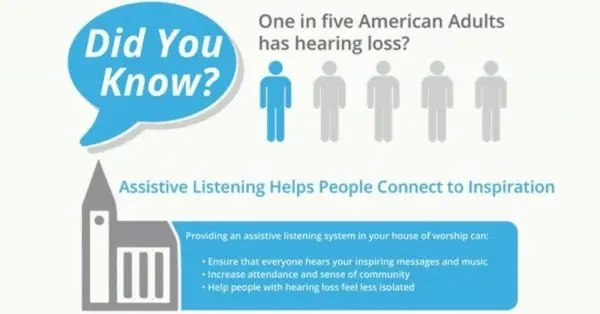
According to epidemiological data from organizations such as the World Health Organization (WHO) and the Hearing Loss Association of America (HLAA), over 48 million Americans experience some degree of hearing loss. As global populations age, this number continues to climb. Within the context of a typical house of worship, the demographic skews older, meaning the concentration of hearing-impaired individuals is frequently higher than the national average.
| Demographic / Metric | Estimated Percentage / Impact on Worship |
|---|---|
| Seniors (Ages 65+) | Approximately 1 in 3 individuals experience disabling hearing loss. |
| Acoustic Environment | Large sanctuaries often feature reverberation times exceeding 2.0 seconds, severely degrading speech intelligibility. |
| Hearing Aid Adoption | While millions own hearing aids, standard acoustic environments in churches still cause words to blur into unintelligible noise without direct audio feeds. |
| Social Isolation Impact | Untreated hearing loss is directly linked to depression, anxiety, and a withdrawal from communal and religious life. |
The Architectural Challenge of Sacred Spaces
Sanctuaries are historically designed for acoustic grandeur—maximizing pipe organ resonance, choir harmonization, and the echoing cadence of spoken oratory. Unfortunately, architectural beauty is frequently the enemy of acoustic clarity. Reverberation causes sound waves to bounce off hard surfaces (stone, glass, hardwood), blurring syllables together. For a person with normal hearing, the brain can often filter this ambient chaos; for an individual with sensorineural hearing loss, it creates an impenetrable wall of noise.
Assistive Listening Systems bypass architectural acoustics entirely by transmitting the pristine, uncompressed audio feed directly from the soundboard into the user’s ear canal or hearing aid. By neutralizing room reverberation, the ALS restores the emotional nuance, whispered cadence, and dynamic inflection of the spoken and sung word.

Official Statements and Industry Insights
Industry leaders and accessibility advocates have long championed the integration of assistive technologies as an ethical and spiritual imperative.
Perspectives on Inclusive Ministry:
Auditory accessibility experts emphasize that true community outreach begins at the sanctuary door. In documentation accompanying comprehensive accessibility frameworks—such as the Listen Technologies Church Assistive Listening Toolkit—industry specialists stress that inclusion is not a passive sentiment.
"Reaching out to those who feel disconnected from your community due to hearing loss is central to sharing the message of inclusion. Genuinely compassionate service involves being aware of and caring for the needs of everyone, especially those dealing with impairments. Make sure they are able to hear the beauty and emotion of the spoken word in your church by providing them with the equipment they need to stay connected."
The Business and Ministry Case from AV Integrators:
Specialized design-build firms like CCI Solutions frequently reiterate that audio technology should serve human connection rather than merely technical specs. When advising church leadership boards, integration consultants note that accessibility solutions often yield exponential returns in community loyalty. Congregants who feel seen, accommodated, and catered to in their moments of physical vulnerability develop profound, lasting loyalty to their faith communities. Furthermore, proactively installing compliant listening systems safeguards religious organizations against accessibility liabilities, ensuring that public accommodations laws are seamlessly honored.
Future Outlook: The Next Generation of Sanctuary Accessibility
As audio engineering and digital connectivity evolve at a rapid pace, the future of Assistive Listening Systems in houses of worship promises even greater personalization, seamless integration, and user-friendly operation.
1. The Rise of Personal Bring-Your-Own-Device (BYOD) Streaming
Historically, assistive listening relied exclusively on dedicated, church-owned FM or infrared receivers handed out at the door. While these remain vital for accessibility compliance, the future increasingly points toward Wi-Fi-based streaming solutions. These systems allow congregants to download an app on their personal smartphones, plug in their own headphones or earbuds, and stream the sanctuary audio feed with zero latency. This eliminates the stigma sometimes associated with asking for specialized assistive hardware and leverages devices users already own and understand.
2. Integration with Advanced Hearing Aids and Bluetooth LE Audio
The mainstream adoption of Bluetooth Low Energy (LE) Audio and Auracast broadcast technology is set to revolutionize church acoustics entirely. In the near future, individuals wearing next-generation hearing aids or wireless earbuds will be able to tune directly into a sanctuary’s uncompressed audio broadcast with a single tap on their smartphone, requiring zero intermediary hardware from the church. Houses of worship that invest in adaptable, future-proof ALS infrastructure today will be exceptionally well-positioned to integrate these emerging broadcast standards tomorrow.
3. Cultural Shift Toward Universal Design
Ultimately, the future of worship facility design is moving away from retrofitted accommodations and toward "Universal Design"—the philosophy of designing buildings, digital spaces, and audio environments that are inherently accessible to all people, regardless of age, size, or ability. By treating assistive listening not as an afterthought for a marginalized minority, but as an essential component of a first-class audio ecosystem, houses of worship will continue to foster environments where every individual can fully engage, worship, and belong.
Conclusion and Actionable Next Steps
The integration of an Assistive Listening System is a transformative milestone for any house of worship. By systematically assessing congregational needs, navigating financial options with expert partners like CCI Solutions, training dedicated staff to act as welcoming ambassadors, and promoting the technology widely, religious leaders can dismantle the invisible barriers of hearing loss.
For facility directors, clergy, and AV technicians seeking to deepen their implementation strategy, comprehensive resources are readily available. Leaders are strongly encouraged to download specialized industry guides, such as the Listen Technologies Church Assistive Listening Toolkit, which provides invaluable templates, sample surveys, signage designs, and promotional announcements.
Is your worship facility prepared to take the next step toward total auditory inclusion? Reach out to our team of AV specialists today to discuss how an advanced Assistive Listening System can transform your community.