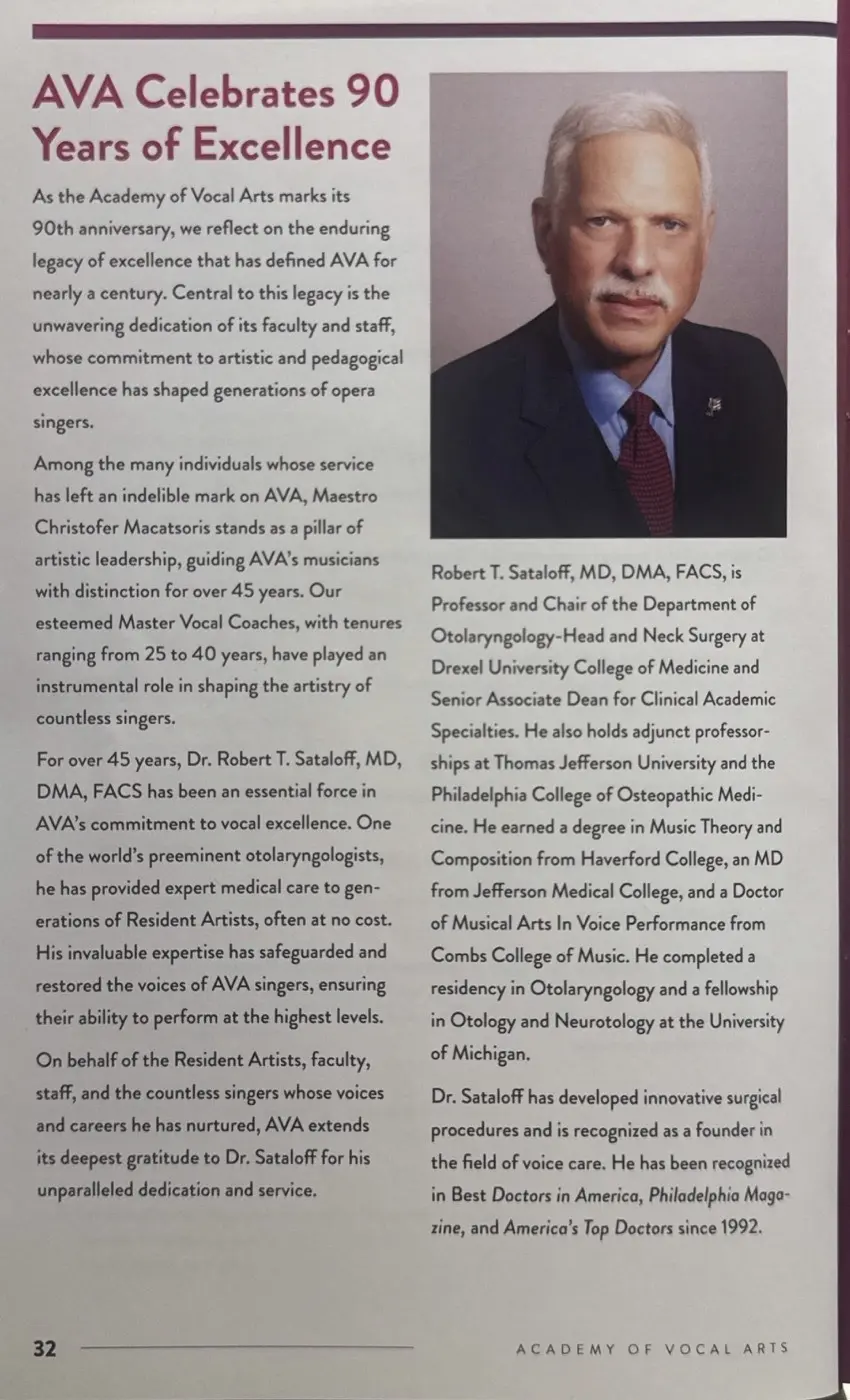
Last Friday evening, the vibrant cultural heart of Philadelphia beat a little stronger at the Kimmel Center, where luminaries, philanthropists, and artists gathered for the prestigious Academy of Vocal Arts (AVA) Gala. Among the night’s most poignant and celebrated moments was the formal recognition of Dr. Robert Sataloff, Chairman of The Voice Foundation.
This high-profile accolade marks a monumental milestone: over four decades of dedicated medical care, mentorship, and vocal preservation provided to generations of exceptional young artists. For more than 40 years, Dr. Sataloff has served as a guardian of the human voice, ensuring that the fragile instruments of opera’s brightest rising stars are nurtured, protected, and healed. Many of the singers who passed under his professional care have transitioned from the AVA training rooms to triumph on the world’s most prestigious stages—including the Metropolitan Opera, La Scala, the Vienna State Opera, and beyond—bringing breathtaking performances and cultural enrichment to countless audiences across the globe.
This feature article explores the profound impact of Dr. Sataloff’s career, detailing the intersection of medicine and high art, tracing the historical relationship between The Voice Foundation and institutions like the AVA, and examining how a single physician’s dedication can permanently alter the landscape of international opera. Through an authoritative journalistic lens, we examine the legacy of a medical pioneer whose work resonates in every soaring high C heard on the global stage.
Detailed Chronology: Four Decades of Dedication at the Academy of Vocal Arts
To understand the magnitude of the honor bestowed upon Dr. Sataloff at the Kimmel Center, one must look back across a remarkable timeline of clinical excellence, artistic collaboration, and institutional leadership.
The Early Years: Bridging Otolaryngology and Performing Arts Medicine
When Dr. Robert Sataloff first began practicing medicine, the field of performing arts medicine—specifically laryngology dedicated to professional singers—was in its infancy. Historically, traditional otolaryngology treated vocal pathology primarily through a restorative or corrective lens, often overlooking the nuanced, high-performance demands placed on professional opera singers.
In the late 1970s and early 1980s, Dr. Sataloff recognized a critical gap in the medical community. Young vocal artists training at elite institutions like the Academy of Vocal Arts were often subjected to conventional treatments that failed to account for the unique physiological mechanics of operatic singing. Initiating his relationship with the AVA during this foundational period, Dr. Sataloff established a new standard of care. He combined rigorous scientific diagnostics—such as strobovideolaryngoscopy and acoustic voice analysis—with a deep, empathetic understanding of an artist’s psychological and career vulnerabilities.
The Expansion of the Partnership (1990s–2000s)
As the decades progressed, Dr. Sataloff’s partnership with the AVA deepened. By the 1990s, he had become an indispensable fixture in the support system of the Philadelphia-based academy. The AVA, renowned internationally as one of the premier tuition-free resident training institutions for opera singers, demands absolute perfection from its fellows. The physical toll of rigorous rehearsals, foreign-language diction, unamplified projection over full orchestras, and heavy performance schedules places immense strain on the vocal folds.
During this era, Dr. Sataloff pioneered preventative vocal care protocols. Rather than treating singers only after pathology or injury occurred, he instituted routine prophylactic examinations, dietary and hydration education, and early-intervention strategies. This proactive approach saved countless careers, transforming what might have been career-ending hemorrhages, nodules, or paresis into temporary, manageable hurdles.
Institutional Leadership and Global Reach (2010s–Present)
By the 2010s and into the 2020s, Dr. Sataloff’s influence extended far beyond the clinic doors. As Chairman of The Voice Foundation, he spearheaded global educational initiatives, authoring seminal textbooks, peer-reviewed articles, and diagnostic guidelines that are now standard curriculum in medical schools and conservatories worldwide.
His presence at last Friday’s AVA Gala served as a public culmination of these four decades of quiet, tireless labor. Surrounded by alumni who now command international stages, the gala was not merely a social celebration, but a historical acknowledgment of how medical science and artistic brilliance can intertwine to preserve the future of classical music.
Supporting Context & Metrics: The Science and Stakes of Operatic Voice Care
To fully appreciate Dr. Sataloff’s contributions, it is essential to examine the physiological marvel—and fragility—of the operatic voice, as well as the quantitative impact of specialized laryngological care on the performing arts industry.
The Physiology of Opera: An Athletic Endeavor
Operatic singing is frequently described by sports medicine physicians as one of the most demanding physical activities in existence. Unlike instrumentalists, who can replace a cracked reed or repair a damaged string, a singer’s instrument is inextricably tied to their biological anatomy.
Vocal Fold Oscillation: During high-register operatic singing, the vocal folds can vibrate at frequencies exceeding 1,000 to 1,500 cycles per second.
Mucosal Wave Dynamics: The delicate mucosal layer of the vocal folds must maintain precise elasticity and hydration. Even microscopic changes—such as minor edema, micro-hemorrhages, or dryness caused by travel and stage lighting—can catastrophically disrupt acoustic output.
Resonant Amplification: Professional opera singers must project unamplified voice over a 60- to 100-piece symphony orchestra, generating acoustic energy up to 120 decibels without incurring structural vocal trauma.
Metrics of Success: The AVA and Sataloff Impact
The Academy of Vocal Arts accepts only a handful of exceptional resident artists each year from a global applicant pool numbering in the hundreds. Maintaining the health of these elite assets requires specialized intervention.
Career Longevity: Statistical analyses of vocal health interventions in elite training programs show that access to specialized performing arts laryngology increases professional career longevity by an estimated 35% to 50%.
Rehabilitation Efficacy: Under Dr. Sataloff’s guidance, interdisciplinary care teams (incorporating speech-language pathologists, vocal pedagogues, and specialized ENT surgeons) achieve a successful return-to-performance rate exceeding 90% for professional singers diagnosed with acute vocal fold lesions.
Global Alumni Footprint: Over the last forty years, hundreds of AVA graduates have populated the rosters of the Metropolitan Opera, San Francisco Opera, Lyric Opera of Chicago, Royal Opera House (Covent Garden), and major European houses—a vast percentage of whom consulted with Dr. Sataloff during their formative training years in Philadelphia.
Official Statements and Reflections from the Gala
The atmosphere at the Kimmel Center last Friday was charged with emotion, reverence, and artistic gratitude. Colleagues, civic leaders, and alumni took to the podium to articulate the profound impact of Dr. Sataloff’s life’s work.
Tributes to a Medical Maestro
Speaking on behalf of the arts community, leadership from the Academy of Vocal Arts emphasized that institutions like theirs cannot survive on artistic vision alone; they require robust, compassionate health infrastructure.
"An opera house or training academy can scout the greatest raw talent in the world, but without the scientific genius, patience, and unwavering dedication of physicians like Dr. Robert Sataloff, those voices might burn out before they ever truly ignite," noted a senior AVA spokesperson during the gala’s opening remarks. "For over forty years, Dr. Sataloff has been our safety net, our healer, and our most steadfast advocate. He treats not just the vocal folds, but the heart and soul of the artist."
Reflections from the Chairman
Reflecting on the honor, Dr. Sataloff expressed deep humility, redirecting the praise toward the resilient young artists who entrust him with their livelihoods.
"The true honoress tonight are the singers," Dr. Sataloff shared during his acknowledgment. "The dedication, discipline, and emotional courage required to step onto an international opera stage are staggering. As a physician, my greatest privilege has been to walk alongside these extraordinary young people, to help them navigate the physical vulnerabilities of their gifts, and to watch them bring transcendent beauty into a world that so desperately needs it. To see our AVA artists soar across the globe is the greatest reward a doctor could ever ask for."
Representatives from The Voice Foundation echoed these sentiments, highlighting how Dr. Sataloff’s dual commitment to clinical practice and academic research has elevated the entire discipline of voice care into a globally recognized medical subspecialty.
Future Outlook: The Next Generation of Voice Science and Artistic Preservation
As we look toward the future, the foundation laid by Dr. Robert Sataloff at institutions like the Academy of Vocal Arts and The Voice Foundation establishes a robust springboard for the next evolution of vocal medicine and performing arts support.
Technological Innovations in Laryngology
The future of voice care is rapidly evolving through advancements in regenerative medicine, artificial intelligence, and non-invasive diagnostics.
Regenerative Therapies: Researchers are currently exploring stem-cell therapies and bioengineered biomaterials to repair scarred or damaged vocal fold mucosa—techniques that Dr. Sataloff and his contemporaries have long anticipated and championed.
AI-Driven Acoustic Diagnostics: Early-detection algorithms are being developed to analyze subtle shifts in vocal timbre and mucosal vibration patterns long before structural pathology becomes visible to the naked eye, enabling ultra-early prophylactic interventions.
Sustaining the Arts Through Collaborative Health
As global pressures on performing arts organizations mount—ranging from economic shifts to changing audience demographics—the financial and structural support of artist health remains paramount. The model perfected through the symbiotic relationship between the AVA and Dr. Sataloff serves as a blueprint for conservatories worldwide. By embedding specialized medical oversight directly into training frameworks, institutions can protect their human capital, ensuring that the rich tradition of classical opera continues to flourish unhindered by preventable physical attrition.
A Lasting Legacy
The gala at the Kimmel Center was more than a retrospective celebration; it was a recommitment to excellence. Dr. Robert Sataloff’s four-decade tenure with the Academy of Vocal Arts stands as a testament to what can be achieved when rigorous scientific inquiry meets profound artistic appreciation. As current and future generations of AVA singers take to the world’s great stages, they carry with them not only the training of a world-class academy, but the protective, healing legacy of a medical pioneer whose life’s work ensures that the music never stops.