
The Teatro Sociale di Rovigo has officially unveiled its eagerly anticipated 2026–27 operatic season, a meticulously curated program that bridges the rich traditions of nineteenth-century masterworks with the witty, incisive brilliance of comic intermezzi, twentieth-century psychological drama, and sparkling operetta. Situated in the heart of the Veneto region, the historic Italian theater continues to solidify its reputation as a vibrant epicentre for world-class lyric theater, drawing international talent, visionary stage directors, and discerning audiences to its neoclassical halls.
The upcoming season is distinguished by an ambitious thematic arc, offering a panoramic view of the human condition through jealousy, societal satire, domestic disconnect, sparkling deception, tragic self-sacrifice, imperial grandeur, and the transformative power of forgiveness. By pairing legendary Italian warhorses—such as Ruggero Leoncavallo’s Pagliacci, Giuseppe Verdi’s La Traviata and Aida, and Gioachino Rossini’s La Cenerentola—with rare Baroque gems like Tommaso Albinoni’s Pimpinone, twentieth-century pearls by Gian Carlo Menotti and Leonard Bernstein, and Johann Strauss II’s effervescent Die Fledermaus, the Teatro Sociale di Rovigo demonstrates an unyielding commitment to artistic diversity.
Throughout late autumn 2026 and deep into the spring of 2027, the theater’s stage will play host to an illustrious roster of celebrated vocalists, virtuosic guest conductors, and innovative stage directors. This comprehensive preview explores the chronology of the 2026–27 season, contextualizes its historical and cultural significance, examines the structural metrics of its production schedule, and outlines the enduring cultural footprint of the Teatro Sociale di Rovigo within the modern European arts landscape.
Detailed Chronology: Production-by-Production Breakdown
The 2026–27 calendar unfolds as a carefully paced journey across operatic genres, beginning in the crisp autumn of November 2026 and culminating in the vibrant spring season of April 2027.
Autumn Intensity: Verismo and Baroque Wit
Pagliacci by Ruggero Leoncavallo
- Performance Dates: November 10–15, 2026
- Cast: Fabio Sartori, Irina Lungu, Ernesto Petti, Giuseppe Infantino, Nikolai Zemlianskikh
- Creative Team: Pier Giorgio Morandi (Conductor), Gabriele Lavia (Director)
The season opens with a dramatic heavyweight: Leoncavallo’s quintessential verismo masterpiece, Pagliacci. Telling the searing tale of jealousy, theatrical illusion, and domestic tragedy within a troupe of traveling commedia dell’arte actors, the production benefits from a star-studded cast. Noted tenor Fabio Sartori leads the ensemble alongside acclaimed soprano Irina Lungu, baritone Ernesto Petti, Giuseppe Infantino, and Nikolai Zemlianskikh. In the pit, veteran maestro Pier Giorgio Morandi brings his authoritative command of the Italian romantic repertoire, while visionary director Gabriele Lavia promises a staging that peels back the layers of theatrical artifice to expose the raw, destructive emotional core beneath.
Pimpinone by Tommaso Albinoni
- Performance Dates: November 26 & 28, 2026
- Cast: Margherita Scaramuzzino
- Creative Team: Federico Guglielmo (Conductor), Maria Selene Farinelli (Director)
Shifting dramatically in scale and tone, the late-November calendar turns to the roots of Italian comic opera with Tommaso Albinoni’s Pimpinone. Best known for his instrumental writing, Albinoni’s foray into the intermezzo genre showcases a brilliant battle of wits between a wealthy, gullible benefactor and his clever, ambitious maid. Soprano Margherita Scaramuzzino takes on the demanding vocal and theatrical requirements of the work. Baroque specialist Federico Guglielmo conducts from the podium, ensuring stylistic purity and rhythmic verve, while director Maria Selene Farinelli crafts a lively, period-informed mise-en-scène that highlights the timeless battle of the sexes.
Winter Reflections: Modern Disconnect and Viennese Charm
The Telephone (Gian Carlo Menotti) & Trouble in Tahiti (Leonard Bernstein)
- Performance Dates: December 11–13, 2026
- Cast: Elisa Balbo, Stefan Astakhov, Andrea Borrelli, David Marco Minotti, Violetta Vitale
- Creative Team: Francesco Lanzillotta (Conductor), Alfredo Corno (Director)
Mid-December brings a double bill exploring the complexities of modern relationships through mid-twentieth-century American and Italian-American lenses. Menotti’s charming one-act comedy The Telephone is paired with Leonard Bernstein’s biting, jazz-infused critique of suburban American domesticity, Trouble in Tahiti. A versatile cast featuring Elisa Balbo, Stefan Astakhov, Andrea Borrelli, David Marco Minotti, and Violetta Vitale handles the intricate dialogue, sharp comedic timing, and sophisticated musical idioms. Conductor Francesco Lanzillotta anchors the orchestra through the stylistic shifts of Bernstein’s syncopated scores and Menotti’s lyricism, under the theatrical direction of Alfredo Corno.
Die Fledermaus by Johann Strauss II
- Performance Date: December 18, 2026 (Gala Holiday Presentation)
- Cast: Kang Hyunwook, Scilla Cristiano, Jacopo Grenti, Antonella Degasperi, Fabrizio Macciantelli, Marco Rovacchi, Ju Sang, Hyeonjung Kim, Claudia Bonazzi, Alessio Sallustio
- Creative Team: Alberto Orlandi (Conductor), Corrado Abbati (Director)
As the holiday season approaches, the theater offers its traditional injection of champagne and waltzes with Johann Strauss II’s operetta masterpiece, Die Fledermaus. Boasting a sprawling ensemble cast—including Kang Hyunwook, Scilla Cristiano, Jacopo Grenti, Antonella Degasperi, Fabrizio Macciantelli, Marco Rovacchi, Ju Sang, Hyeonjung Kim, Claudia Bonazzi, and Alessio Sallustio—the production promises lighthearted deceit, masquerade balls, and soaring vocal melodies. Alberto Orlandi conducts this festive performance, while operetta stalwart Corrado Abbati oversees a staging designed to delight traditionalists and newcomers alike.
The New Year Unfolding: Verdi’s Timeless Dramas
La Traviata by Giuseppe Verdi
- Performance Dates: January 21–24, 2027
- Cast: Federica Guida, Maria Laura Iacobellis, Davide Tuscano, Sanlin Wang, Svilen Denchev, Jorge Nelson Martínez Gonzales
- Creative Team: Production Ensemble
The New Year commences with January’s run of Verdi’s enduring masterpiece of Parisian sacrifice and societal hypocrisy, La Traviata. The role of the tragic courtesan Violetta Valéry is shared by two promising sopranos, Federica Guida and Maria Laura Iacobellis, supported by a cast that features Davide Tuscano, Sanlin Wang, Svilen Denchev, and Jorge Nelson Martínez Gonzales. The production highlights the psychological claustrophobia of mid-nineteenth-century bourgeois society against the transcendent, heart-wrenching beauty of Verdi’s lyrical score.
Aida by Giuseppe Verdi
- Performance Dates: February 24–28, 2027
- Cast: Marily Santoro, Vincenzo Costanzo, Martina Belli, Alexandre Duhamel, Antonio Di Matteo, Andrea Pellegrini
- Creative Team: Alessandro Cadario (Conductor), Ivan Stefanutti (Director)
Late February sees the return of grand opera in its most majestic form with Verdi’s monumental Aida. Set against the backdrop of ancient Egyptian military dominance and Ethiopian subjugation, the opera explores the agonizing intersection of patriotic duty and forbidden love. Soprano Marily Santoro tackles the grueling title role, supported by tenor Vincenzo Costanzo as Radamès and mezzo-soprano Martina Belli as Amneris. The stellar cast is rounded out by Alexandre Duhamel, Antonio Di Matteo, and Andrea Pellegrini. Conductor Alessandro Cadario commands the orchestral forces, while director and designer Ivan Stefanutti creates a visually breathtaking world of monumental architecture and intimate betrayal.
Spring Finale: Bel Canto Comedy and Redemption
La Cenerentola by Gioachino Rossini
- Performance Dates: April 21–25, 2027
- Cast: Mara Guadenzi, Chuan Wang, Marco Filippo Romano, Veronica Prando, Silvia Regazzo, Roberto De Candia, José Coca Loza
- Creative Team: Alessandro Palumbo (Conductor), Aldo Tarabella (Director)
The 2026–27 season reaches its triumphant conclusion in late April with Rossini’s sparkling bel canto masterpiece, La Cenerentola. Discarding magical slippers in favor of a virtuous heart and a dropped bracelet, Rossini’s reimagined Cinderella story relies on vocal agility, rapid-fire patter songs, and sparkling ensemble numbers. Mezzo-soprano Mara Guadenzi stars in the title role, joined by tenor Chuan Wang as Don Ramiro and a masterclass of buffo and lyric specialists including Marco Filippo Romano, Veronica Prando, Silvia Regazzo, Roberto De Candia, and José Coca Loza. Conductor Alessandro Palumbo guides the score’s champagne-like fizz, while director Aldo Tarabella delivers a whimsical, visually inventive production that closes the season on a note of pure theatrical joy.
Supporting Context & Metrics: Cultural Geography and Production Scope
To fully appreciate the scope of the Teatro Sociale di Rovigo’s 2026–27 season, one must examine the institutional framework that sustains it. Rovigo, situated in the fertile Po Valley between the Adige and Po rivers, maintains an outsized cultural footprint. While geographically compact compared to neighboring metropolitan cultural capitals like Milan, Venice, or Bologna, the city has long punched above its weight class in the preservation and promotion of the lyric arts.
Architectural Heritage and Acoustic Excellence
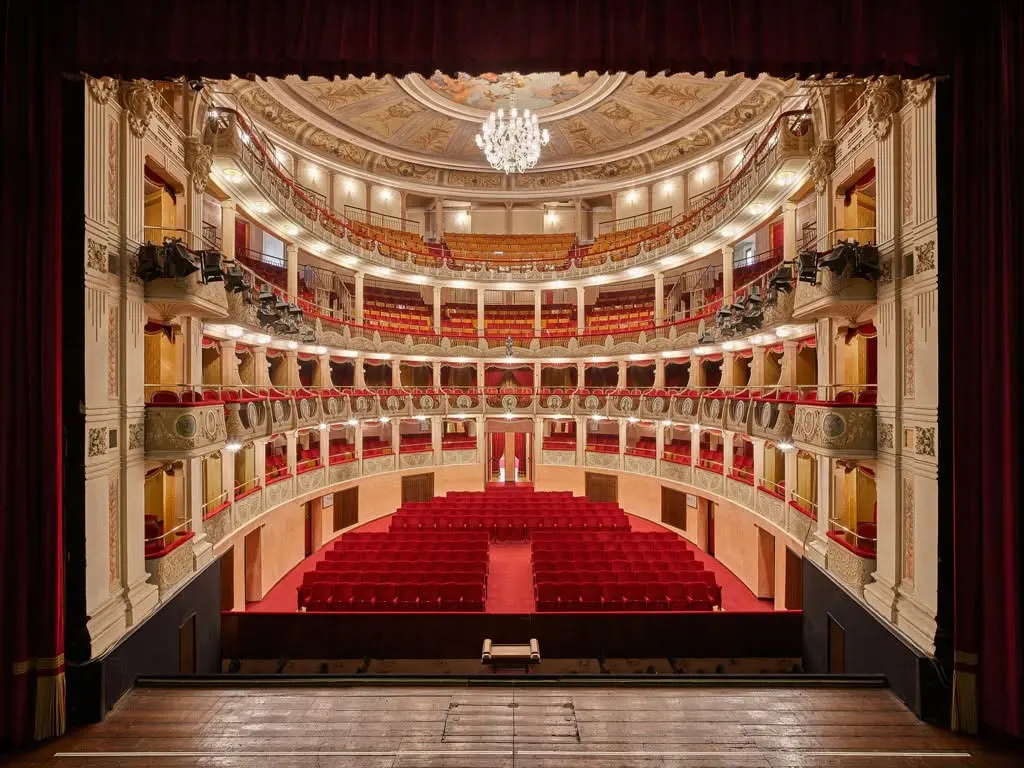
The Teatro Sociale itself is a jewel of neoclassical theater architecture. Originally inaugurated in the early nineteenth century (and rebuilt following a devastating mid-twentieth-century fire), the venue boasts horseshoe-tier auditorium seating renowned for its warm, intimate acoustic profile. This acoustic intimacy makes it an ideal testing ground for both grand-scale orchestral works like Verdi’s Aida and delicate, chamber-scale experiments like Albinoni’s Pimpinone.
Season Metrics at a Glance
- Total Operatic Productions: 7 distinct production blocks spanning 8 individual operas.
- Chronological Span: November 10, 2026, through April 25, 2027 (approximately 5.5 months of active performance windows).
- Repertoire Diversity: Encompasses Baroque intermezzo (Pimpinone), Verismo (Pagliacci), Mid-Century American/Contemporary theatrical double bills (The Telephone / Trouble in Tahiti), Viennese Operetta (Die Fledermaus), Romantic Italian core repertoire (La Traviata, Aida), and Bel Canto comic opera (La Cenerentola).
- Artistic Collaborators: Over 30 principal vocal soloists, alongside dedicated resident and guest choruses, orchestras, and technical design teams.
Official Statements & Artistic Vision
In statements accompanying the institutional release of the 2026–27 playbill, artistic leadership at the Teatro Sociale di Rovigo emphasized the necessity of balancing accessibility with intellectual rigor. The theater’s programming philosophy centers on the conviction that regional Italian opera houses must serve dual functions: preserving the Italian national patrimony while engaging contemporary audiences through provocative stage direction and stylistic variety.
"Opera cannot exist as a museum piece," noted a representative from the theater’s artistic direction board during the season preview briefing. "When we mount a work as venerable as Pagliacci or Aida, our duty is to honor the musical score while interrogating its human relevance for modern spectators. Conversely, by introducing our audiences to lesser-performed works like Albinoni’s Pimpinone or pairing Bernstein with Menotti, we broaden the definition of what lyric theater can achieve within these historic walls."
The emphasis on director-led conceptual staging—evident in the recruitment of notable theatrical directors such as Gabriele Lavia, Ivan Stefanutti, and Aldo Tarabella—signals the theater’s dedication to visual storytelling. These partnerships ensure that productions developed or hosted in Rovigo are competitive on the broader European stage, frequently serving as origin points or tour stops for interpretations destined for major international venues.
Future Outlook: Sustaining the Lyric Tradition in the Veneto
As the Teatro Sociale di Rovigo looks toward the autumn launch of the 2026–27 season, institutional planning extends far beyond the final curtain fall of Rossini’s La Cenerentola in April 2027. Regional theaters across Italy face ongoing economic and logistical challenges, ranging from shifting public subsidy models to the rising costs of mounting large-scale orchestral and scenic productions.
Despite these hurdles, the breadth and ambition of the 2026–27 season demonstrate robust institutional health and creative resilience. By fostering strategic partnerships with guest artists who move fluidly between La Scala, the Vienna State Opera, and the Metropolitan Opera, the Teatro Sociale di Rovigo maintains its status as a vital destination on the international cultural circuit.
Educational outreach initiatives, youth ticket subsidies, and pre-performance lecture series will continue to run parallel to the mainstage calendar, ensuring that the next generation of operatic enthusiasts is cultivated locally. Ultimately, the 2026–27 season stands as a testament to the enduring power of the lyric art form—a vibrant bridge connecting centuries of musical genius with the heartbeat of contemporary audiences in Rovigo and beyond.