
Executive Overview
We stand at a profound technological and biological crossroads in voice science. Today, artificial intelligence (AI) is fundamentally altering the methodology of academic research, redefining clinical data analytics, and revolutionizing how medical professionals approach patient care. At the heart of this paradigm shift is The Voice Foundation and its premier peer-reviewed publication, the Journal of Voice.
Far from being a recent bandwagon driven by the generative AI boom of the 2020s, voice science has quietly intersected with machine learning for more than three decades. The convergence of computational power and biological acoustics has unlocked unprecedented diagnostic vistas. From identifying hidden pathological markers in human speech to treating the voice as a digital biomarker for complex systemic illnesses—including Parkinson’s disease, depression, and respiratory conditions—AI has transformed the voice from a purely artistic medium into an objective, non-invasive diagnostic window.
This article explores the historical trajectory of AI in voice science, reviews landmark studies that have shaped the field, details the explosive growth of recent literature, and highlights the crucial ethical framework required to govern this new frontier.
A Legacy of Innovation: Bridging Art and Science
To understand the magnitude of today’s technological leap, one must examine the institutional foundations that made it possible. In 1969, Dr. Wilbur James Gould founded The Voice Foundation in New York City. At a time when interdisciplinary care for the human voice was virtually non-existent, Dr. Gould possessed the visionary foresight to bring together distinct professional silos—physicians, scientists, speech-language pathologists, performing artists, and vocal pedagogues—to share knowledge and elevate the standard of care for professional voice users.
[1969] Foundation Established by Dr. Wilbur James Gould
  │
  ├──► [1972] Inaugural Annual Symposium (Care of the Professional Voice)
  │
  ├──► [1973] First Gala (Voices of Summer)
  │
  └──► [1989] Leadership Transition to Dr. Robert Thayer Sataloff (Relocation to Philadelphia)
The Foundation hosted its inaugural Annual Symposium—Care of the Professional Voice—in 1972, followed by its first Gala (later christened Voices of Summer) in 1973. For more than five decades, the institution has successfully bridged the gap between art and science, the medical clinic and the performance stage.

Since 1989, The Voice Foundation has been led by Dr. Robert Thayer Sataloff, an internationally renowned otolaryngologist, professional singer, and conductor. Having authored more than 1,200 publications, including 79 textbooks, Dr. Sataloff steered the Foundation’s relocation to Philadelphia. Under his stewardship, the organization has continuously expanded the boundaries of interdisciplinary scientific research and education.
Today, the annual Philadelphia symposium draws hundreds of medical specialists, scientists, academics, speech-language pathologists, and performing artists from across the globe. Concurrently, the Journal of Voice stands undisputed as the premier peer-reviewed publication dedicated exclusively to voice science and medicine.
Detailed Chronology: 30 Years of AI Research in Voice Science
A common misconception in contemporary tech discourse is that artificial intelligence in medicine is a phenomenon of the 2020s. In reality, the Journal of Voice has been publishing AI-driven research for over thirty years.
The foundational roots were planted in 1994, the exact same year the World Wide Web was breaking into public consciousness and long before electronic mail became ubiquitous in academic offices. That year, the journal published a landmark paper by Rihkanen and colleagues entitled “Spectral Pattern Recognition of Improved Voice Quality.” This pioneering study utilized early neural networks to analyze and classify human voice characteristics.
Publication Timeline of AI-Related Papers in the Journal of Voice:
┌─────────────────────┬──────────────────────────────────────────┐
│ Period              │ Number of AI-Related Papers Published    │
├─────────────────────┼──────────────────────────────────────────┤
│ 1994 – 2015         │ 17 papers                                │
│ 2016 – 2019         │ 27 papers                                │
│ 2020 – 2022         │ 16 papers                                │
│ 2023 – 2025         │ 102 papers (63% of historical total)     │
└─────────────────────┴──────────────────────────────────────────┘
The publication timeline reveals a striking acceleration:
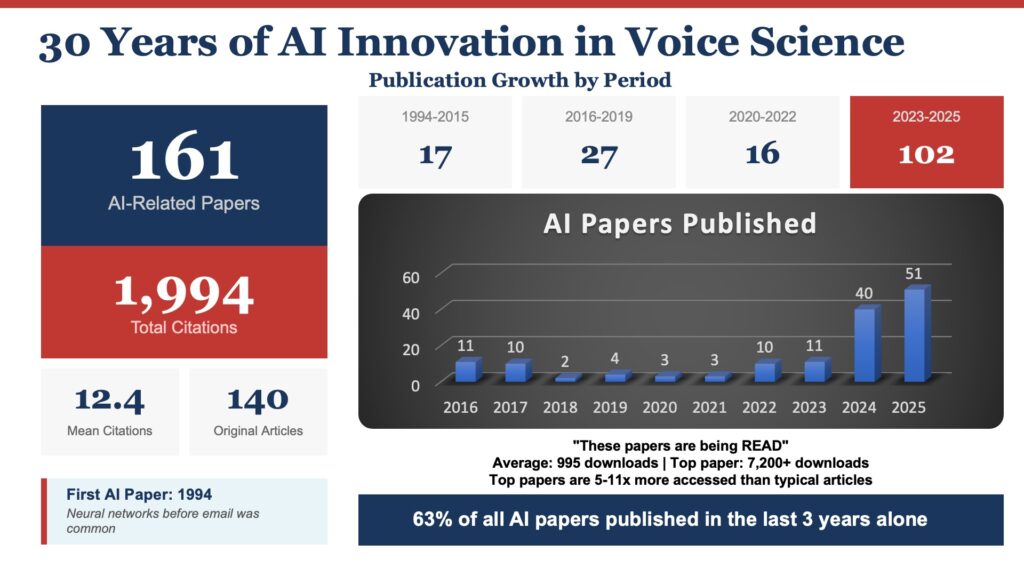
- The Pioneer Era (1994–2015): 17 papers. Progress was steady, bound by the computational limits of early neural networks and smaller datasets.
- The Machine Learning Expansion (2016–2019): 27 papers. As computational processing power scaled, machine learning models began parsing complex acoustic parameters with greater speed and fidelity.
- The Pandemic and Consolidation Era (2020–2022): 16 papers. During a period of global healthcare disruption, researchers increasingly turned to remote acoustic analysis and telemedicine frameworks.
- The Exponential Explosion (2023–2025): 102 papers. Out of 161 historical AI papers tracked by the journal, 63 percent were published in this three-year window alone.
In the single year of 2025, the Journal of Voice published 51 AI-related papers—surpassing the total output of the journal’s first two decades combined. This is not gradual academic growth; it is an exponential transformation of the discipline.
Supporting Context & Metrics: Beyond Citations to Real-World Impact
Academic papers are frequently evaluated by citation counts, but the true metric of medical and scientific literature is operational utility: Are clinicians, researchers, and speech-language pathologists actually reading, downloading, and applying these insights to patient care?
The usage data from the Journal of Voice confirms an extraordinary global reach:
- The average AI paper published in the journal has been downloaded nearly 1,000 times.
- The most-accessed AI paper—a study focusing on machine learning applications for COVID-19 detection—has shattered normal distribution curves with over 7,200 downloads, representing eleven times the median download rate for articles in its respective issue.
- The two most-cited papers—a deep learning study by Fang and colleagues (193 citations) and a machine learning survey by Hegde and colleagues (147 citations)—have each been downloaded nearly 5,000 times.
These figures represent more than vanity metrics; they signify a desperate and active demand among frontline clinicians and researchers for practical, data-driven tools to enhance diagnostic accuracy and treatment outcomes.
Landmark Research Shaping the Field
Deep Learning for Voice Pathology Detection
Published in 2019, “Detection of Pathological Voice Using Cepstrum Vectors: A Deep Learning Approach” by Fang et al. remains the most-cited AI paper in the journal’s history. The study proved that deep neural networks could identify subtle vocal pathologies with exceptional precision by extracting acoustic features entirely imperceptible to the human ear.
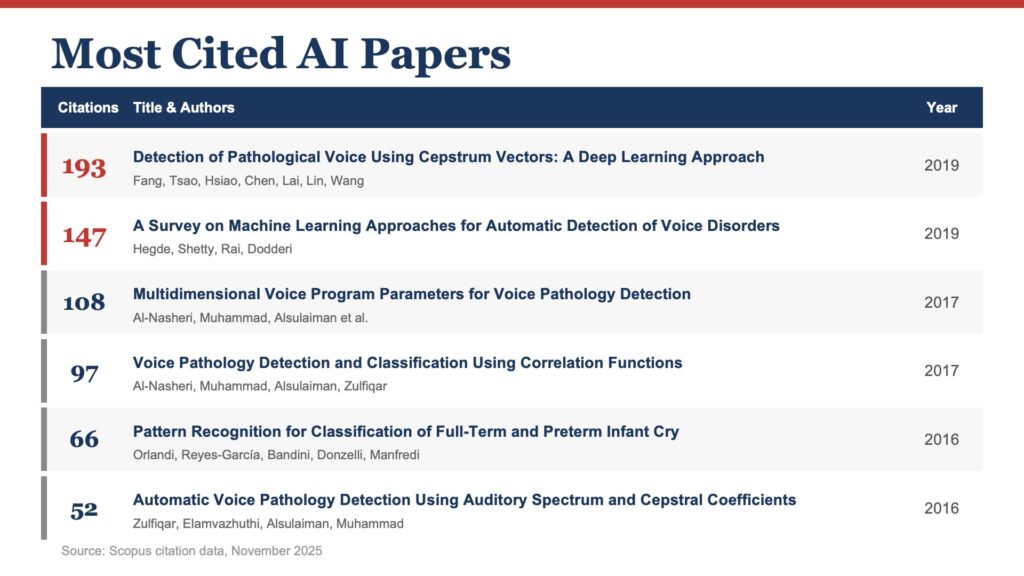
This work was contextualized by Hegde and colleagues’ comprehensive “Survey on Machine Learning Approaches for Automatic Detection of Voice Disorders,” which mapped the analytical landscape of machine learning in voice science. Subsequent breakthroughs—such as Chen and Chen’s deep neural networks for voice classification, Fujimura’s work on one-dimensional convolutional neural networks, and Cho and Choi’s comparative analysis of CNN models for laryngoscopic imaging—have continuously expanded the boundaries of clinical feasibility.
Voice as a Digital Biomarker
Perhaps the most paradigm-shifting development in recent voice science is the conceptualization of the human voice as a digital biomarker—a non-invasive window into systemic neurological, psychological, and physiological health.
Voice Acoustic Properties ──► Machine Learning Processing ──► Digital Biomarkers
                                                                  │
        ┌─────────────────────────┬───────────────────────────────┴───────────────────────────────┐
        ▼                         ▼                               ▼                               ▼
Neurological Health     Psychiatric Disorders                 Respiratory Sentinel            Cardiovascular Trends
(e.g., Parkinson's)     (e.g., Depression, Bipolar)          (e.g., COVID-19 screening)        (Stress/Fatigue markers)
Groundbreaking research has demonstrated the viability of voice analysis in detecting and monitoring degenerative motor conditions like Parkinson’s disease. For instance, Hemmerling and Wójcik-Pędziwiatr’s 2022 paper on predicting Parkinson’s severity from voice signals quickly accumulated 29 citations within three years, accelerating the march toward bedside clinical applications.
Furthermore, systematic reviews exploring vocal quality as a digital biomarker for depression and bipolar disorder hint at a revolutionary future. The capability to screen for mental health shifts through routine voice analysis could dramatically reduce the burden on overstretched psychiatric systems and enable preventative therapeutic interventions long before acute clinical crises manifest.
AI Chatbots in Clinical Practice
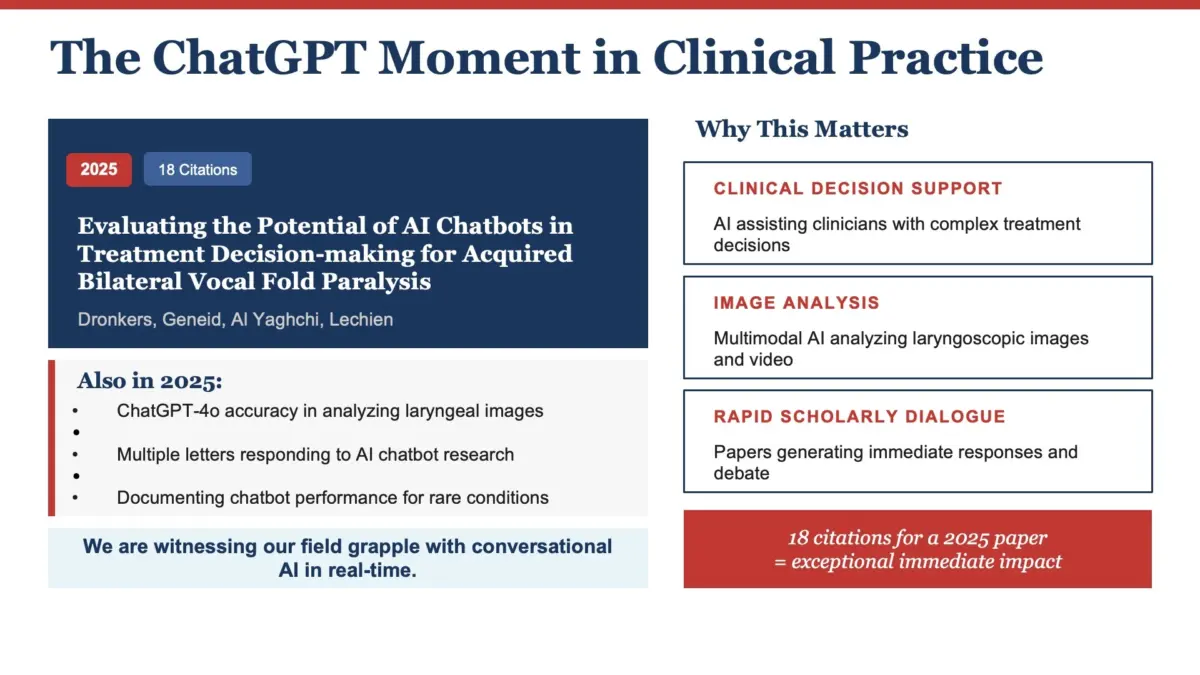
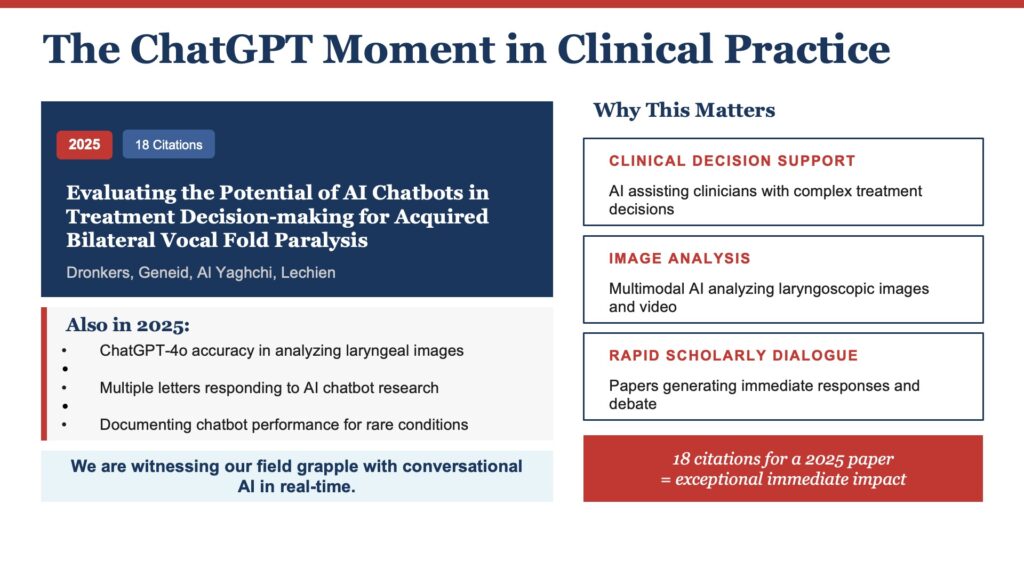
In 2025, the journal expanded its scope to evaluate conversational artificial intelligence and large language models (LLMs) in clinical decision-making. Dronkers and colleagues’ study, “Evaluating the Potential of AI Chatbots in Treatment Decision-making for Acquired Bilateral Vocal Fold Paralysis,” accumulated 18 citations almost immediately upon release—a testament to its urgency.

Accompanied by rigorous reader responses, letters to the editor, and analyses evaluating models like ChatGPT-4o in interpreting complex laryngeal images, the field is actively grappling with the opportunities, limitations, and ethical hazards of conversational AI in medical workflows.
Official Statements and Expert Perspectives
To capture the philosophical and practical challenges facing the discipline, leading experts offer nuanced assessments of AI’s current standing and future trajectory.
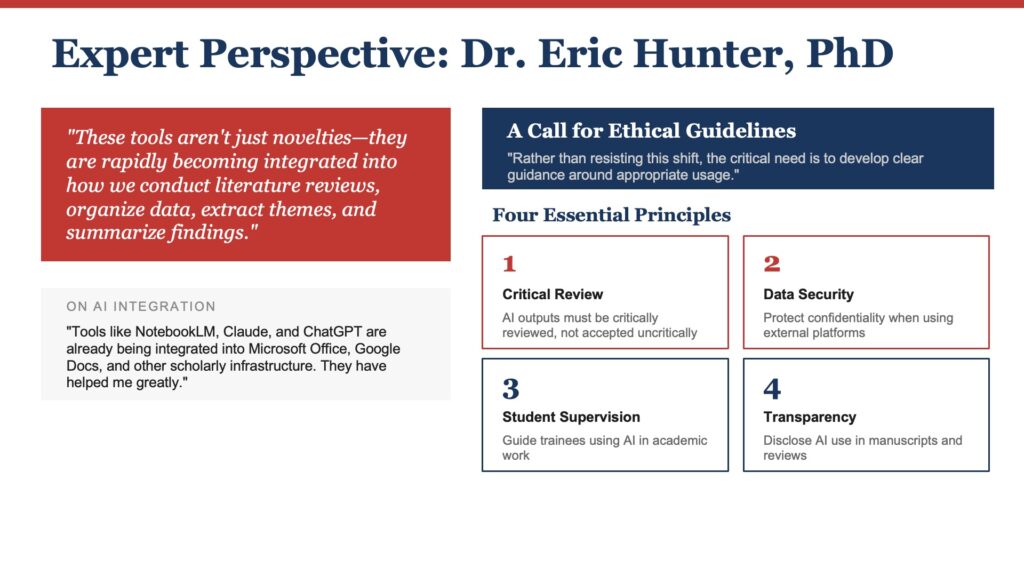
Dr. Mark Berardi: AI as a Tool for Complexity
Drawing from a rich background in physics and computation, Dr. Mark Berardi views artificial intelligence fundamentally as a mechanism for managing complexity.
"Machine learning and AI are tools to help with complexity, and communication is incredibly complex in its neurobiological and physiological processes. So I think the application is warranted."
Dr. Berardi’s own research centers on voice-based digital biomarkers for aging and depression. While noting that capturing speech and voice signals has become technically trivial, he emphasizes that the true hurdle lies in the inherent complexity of human communication itself—an arena where machine learning excels.
Regarding generative AI, Dr. Berardi maintains a pragmatic perspective. While not yet viewing it as a primary driver of basic scientific discoveries, he acknowledges its unmatched utility in breaking research bottlenecks, particularly in computer coding and data processing.
"I can now quickly create bespoke code and edit it with natural language prompts."
Intriguingly, Dr. Berardi’s current work investigates human-AI communication dynamics: how humans subconsciously alter their linguistic patterns when speaking to chatbots versus real people, and how synthetic environments like video conferencing modify baseline vocal behavior.
"We are already seeing linguistic differences in chatbot interactions. The field may need to expand to understand not just human voice, but human voice in conversation with machines."
Dr. Eric Hunter: Embracing Change with Ethical Clarity
Dr. Eric Hunter focuses heavily on the institutional and academic implications of AI integration within scholarly publishing and peer review.
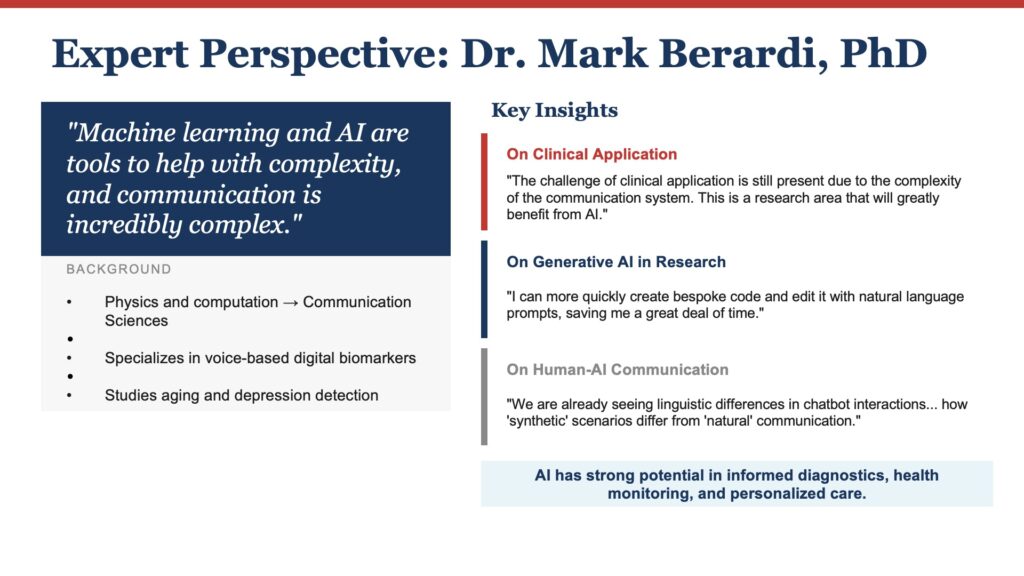
"These tools aren’t just novelties. They are rapidly becoming integrated into how we conduct literature reviews, organize data, extract themes from large bodies of text, and even summarize findings."
Dr. Hunter stresses that large language models and automated workflows are permanent fixtures of the academic ecosystem. Rather than fighting an impossible rearguard action against technological adoption, he issues a vital call to action for the scientific community: establish clear, transparent guidance regarding appropriate usage for both authors and reviewers.
To navigate this transition successfully, Dr. Hunter outlines four essential principles for academic integrity in the age of AI:
- Transparency: Full disclosure of AI assistance in literature synthesis, data sorting, or editorial polish.
- Human Accountability: Absolute authorial responsibility for all factual claims, data integrity, and analytical conclusions generated or refined via machine learning.
- Intellectual Rigor: Utilizing AI as an assistive scaffolding to accelerate productivity rather than a substitute for deep critical thinking.
- Equitable Standards: Developing standardized editorial policies across international journals to prevent confusion and maintain peer-review rigor.
"Our field will benefit most if we embrace the productivity these tools offer while also building a shared ethical framework for their responsible use."
A Global Research Community
The rapid evolution of AI-driven voice science is not the isolated achievement of a single laboratory or academic institution. It is the product of an interconnected, global network of researchers spanning every inhabited continent.
Leading contributors whose names frequently anchor the pages of the Journal of Voice include:
- Jérôme René Lechien (6 papers)
- Dimitar Deliyski (5 papers)
- Stephanie Zacharias (5 papers)
- Ahmed Yousef (4 papers as first author)
- Paavo Alku, Leonardo Wanderley Lopes, and Maryam Naghibolhosseini (4 papers each)
Supported by dozens of international research groups, these scientists are turning abstract machine learning algorithms into tangible diagnostic instruments, proving that the future of voice medicine is inherently collaborative and global.
Future Outlook and Strategic Path Forward
As the Journal of Voice looks toward the next decade of discovery, its mission remains anchored in publishing rigorous, boundary-pushing research while preserving uncompromising standards of scientific integrity.
However, the rapid acceleration of artificial intelligence introduces three foundational imperatives that the community must address collectively:
- Pragmatic Engagement: Researchers and clinicians must engage with AI tools thoughtfully. These platforms are designed to manage immense datasets and computational complexity. Practitioners must learn their exact capabilities, understand their limitations, and deploy them to amplify human clinical expertise—never to replace human medical judgment.
- Ethical Harmonization: The creation of a shared ethical framework, as championed by Dr. Eric Hunter, cannot be achieved by any single journal or institution. It demands a coordinated global consensus among professional societies, academic publishers, clinicians, and ethicists.
- Continuous Knowledge Sharing: The 161 AI-related papers published to date represent merely the opening chapter of a much larger story. Clinicians, educators, and laboratory scientists must continue sharing empirical findings to refine our collective understanding of vocal physiology and pathology.
An Extraordinary Moment
For hundreds of thousands of years, the human voice has served as our fundamental instrument of connection, emotional expression, and personal identity. It transmits our inner psychological states, our neurological health, and our biological vitality in ways that no other physiological signal can replicate.

Now, for the first time in human history, we possess computational tools sophisticated enough to genuinely decode that complexity—to interpret what the voice reveals about our brains, our bodies, and our overall well-being. We stand equipped with technologies that can extend the reach of expert clinicians, catch subtle pathologies before they manifest as severe medical conditions, and democratize access to advanced voice care across the globe.
This is an extraordinary moment in the annals of medicine. With The Voice Foundation and the Journal of Voice standing firmly at the center of this revolution, the coming decade promises even more staggering discoveries. The sonic frontier is open, and the mapping of the human voice has only just begun.
About the Author
Ian DeNolfo is Executive Director of The Voice Foundation, which publishes the Journal of Voice. A graduate of The Juilliard School and The Curtis Institute of Music, he formerly performed as a leading tenor at major opera houses worldwide before transitioning to arts administration and scientific leadership at The Voice Foundation.