
By Ian DeNolfo, Executive Director of The Voice Foundation
Executive Overview
We stand at a genuine inflection point in the annals of voice science—a historic juncture where artificial intelligence (AI) and machine learning are fundamentally reshaping how researchers conduct investigations, analyze complex datasets, and deliver patient care. For centuries, the human voice has remained an intensely personal, profoundly intricate medium of communication. It serves as our primary instrument of connection, emotional expression, and personal identity. Yet, despite its central role in the human experience, decoding the underlying neurobiological, mechanical, and psychological mechanisms of vocal production has historically challenged the limits of clinical observation.
Today, that paradigm is changing at an exponential pace. Advanced computational models are unlocking patterns within acoustic signals that evade even the most highly trained human ear. From the early days of basic neural network experiments in the mid-1990s to the explosive surge of deep learning architectures and generative models in the 2020s, AI has transitioned from an experimental novelty into a foundational pillar of modern voice science. At the center of this transformation is The Voice Foundation and its flagship publication, the Journal of Voice. By bridging the gap between clinical practice and cutting-edge computation, the voice science community is pioneering a new era of diagnostics, therapeutics, and digital biomarkers that promise to redefine modern healthcare.
A Legacy of Innovation: Bridging Art and Science
To understand the magnitude of today’s technological revolution, one must first look to the visionary roots that made this interdisciplinary progress possible. In 1969, Dr. Wilbur James Gould founded The Voice Foundation in New York City. At a time when the specialized, interdisciplinary care of the human voice was virtually non-existent, Dr. Gould possessed the remarkable foresight to bring together distinct professional cohorts who rarely collaborated: physicians, scientists, speech-language pathologists, performing artists, and vocal pedagogues. His mission was to create a shared ecosystem where expertise in the care of the professional voice user could be freely exchanged and systematically expanded.
This foundational vision bore fruit rapidly. The organization held its first Annual Symposium—Care of the Professional Voice—in 1972, establishing an intellectual home for global researchers. This was followed by its inaugural Gala (later celebrated as Voices of Summer) in 1973. For more than five decades, The Voice Foundation has continuously built durable bridges between art and science, seamlessly connecting the demands of the clinical examining room with the realities of the theatrical stage.

Since 1989, the Foundation has operated under the visionary leadership of Dr. Robert Thayer Sataloff, an internationally renowned otolaryngologist who is simultaneously an accomplished professional singer and conductor. Dr. Sataloff’s staggering academic output includes more than 1,200 publications and 79 textbooks. Under his stewardship, the Foundation relocated its headquarters to Philadelphia and expanded its global reach, cementing its status as the world’s premier organization for voice research and education. Today, the annual Philadelphia Symposium draws hundreds of elite medical, scientific, academic, and artistic professionals from every corner of the globe, while the Journal of Voice stands firmly as the definitive, peer-reviewed journal dedicated exclusively to voice science and medicine.
Three Decades of AI Research: A Detailed Chronology
While contemporary mainstream discussions often frame artificial intelligence as a brand-new phenomenon born out of the 2020s, the readership and contributors of the Journal of Voice have been pioneering computational approaches for over thirty years.
The Genesis: 1994 and the First Neural Networks
The integration of machine learning into voice science began far earlier than most realize. In 1994—thirty-one years ago—the Journal of Voice published a seminal paper by Rihkanen and colleagues titled "Spectral Pattern Recognition of Improved Voice Quality." This pioneering work utilized nascent neural network architectures to analyze voice signals and evaluate quality improvements. To put this milestone into historical perspective, 1994 was the exact same year the World Wide Web was first emerging into public consciousness. Researchers in voice science were successfully applying AI methodologies to acoustic data before the vast majority of the professional workforce had ever sent an email.
The Slow-Growth Era (1995–2015)
For the next two decades, AI research within the field progressed at a steady, incremental pace. Between 1995 and 2015, the journal published 17 papers dedicated to machine learning and computational analysis. During this period, computer science capabilities were limited, computational power was expensive, and datasets were relatively small. Yet, these formative decades laid the theoretical and methodological groundwork necessary for future breakthroughs. Researchers established the baseline parameters for feature extraction, signal processing, and basic pattern recognition.
The Acceleration Phase (2016–2022)
As computational power surged, cloud infrastructure matured, and open-source machine learning libraries proliferated, the cadence of publication accelerated. Between 2016 and 2019, the journal published 27 AI-related papers, followed by another 16 papers between 2020 and 2022. During this window, traditional machine learning models gave way to sophisticated deep learning frameworks, including convolutional neural networks (CNNs) and recurrent neural networks (RNNs), capable of processing raw acoustic data with unprecedented fidelity.
The Exponential Explosion (2023–Present)
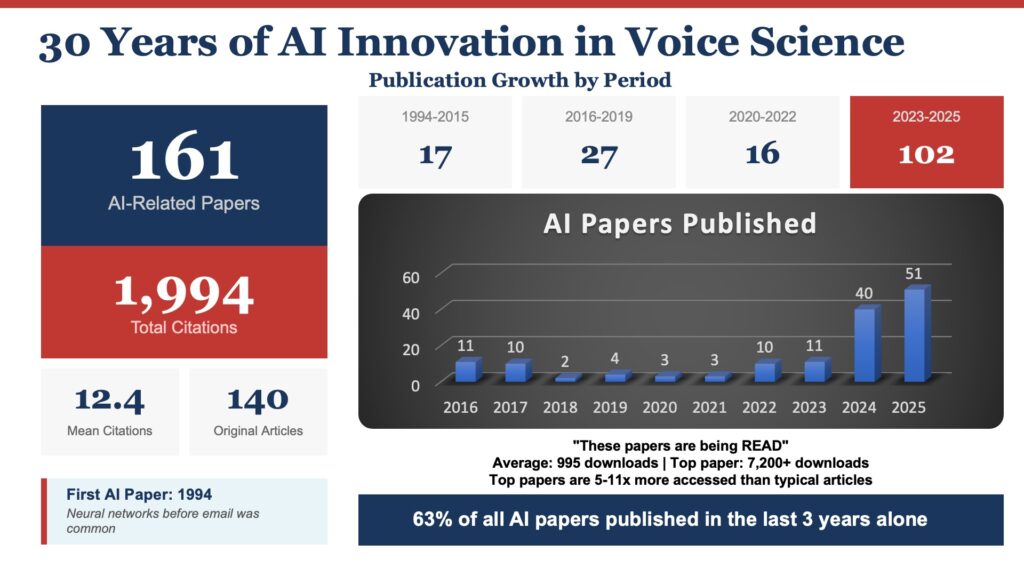
The past three years have witnessed a staggering, unprecedented transformation. Out of 161 total AI-related papers published in the history of the Journal of Voice, 102 articles—representing an astonishing 63 percent of the total output—were published between 2023 and early 2025.
The timeline tells a dramatic story of exponential adoption:
- 1994–2015: 17 papers
- 2016–2019: 27 papers
- 2020–2022: 16 papers
- 2023–2025: 102 papers
In the single year of 2025 alone, the journal published 51 artificial intelligence papers—surpassing the total output of the entire first two decades of computational voice research combined. This is not merely gradual growth; it is an exponential paradigm shift that has permanently altered the landscape of the discipline.
Supporting Context & Metrics: Beyond Citations to Real-World Impact
Academic output is often measured by citation counts, but the true value of the research published in the Journal of Voice is reflected in its profound, real-world utility among clinicians, speech-language pathologists, and biomedical engineers around the globe.
Recent usage statistics underscore the extraordinary reach of these digital assets:
- The average AI-focused paper published in the journal has been downloaded nearly 1,000 times.
- The single most-accessed AI paper—a landmark study examining machine learning applications for COVID-19 detection via voice—has amassed over 7,200 downloads, a figure eleven times higher than the median for articles in its respective issue.
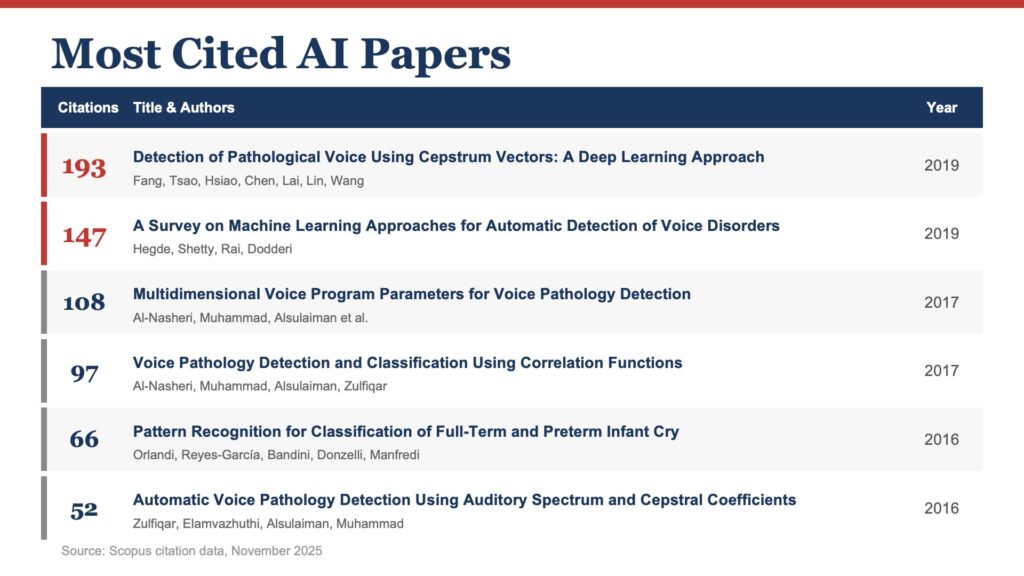
- The two most-cited papers in the journal’s computational history—Fang and colleagues’ deep learning study (193 citations) and Hegde’s comprehensive machine learning survey (147 citations)—have each been downloaded nearly 5,000 times.
These metrics represent far more than passive academic curiosity. They demonstrate that frontline clinicians, hospital researchers, and voice therapists are actively turning to peer-reviewed computational literature to find practical, actionable tools to elevate patient care.
Landmark Research Reshaping the Field
The influx of computational papers has driven extraordinary advancements across several distinct sub-disciplines of voice science and clinical medicine.
Deep Learning for Voice Pathology Detection
In 2019, Fang and colleagues published "Detection of Pathological Voice Using Cepstrum Vectors: A Deep Learning Approach," a landmark paper that currently stands as the most-cited AI publication in the journal’s history with 193 citations. This research proved definitively that deep neural networks could detect underlying voice pathologies with remarkable diagnostic accuracy by isolating acoustic features imperceptible to the human ear.
This work built upon earlier foundational contributions, such as Hegde and colleagues’ comprehensive "Survey on Machine Learning Approaches for Automatic Detection of Voice Disorders" (147 citations) and Al-Nasheri’s 2017 dual studies on Multidimensional Voice Program parameters and correlation functions. More recently, researchers like Chen and Chen, Fujimura, and Cho and Choi have pushed the envelope further by implementing one-dimensional convolutional neural networks and advanced image-classification models for laryngoscopy.
Voice as a Digital Biomarker
Perhaps the most transformative conceptual evolution in recent years is the recognition of the human voice as a digital biomarker—a non-invasive, continuous window into systemic health and neurological function.

The Journal of Voice has featured groundbreaking investigations into utilizing acoustic analysis for the early detection and longitudinal monitoring of neurodegenerative conditions such as Parkinson’s disease. For instance, Hemmerling and Wójcik-Pędziwiatr’s 2022 study on predicting Parkinson’s severity from voice signals quickly garnered 29 citations within three years, paving the way for clinical translation.
Beyond neurology, recent systematic reviews have explored voice quality as a digital biomarker for affective disorders, including clinical depression and bipolar disorder. The clinical implications are profound: routine, automated voice screening could enable early psychiatric intervention, reduce the burden on overstretched mental healthcare systems, and provide objective metrics for treatment efficacy. Similar breakthroughs involving machine learning assessments of respiratory health during the COVID-19 pandemic highlighted how vocal analysis can act as an early sentinel for pulmonary disease.
AI Chatbots in Clinical Practice
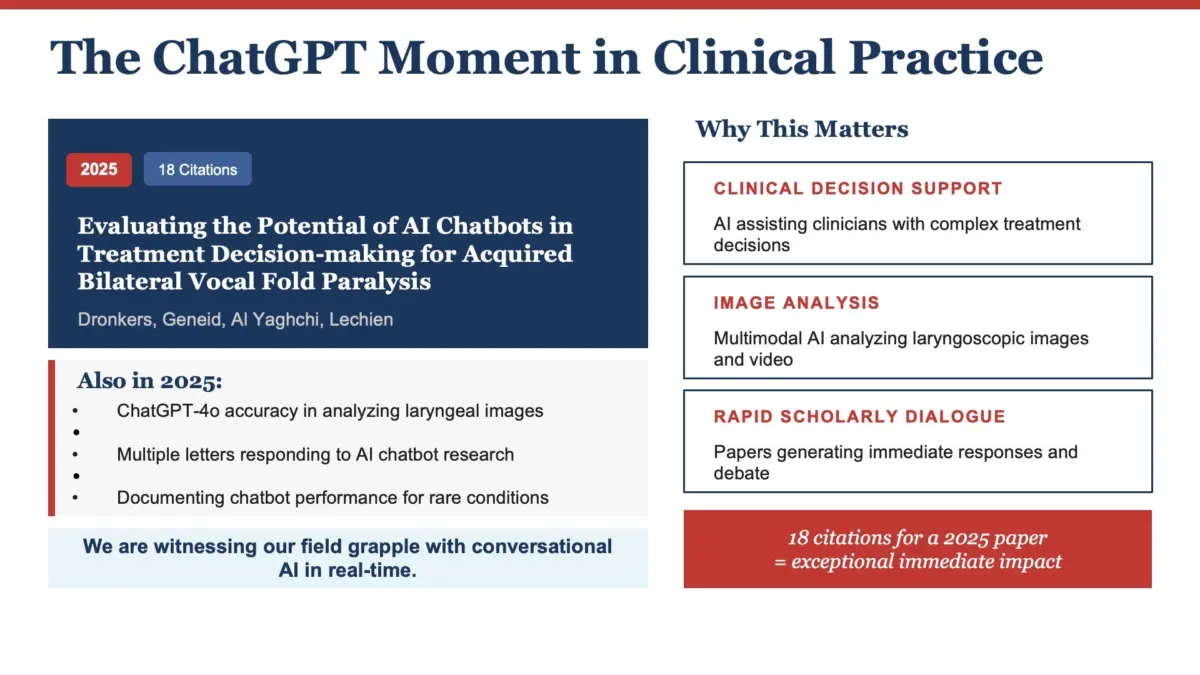
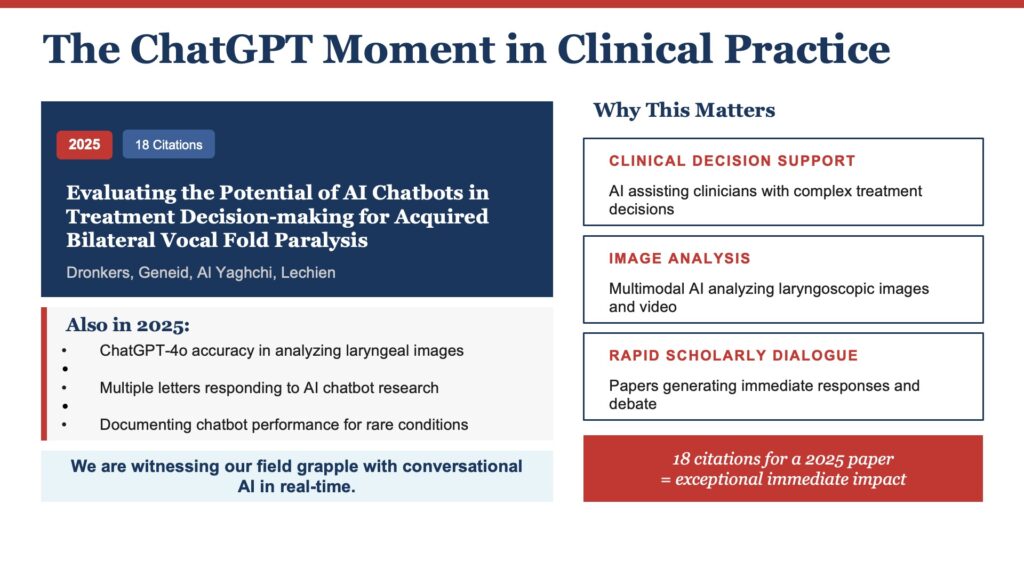
The technological wave has also swept into conversational artificial intelligence. In 2025, the journal published critical investigations examining the efficacy of AI chatbots in clinical decision-making. Dronkers and colleagues’ paper, "Evaluating the Potential of AI Chatbots in Treatment Decision-making for Acquired Bilateral Vocal Fold Paralysis," accumulated 18 citations almost immediately upon publication—an extraordinary velocity that reflects the urgent nature of the topic.
This work sparked robust academic discourse, including subsequent letters to the editor and investigative responses analyzing the diagnostic accuracy of models like ChatGPT-4o in interpreting complex laryngeal images. The field is actively and transparently grappling with the integration of conversational AI into daily medical workflows.
Official Perspectives: Insights from Field Leaders
To contextualize these monumental shifts, leading minds within The Voice Foundation community offer vital perspectives on the opportunities and responsibilities accompanying the rise of artificial intelligence.
Dr. Mark Berardi: AI as a Tool for Managing Complexity
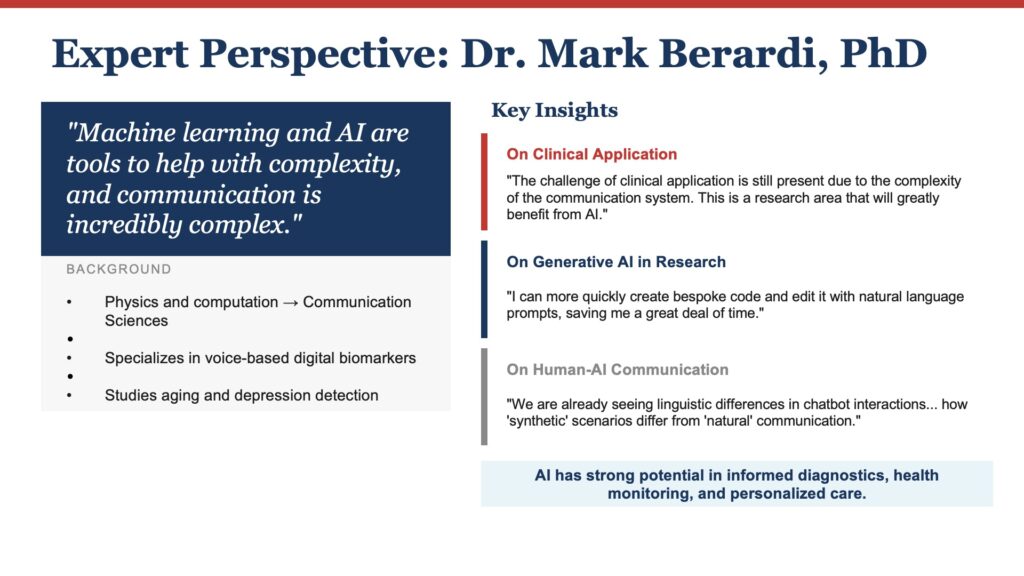
Dr. Mark Berardi, whose academic roots span physics and computation, views artificial intelligence not as a replacement for human intellect, but as an indispensable engine for managing complexity.
"Machine learning and AI are tools to help with complexity, and communication is incredibly complex in its neurobiological and physiological processes. So I think the application is warranted," Dr. Berardi observes.
His current research centers on extracting health insights from vocal biomarkers related to aging and depression. While acquiring speech signals has become remarkably straightforward, the primary challenge remains the intrinsic complexity of human communication. According to Dr. Berardi, generative AI serves as a powerful accelerator for overcoming research bottlenecks, particularly in data processing and custom coding, allowing researchers to build bespoke computational models via natural language prompts.
Intriguingly, Dr. Berardi is also pioneering research into human-AI communication itself—examining how individuals alter their vocal patterns, cadence, and linguistic structures when conversing with machines versus humans, or during synthetic interactions like Zoom conferences. As synthetic communication becomes ubiquitous, voice science must expand its scope to understand the human voice in direct dialogue with artificial systems.
Dr. Eric Hunter: Embracing Change with Ethical Clarity
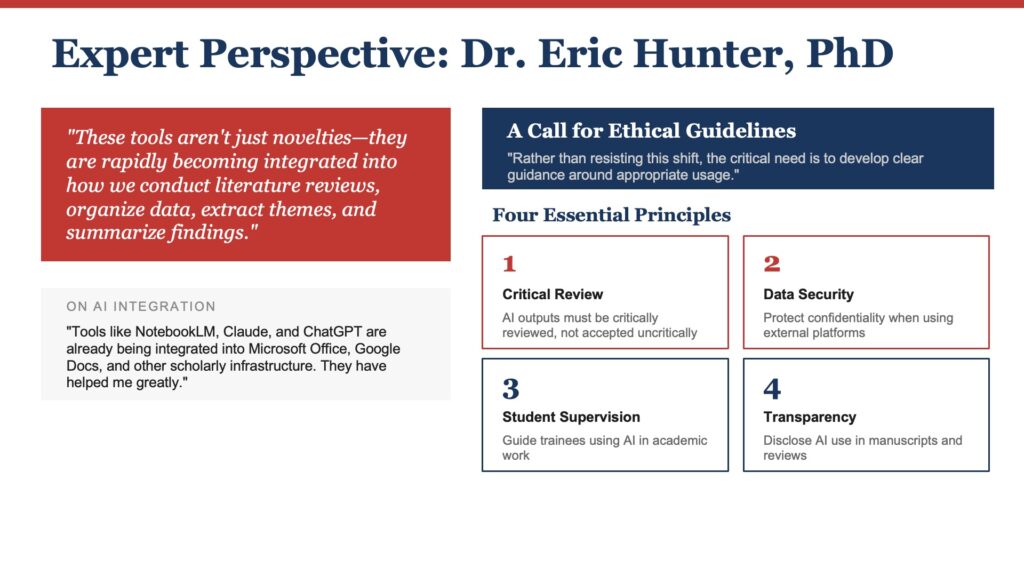
Dr. Eric Hunter emphasizes the profound institutional and workflow transformations brought on by large language models and automated platforms.
"These tools aren’t just novelties," Dr. Hunter notes. "They are rapidly becoming integrated into how we conduct literature reviews, organize data, extract themes from large bodies of text, and even summarize findings."
Dr. Hunter points out that AI platforms like NotebookLM, Claude, and ChatGPT are permanently embedding themselves into standard academic infrastructure, from manuscript drafting to peer review. Rather than resisting this inevitable shift, he issues a clear, urgent call to action: the voice science community must proactively establish clear guidance and ethical frameworks governing appropriate usage.
He outlines four essential pillars for academic integrity in the age of AI:
- Transparency: Complete disclosure of AI tool utilization in literature reviews, data synthesis, and manuscript preparation.
- Accountability: Absolute human responsibility for the factual accuracy and intellectual integrity of published findings.
- Data Privacy: Rigorous protection of patient health information and sensitive acoustic datasets.
- Editorial Standards: Collaborative development of shared ethical guidelines across editorial boards and scientific societies.
"Our field will benefit most," Dr. Hunter concludes, "if we embrace the productivity these tools offer while also building a shared ethical framework for their responsible use."
A Global Research Community
The rapid advancement of AI in voice science is propelled by a vast, interconnected international network of researchers. The pages of the Journal of Voice reflect contributions from laboratories spanning every inhabited continent. Prominent leaders in this computational renaissance include Jérôme René Lechien (6 papers), Dimitar Deliyski (5 papers), Stephanie Zacharias (5 papers), and Ahmed Yousef (4 papers as first author), alongside Paavo Alku, Leonardo Wanderley Lopes, and Maryam Naghibolhosseini (4 papers each).
This decentralized, global collaboration demonstrates that the digital transformation of voice science is not driven by a few isolated institutions, but by a unified worldwide community committed to unlocking the mysteries of human phonation through advanced computation.
Future Outlook and the Path Forward
As the Journal of Voice looks toward the horizon, it remains steadfastly committed to publishing rigorous, peer-reviewed research that pushes boundaries while preserving the highest standards of scientific integrity. However, navigating this new frontier requires deliberate, collective action across three key fronts:
- Thoughtful Engagement: Researchers and clinicians must master AI tools as instruments for managing complexity. We must understand their computational limitations and utilize them to amplify human expertise rather than abdicate clinical judgment.
- Ethical Harmonization: The community must unite to establish robust, transparent ethical frameworks. As Dr. Hunter emphasizes, questions of data privacy, algorithmic bias, and authorship transparency demand a coordinated global response.
- Open Collaboration: The 161 AI papers published to date represent only the opening chapter. Every clinician, therapist, and educator possesses unique insights capable of enriching our collective understanding.
An Extraordinary Moment
For hundreds of thousands of years, the human voice has served as our ultimate instrument of connection, emotional depth, and individuality. It carries the subtle signatures of our health, our psychology, and our humanity in ways that no other biological signal can replicate.
Today, for the first time in human history, we possess computational tools sophisticated enough to truly decode that complexity. We stand equipped with technology capable of extending the reach of expert clinicians, detecting subtle pathological changes long before symptoms manifest, and democratizing access to superior voice care across the globe.
This is a truly extraordinary moment. With The Voice Foundation and the Journal of Voice standing at the very center of this revolution, the next decade promises unprecedented breakthroughs. The chorus of art, science, and artificial intelligence has only just begun to sing.