
Executive Overview
For music educators across the globe, the weeks leading up to the annual winter concert represent a high-stakes balancing act. The season is a blur of twinkling lights, festive energy, and a rapidly diminishing countdown clock of rehearsals. Every single instructional minute is acutely precious. While in-class rehearsals are essential for cohesive ensemble blending, the true battleground for concert readiness often lies in the domestic sphere: home practice.
Getting students to independently pick up their instruments, warm up their vocal cords, and drill challenging passages outside of school hours has long been considered a holiday miracle. However, a major paradigm shift is underway in music pedagogy. Educators are moving away from ambiguous, punitive "practice logs" and moving toward targeted, interactive, and gamified digital strategies.
By harnessing modern music education technology—specifically platforms like MakeMusic Cloud—teachers are turning the dreaded holiday practice crunch into an engaging, collaborative, and rewarding experience. This comprehensive report explores the five most effective strategies music teachers are implementing this season, the role of digital innovation in fostering student accountability, and how pedagogical tools are redefining the modern music classroom.
Detailed Chronology & Strategic Implementation: The 4-Week Holiday Framework
To combat the natural chaos of the November-December stretch—complicated by Thanksgiving breaks, holiday travel, and mid-semester fatigue—successful directors are abandoning ad-hoc assignments in favor of structured, chronological frameworks. The strategy relies on micro-goals: short, specific, and intrinsically rewarding tasks that seamlessly bridge the gap between classroom instruction and home execution.
Week 1: Establishing Foundations with Seasonal Materials
The transition from autumn to the winter holidays requires a recalibration of fundamental exercises. Rather than forcing students to choose between technique builders and holiday tunes, modern curricula integrate the two.
- The Festive Foundations Initiative: Programs like Festive Foundations inject holiday cheer directly into daily technical routines for band and string students. Recognizing the universal pressure on music programs, developers have temporarily opened these resources to all educators, regardless of subscription status.
- Structured Pacing: To guide teachers through this critical phase, pedagogical experts have designed structured four-week lesson plans—such as Festive Fun with Foundations—that map out exact weekly assignments. This ensures that warm-ups actively reinforce the specific key signatures, rhythms, and stylistic nuances required for upcoming concert repertoire.
Week 2: Gamifying Theory and Injecting Energy
As the novelty of the semester wears thin, engagement can plummet. Week two often calls for a pivot toward gamification to maintain momentum during warm-ups.
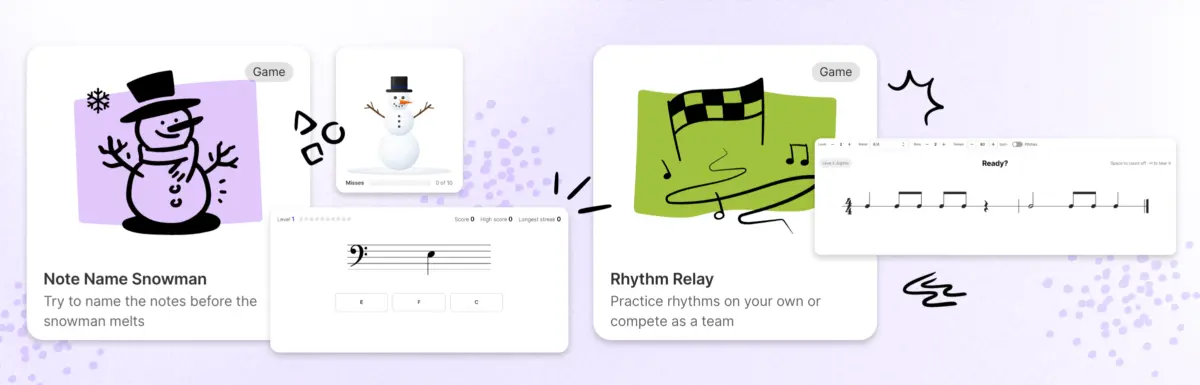
- Interactive Theory Games: Utilizing digital tools like MakeMusic’s Theory Games, educators can project interactive challenges for the entire class or assign them for individual play.
- Note Name Snowman and Rhythm Relay: These tools transform dry sight-reading and rhythmic drills into high-stakes, entertaining challenges. Students are tasked with naming as many notes as possible before a virtual snowman melts or mastering rhythmic cells on the fly without requiring hours of teacher-led prep work. This immediate feedback loop builds fluency while injecting much-needed levity into high-stress weeks.
Week 3: Personalization and Ownership through Solo Exploration
Autonomy is one of the most powerful psychological drivers of intrinsic motivation. By week three, students should be given the agency to steer a portion of their musical journey.
- Catalog Exploration: Instead of top-down mandates, teachers are inviting students to browse extensive digital catalogs—featuring tens of thousands of titles—to select a holiday solo that genuinely resonates with them.
- Low-Pressure Recitals: Choir and instrumental directors are incorporating Holiday Solo Recital frameworks into their syllabi. Students spend a fortnight learning their self-selected octavos or instrumental solos, culminating in supportive, low-pressure class micro-recitals. When a student chooses the music, the friction of home practice naturally dissolves.
Week 4: Final Polish via Audio/Visual Submissions and Countdowns
In the final days leading up to the curtain call, macro-practice (practicing an entire piece from start to finish) becomes inefficient. Precision is required.
- Targeted Video/Audio Assignments: Educators are leveraging integrated audio and video assignment features. Teachers isolate the exact measures that plagued the previous full ensemble rehearsal—perhaps a treacherous brass syncopation or a soaring soprano leap. Students record exclusively that passage, listen back critically to their own execution, and submit their absolute best take.
- The Practice Countdown Calendar: To keep younger or less-organized students on track, daily countdown calendars—delivered via paper or digital portals—offer micro-tasks. Tasks range from "play your concert opener at half-tempo while marching in place" to "record yourself and find one dynamic contrast to improve." Completed weeks are rewarded with low-stakes incentives, such as letting the student curate the next day’s class warm-up.
Supporting Context & Technological Metrics
The integration of cloud-based music software into traditional curricula is no longer an experimental novelty; it is a quantified operational necessity for modern music programs. Industry metrics and pedagogical research highlight several key shifts in how music education functions during peak seasons.
The Accountability Gap
Historically, paper practice logs relied heavily on parental signatures—a system prone to estimation, falsification, or total neglect. Digital submissions close this accountability gap entirely. When a student submits an audio or video recording through platforms like MakeMusic Cloud:

- Objective Diagnostics: The educator receives an unvarnished, authentic snapshot of the student’s technical grasp on specific measures before the full ensemble reconvenes.
- Rehearsal Efficiency: Class time is instantly liberated from remedial note-learning, allowing conductors to focus on musicality, balance, interpretation, and expression.
- Data-Driven Instruction: Teachers can track historical progress, noting whether rhythmic inaccuracies are systemic across an entire section or isolated to individual learners.
Accessibility and Community Support
Technology also serves to democratize access to high-level instructional resources. By removing financial and logistical barriers—such as temporary free access to foundational holiday materials and comprehensive trial windows—more programs are able to bridge equity gaps.
Furthermore, digital platforms have catalyzed professional networking among isolated educators. Online communities, such as the Teaching With MakeMusic Cloud Facebook group and dedicated pedagogical podcasts (e.g., the TakeNotes Podcast hosted by veteran composers Brian Balmages and Chris Bernotas), provide immediate peer support, troubleshooting, and decades of collective institutional knowledge to teachers navigating the holiday crunch.
Official Insights & Expert Perspectives
Pedagogical designers and veteran composers emphasize that the secret to holiday concert success lies not in increasing the sheer volume of practice, but in refining its psychological and structural quality.
"The goal of holiday practice should never be to overwhelm a student already burdened by semester-end academic tests and family obligations," notes a leading curriculum developer in music tech circles. "The most successful assignments are bite-sized, hyper-specific, and inherently engaging. When a student knows exactly what measures to look at, and they have a tool that lets them hear themselves play against an accompaniment, practice stops feeling like a chore and starts feeling like progress."
Educators who have transitioned to video-based formative assessments report a marked decrease in pre-concert anxiety—both for themselves and their students. Knowing precisely where the ensemble stands days before the performance eliminates the catastrophic surprises that often plague dress rehearsals.
Moreover, composers who contribute to these seasonal repositories emphasize the emotional resonance of the music. By blending rigorous foundational technique with beloved holiday motifs, students are reminded why they joined band, choir, or orchestra in the first place: the sheer joy of collaborative artistic expression.
Future Outlook: The Evolution of Music Pedagogy
As we look beyond the current holiday season, the intersection of cloud technology and traditional instrumental/vocal instruction points toward a hyper-personalized future for music education.
The successful navigation of the "holiday concert crunch" serves as a microcosm for the broader evolution of the discipline. As artificial intelligence integration, automated accompaniment tracking, and high-fidelity cloud recording become standard classroom fixtures, the role of the music educator is elevated. Teachers spend less time policing compliance and more time acting as master coaches, mentors, and artistic directors.
For programs seeking to modernize their approach without sacrificing musical integrity, the path forward is clear. By embracing digital ecosystems that combine rigorous fundamentals, gamified engagement, and streamlined assessment, music educators can ensure that the holiday season remains what it was always meant to be: a joyful celebration of student achievement, community, and song.