
Executive Overview
For one intense week this autumn, the historic and vibrant cultural hub of Shanghai became the epicenter of the global classical music world. The city played host to Operalia, the prestigious World Opera Competition founded in 1993 by legendary tenor and conductor Plácido Domingo. Bringing together thirty-four of the world’s most promising young vocalists, the event transformed the city’s conservatory spaces and grand stages into a high-stakes crucible of talent, ambition, and international artistic exchange.
As the competition unfolded across late October and early November, it offered a fascinating window into the current state and future trajectory of international opera. From the meticulously managed preliminary rounds at the He Luting Concert Hall to the grand finale at the architectural marvel that is the Shangyin Opera House, Operalia once again underscored its unique role in the ecosystem of classical music. Unlike traditional competitions that merely hand out cash prizes and fade into memory, Operalia functions as an elite international hiring fair, a grueling professional audition, and a vital bridge connecting rising talent directly to the artistic directors and casting consultants who dictate the seasons of the world’s foremost opera houses.
Yet, this year’s edition in Shanghai was defined by more than just high notes and glittering scorecards. It captured a pivotal moment of transition for the global opera landscape. The surging prominence of Asian—and specifically Chinese—vocal talent took center stage, culminating in a formidable showing by young Chinese baritones who dominated the final rounds. Simultaneously, the competition sparked critical discussions regarding the rapid expansion of cultural infrastructure in East Asia, juxtaposing Shanghai’s breathtaking new performance venues against the enduring realities of building sustainable, world-class artistic institutions.
Ultimately, the Shanghai edition of Operalia demonstrated that while prizes matter, the true measure of the competition lies in its capacity to set wheels in motion, forging professional destinies that will resonate across the stages of Vienna, Milan, New York, and Salzburg for decades to come.
Detailed Chronology: From Conservatory Halls to the Grand Finale
The journey to the Operalia podium is neither swift nor forgiving. For the thirty-four contestants who converged on Shanghai, the competition represented the culmination of rigorous global screening processes, distilling thousands of applicants down to an elite cohort representing nations as diverse as China, Russia, South Korea, Ukraine, the United Kingdom, Kazakhstan, the United States, Spain, and Cuba.
The Preliminaries: October 26–27
The competition officially kicked off on October 26 at the Shanghai Conservatory of Music’s intimate, 742-seat He Luting Concert Hall. Over two days, seventeen contestants performed daily, backed by a trio of master collaborative pianists: Artem Grishaev, Kamal Khan, and Nino Sanikidze.
The format of the preliminary rounds is designed to test versatility and stylistic authenticity. Each singer presented a selection of operatic arias of their own choosing. Furthermore, those who wished to contend for the coveted special zarzuela prize—a category championed by Plácido Domingo to preserve and promote the beloved Spanish lyric-dramatic genre—had to incorporate a zarzuela selection into their repertoire. The atmosphere inside the He Luting Concert Hall was thick with nervous energy; for many contestants, these few minutes represented the single most important audition of their young lives.
The Semifinals: October 28
Following the grueling elimination process of the quarterfinals, the field was significantly culled for the semifinal round on October 28. Here, the pressure intensified exponentially. The vocalists were no longer simply trying to survive the cut; they were auditioning for the attention of a jury panel that reads like an elite directory of the global opera industry. Every inflection, phrasing choice, and dramatic nuance was scrutinized by individuals capable of altering the course of a professional career with a single contract offer.
The Grand Final: November 1
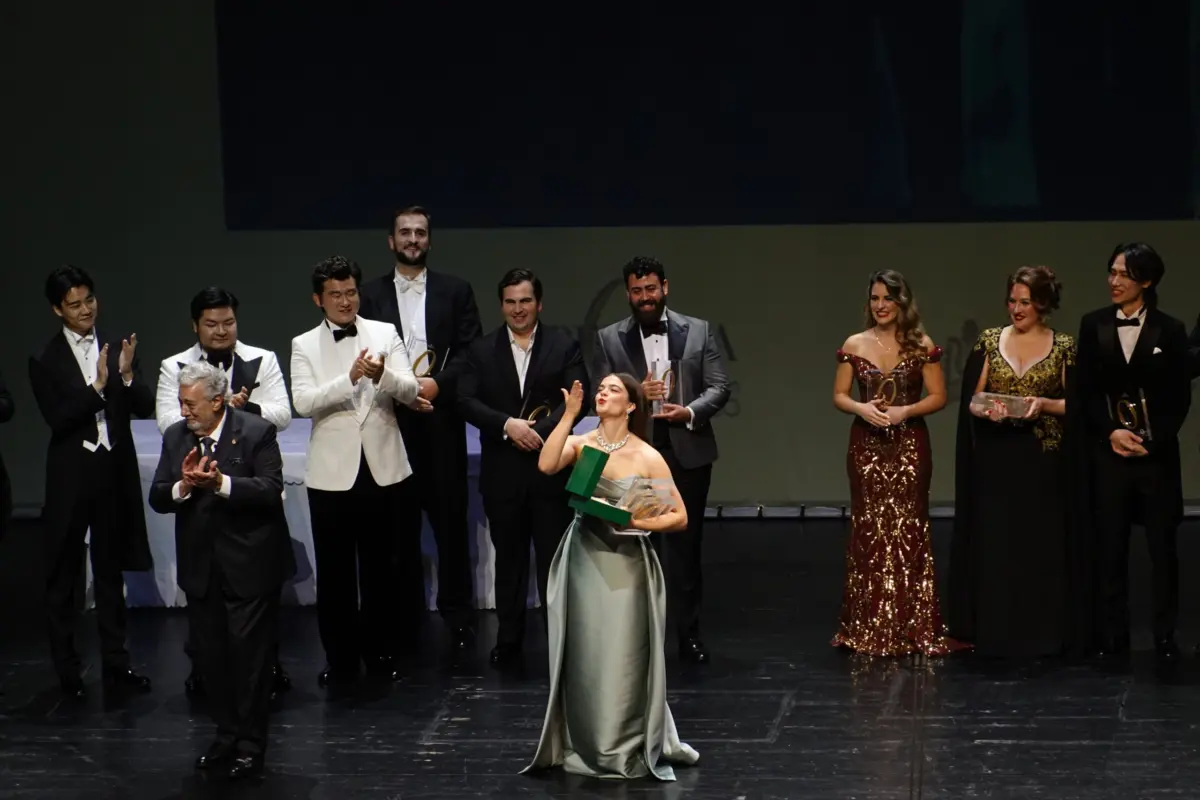
The climax of the competition arrived on the evening of November 1 at the magnificent Shangyin Opera House. Opened in 2019, the venue provided a breathtaking backdrop for the final showdown. Fourteen finalists took to the stage, backed not by pianos, but by the full majesty of the Shanghai Conservatory Orchestra.
Adding an extraordinary layer of prestige to the evening, Plácido Domingo himself stepped onto the podium to conduct the orchestra for the specialized zarzuela round. The hall resonated with soaring high notes, rich baritone warmth, and dramatic intensity as the finalists poured every ounce of their training and artistry into their performances.
Following the final notes, the jury retired to tabulate their scores, leading to the much-anticipated announcement of the winners. While the evening celebrated remarkable triumphs—particularly among the male vocalists, with baritones making a commanding statement—it also stirred intense public debate. The conspicuous absence of a Chinese winner among the top tier left many local opera enthusiasts visibly dismayed. Yet, within the industry, this outcome was widely viewed as a testament to the absolute independence and uncompromising standards of the international jury panel, who evaluated candidates purely on the comparative strength of their performances that specific evening.
Supporting Context & Metrics: The Anatomy of an Elite Jury
What separates Operalia from virtually every other music competition on earth is its jury. Rather than a panel of retired singers, academic theorists, or generalist critics, Operalia assembles a jury comprising the supreme decision-makers of the international opera world.
The 2024 Jury Roster
Presided over by Plácido Domingo, the twelve-person jury for the Shanghai competition included:
- Sophie de Lint (Dutch National Opera)
- Marta Domingo (Stage Director)
- Jonathan Friend (Casting Consultant)
- Michael Heaston (Metropolitan Opera)
- Peter Katona (Royal Ballet and Opera, London)
- Robert Körner (Wiener Staatsoper)
- Liao Changyong (Shanghai Conservatory of Music)
- Erik Malmquist (Bayerische Staatsoper)
- Isla Mundell-Perkins (Festival d’Aix-en-Provence)
- Christina Scheppelmann (La Monnaie)
- Sebastian F. Schwarz (Teatro alla Scala)
- Evamaria Wieser (Salzburg Festival and Lyric Opera of Chicago)
The Scoring Mechanism
The mechanics of Operalia’s scoring are deceptively simple yet rigidly structured. Jurors evaluate contestants on a numerical scale from five to ten. Crucially, this scoring is entirely private and independent. There are no collective roundtable discussions, no political negotiations, and no attempts to forge a consensus.
A singer might easily receive a stellar ten from one house casting director who desperately needs that specific voice type for an upcoming production, while receiving a five from another juror whose institution has entirely different acoustic properties or repertoire demands. As Peter Katona succinctly summarized the philosophy: "Points are points." The final rankings are simply the mathematical sum of twelve distinct, unvarnished artistic assessments.
The Travelling Format
Unlike traditional competitions permanently anchored to a single European or American cultural capital, Operalia operates on a nomadic model reminiscent of Formula One racing. Over its three-decade history, the competition has traversed the globe, touching down in cities as diverse as Sofia, Mumbai, Cape Town, Riga, Moscow, Beijing, and now Shanghai.
This travelling format ensures that Operalia never stagnates. Each host city injects a fresh cultural dynamic, introducing local audiences, distinct acoustic environments, and regional pools of raw talent into the global conversation. It democratizes access, bringing the highest echelons of the opera world directly to regions experiencing rapid cultural development.
Official Statements & Industry Insights
Interviews with members of the Operalia jury reveal a profound depth of philosophy regarding what it takes to survive—and thrive—in the punishingly rigorous profession of modern opera.
Beyond "A Voice on Two Legs"
For Peter Katona of London’s Royal Ballet and Opera, technical polish is merely the baseline entry requirement. In an art form where young singers are increasingly expected to act with the nuance of film actors while projecting unamplified voices over massive orchestras, personality is everything.
"It is not enough to simply be a voice on two legs," Katona observed. "A competition aria lasts only a few minutes, but a stage performance requires a complete artistic identity. The singer must bring an inner life, a mind, and a soul to the music."
Katona also emphasized the long-term view of the competition. The true success of Operalia, he argues, cannot be judged solely by who takes home the first-place trophy on final night. Looking back over finalists from ten, twenty, or thirty years ago, the competition’s legacy is written in the countless working professionals who built substantial international careers after making their breakthrough on the Operalia stage.
The Unforgiving Realities of the Stage
While Operalia opens doors, the exposure it provides is a double-edged sword. A magnificent night can launch a global career; a public miscalculation in front of the world’s top casting directors can leave a lasting mark. Sebastian F. Schwarz of Teatro alla Scala offered a stark illustration of the realities awaiting young artists in major European houses. He recalled the infamous loggionisti—the notoriously demanding opera-goers in the upper galleries of La Scala—who are entirely unafraid to voice their displeasure in no uncertain terms.
"A casting director must do more than identify a promising voice," Schwarz explained. "They must judge whether a singer is ready to withstand the intense psychological and physical demands of the stage. Timing can matter just as much as raw talent."
Echoing this sentiment, Evamaria Wieser, director of the Young Singers Project at the Salzburg Festival, noted that casting is ultimately an exercise in matching puzzle pieces rather than crowning absolute victors. "The best singer in a competition is not necessarily the right singer for a specific production or a particular acoustic space," she noted.
The Rise of Chinese Vocal Talent
One of the most striking narratives of the Shanghai competition was the extraordinary strength of the male vocalists, particularly the baritones. Four baritones reached the grand final, three of whom were Chinese.
This phenomenon reflects a broader structural evolution in China’s relationship with classical music. Liao Changyong, President of the Shanghai Conservatory of Music and a winner of Operalia in Tokyo in 1997, noted that hosting the competition was a deliberate strategy to integrate local institutions into the global artistic mainstream.
Plácido Domingo himself praised the caliber of the Chinese contestants prior to the finals, stating that they "already possess voices capable of taking to the international stage." This assessment was reinforced by international jurors who have witnessed a dramatic upward trajectory in the quality of vocal training across China over the past decade. Evamaria Wieser highlighted recent masterclasses at the Shanghai Conservatory where she encountered young sopranos of astonishing potential, while Sebastian F. Schwarz pointed out that at La Scala’s prestigious young artist program, three of the twelve resident singers are now Chinese—comprising two tenors and one bass.
Future Outlook: Infrastructure vs. Artistic Ecosystem
As the curtain fell on Operalia Shanghai, conversations among the international delegates inevitably turned toward the future—not just of the winning singers, but of the host city itself.
Shanghai’s commitment to classical music is breathtaking in scale. Alongside the Shangyin Opera House, city leaders have invested heavily in futuristic cultural infrastructure, most notably the sprawling new Shanghai Grand Opera House near the river. Peter Katona, who toured the new facility during competition week, expressed immense admiration for its scale and architectural ambition, particularly its river-facing performance spaces.
However, Katona offered a sobering, authoritative reality check that resonates across the global performing arts sector. Building magnificent monuments to opera is the easy part; breathing sustainable artistic life into them is the ultimate challenge.
"Impressive architecture is only the beginning," Katona cautioned. "The more difficult task is building the artistic infrastructure that can make such a venue function as a living opera house. Ideally, a theatre of this scale requires its own resident company, substantial in-house productions, deep financial resources, and, most importantly, an audience willing to fill the seats on a continuous basis."
This insight cuts to the heart of Shanghai’s cultural ambitions. Events like Operalia provide an electrifying jolt of international prestige, placing local artists and institutions in direct dialogue with the titans of the global industry. Yet, the long-term health of an opera city cannot be measured merely by the grandeur of its real estate or the frequency of visiting galas. It depends entirely on whether these platforms can cultivate a self-sustaining ecosystem that supports local artists, nurtures new audiences, and generates original productions year after year.
For the thirty-four singers who traveled to Shanghai, the competition is now history. The scorecards have been archived, the trophies awarded, and the monetary prizes distributed. But as the delegates departed for Vienna, New York, Milan, and Salzburg, the true legacy of Operalia Shanghai was already quietly unfolding in dressing rooms, contract negotiations, and rehearsal studios across the globe. For many of these young artists, the most consequential conversation of their lives did not end with the final chord of the orchestra—it was only just beginning.