
Executive Overview
The human voice is perhaps our most intimate and versatile instrument. It is an intricate biological marvel capable of conveying subtle emotional nuances, authoritative commands, and soaring artistic expressions. Yet, for all its daily ubiquity, the mechanics of vocal production remain a mystery to the average person—and, historically, to much of the traditional medical community.
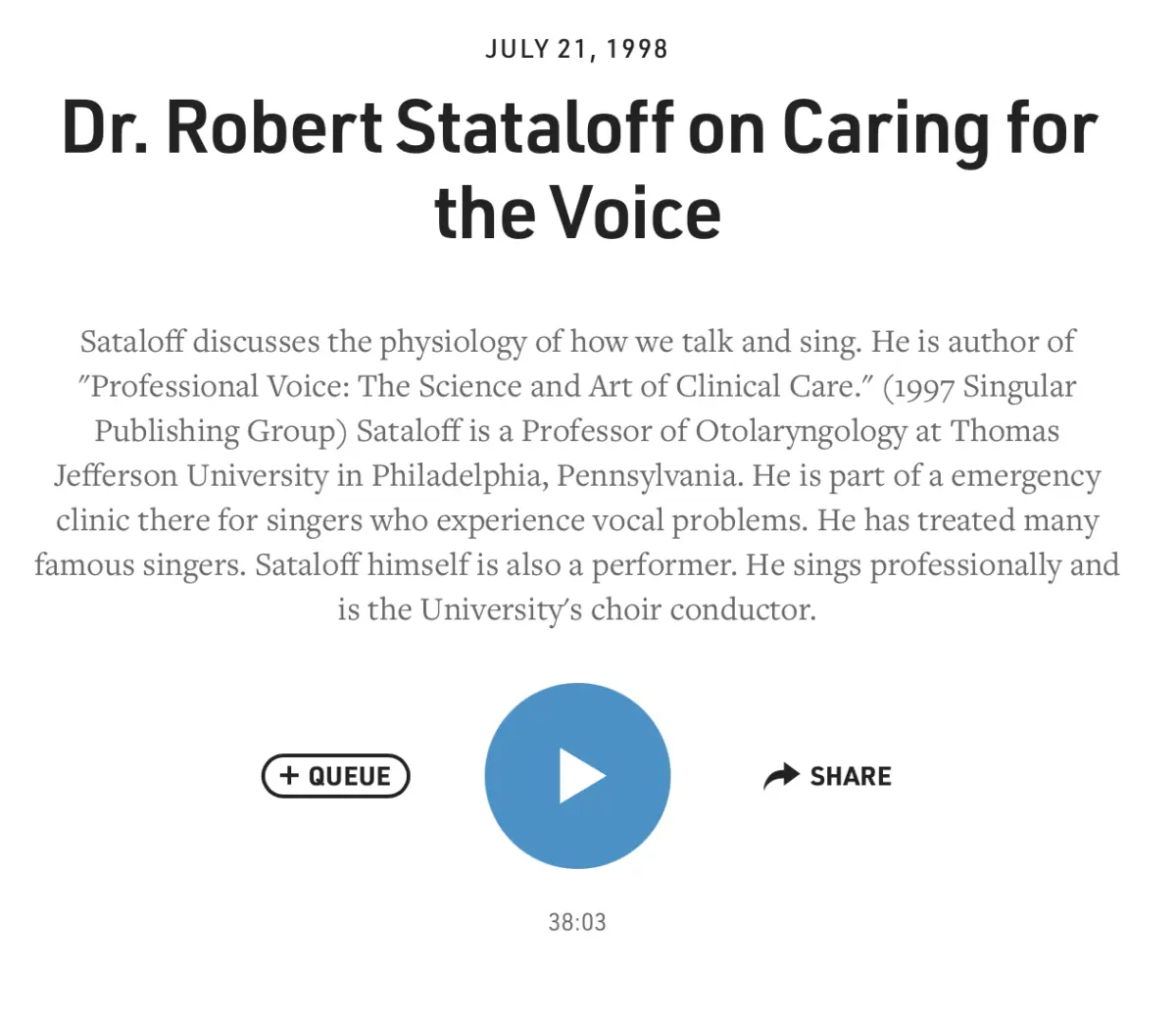
In January 2023, The Voice Foundation spotlighted a profound piece of broadcast and medical history: a deep-dive archival feature revisiting the renowned otolaryngologist Dr. Robert Thayer Sataloff’s classic 1998 interview on NPR’s Fresh Air with host Terry Gross. Originally broadcast during an era when Laryngology and specialized voice care were still fighting for mainstream recognition as distinct medical sub-specialties, this interview serves as a fascinating time capsule. It captures a pivotal moment when the science of the voice stepped out of the shadows of general otolaryngology and into the public consciousness.
This retrospective look is more than a nostalgic nod to late-90s public radio. It offers a timeless masterclass in vocal physiology, the fragility of the human vocal cords, and the groundbreaking medical interventions that have since saved the careers of countless world-class singers, actors, broadcasters, and public speakers. Dr. Sataloff’s conversation with Gross broke down complex clinical concepts—ranging from mucosal wave dynamics to the physiological impacts of psychological stress—making them accessible to millions of listeners. This article provides an exhaustive exploration of that historic interview, contextualizing its enduring impact on modern voice science, otolaryngology, and performing arts medicine.
Detailed Chronology: The Evolution of Voice Care and the 1998 Milestone
To fully appreciate the significance of Dr. Sataloff’s appearance on Fresh Air, one must trace the historical trajectory of vocal medicine. For centuries, injuries or disorders of the voice were poorly understood. Singers and speakers experiencing chronic hoarseness, sudden loss of range, or vocal fatigue were frequently given rudimentary advice: "rest your voice," or worse, subjected to crude, invasive treatments based on trial and error.
The Pre-Specialization Era (Pre-1970s)
Before the emergence of dedicated laryngology and voice clinics, vocal problems fell under the broad umbrella of general Ear, Nose, and Throat (ENT) medicine. While general ENT specialists were exceptionally skilled at treating sinus infections, tonsillitis, and standard pathology, they rarely possessed the specialized tools or granular training required to analyze the microscopic oscillations of the vocal folds. A standard physical examination of the larynx often involved a small indirect mirror held at the back of the throat—a method that offered only a fleeting, static glimpse of a structure that vibrates hundreds of times per second.
The Rise of Modern Laryngology (1970s–1990s)
The landscape of vocal medicine transformed dramatically in the latter half of the 20th century. Technological breakthroughs revolutionized the field, most notably:
- Stroboscopy: The development of rigid and flexible laryngoscopes equipped with stroboscopic light sources allowed physicians to optically "slow down" the rapid vibration of the vocal folds, rendering the mucosal wave visible to the naked eye.
- Acoustic and Aerodynamic Analysis: Sophisticated computer software enabled objective measurement of jitter, shimmer, airflow rates, and subglottic pressure.
- Interdisciplinary Collaboration: Pioneers like Dr. Sataloff recognized that treating a singer or professional voice user required a collaborative team: otolaryngologists, speech-language pathologists, singing voice specialists, and voice scientists working in unison.
The 1998 Fresh Air Broadcast
By 1998, Dr. Robert Thayer Sataloff was already recognized globally as a titan in the field. Serving as a professor, clinician, conductor, and author, he stood at the vanguard of performing arts medicine. When Terry Gross welcomed him onto Fresh Air, the interview struck a chord because it bridged the gap between clinical science and human artistry.
Gross—known for her incisive, deeply researched interviewing style—pressed Dr. Sataloff on the everyday vulnerabilities of the voice. They explored how common ailments like acid reflux, common colds, emotional distress, and environmental pollutants can permanently alter or temporarily derail a professional career. The interview demystified the throat, reframing the vocal folds not merely as passive tissues, but as finely tuned instruments subject to wear, tear, and miraculous recovery.

Supporting Context & Metrics: The Anatomy of Vulnerability
To understand the insights Dr. Sataloff shared with Terry Gross, it is vital to examine the physiological realities of the human voice. The vocal folds are composed of remarkably delicate layers of tissue, including the epithelium, the superficial layer of the lamina propria (Reinke’s space), intermediate and deep layers, and the thyroarytenoid muscle.
The Physics of Phonation
During phonation, air expelled from the lungs rushes past the approximated vocal folds, setting the mucosal tissue into rapid, undulating motion. For a normal human speaking voice, these folds vibrate approximately 100 to 250 times per second; for a soprano hitting high notes, that frequency can skyrocket past 1,000 cycles per second.
Consider the following clinical metrics that underscore the precision required for vocal production:
- Microscopic Margins: The vibratory portion of the vocal fold in an adult is roughly 11 to 17 millimeters in length. Pathology as small as a fraction of a millimeter—such as a micro-hemorrhage, a tiny nodule, or a localized polyp—can drastically disrupt the mucosal wave, leading to dysphonia (hoarseness).
- Hydration Dependency: The superficial layer of the lamina propria relies heavily on systemic and surface hydration to maintain its optimal viscoelastic properties. Dehydration increases the viscosity of the vocal fold mucosa, requiring higher phonation threshold pressure—essentially forcing the vocal folds to collide with greater mechanical impact, accelerating fatigue and injury.
- Prevalence in Professional Populations: Studies in vocal health indicate that up to 30% of the working population rely heavily on their voices as primary occupational tools (teachers, lawyers, sales professionals, call center agents, and performers). Among these, voice disorders account for significant productivity losses, absenteeism, and early career terminations.
Environmental and Lifestyle Stressors Highlighted by Sataloff
In his discussions with Terry Gross, Dr. Sataloff repeatedly emphasized the multifactorial nature of voice disorders. Vocal health is not isolated to the larynx; it is a systemic reflection of the entire body’s health. Key factors include:
- Laryngopharyngeal Reflux (LPR): Unlike classic gastroesophageal reflux disease (GERD), LPR often occurs silently without classic heartburn. Stomach acid and pepsin travel up the esophagus, directly irritating the sensitive posterior larynx and vocal folds, leading to morning hoarseness, chronic throat clearing, and granulomas.
- Endocrine Influences: Hormonal fluctuations—particularly thyroid imbalances and sex hormone shifts during the menstrual cycle or menopause—have profound structural and functional impacts on vocal fold tissues.
- Psychogenic Factors: The voice is arguably the most sensitive emotional barometer of the human psyche. Anxiety, depression, and acute stress manifest physically in the laryngeal musculature, causing hyperfunction, muscle tension dysphonia, and even psychogenic aphonia (sudden loss of voice without structural pathology).
Official Statements and Archival Significance
The decision by The Voice Foundation—an international organization founded by Dr. Sataloff and other visionaries to advance all aspects of voice medicine and research—to republish and promote the 1998 interview highlights the enduring value of foundational media archives.
“Revisiting historical dialogues like Dr. Sataloff’s conversation with Terry Gross reminds our community of how far we have traveled, while underscoring the timeless principles of vocal stewardship. The challenges performers faced in 1998—balancing artistic demands with rigorous vocal hygiene—remain utterly relevant today in the era of non-stop digital broadcasting, podcasts, and global touring.”
— Archival Review Notes, The Voice Foundation
When Dr. Sataloff spoke on Fresh Air, he articulated a philosophy that has since become the gold standard of modern voice care: prevention and education are vastly superior to surgical intervention. He urged performers, parents, and educators to recognize the early warning signs of vocal fatigue—such as loss of upper range, increased effort required to speak or sing, and a persistent need to clear the throat—long before irreversible pathology develops.
Furthermore, the interview served as a public service announcement against prevailing medical myths of the era. Dr. Sataloff systematically debunked the notion that harsh home remedies, casual self-medication with over-the-counter numbing sprays, or ignoring persistent hoarseness were acceptable strategies. By bringing these clinical truths to NPR’s massive, intellectually curious audience, the broadcast legitimized voice care as a rigorous scientific discipline rather than a collection of theatrical old-wives’ tales.

Future Outlook: The Next Frontier in Vocal Health and Science
As we look toward the future, the foundational insights provided by experts like Dr. Robert Thayer Sataloff continue to pave the way for cutting-edge advancements in otolaryngology and regenerative medicine. The intersection of modern technology and voice science is opening doors that seemed purely sci-fi during the 1998 broadcast.
Regenerative Medicine and Stem Cell Therapy
One of the most promising frontiers in voice care involves tissue engineering and regenerative medicine. Treating scarring of the vocal fold lamina propria—historically one of the most stubborn and career-ending conditions in professional singers—is moving away from purely ablative surgery. Researchers are actively exploring:
- Injectable Biopolymers and Hydrogels: Designing synthetic and biological scaffolds that mimic the unique viscoelastic properties of healthy vocal fold tissue.
- Stem Cell Applications: Utilizing mesenchymal stem cells to regenerate damaged mucosal tissue and eliminate fibrous scar tissue without altering vibratory mechanics.
Artificial Intelligence and Advanced Diagnostics
Machine learning and artificial intelligence are revolutionizing early detection. Advanced acoustic diagnostic tools powered by AI algorithms can now analyze voice samples captured via smartphone or clinical recording equipment, detecting subtle acoustic markers of laryngeal pathology, neurological voice disorders (such as spasmodic dysphonia or Parkinson’s-related vocal changes), and fatigue long before they become clinically severe.
Telehealth and Global Access to Voice Care
The COVID-19 pandemic accelerated the adoption of tele-laryngology and virtual voice therapy. While a stroboscopic examination still requires an in-person visit to a specialized otolaryngologist, synchronous telehealth platforms have enabled speech-language pathologists and voice coaches to monitor vocal rehabilitation, conduct auditory-perceptual evaluations, and provide continuous guidance to patients across the globe.
Continuing the Legacy
The re-emergence of historical milestones like the 1998 Fresh Air interview serves a vital purpose for a new generation of medical professionals, speech therapists, and vocal artists. It bridges the gap between historical discovery and future innovation. Dr. Sataloff’s clear, compassionate, and uncompromisingly scientific explanations remind us that while our tools—from stroboscopes to AI diagnostics—will continue to evolve, the core mission of voice care remains unchanged: to protect, heal, and elevate the most uniquely human instrument of all.
For those interested in exploring the complete archival recording, the full interview can be accessed through the Fresh Air Archive or by visiting official educational portals hosted by The Voice Foundation.