
Executive Overview
To understand the enduring spirit of the Tampere Jazz Happening, one must first understand Finland’s relationship with time, water, and heat. Two millennia ago, the Roman Empire elevated bathing to an architectural and social art form, weaving an entire culture around the communal bathhouse. Though the legions of Rome never marched north into the rugged, pine-forested expanses of Fennoscandia, that ancient Mediterranean ethos found a permanent, fiercely preserved home in the Finnish sauna. Today, as steam rises from wood-fired and electric stoves across the country of a thousand lakes, this continuous, unbroken tradition of communal cleansing and contemplation remains as vital as it was in antiquity.
It was against this cultural backdrop of ritual purification and deep-seated community that the Tampere Jazz Happening (TJH) celebrated its landmark 45th anniversary. Marking a significant turning point in the festival’s illustrious history, this year’s edition also signaled the dawn of a new era. Following the retirement of long-serving visionary Juhamatti Kauppinen after decades of dedicated stewardship, the curatorial reins were handed over for the first time to Martyna van Nieuwland. Stepping into the role of artistic director, van Nieuwland faced the delicate task of balancing the festival’s storied heritage with a forward-thinking, risk-taking programming ethos.
Spanning four days from October 29 to November 1, the 45th Tampere Jazz Happening proved that avant-garde jazz and improvised music share a profound kinship with the Finnish national character: both require endurance, deep listening, a willingness to embrace the raw elements, and a delicate balance between intense heat and profound serenity. Across iconic venues such as the recently renovated Pakkahuone—a historic former customs house situated a stone’s throw from the Tampere railway station—and the buzzing, intimate confines of the Telakka venue, international luminaries and homegrown Finnish trailblazers converged. They delivered a masterclass in sonic exploration, proving once again why Tampere remains one of Europe’s most vital pilgrimage sites for contemporary jazz aficionados.
Detailed Chronology: A Weekend of Elemental Improvisation
Day One: Opening Heat and National Recognition
In Finland, the British tradition of clocking out on a Friday afternoon to crowd into a smoke-filled pub is seamlessly replaced by a pilgrimage to an overcrowded public lakeside bathhouse. Locals and festival-goers alike gathered at Kaupinojan Sauna, nestled directly on the frigid shores of Lake Pyhäjärvi, alternating between the searing heat of the timber-lined hot rooms and the breathtaking shock of the icy lake waters. It was a uniquely grounding, sensory-rich preparation for a long, demanding evening of cutting-edge jazz.
The official festival proceedings commenced at Pakkahuone with a moment of national pride: the presentation of the prestigious Yrjö Award to multi-instrumentalist Pauli Lyytinen. Stepping onto the stage alongside master drummer Markku Ounaskari, Lyytinen immediately set a high bar. The duo delivered an intense, telepathic performance characterized by intricate rhythmic interplay and textural depth, opening a marathon series of concerts at the historic customs house.
For those eager to dive deeper into the current state of Finnish improvised music, a brief, brisk walk between Pakkahuone and the nearby Telakka venue offered instant rewards. Telakka was packed to capacity, hosting a triple-bill of boundary-pushing acts. Among them, vocalist Anna Dantchev and her Dantchev Domain quartet captivated the room by subverting traditional jazz instrumentation. Eschewing the ubiquitous double bass that so often anchors a vocal-led ensemble, Dantchev opted for a striking frontline of trombone and tuba, underpinned by driving, nuanced percussion. The result was a rich, dark-toned acoustic landscape that immediately established the festival’s appetite for unconventional sonic pairings.
Day Two: Transatlantic Dialogues and Miraculous Instruments
As the local population engaged in philosophical deliberations within the steam of the saunas, visiting international artists engaged in an equally intense musical dialogue. The ensemble Cosmic Ear, featuring Goran and his fellow musicians, offered a masterclass in spontaneous composition. Trumpet and double bass stood face-to-face on the stage, sparring in agile counterpoint before eventually merging into massive, unified statements. While occasional treatments of electronic sound expanded the group’s palette, the deep, traditional spirit of creative jazz remained firmly at the core.
The morning and afternoon transitions also highlighted the sheer physical realities of touring avant-garde musicians. The searing, visceral saxophone work of Mats Gustafsson offered a stark, abrasive contrast to the more restrained, velvety tones of Christer Bothén’s bass clarinet. As true multi-instrumentalists steeped in the exploratory ethos of Don Cherry, these artists moved effortlessly between bass clarinet, grand piano, acoustic percussion, and the rare six-string n’goni. However, international logistics nearly derailed a key performance: due to strict airline regulations regarding traditional African instruments, the n’goni had been left stranded at a departure airport. In true festival spirit, the organizers scrambled to execute a miraculous eleventh-hour rescue mission, successfully sourcing a replacement n’goni and ensuring it reached the stage in time for the performance.
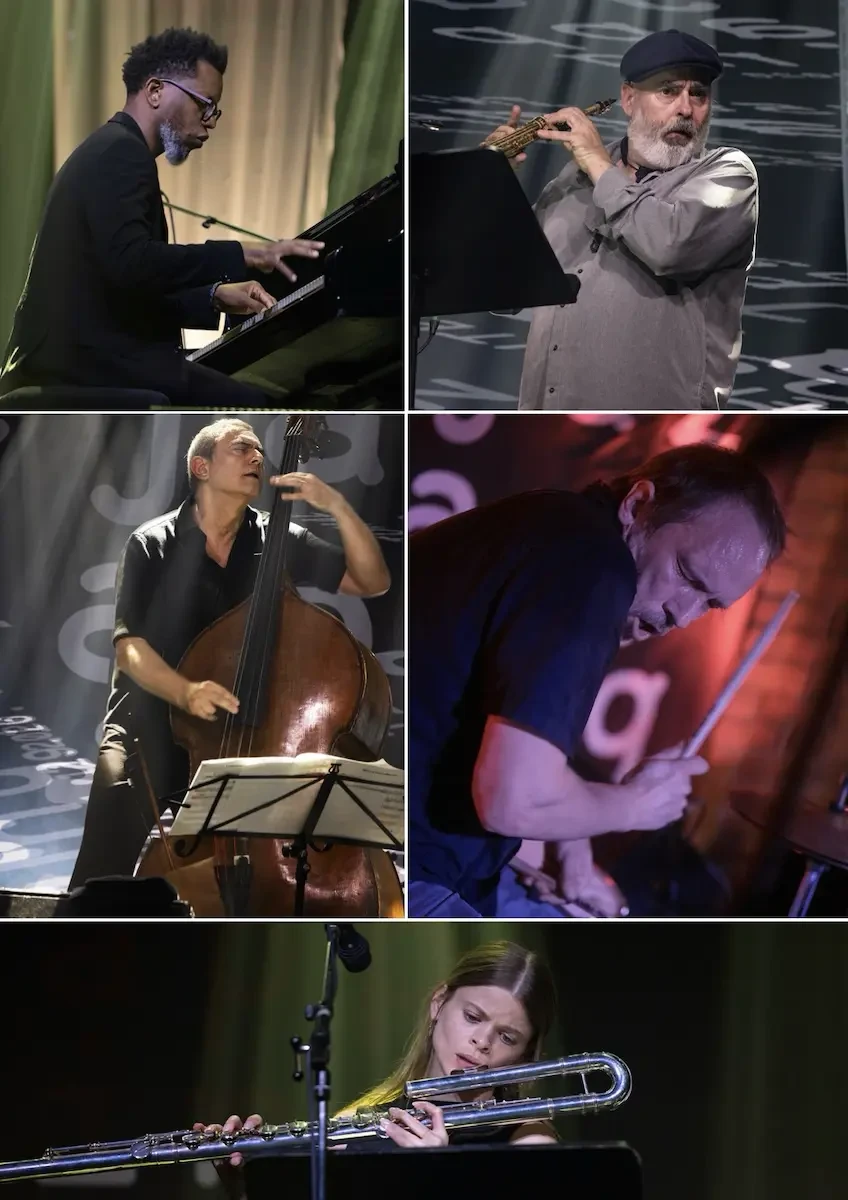
Later, the focus shifted to the expansive sonic architecture of pianist Aruán Ortiz and his newly conceptualized project, I’ve Known Rivers—which, given the geographical context of Finland’s sprawling waterways, might easily have been retitled I’ve Known Lakes. The project’s title nods to Langston Hughes’ seminal 1920 poem, as well as an avant-garde chamber jazz concept originally forged in the 1980s by pianist Anthony Davis, flutist James Newton, and cellist Abdul Wadud.
Assembling an exceptional trio alongside flutist Laura Cocks and cellist Jeremy Harman, Ortiz created a soundworld that mirrored the natural topography of Tampere itself. The city owes its very existence to Tammerkoski—the powerful rapids that transformed the municipality into an industrial powerhouse in the 19th and 20th centuries and continue to generate hydroelectric power today. Beginning in a subdued, contemplative chamber-jazz register, Ortiz’s trio gradually unleashed a torrent of dynamic energy, serving as a visceral reminder of the immense, untamed force that moving water can unleash.
Day Three: Centenary Celebrations and Free-Jazz Conflagrations
History hung heavy over Pakkahuone on the third day of the festival, marking a full century of Finnish jazz history. Exactly one hundred years ago, a steamship carrying a group of itinerant jazz musicians from New York docked in Helsinki, bringing the syncopated rhythms of the New World to the Nordic shores and planting the seeds for a thriving domestic scene.
To celebrate this centenary, saxophonist Mikko Innanen assembled an all-star octet comprising some of Finland’s finest contemporary improvisers. Performing on the grand Pakkahuone stage, the ensemble reinterpreted foundational Finnish jazz classics through a modern lens. The arrangements discarded nostalgia in favor of rigorous, high-energy deconstruction, breathing radical new life into historical repertoire and proving that the Finnish jazz tradition is as innovative today as it was in its infancy.
Meanwhile, back at the intimate Telakka venue, the free-jazz avant-garde was operating at full throttle. A searing duo performance featuring saxophonist Camila Nebbia and guitarist Jukka Kääriäinen pushed structural boundaries to their absolute limits, setting the stage for one of the festival’s most anticipated collaborations: guitarist Raoul Björkenheim and drummer Paal Nilssen-Love.
Having known and collaborated with each other for over a quarter of a century, Björkenheim and Nilssen-Love used their performance to showcase their first official duo album, Ping. The resulting onslaught of rapid-fire micro-movements, thunderous percussion, and searing guitar feedback left the audience thoroughly exhausted and exhilarated—generating a physical reaction in the room that rivaled the heat of any traditional Finnish sauna.
Returning to Pakkahuone offered a striking gear shift. Dutch alto saxophonist Benjamin Herman brought his celebrated Tokyo Sessions project to the festival. Having spent considerable time immersed in the underground jazz circuits of Japan, Herman introduced his special guest, Japanese tenor saxophonist Tomoaki Baba. The front-line interplay between Herman and Baba was nothing short of phenomenal—a masterclass in telepathic phrasing, lightning-fast harmonic navigation, and deep-groove interaction, buoyed by a powerhouse rhythm section that kept the momentum relentlessly driving forward.
Day Four: Poetic Power and Nordic Serenity
As the festival drew to its conclusion on Sunday, the programming embraced meditative depth and raw, poetic intensity. Among the undisputed highlights of the weekend was French bassist Claude Tchamitchian, who arrived carrying an instrument of immense historical significance—a specialized double bass inherited from the late, legendary Jean-François Jenny-Clarke. Following a string of acclaimed solo concerts and educational masterclasses throughout the Baltic countries, Tchamitchian expressed visible delight in returning to Tampere, this time fronting his Poetic Power trio. Joined by powerhouse drummer Eric Echampard and the remarkably versatile Christophe Monniot on saxophones, Tchamitchian delivered a set of monumental weight and shimmering textural beauty.
Opening the Sunday slate just prior was Beiggja, an ensemble embodying the cross-border collaborative spirit of contemporary European jazz. Featuring an almost entirely Norwegian lineup—with the sole exception of dynamic Dutch saxophonist Kika Sprangers—the quartet transported the audience on an expansive, cinematic journey into the quiet, mist-shrouded serenity of the Scandinavian fjords.
Supporting Context & Metrics: The Anatomy of a Milestone
To fully appreciate the scale and cultural impact of the 45th Tampere Jazz Happening, one must examine the operational metrics and historical weight underpinning the four-day event:
- Longevity and Continuity: Established in 1982, the festival has survived economic shifts, changing musical tides, and the retirement of long-time leadership to maintain its position as one of Europe’s most respected boutique jazz festivals.
- Curatorial Transition: The 2024 edition marked the official handover from Juhamatti Kauppinen—who defined the sound and international prestige of the festival for decades—to new Artistic Director Martyna van Nieuwland, signaling a deliberate pivot toward cross-disciplinary international collaborations and gender-balanced lineups.
- Venue Ecosystem: The festival relies on a dual-anchor venue model. Pakkahuone, the historic red-brick former customs house, serves as the grand stage for large-scale international projects and historical retrospectives, while Telakka—a vibrant cultural hub housed in a 19th-century granary—functions as the crucible for underground, free-jazz, and experimental late-night explorations.
- Economic and Cultural Footprint: Drawing thousands of international delegates, critics, and music tourists to the Pirkanmaa region, the festival injects vital cultural capital into Tampere, reinforcing its dual identity as both a historic industrial manufacturing center and a modern hub for the arts.
Official Statements & Curatorial Vision
Stepping into the role of artistic director for an institution as revered as the Tampere Jazz Happening is no small undertaking. Speaking on her vision for the 45th edition, Martyna van Nieuwland emphasized the importance of maintaining the festival’s adventurous spirit while honoring the institutional memory built by her predecessor:
"Tampere has always possessed a unique gravitational pull for musicians who refuse to stay within safe boundaries," van Nieuwland noted during the festival’s opening weekend. "When we look at the history of this festival, it was built on a willingness to take risks—to invite artists from across the globe to engage with the austere, beautiful landscape of Finland. My goal is to protect that uncompromising curatorial integrity while opening the doors wider to new generational voices, unexpected instrumental combinations, and dialogues that cross historical eras."
Reflecting on the emotional resonance of receiving the Yrjö Award on the Pakkahuone stage, multi-instrumentalist Pauli Lyytinen remarked on the symbiotic relationship between Finnish musicians and their natural environment:
"Playing music in Finland is intrinsically tied to the spaces we inhabit—the vastness of the forests, the changing of the water, and the quiet spaces we carve out for ourselves, whether in a cabin by a lake or in a crowded sauna," Lyytinen said. "To receive this recognition here in Tamp, surrounded by peers who understand the depth of that sonic language, is an absolute honor."
Future Outlook: Looking Ahead to the 46th Edition
As the final notes of Claude Tchamitchian’s Poetic Power trio faded into the crisp autumn air of late Sunday evening, the transient community of musicians, journalists, and avid listeners began to disperse. They left behind a city that had, for four intensive days, served as the global capital of improvised music.
Although Finland famously lacks the deep, sheer-walled fjords of its western neighbor, its countless inland lakes offer an equivalent, incomparable brand of deep tranquillity. For the fortunate few who maintain a lakeside cabin, the ritualistic combination of wood-fired sauna heat and bracing winter swimming remains a luxury that city dwellers can only dream of during the long, dark winter months.
Yet, for the international jazz community, Tampere offers its own form of seasonal reclamation. The festival serves as a vital psychological and cultural anchor, pulling artists and audiences out of the ordinary flow of time and into the unpredictable, exhilarating current of live creation. Already, preparations are underway for the future. Organizers have confirmed that the Tampere Jazz Happening will return for its 46th consecutive edition, scheduled to take place from October 29 to November 1, 2025.
For those who bore witness to the steam, sweat, and sonic breakthroughs of this anniversary year, the journey back to Tampere next autumn is not merely an option—it is an essential annual pilgrimage.