
Executive Overview
The prestigious Gran Teatre del Liceu in Barcelona has announced a significant series of cast changes for its upcoming, highly anticipated autumn staging of Giuseppe Verdi’s monumental opera, Aida. This major realignment of star-studded vocal talent, set to unfold across September and October of 2026, involves several high-profile replacements across principal roles, including Amonasro, the King of Egypt, Radamès, and the High Priestess (Sacerdotessa).
While late-stage casting adjustments are an inherent and often anticipated logistical hurdle in the high-stakes world of international grand opera, the sheer volume of modifications for this specific run of Aida underscores the complex operational dynamics of managing world-class repertory houses. The revisions affect multiple performance dates, introducing both seasoned veterans and thrilling vocal powerhouses to the Liceu stage.
Despite the shifts, the production’s core star power remains exceptionally robust. The staging, famously conceived by acclaimed visual artist and filmmaker Shirin Neshat, will still feature an extraordinary roster of opera superstars, including Anna Netrebko, Anna Pirozzi, Piotr Beczała, and Ekaterina Semenchuk. Musical direction for the run is shared by conductors Antonello Manacorda and Josep Gil, who are tasked with steering the grand orchestral and vocal forces through Verdi’s lush, emotionally charged score.
This report provides an exhaustive breakdown of the announced alterations, a detailed performance-by-performance chronology of the cast configurations, an analysis of the logistical realities driving these changes, and a look ahead at what this means for the broader European classical music season.
Detailed Chronology and Cast Matrix
To fully comprehend the scope of the adjustments at the Gran Teatre del Liceu, one must examine the intricate jigsaw puzzle of alternating casts. Verdi’s Aida is notoriously demanding, requiring stamina, massive vocal projection, and immense dramatic depth. Consequently, major opera houses routinely employ double or triple casts for key roles, particularly over an extended run, to preserve the voices of their artists and ensure peak performance quality.
The recent announcements from the Liceu management outline specific dates for incoming artists who will step in to cover key performances. Below is the precise breakdown of the alterations across the 2026 run.
The Role of Amonasro: Ethiopian King and Father of Aida
The complex, conflicted role of Amonasro—torn between paternal love, patriotic duty, and deep-seated vengeance—has seen the most substantial restructuring.
- Ángel Ódena: The distinguished Spanish baritone steps in to replace Ariun Ganbaatar. Ódena will assume the mantle of Amonasro on September 23, 29, and October 3, 8, 11, and 14, 2026. Known for his rich timbre and commanding dramatic presence in Verdi and Puccini repertoire, Ódena’s integration into the cast brings seasoned reliability to these crucial performances.
- Ludovic Tézier: The celebrated French baritone, widely regarded as one of the preeminent Verdi stylists of his generation, will step in for Igor Golovatenko on September 27, October 2, and October 6, 2026. Tézier’s velvet-toned delivery and profound interpretative depth are expected to be high points of the run.
- Amartuvshin Enkhbat: The powerhouse Mongolian baritone—whose voice has electrified audiences across the globe with its staggering volume, dark core, and old-school Italianate phrasing—will also replace Igor Golovatenko. Enkhbat takes over the role on October 9, 13, and 15, 2026.
The Role of Radamès: The Star-Crossed Egyptian Commander
The role of the heroic military commander Radamès, one of the most perilous and coveted tenor parts in the Italian repertoire, has undergone a pivotal modification at the top of the run.
- Ivan Gyngazov: The acclaimed Russian tenor will now step in to sing Radamès, replacing Yusif Eyvazov. Gyngazov is scheduled to take the stage on September 25, 27, and October 1, 4, and 7, 2026. Gyngazov’s heroic upper extension and dramatic heft make him well-suited to navigate the soaring lines of "Celeste Aida" and the harrowing trials of the Nile and judgment scenes.
The Role of the King of Egypt
The majestic and authoritative ruler of Egypt requires a bass with both gravitas and vocal resonance. The Liceu has adjusted its bass roster for this role across multiple dates.
- Vittorio De Campo: The versatile Italian bass takes over the role of the King, initially replacing Manuel Fuentes. Furthermore, De Campo will share the role alongside bass George Andguladze in place of Riccardo Fassi across various performances throughout the run, ensuring a rich, resonant foundation to the ensemble scenes.
The Role of the Sacerdotessa (High Priestess)
The ethereal, off-stage spiritual voice of the High Priestess, which cuts through the solemn temple scenes to invoke Ptah, requires pristine vocal control and silvery tone. The Liceu has divided these duties cleanly between two talented sopranos:
- Carmen Buendía: Will sing the role of the Sacerdotessa on September 25, 28, and October 1, 2, 4, 6, 9, 13, and 15, 2026.
- Núria Vilà: Will take on the role of the Sacerdotessa on September 23, 27, 29, and October 3, 7, 8, 11, and 14, 2026.
Supporting Context & Operational Metrics
The Economics and Logistics of Major Opera Casting
The operational mechanics behind a top-tier European opera house like the Gran Teatre del Liceu are staggering. Planning an institutional-scale production like Aida requires years of advance coordination. Set design, costume fabrication, orchestral rehearsals, chorus preparation, and star artist bookings are locked in long before the curtain rises. However, the modern operatic ecosystem is uniquely vulnerable to last-minute disruptions.
- Vocal Preservation and Fatigue: Aida is a heavy-weight opera. The title role, Radamès, and Amonasro are endurance tests. Double-casting is not merely a convenience; it is an absolute necessity to prevent vocal burnout and injury. When an artist withdraws due to illness, scheduling conflicts, or personal reasons, the administrative domino effect requires immediate negotiation with management agencies across time zones.
- The Global Talent Pool: The ability of the Liceu to secure artists of the caliber of Ludovic Tézier, Amartuvshin Enkhbat, and Ivan Gyngazov on relatively short notice highlights the theater’s immense global prestige. Singers of this tier maintain complex international calendars, often booked years in advance at the Metropolitan Opera, Teatro alla Scala, the Vienna State Opera, and the Royal Opera House, Covent Garden. Securing their availability speaks to the robust networking capabilities of the Liceu’s artistic administration.
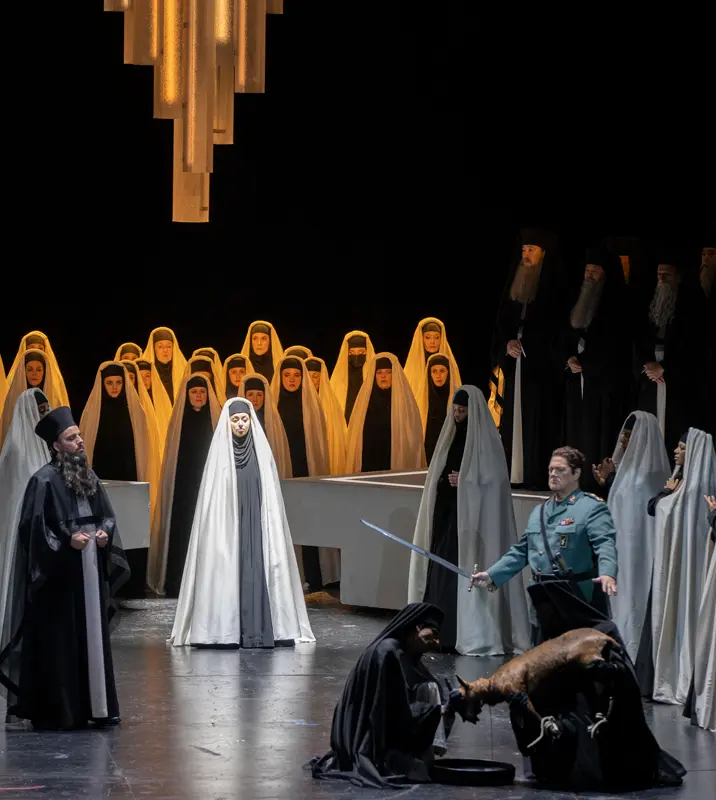
- Shirin Neshat’s Vision: A critical factor anchoring this production is the distinct directorial vision of Shirin Neshat. Known for her striking, politically resonant, and visually arresting cinematic style, Neshat’s production of Aida relies heavily on stark imagery, geopolitical subtext, and rigorous spatial choreography. Cast changes must seamlessly integrate into an already established mise-en-scène, requiring quick-study artists who can adapt to complex directorial blocking without compromising the artistic integrity of the original staging concept.
Official Statements and Artistic Analysis
While administrative adjustments of this nature are frequently handled through standard press communications rather than exhaustive executive press conferences, the underlying curatorial philosophy remains transparent: the show must not only go on, but it must excel at the highest possible international standard.
In its official release, Liceu management emphasized that the integrity of the musical and theatrical presentation remains unimpaired. The engagement of elite artists such as Ludovic Tėzier and Amartuvshin Enkhbat ensures that the dramatic confrontations between father (Amonasro) and daughter (Aida) will lose none of their psychological intensity or vocal thunder. Similarly, the insertion of Ivan Gyngazov guarantees that the romantic and military tragedies of Radamès will be delivered with unyielding passion.
The Core Ensemble: Unshaken Pillars
It is vital to note that the primary anchors of the production remain firmly in place. The presence of international megastars Anna Netrebko and Anna Pirozzi—who share or alternate in the grueling title role of the enslaved Ethiopian princess—ensures massive public and critical interest. Pirozzi is celebrated globally for her searing Italianate high notes and visceral dramatic commitment, while Netrebko remains one of the defining operatic sopranos of the 21st century, renowned for her vocal luxury and magnetic stage presence.
Furthermore, the participation of tenor Piotr Beczała (alternating in select performances) and mezzo-soprano Ekaterina Semenchuk as the fiercely jealous Egyptian princess Amneris guarantees that the vocal fireworks of the upper cast remain undiminished. Semenchuk’s portrayal of Amneris—a role defined by psychological torment, unrequited love, and vengeful fury—is widely considered definitive by modern standards.
On the podium, maestro Antonello Manacorda brings his rigorous attention to orchestral detail, balancing the monumental brass choruses of the Triumphal Scene with the intimate, chamber-like woodwind textures that characterize Verdi’s late-style scoring. Alongside co-conductor Josep Gil, the musical leadership is well-equipped to guide the incoming cast members through the specific acoustic landscape of the Liceu.
Future Outlook: The 2026/2027 Season at the Liceu
As the Gran Teatre del Liceu prepares for the curtain to rise on September 25, 2026, the focus shifts from administrative logistics to artistic execution. The autumn run of Aida serves as a cornerstone of the theater’s seasonal calendar, drawing operagoers from across Europe, Asia, and the Americas to the iconic Ramblas venue.
What Audiences Can Expect
- High Artistic Stakes: With multiple cast permutations involving vocal heavyweights, no two performances of this Aida run will be identical. Opera connoisseurs are already analyzing the specific date combinations to catch particular vocal pairings—such as the pairing of specific Amonasros with the reigning sopranos.
- Directoralty Re-engagement: The revival of Shirin Neshat’s production will test how well the visual and thematic concepts hold up upon restaging. The adaptability of the incoming artists—Ódena, Tézier, Enkhbat, Gyngazov, De Campo, Buendía, and Vilà—will be critical in maintaining the tight theatrical cohesion demanded by Neshat’s aesthetic.
- Box Office Resilience: Despite the shifting roster, demand for tickets remains extraordinarily high. The brand equity of the Gran Teatre del Liceu, combined with the presence of global icons like Netrebko, Pirozzi, and Beczała, ensures that the production will be a major cultural event of the Spanish autumn.
In conclusion, while cast changes of this magnitude can occasionally create logistical ripples, the Liceu’s proactive recalibration demonstrates agile arts management. By securing world-class replacements without compromising the artistic ambition of the project, the theatre has reaffirmed its status as one of the premier opera houses in the world. As the brass fanfare of the grand march echoes through the hall this September, audiences can anticipate an Aida that honors Verdi’s timeless genius while showcasing the extraordinary adaptability and resilience of contemporary grand opera.