
Executive Overview
Music education is universally recognized as one of the most creatively fulfilling vocations in the academic sphere, yet it remains intensely demanding. Behind every soaring concert band performance, pristine choir recital, and brilliantly executed orchestra piece lies a labyrinth of administrative burdens: managing sprawling rehearsals, tracking granular student progress, drafting comprehensive lesson plans, and grading hundreds of individual practice submissions. For many educators, the daily routine is a relentless race against the clock.
Recognizing these systemic pressures, the educational technology sector is undergoing a paradigm shift. Platforms like MakeMusic are leading the charge by introducing advanced collaboration features designed to dismantle professional isolation. By bridging the gap between co-teachers, streamlining departmental workflows, and fostering vast online educator communities, these digital solutions are transforming how music is taught.
This article explores the critical evolution of collaborative music teaching, examining new platform capabilities such as robust co-teaching integrations and cross-organizational assignment sharing. By analyzing these modern workflows, we uncover how educators are reclaiming their time, standardizing curricula, and ultimately returning their focus to what matters most: inspiring the next generation of musicians.
Detailed Chronology: The Evolution of Digital Collaboration in Music Instruction
To understand the significance of today’s collaborative tools, one must trace the evolutionary trajectory of music education technology over the past two decades.
Phase 1: The Analog Era and Isolated Workstations (Early 2000s)
In the early days of digital music notation and practice software, tools were largely designed for individual use. A teacher would log into a standalone desktop application, create assignments, and manage a single roster. Collaboration was strictly analog—teachers shared physical manila folders of sheet music, photocopied theory worksheets by hand, and held exhausting after-school departmental meetings to align their curricula. If an educator fell ill or shared an ensemble with a colleague, bridging the gap required tedious manual handoffs, mismatched login credentials, and fragmented record-keeping.
Phase 2: The Migration to the Cloud (2010s)
As cloud computing matured, software developers began migrating music practice platforms to web-based ecosystems. MakeMusic Cloud and similar environments allowed students to practice at home while giving teachers centralized dashboards to view assignments and grades. While this drastically improved student-facing workflows, teacher-to-teacher collaboration remained rudimentary. Educators could view data for their own assigned classes, but cross-collaborating meant exporting data files, sending cumbersome emails, or sharing a single administrative account password—a practice fraught with security and privacy concerns.
Phase 3: The Integrated Ecosystem and Co-Teaching Revolution (Present Day)
Entering the mid-2020s, platform developers recognized that modern music programs are rarely run by a single, isolated instructor. Large marching bands, comprehensive middle school programs, and high school concert ensembles often require multiple directors working in tandem.
In response, developers rolled out dedicated co-teaching functionalities. No longer limited to a single administrative view, teachers could formally invite colleagues into shared digital classrooms with full transparency. Concurrently, the introduction of advanced assessment tools—such as flexible Multiple Choice Assessments for theory and listening comprehension—paved the way for cross-organizational resource sharing. Educators could finally build, curate, and distribute standardized quizzes and instructional materials across an entire school district with a few simple clicks, establishing a unified standard for music literacy.
Supporting Context & Metrics: The Reality of the Modern Music Educator
To fully appreciate the necessity of these technological advancements, one must examine the operational realities facing modern music classrooms.
The Burnout Epidemic
According to recent pedagogical surveys across K-12 arts education, fine arts teachers experience high rates of emotional and administrative exhaustion. Unlike traditional classroom subjects where a teacher may instruct the same group of students in standardized blocks, music educators frequently juggle multiple distinct ensembles (e.g., concert band, jazz band, marching band, wind ensemble, and freshman music theory) encompassing anywhere from 50 to upwards of 200 students per day.
When factored against the need to evaluate individualized instrumental and vocal performances—listening for pitch accuracy, rhythm, tone quality, and articulation—the grading workload becomes staggering. A teacher spending just three minutes evaluating a single student’s weekly practice submission for a 150-student program invests over seven hours per week solely on digital listening logs, before lesson planning, rehearsal staging, and administrative reporting even begin.
The "Island" Phenomenon
Compounding the workload is the geographic and structural isolation inherent to many school environments. A significant percentage of music educators are "departments of one"—meaning they are the sole fine arts instructor in their elementary school, middle school, or even small high school. Without a peer down the hall to bounce ideas off of, validate grading rubrics, or share assessment creation duties, these educators operate on an island.
Even within larger, multi-teacher programs, scheduling conflicts often prevent directors from collaborating effectively. Marching band directors might spend the fall season managing distinct instrument sections across different practice fields, struggling to maintain a unified ledger of student achievements.
The Digital Solution: Bridging the Gap
Modern collaborative software addresses these structural pain points directly:
- Administrative Efficiency: Co-teaching integrations cut redundant data entry and inter-director communication time by up to 50% in shared large ensembles.
- Curricular Consistency: Intra-organizational assignment sharing eliminates the "reinventing the wheel" phenomenon, allowing a department of four teachers to split assessment design duties rather than each creating separate quizzes from scratch.
- Professional Support Networks: Online professional learning communities (PLCs), such as specialized educator Facebook groups and digital forums, provide immediate sounding boards that mitigate isolation and accelerate the adoption of best practices.
Official Statements and Platform Architecture: Inside the Technology
The operational mechanics of these collaborative tools reflect a deep understanding of pedagogical workflows. Industry leaders and educators alike have highlighted the transformative impact of these platform integrations.
Deconstructing the Co-Teaching Architecture
The core philosophy behind modern co-teaching tools is simple yet profound: two conductors, one vision. Rather than forcing schools to rely on awkward workaround methods, platforms like MakeMusic have formalized co-teaching directly within class settings.
+-----------------------------------------------------------------+
|                       CLASS SETTINGS                            |
|                                                                 |
|  Primary Instructor (Director A)                                |
|         |                                                       |
|         +---> Invites Co-Teacher via Email                      |
|                     |                                           |
|                     v                                           |
|         Secondary Instructor (Director B / Student Teacher /    |
|                                        Special Ed Support)      |
|                                                                 |
|  [Shared Access: Rosters, Grading, Assignments, Analytics]      |
+-----------------------------------------------------------------+
When a primary instructor adds a co-teacher to a MakeMusic class via email invitation, both educators gain synchronized access to the digital environment. This architecture serves several vital educational paradigms:
- Large Ensemble Partnerships: When two directors share a massive concert band or marching band program, co-teaching ensures both leaders work from the exact same real-time data. There is no longer a need to compare notes at the end of the day or coordinate schedules to review student submissions.
- Mentoring Student Teachers: Veteran educators can integrate student teachers into the actual operational workflow of a classroom. Instead of observing from the sidelines or dealing with restrictive permission tiers, student teachers gain hands-on experience designing assignments, managing rosters, and evaluating student performances under active mentorship.
- Special Education Integration: In inclusive classrooms, specialized education co-teachers often work directly alongside ensemble directors to support students with diverse learning needs. By granting these specialists direct access to the platform, they gain the exact pedagogical context required to assist students effectively within their musical repertoire.
The Power of Multiple-Choice Assessments and Resource Sharing
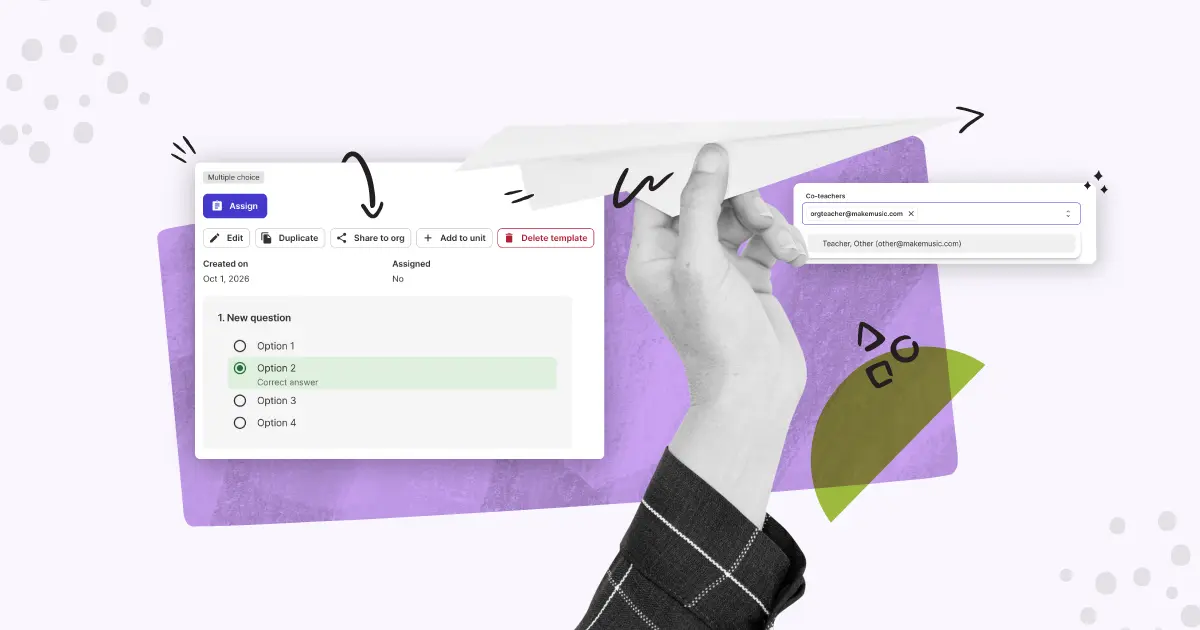
In addition to live co-teaching, recent platform updates have introduced Multiple Choices Assessments. These tools provide a quick, highly flexible framework for evaluating music theory, active listening, notation identification, and historical context.
Recognizing the value of these assets, developers have enabled cross-organizational assignment sharing. The technical workflow is intentionally streamlined:
- An educator designs a robust multiple-choice quiz on complex rhythm notation or interval identification within their personal library.
- From the assignment settings menu, the educator selects the sharing option and designates the asset for internal organizational distribution.
- Colleagues operating within the same educational network or organization can instantly locate the assessment in their shared repository and save a direct copy to their own accounts.
This capability fundamentally changes department dynamics. High school band directors can instantly align their theory benchmarks with middle school feeder programs. Choir directors can share solfège identification exercises effortlessly. Most importantly, newly hired educators can bypass the grueling orientation period of building a curriculum from scratch, stepping into their classrooms with a robust, pre-vetted library of assessments already waiting for them.
Future Outlook: The Horizon of Collaborative Music Pedagogy
As educational technology continues to mature, the future of collaborative music instruction points toward even greater integration, automation, and community connectedness.
Predictive Curriculum Alignment
Looking ahead, industry analysts anticipate that collaborative platforms will begin utilizing anonymized, aggregate data to suggest curriculum improvements. Imagine a platform that recognizes a widespread student deficiency in compound meter rhythm reading across an entire school district, automatically prompting the departmental co-teachers with curated, peer-reviewed remediation assignments.
Expanding Professional Learning Communities (PLCs)
While digital tools handle the operational mechanics of co-teaching and file sharing, the human element of collaboration remains paramount. Online communities—such as the active networks centered around digital teaching platforms—will likely evolve into formal peer-review marketplaces. Educators will not only share quizzes within their local school organizations but will also have opportunities to peer-review, rate, and adopt instructional modules created by master music educators nationwide.
Sustainability as a Core Pedagogical Goal
Ultimately, the overarching trajectory of these innovations points toward a singular objective: making the profession sustainable. For decades, music education has operated on a culture of overwork, where dedicated educators sacrifice personal time to ensure their students receive a world-class artistic foundation.
By automating administrative handoffs, eliminating redundant content creation through seamless sharing, and breaking down the physical and organizational walls of the isolated classroom, modern technology is redefining the vocation. Teaching music will always demand passion, patience, and profound artistic dedication—but with the right collaborative framework in place, educators no longer have to carry the weight alone.
Conclusion
The modern music classroom is a complex, high-energy environment where creativity meets intense administrative demand. Navigating this landscape requires more than just talent and passion; it requires robust support systems.
Through advanced co-teaching integrations, cross-organizational resource sharing, and vibrant professional communities, platforms like MakeMusic are proving that music education is fundamentally better when built on collaboration. By sharing the load, educators can spend less time wrestling with administrative overhead and more time doing what they love: making music come alive for their students.
Ready to transform your workflow and experience a smarter, more connected way to teach music? Explore the tools designed by educators, for educators, and take the next step in your professional journey.