
Executive Overview
For centuries, Western classical and contemporary music instruction has placed the mastery of performance repertoire at the center of the pedagogical universe. Students spend months, sometimes years, polishing single pieces to technical perfection. Yet, a glaring paradox persists across global music academies and private studios: countless pianists who can brilliantly execute a complex Chopin nocturne find themselves utterly paralyzed when handed a basic level-one sight-reading piece.
Lara Mirinjian, an accomplished pianist, dedicated piano instructor, and sight-reading specialist, knows this frustration intimately. "Over ten years of lessons and I still couldn’t read fluently from a level one book," Mirinjian reflects. "It was ridiculous. How was this possible?"
This investigative report examines the structural failures of traditional instrumental pedagogy, explores the psychological and mechanical barriers preventing students from achieving reading fluency, and outlines a principled, systematic framework for transforming sight-reading from an elusive talent into a reliable, mastered skill. By evaluating academic research, pedagogical case studies, and fundamental cognitive principles, this article presents a definitive roadmap for educators, intermediate players, and advanced musicians alike to bridge the gap between technical execution and musical literacy.
Detailed Chronology: The Evolution of Sight-Reading Struggles
The journey to becoming a fluent sight-reader is rarely linear, typically marked by distinct developmental phases characterized by institutional oversight, psychological roadblocks, and eventual pedagogical breakthroughs.
Phase 1: The Illusion of Progress (Years 1–5)
In the early stages of piano instruction, students are introduced to the grand staff, note names, and basic rhythmic values. However, pedagogy often pivots rapidly away from pure reading toward learning by rote, imitation, or memorization. Because students can memorize a piece after a few repetitions, teachers and parents frequently mistake memorization prowess for genuine reading capability. The underlying deficiency remains hidden beneath the veneer of sounding accomplished.
Phase 2: The Widening Gap (Years 5–10)
As repertoire advances in complexity—incorporating polyphony, shifting time signatures, and dense harmonic structures—the cognitive load increases exponentially. Students who lack foundational reading skills resort to grueling, measure-by-measure deciphering. Practice sessions transform into frustrating exercises in memorization rather than explorations of new literature. This is the stage where many students—and adults returning to the instrument—begin to believe they suffer from inherent cognitive deficits, learning disorders like ADD, or a permanent lack of musical aptitude.
Phase 3: Institutional Disconnect and Pedagogical Neglect
Historically, private and institutional music instruction has suffered from a systemic void regarding how to teach sight-reading. Dr. Dianne Hardy, Assistant Professor of Music Education and Piano at Dickinson State University, conducted a landmark study investigating why sight-reading remains so poorly integrated into modern piano curricula. Her findings revealed startling insights from educators themselves:
- The Knowledge Gap: The majority of surveyed teachers admitted they omitted sight-reading from their programs simply because they did not know how to teach it systematically.
- Method Book Omissions: Many educators cited that standard method book series failed to provide sequential, step-by-step instruction on developing the skill.
- Category Error: A significant cohort of teachers failed to recognize sight-reading as a distinct, specialized skill set, erroneously assuming it would automatically improve as a byproduct of learning standard repertoire.
- The Imposter Syndrome: Perhaps most revealingly, several teachers confessed they avoided teaching sight-reading altogether because they were notoriously poor sight-readers themselves.
Phase 4: The Pedagogical Awakening and Principle-Based Mastery
Mirinjian’s trajectory shifted permanently when she encountered an instructor who understood the cognitive mechanics of sight-reading. Rather than relying on rigid, rote methods, this approach was rooted in universal principles. By stripping away complex repertoire and returning to the absolute basics—coupled with strict rules regarding tempo, continuity, and limited exposures—Mirinjian experienced exponential growth in both her own playing and her students’ capabilities.
Supporting Context & Metrics: The Anatomy of Reading Fluency
To understand why traditional approaches fail, one must examine the cognitive architecture required for fluent musical sight-reading. Reading music shares profound structural parallels with reading spoken language.
[Visual Stimulus: Musical Score]
          ↓
[Pattern Recognition & Chunking] (Chords, Scales, Intervals)
          ↓
[Cognitive Anticipation & Motor Planning]
          ↓
[Physical Execution on the Keyboard]
          ↓
[Auditory Feedback & Correction Loop (NO STOPPING)]
The Cognitive Bottleneck: Chunking vs. Decoding
In cognitive psychology, "chunking" refers to the process of grouping individual pieces of information into larger, meaningful units. Novice sight-readers attempt to decode music note-by-note, much like a child sounding out every individual letter in a complex sentence. This overloads working memory.

Advanced sight-readers, conversely, perceive musical patterns—intervals, scalar passages, triads, and inversions—as instantaneous visual clusters. They process whole phrases ahead of their fingers, creating a temporal buffer between the eye, the brain, and the musculature.
Empirical Insights from Academic Research
- The Frequency Factor: Studies in musical cognition indicate that daily, micro-dosed sight-reading (spending 5 to 10 minutes on extremely simple material) yields vastly superior long-term neural adaptations compared to weekly, hour-long cramming sessions.
- The Principle of Non-Interruption: Educational metrics show that students who permit themselves to stop, correct mistakes, and restart during sight-reading exercises reinforce error pathways in the brain. Conversely, maintaining a steady pulse—even if notes are missed—trains the brain to prioritize global momentum over localized perfection.
As the renowned philosopher Ralph Waldo Emerson famously noted:
"As to methods there may be a million and then some, but principles are few. The man who grasps principles can successfully select his own methods. The man who tries methods, ignoring principles, is sure to have trouble."
Official Statements and Pedagogical Frameworks
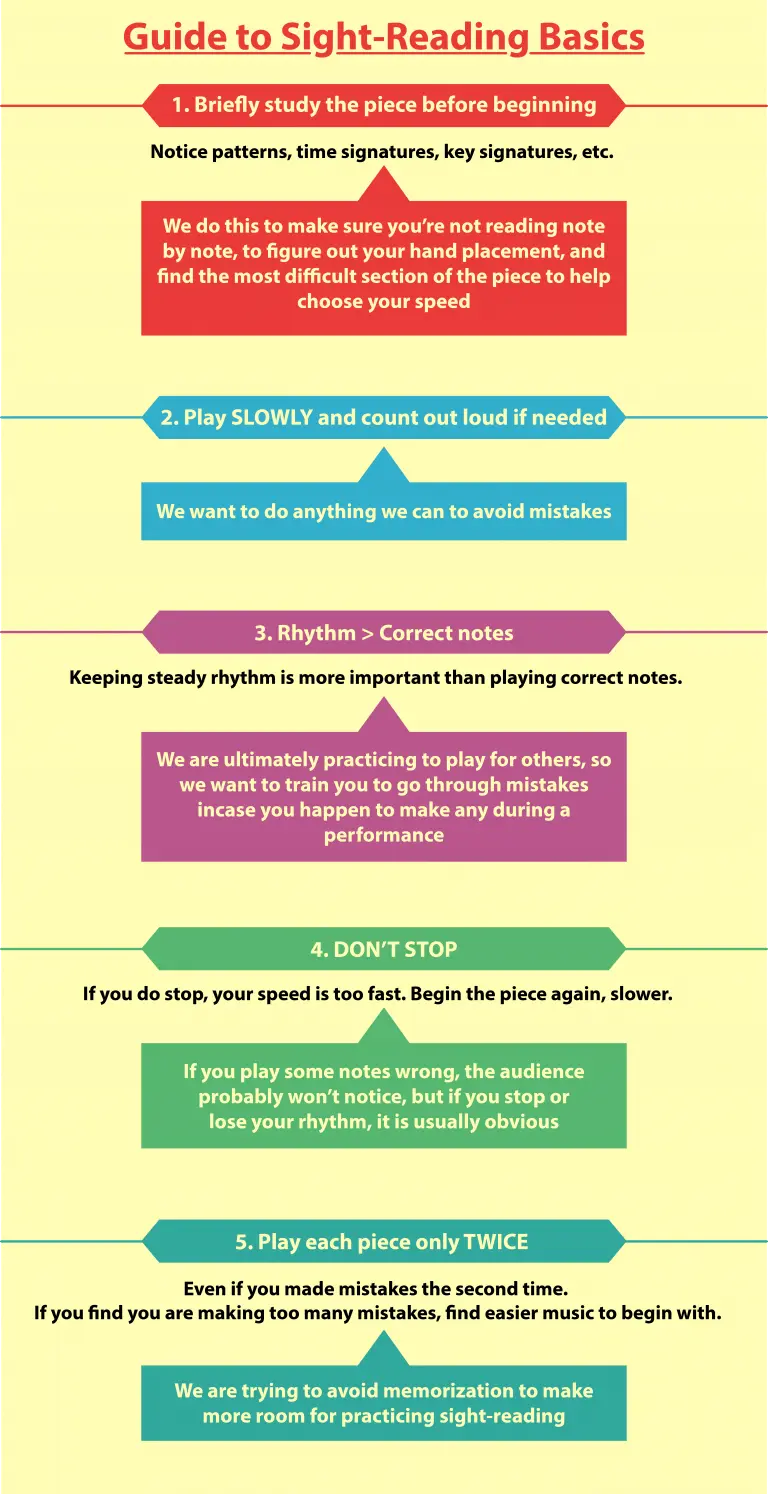
Transitioning from a struggling reader to a confident musician requires strict adherence to core principles. Mirinjian’s framework relies on a disciplined, step-by-step protocol that can be adapted by players of any instrument, though optimized here for the piano.
The Foundational Rules of Sight-Reading Practice
- Embrace Radical Simplicity: Always start with music significantly below your current technical and reading level—even if you are an advanced pianist. This clears out unaddressed "cracks" in your foundational literacy.
- The Two-Read Rule: Read each piece only twice. The first read exposes patterns and challenges; the second solidifies overall shape and fixes minor errors. Lingering longer turns the exercise into repertoire learning rather than sight-reading.
- Rhythm Over Perfection: The absolute pulse must never be sacrificed for an accurate note.
Step-by-Step Implementation Guide
When approaching a new, elementary sight-reading exercise (such as a simple five-note middle C piece):

- Step 1: Environment and Preparation. Secure your score on the music stand or tablet, focusing entirely on the initial micro-piece.
- Step 2: Pre-Reading Pattern Recognition. Scan the score before playing. Identify repetitions, step-wise motions, and directional changes (e.g., “Note starts on C, repeats twice, steps up to D, repeats five times, returns to C”).
- Step 3: Rhythmic Internalization. Analyze the time signature and establish the internal metronomic count, vocalizing the beats out loud (1, 2, 3, 4).
- Step 4: Tactile Positioning. Place hands and fingers on the correct keys proactively before sound is produced.
- Step 5: The Commitment to Motion. Internalize the cardinal rule: Do not stop. If a wrong note is played, let it go. If the brain stalls, slow the entire tempo down rather than halting.
- Step 6: Initial Execution. Play through the piece at an excruciatingly slow, metronomic, and uninterrupted pace.
- Step 7: The Second-Pass Refinement. Execute the piece a second and final time, incorporating immediate cognitive feedback from the first attempt while preserving the underlying tempo.
- Step 8: Progression. Advance immediately to the subsequent, equally accessible piece.
Future Outlook: Redefining Musical Education
As we look toward the future of music pedagogy, the integration of structured sight-reading into standard curricula is no longer viewed as an optional luxury, but as an essential pillar of comprehensive musicianship.
Modern pedagogical evolution is shifting away from the elitist notion that sight-reading is an innate, unteachable talent gifted only to the musical prodigy. Instead, institutions, digital learning platforms, and private instructors are recognizing it as a mechanical, learnable skill grounded in visual recognition, cognitive chunking, and motor coordination.
For the individual musician, acknowledging past reading deficiencies is the first step toward true liberation. By shedding ego, embracing elementary material, and committing to daily, disciplined practice governed by timeless principles, any pianist can dismantle the mental blocks holding them back.
Information without action remains inert. Whether you are a novice struggling with treble clef lines or an advanced performer seeking to refine your structural awareness, the path forward is clear: open a book far below your level, count the pulse, keep your hands moving, and let the transformative power of principle-based sight-reading unlock your true musical potential.