
Executive Overview
The modern music industry operates at a relentless, hyper-accelerated pace. In the era of digital distribution, independent record labels, artist management firms, and boutique music companies are no longer just competing on creative vision; they are competing on operational velocity. Coordinating a single commercial music release requires navigating a labyrinthine web of tasks: scheduling metadata distribution, syncing marketing campaigns, aligning sync licensing pitches, managing physical manufacturing timelines, and ensuring cross-departmental communication.
Enter Groovedesk, a newly launched SaaS startup engineered specifically to address these administrative bottlenecks. Designed to organize and fully automate the lifecycle of music releases, Groovedesk has officially emerged from its incubation phase with over 40 companies already onboarded.
Behind this innovative platform is a founding team of seasoned industry veterans hailing from powerhouses such as Red Light Management, !K7 Music, and Landr. What began as an internal operational hack—developed to solve logistical headaches for their own artist and label services agency, Mega Labs—has rapidly transformed into a standalone software venture. The demand for their proprietary tool was so overwhelming that the founders made the strategic decision to shutter Mega Labs entirely, pivoting their full attention and capital toward building Groovedesk into the industry’s premier workflow automation platform.
This article explores the genesis of Groovedesk, the structural inefficiencies plaguing modern music operations, the backgrounds of its visionary founders, and what this launch signals for the future of independent label infrastructure.
Detailed Chronology: From Agency Pain Points to Standalone SaaS
To understand Groovedesk, one must trace its roots back to the daily operational struggles of Mega Labs, an artist and label services agency run by a collective of forward-thinking music industry executives.
The Mega Labs Era (Pre-2024)
Operating within the modern music landscape means managing a deluge of fragmented software. While artists and labels have access to advanced digital signal processors (DSPs) for distribution and sophisticated marketing analytics dashboards, the internal coordination required to push a record from the mixing studio to digital storefronts has historically been fractured.
The team at Mega Labs found themselves constantly battling administrative friction. Projects were managed across a chaotic mix of generic project management tools, shared spreadsheets, endless email threads, and disparate communication apps. Important release milestones were slipping through the cracks not due to a lack of talent, but because of poor operational synchronization.
Recognizing that custom-built efficiency was the only way to scale their agency without burning out their staff, the leadership team initiated the development of an internal software tool. The goal was simple: build a centralized dashboard that could automate repetitive release workflows, establish clear accountability, and give every stakeholder a real-time snapshot of a campaign’s status.
The Pivot and Productization (2024–2025)
As Mega Labs utilized the software internally, word began to spread across their network of indie label partners, managers, and independent artists. Colleagues across the industry experienced the same administrative bottlenecks and began requesting access to the proprietary tool.
What started as an internal productivity hack quickly revealed itself to be a massive, unserved market opportunity. The music technology sector is saturated with artist-facing distribution tools (such as DistroKid, TuneCore, and Landr) and fan-engagement marketing platforms, but there was a glaring gap in the market for B2B operational software built specifically for the administrative machinery of record labels.
Throughout 2024, the team conducted closed-beta tests, refining the software based on direct feedback from label managers, product directors, and artist publicists. The validation was unequivocal. By the end of 2025, the founders made a bold, calculated gamble: they completely shut down Mega Labs as an agency to concentrate 100% of their resources, capital, and expertise on scaling the software as a standalone platform, officially christening it Groovedesk.
The Official Launch (Late 2026)
Following months of refinement and early adopter testing, Groovedesk officially opened its digital doors to the broader music industry. With more than 40 companies already integrated into the platform during its soft-launch and beta phases, the startup entered the market with immediate commercial traction and proven product-market fit.
Supporting Context & Metrics: The Operational Crisis in Modern Labels
To fully appreciate the value proposition of Groovedesk, one must examine the macro-economic and operational realities facing modern music companies.
The Volume Problem
According to reports from prominent industry trackers, tens of thousands of new tracks are uploaded to streaming services like Spotify and Apple Music every single day. While major labels have entire departments dedicated to global project management, independent labels and boutique music companies often operate with lean, agile teams. A single product manager at an indie label may find themselves simultaneously overseeing release cycles for a dozen different acts.
This sheer volume of output has created an administrative crisis. A typical release checklist can easily span over 100 distinct action items, including:

- Finalizing master delivery and metadata (ISRC, UPC, artist credits).
- Scheduling distribution via aggregators.
- Coordinating press releases, EPKs (Electronic Press Kits), and playlist pitching windows.
- Deploying social media teasers, TikTok audio snippets, and ad campaigns.
- Fulfilling physical manufacturing orders (vinyl, CD, merch) with notoriously backlogged pressing plants.
- Accounting, royalty forecasting, and reporting back to artists and investors.
When executed manually, this process is prone to human error, missed deadlines, and severe team burnout.
The Fragmented Tech Stack Dilemma
Before platforms like Groovedesk entered the fray, music companies relied on a "Frankenstein" tech stack. A label might use Slack for team chat, Asana or Notion for task tracking, Google Drive for asset storage, and proprietary accounting software for financials. None of these platforms inherently understand the nuances of a music release cycle.
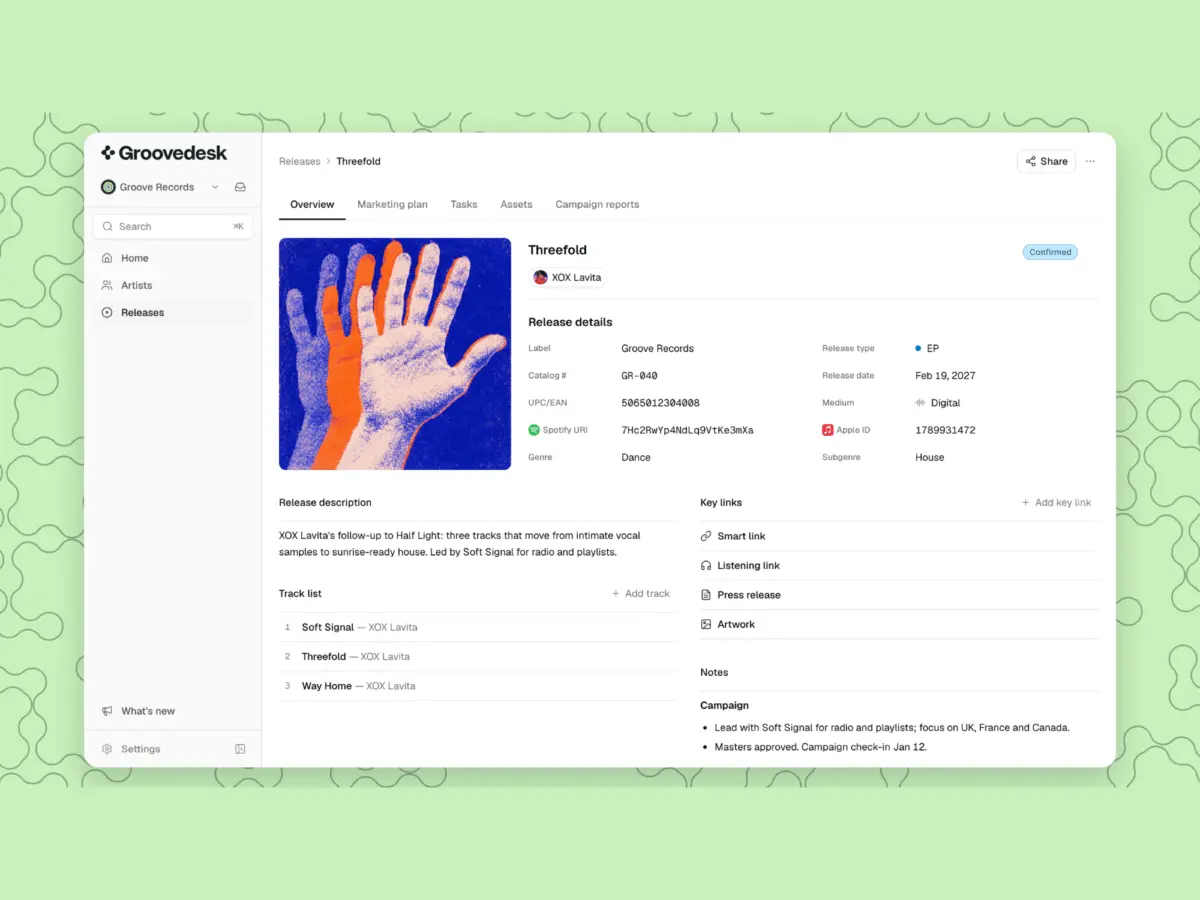
Groovedesk solves this by acting as an operational nerve center. By centralizing asset management, automated timeline generation, and role-based task delegation, the platform bridges the gap between creative output and corporate logistics.
Early Adoption Metrics
The fact that Groovedesk secured over 40 companies during its initial rollout is no small feat in the risk-averse music business. Labels and management firms are notoriously protective of their operational pipelines and data security. The rapid adoption of the platform underscores a desperate industry-wide hunger for specialized B2B productivity tools. These early adopters range from electronic music micro-labels to established independent pop and rock operations, proving the platform’s vertical-agnostic versatility.
Official Statements and Industry Insights
While the founders have kept initial corporate announcements streamlined, the pedigree of the team speaks volumes about the philosophy driving Groovedesk. Comprising industry veterans from Red Light Management (one of the world’s largest independent artist management companies), !K7 Music (the legendary independent electronic and alternative label based in Berlin), and Landr (a pioneer in AI-powered music production and creator tools), the founding team possesses a rare 360-degree view of the music business.
Industry analysts have noted that Groovedesk’s founding team bridges two traditionally siloed worlds: high-level artist representation and scalable tech product development.
"The music industry is brilliant at creating culture, but historically terrible at operational efficiency," notes one independent label consultant familiar with early-stage music tech tools. "For years, labels have tried to force generic project management tools to fit music releases. Groovedesk succeeds because it speaks the native language of the industry—it understands that a release isn’t just a task; it’s a living, breathing, time-sensitive cultural event."
By assembling talent from artist management, label operations, and tech scaling, Groovedesk has positioned itself not as a disruptive tech outsider trying to "fix" the music business, but as an insider-built solution designed by people who have felt the exact pain points they are now eliminating.
Future Outlook: Where Goes Groovedesk?
As Groovedesk steps out of the shadow of its predecessor agency and into the spotlight of the global music tech ecosystem, the road ahead looks both challenging and ripe with opportunity.
Scaling the Platform
The immediate priority for Groovedesk’s executive team is scaling their onboarding infrastructure to accommodate the influx of interest following their public launch. Moving past the initial threshold of 40 companies will require robust customer success frameworks, localized support, and continuous feature expansion based on the diverse workflows of global labels.
Potential Feature Roadmaps
While current functionality centers heavily on release organization and workflow automation, the architectural foundation of Groovedesk opens the door for powerful future integrations. Observers in the music tech space anticipate several potential evolutionary paths for the platform:
- AI-Driven Predictive Scheduling: Utilizing machine learning to analyze past campaign timelines and automatically predict potential bottlenecks or suggest optimal release dates based on genre-specific traffic.
- D2C and Supply Chain Integrations: Expanding automation directly into physical manufacturing networks and direct-to-consumer (D2C) merch stores to streamline vinyl and apparel fulfillment alongside digital drops.
- Financial and Royalty Workflows: Integrating predictive budgeting and automated expense tracking to give label accountants real-time insights into campaign ROI.
A New Standard for Label Operations
Groovedesk’s launch marks a mature shift in the music tech landscape. For over a decade, the lion’s share of venture capital and software development in music was funneled into consumer-facing streaming utilities or creator tools for bedroom producers.
However, the backbone of the industry—the independent labels and management teams that discover, nurture, and break the artists we love—has long been underserved by dedicated enterprise software. By turning their own operational survival guide into a scalable SaaS product, the creators of Groovedesk are not just making music releases easier; they are professionalizing and future-proofing the independent music sector for the decades to come.
As the platform matures and its user base expands beyond its initial cohort of 40 companies, Groovedesk is well-positioned to become the indispensable operating system for the modern music business.