
Executive Overview
On November 19, the Washington National Opera (WNO) presented the second of three deeply anticipated performances of John Adams’s monumental 20th-century masterpiece, Nixon in China. Staged within the cavernous yet acoustically responsive confines of Constitution Hall, this production marked a bold continuation of the company’s recent spatial experimentation. Following the structural blueprint established during their earlier staging of Madama Butterfly, the creative team opted for a central "thrust stage" configuration, enveloping the action with audience seating arrayed across three sides.
The resulting atmosphere was intensely immersive, effectively shrinking the vast expanse of the hall into an intimate chamber for historical reenactment and psychological introspection. By combining visionary stage direction, rare archival media, a masterclass in minimalist conducting, and a powerhouse roster of vocal talent, the WNO delivered an artistic triumph. This production not only reaffirmed the timeless relevance of Adams’s minimalist landmark but also signaled a dynamic new chapter for the company as it boldly ventures beyond traditional opera house architecture to redefine modern operatic performance.
Detailed Chronology: Staging, Musical Direction, and Vocal Mastery
Absorbing Visuals: Integrating Archive and Minimalist Space
To realize this ambitious vision, the WNO enlisted director Elkhanah Pulitzer, who originally helmed the production for the Los Angeles Philharmonic in 2017. Working alongside film designer Bill Morrison and scenic and projection designer Alexander V. Nichols, Pulitzer achieved a rare synergy between live performance and historical documentation. The creative team successfully located, acquired, and transferred 22 reels of vintage Super 8mm home movies, repurposing them as an evocative, living backdrop for the opera’s shifting tableaus.
The archival footage was seamlessly integrated into John Adams’s pulsating score. Projections ranged from intimate home-movie glimpses inside Air Force One during the Nixons’ historic arrival in China to documentary footage of Pat Nixon’s public diplomatic tour. Audiences watched archival echoes of the actual pig farm visits, encounters with bewildered Chinese schoolchildren, and glimpses of exotic fauna, mirroring the exact domestic scenes Pat recounts in her sweeping Act II monologue. The famed, historic toast with Premier Chou En-Lai was similarly rendered in flickering, nostalgic hues. Rather than serving as a cheap gimmick or a visual distraction, the projections functioned as a emotional subtext, grounding the high-stakes geopolitical opera in human reality.
Projections were used with calculated restraint during more intimate passages, such as the poignant Act III sequence where all six primary characters reflect upon the trajectory of their pasts. Similarly, visual effects were applied sparingly during the tour-de-force political ballet in Act II, allowing the raw choreography to command the stage.
Under the guidance of choreographer Jessica Lang, the ballet—The Red Detachment of Women—was executed with breathtaking precision by the Washington National Opera Ballet. Utilizing the minimal spatial boundaries of the thrust stage to their maximum aesthetic potential, the dancers created a visually arresting, tightly wound political critique. Special recognition belongs to Kaya Mei-Wan Thomas and Jaryd Farcon, whose expressive, razor-sharp choreography anchored the sequence and elevated it from a mere historical pastiche to a gripping dramatic pivot.
Propelling Energy: Robert Spano in the Pit
In the orchestral pit, maestro Robert Spano delivered an astonishing masterclass in conducting, leading the orchestra with microscopic precision and sweeping macro-dynamic vision. John Adams’s iconic score is a paradoxical creation: it utilizes the relentless pulse and structural economy of 19th-century-inflected minimalism while freely cross-pollinating with jazz idioms, big-band references, and sweeping late-romantic melodic lines.
Spano’s meticulous attention to detail extracted every stylistic nuance from the orchestration. During the dance sequences of Acts II and III, as well as the cascading vocal arias, he honored the strictures of the minimalist rhythm while affording the singers vital elasticity, allowing them to bend tempi and sustain luxurious legato lines. The slow-building crescendos—fostered by Adams’s characteristic repetitive motifs—were masterfully handled, erupting into thrilling sonic climaxes during the opening chorus, "The People are the Heroes Now," and the rousing Act I finale, "Cheers."
Conversely, Spano demonstrated supreme restraint during the fragile, reflective textures of Act III, thinning the orchestral fabric to provide an expansive cushion for the vocalists without sacrificing forward momentum. The resulting instrumental soundscapes were richly varied, highlighting the eerie hum of synthesizers, biting brass choruses, delicate woodwind filigree, and a devastatingly rich, weeping violin solo in Act III. It was a triumphant, career-defining feat of operatic conducting.
The Nixons: Portrayals of Power and Fragility
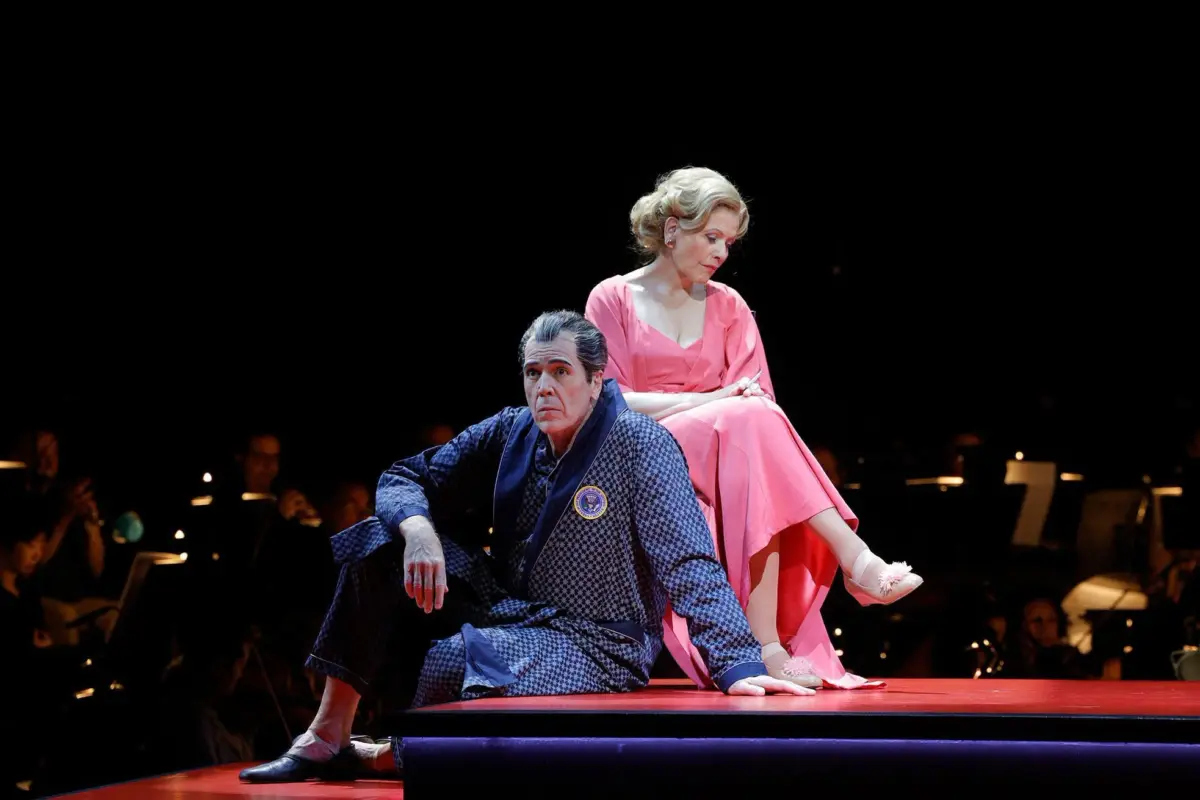
In the monumental role of Richard Nixon, baritone Thomas Hampson brought an undeniable swagger, bravura, and political charisma to the opera’s public-facing scenes. Whether flashing his signature double peace signs, working a handshake line, or projecting supreme self-assurance, Hampson’s Nixon was a man determined to control every micro-interaction of the historical summit. Yet, as the opera progressed into the vulnerable, reflective landscape of Act III, Hampson stripped away the armor, delivering a deeply multifaceted and psychologically fragile interpretation.
Vocally, Hampson maintained the flexible, lyric core of his middle register, executing brilliant bravura runs during his iconic aria, "News has a kind of mystery." When reiterating key motifs like "News" and "listening," he imbued the text with incisive, accented phrasing. However, certain technical pressures were apparent: when forced into the upper limits of his baritone range, Hampson’s tone occasionally took on a hollow, strained quality, most notably during the high-octane "Cheers" finale of Act I.
This vocal coloring, whether intentional or structural, mirrored the character’s journey; Acts I and II featured a brighter, brassier sonic profile that captured the pomp, bureaucratic formality, and hubris of the presidency. In Act III, however, as Nixon reflects on his past and shares a tender moment with his wife, Hampson consciously shifted to a darker, more burnished timbre. His legato phrases became more seamlessly connected, downplaying the harsh accents in favor of crystalline, intimate diction.
As Pat Nixon, legendary soprano Renée Fleming brought her customary poise, grace, and aristocracy to the stage, delicately balancing societal elegance with profound psychological fragility, particularly in the closing moments of Acts II and III. Her expansive Act II scene, anchored by the text "I Don’t daydream and don’t look back," was sung with signature polish, flawless breath support, and pristine diction. Her middle register possessed a lush, velvety warmth, while her stratospheric high notes gleaned effortlessly, floating above the hall with zero perceptible strain. In Act III, during her intimate vocal dialogues with Hampson’s Nixon, Fleming’s delivery took on a caressing, protective quality, wrapping the character in a tone of profound emotional depth.
Strong Support and Ensemble Brilliance
The supporting cast proved equally formidable, anchoring the production with star-making turns. As Madame Mao Tse-Tung, soprano Kathleen Kim made an indelible, electrifying impression from her very first entrance in the aria "I Am the Wife of Mao Tse-Tung." From the outset, Kim commanded the room with sharp, accented phrasing and terrifying vocal security. Her high notes were fired off with laser-like power, particularly as she aggressively spat the word "the book" while waving "The Little Red Book" aloft. It was impossible to look away as she delivered each line with uncompromising force and grit. By Act III, however, Kim’s tonal palette shifted; her aggressive edge softened, and she allowed a surprising vulnerability to emerge, visibly displaying genuine affection for Chairman Mao as she danced alongside tenor John Matthew Myers.
Making his Washington National Opera debut, Myers portrayed Mao Tse-Tung with a potent, ardent tenor voice in Act I, cleverly undercutting his vocal authority with a frail, physically diminished stage presence. In Act III, he adopted a lighter, airier vocal approach, proving a charming and nimble physical partner to Kim’s Madame Mao as the two actors playfully sparred through movement and song.
As Premier Chou En-Lai, baritone Joo Won Kang was, quite simply, magnificent. From the opera’s outset, he projected quiet authority and immaculate vocal control. In Act III, his baritone was imbued with devastating pathos as he delivered the existential question, "Whether anything they did was good." Kang anchored the emotional core of the entire opera in his concluding lines, allowing his voice to slowly, hauntingly evaporate alongside the dying embers of the orchestra.
The ensemble casting added rich texture to the canvas. The three secretaries—portrayed by Veronica Siebert, Anna Maria Vacca, and Cecelia McKinley—blended their voices to crystalline, chromatic perfection. Meanwhile, Robert Pomakov brought a deliciously diabolical edge to Henry Kissinger during the Act II dance number, while leaning into broader comedic beats in the opening scenes. Pomakov’s cavernous bass boomed with authority through the early acts and provided resonant punctuation in his brief Act III appearances. Special praise must also be directed toward the WNO chorus, whose opening rendition of "The People are the Heroes Now" built organically and relentlessly into a thrilling, room-shaking fortissimo.
Supporting Context & Metrics
To fully appreciate the scope of this WNO production, one must examine the operational and historical data surrounding the staging of Nixon in China since its 1987 premiere at Houston Grand Opera:
- Production Scale: The WNO’s deployment of a 360-degree/three-sided thrust stage inside Constitution Hall marks one of the most ambitious spatial experiments in the company’s recent history, accommodating an immersive audience capacity exceeding 3,000 patrons per performance.
- Archival Integration: Director Elkhanah Pulitzer’s multimedia team sourced, restored, and synchronized 22 distinct reels of Super 8mm amateur home movie footage to construct the real-time historical backdrop.
- Score Complexity: John Adams’s score requires an augmented minimalist ensemble, featuring an expanded percussion section, a dynamic synthesizer pad component, and saxophone quartet integration—all of which were balanced by maestro Robert Spano to fit the unique acoustic challenges of Constitution Hall.
- Historical Legacy: Premiered over three decades ago with a libretto by Alice Goodman, Nixon in China has transitioned from a contemporary novelty into the most frequently performed American opera of the late 20th century.
Official Statements
Reflecting on the artistic ambitions and community impact of the Constitution Hall residency, WNO leadership and creative stakeholders released statements emphasizing the evolution of the company’s performance footprint:
"By moving outside the traditional proscenium arch of the opera house and into non-traditional venues like Constitution Hall, we are fundamentally redefining how audiences experience dramatic storytelling. Bringing a monumental work like John Adams’s Nixon in China into an immersive thrust configuration allows our patrons to sit shoulder-to-shoulder with history, stripping away the fourth wall and turning passive observers into active participants in the drama."
— Washington National Opera Production Statement
Director Elkhanah Pulitzer elaborated on the multimedia aesthetic:
"We didn’t want the home movie footage to feel like a history lesson projected on a wall. We wanted it to breathe with the music. By weaving the actual texture of the Nixons’ private documentation—the Super 8 grain, the home-movie flicker—with Adams’s hypnotic musical engine, the past stops being a textbook and transforms into a living, breathing emotional landscape."
Future Outlook
The resounding critical and popular success of Nixon in China marks a watershed moment for the Washington National Opera. By successfully mounting complex, large-scale modern masterpieces in unconventional acoustic and spatial environments, the company has proven its willingness to take high-stakes artistic risks.
As the WNO looks toward future seasons, the lessons learned from Constitution Hall—particularly the successful synthesis of minimalist music, immersive staging, and archival multimedia design—will undoubtedly influence its approach to both contemporary works and traditional masterworks. This triumph demonstrates that regional opera companies can successfully expand their demographic reach, modernize their staging mechanics, and deliver intellectually rigorous, visually arresting art without sacrificing musical integrity. The triumph of Nixon in China ensures that the WNO enters its next operational era with renewed confidence, proven versatility, and an eager, expanding audience base ready for the future of American opera.