
Executive Overview
Contemporary classical music has long been bound by the strictures of precision: rigid time signatures, metronomic discipline, and the faithful execution of a composer’s historical intent. Yet, on the fringes of the genre, a quiet revolution is taking place, spearheaded by artists who view traditional instruments not as museums artifacts, but as living, breathing ecosystems. Few embody this paradigm shift quite like Lara Somogyi.
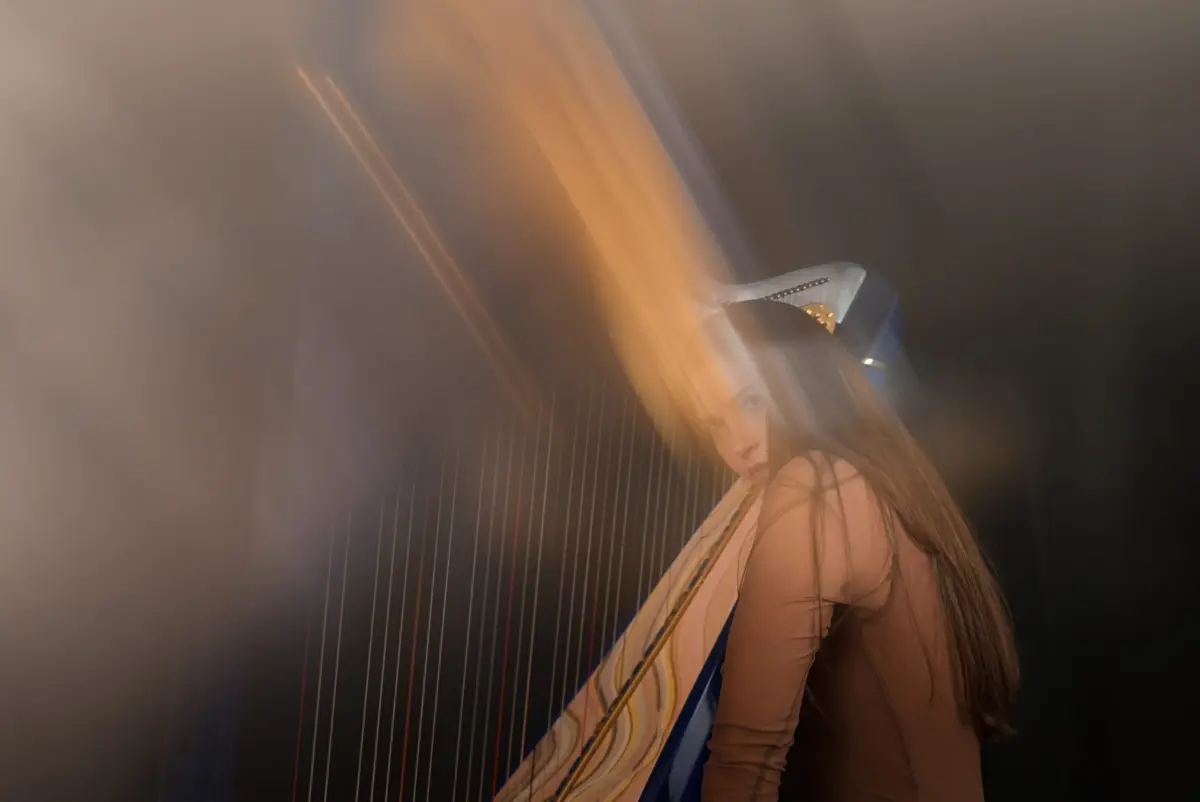
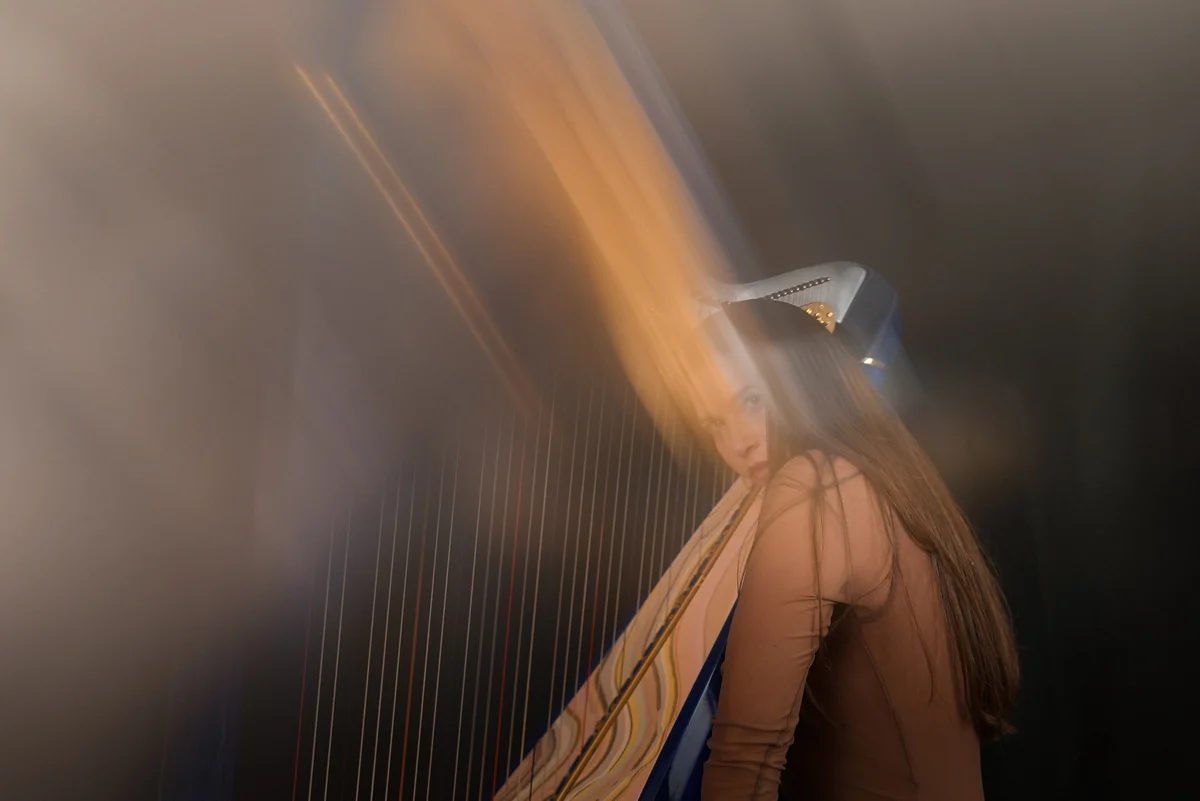
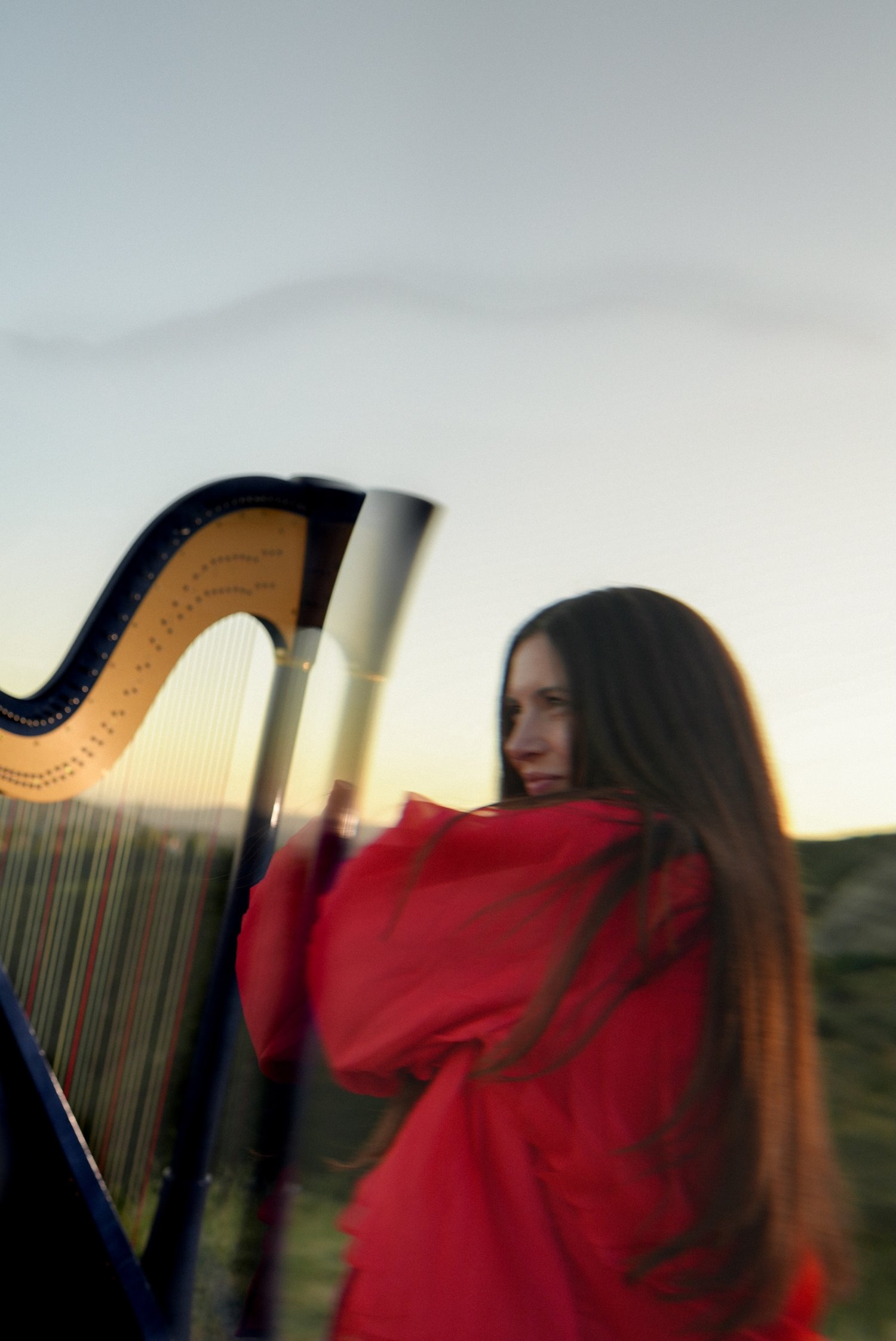
An avant-garde harpist and composer whose work defies easy categorization, Somogyi has spent the better part of the last decade dismantling preconceived notions of what the harp can—and should—sound like. Operating from her studio in the sprawling, sun-bleached badlands of Joshua Tree, California, she bridges the chasm between classical conservatory rigor and the untethered world of electronic improvisation.
Her latest full-length album, a [time] patterned, represents the zenith of this philosophy. Conceived in the wake of her father’s passing, the record is not a mournful dirge, but a profound, tactile meditation on human temporality, memory, and the fluid nature of time itself. By routing acoustic and electro-acoustic harps through a nest of guitar pedals, tape loops, and spatial processors, Somogyi warps the linear progression of sound, mirroring the erratic, beautiful ways the human mind processes recollection.
This profile examines Somogyi’s artistic evolution—from her idyllic beginnings in Hawaii to formative encounters with ambient pioneer Brian Eno—and explores how a [time] patterned redefines the intersection of classical instrumentation and modern sound design.
Detailed Chronology: From the Tropics to the Avant-Garde
Roots in Kauaʻi: The Sonic Genesis
Lara Somogyi’s story begins in the lush, dramatic terrain of Kauaʻi, Hawaii. Words like "beautiful," "relaxed," and "communal" populate her memories of early childhood, painting a picture of an upbringing deeply attuned to the natural world.
This genesis is explicitly captured in a [time] patterned’s opening track, "Fingerprints." The piece welcomes listeners with an authentic field recording of conversing birds, soon joined by a serene, approachable harp melody that evokes images of children playing by the water. There is an intentional blurriness to the production—a sonic haze that frames the scene like a cartoon thought bubble or a half-remembered flashback.
While the album quickly devolves into more experimental, laboratory-style explorations, Somogyi insists a [time] patterned is not a sonic autobiography. There is no traditional narrative arc. Instead, each composition functions as a standalone snapshot, a "sonic room" for the listener—and the artist—to inhabit. Starting in Hawaii, however, was foundational.
The New York Pulse and London Transformation
From the island tranquility of Hawaii, Somogyi’s path led her to the relentless pulse of New York City. The metropolis instilled in her a profound realization: that most complex artistic questions do not possess a single right answer. "There’s a pulse underlying that makes you feel like anything is possible," she reflects.
That expansive mindset catalyzed another geographic leap, this time across the Atlantic to the Royal Academy of Music in London. Somogyi describes her time at the academy as her most "transformative period." It was here that her musical vocabulary expanded exponentially. Rather than abandoning her classical footing, she began augmenting her foundational knowledge with electronics and live improvisation. This period marked the beginning of her ongoing quest to unify two disparate worlds, describing the synthesis as a process of "enchantment."
Around this time, her artistic parameters widened dramatically. She staged a recital entirely inspired by the color green, asking herself: What does it feel like to play green? She immersed herself in the emotive songwriting of Rufus Wainwright (with whom she would later collaborate) and experienced a serendipitous encounter with ambient music legend Brian Eno—a meeting that would permanently alter her relationship with sound.
The Brian Eno Encounter and the blueprints Epiphany
"That, I will always pinpoint as one of the big turning points in my understanding of music, life, being present, and actually sitting with yourself and not rushing, not going through the motions of what you’re blueprinted to do," Somogyi says of her interaction with Eno, an ethos that heavily influenced her 2024 EP, blueprints.
She vividly recalls a moment when Eno held up a rose petal, urging her to look past its initial surface color and angle it toward the sun. "Look how the light is coming through the petals. Have you seen that colour before?" he asked.
The lesson was granular: Eno taught her to distinguish between the unique cadences of different birdsongs rather than hearing nature as a homogeneous background noise. It was a masterclass in mindfulness. "It taught me to be present in the feelings, to notice more," Somogyi notes. "And how does that translate into yourself, your body, the rest of your actions throughout your day?"
Collaborative Milestones and !
Every geographical shift and artistic collaboration has added weight to Somogyi’s creative foundation. Her recent collaborative release, désert, was an improvisational study of the Joshua Tree badlands created alongside Québécois pianist Jean-Michel Blais.
Prior to that, her 2002 critically acclaimed debut solo record, ! (pronounced exclamation), served as a manifesto for her sonic seafaring. Every sound on the record emanated deliberately from the physical mechanics of the harp itself. The album earned praise from tastemakers like Pitchfork and BBC 6 Music for its boundary-pushing brilliance.
"It was about breaking through traditional ideas of what you think it should sound like," Somogyi explains. "What if you flip it on its head and play in places that aren’t conventionally allowed in a traditional setting?"
Supporting Context & Metrics: Deconstructing a [time] patterned
Four years after her debut, a [time] patterned arrives as an intensely personal yet universally resonant work, shaped by the passing of Somogyi’s father just as writing commenced.
The Mechanics of Time-Warping
Rather than delivering a straightforward grief record, Somogyi chose to interrogate time itself. "As musicians, you spend so much time with time," she observes. "It’s rhythm. It’s everything. It’s how you create your music—you’re in time; you’re not in time. What does it feel like when you stretch it, when you’re late, when you’re early?"
In her Joshua Tree studio, Somogyi gestures toward her array of acoustic and electro-acoustic harps, panning the camera to a nest of guitar pedals, tape loops, and processors. These tools are central to her time-warping methodology.
- Tape Loops: "A tape loop—how it imprints is how it imprints. You have no control over it," she notes.
- Guitar Pedals: "Guitar pedals take time and they jumble it and then give it back to you in a completely different order, which feels really exciting because you’re hearing things that you played into the machine, but it’s not how you played it in. That’s a metaphor for memories and how you’re experiencing things."
Sound Design and Guest Collaborators
While the album embraces the unpredictable nature of electronic processing, Somogyi remains firmly in control—twisting dials and running her fingers across strings.
The track "Sojourn" serves as a striking counterpoint to the album’s gentle opener, showcasing the quivering glitches of her delay pedals, which evoke the sensory overload of stepping into a butterfly conservatory. Meanwhile, rich, romantic swells akin to a whale’s slipstream are provided by a London-based string section, marking another departure from her historical harp-only rule.
Further elevating the record is "sitting circle," a collaboration with master arranger Rob Moose—whose credits include Sufjan Stevens’s landmark album Illinois, Phoebe Bridgers, and numerous indie luminaries. Tracks like "elsewhere" transition seamlessly from dream-sequence glissandos into trigonometric arpeggios, while "intimacy gradient" feels thrillingly suspended in-between states, sounding akin to a vibrating tattoo gun applied directly to scuttling, asymmetrical strings.
Official Statements & Artistic Philosophy
Throughout her career, Somogyi has maintained a fiercely anti-dogmatic approach to composition, prioritizing sensory experience over numerical rigidity.
"There’s nothing about time that’s numerical to me. It’s all sensory. It’s all based on how you’re experiencing things. It’s like: how did it smell that month? The summer that smelled like fresh grass. What was the sound through the trees in that moment?" — Lara Somogyi
This sensory philosophy extends to her compositional process, which she describes as largely intuitive and out-of-body. "A lot of it is purely out-of-body," she admits. "I do sit with it a lot while I’m making it, but then I’m able to release it and then listen and watch it as an observer." Rejecting self-critique after the fact, she views her finished work as an emotional transmission: "It feels kind of felt rather than thought."
The Graphic Score
To understand Somogyi’s live performance philosophy is to understand her use of graphic scores. Pulling out a piece of cardstock as wide as a diner menu—spotted with brightly colored triangles, squares, circles, and dotted lines—she explains this non-traditional notation method, utilized historically by avant-garde pioneers like Brian Eno, Terry Riley, and George Crumb.
"It’s a snapshot of the record in graphic pattern form," Somogyi explains. "It’s meant to not be a linear representation, but more so a sensory one or a decorative one, where it’s open to interpretation, just like everything else. Even when I’m relearning these pieces to play [live], I’m referencing these types of shapes… That’s another beauty of graphic scores—that they’re supposed to be played differently each time."
By liberating herself from rigid classical transcription, Somogyi embraces the unreliability of human memory. Just as a childhood in Hawaii shifts in color and tone depending on one’s mood or vantage point, her live performances capture the unrepeatable essence of a singular moment.
"In classical music, it’s very much about, did you do it perfectly? Did you express what the composer wanted?" she reflects. "There’s such beauty in that art as well… But I can do both. I feel a lot more enchantment doing it the way that’s not exact each time. It feels free."
Future Outlook
As a [time] patterned establishes its footprint across the contemporary ambient and classical landscapes, Lara Somogyi stands as a vital artist defining the outer limits of her instrument. Unburdened by pretense and endlessly curious, her mission remains rooted in pure, unadulterated joy.
Whether she is curating immersive live performances using graphic notation, collaborating with indie royalty, or pulling otherworldly textures from guitar pedals in the Mojave Desert, Somogyi’s trajectory points toward an increasingly borderless musical future.
"I’m going to be front row at every cool harp concert," she smiles. "The exploration of the harp in a new space has always been in my body, forever. I just knew I wanted the harp to be my life, and to explore it is my greatest joy and my greatest privilege."