
Executive Overview
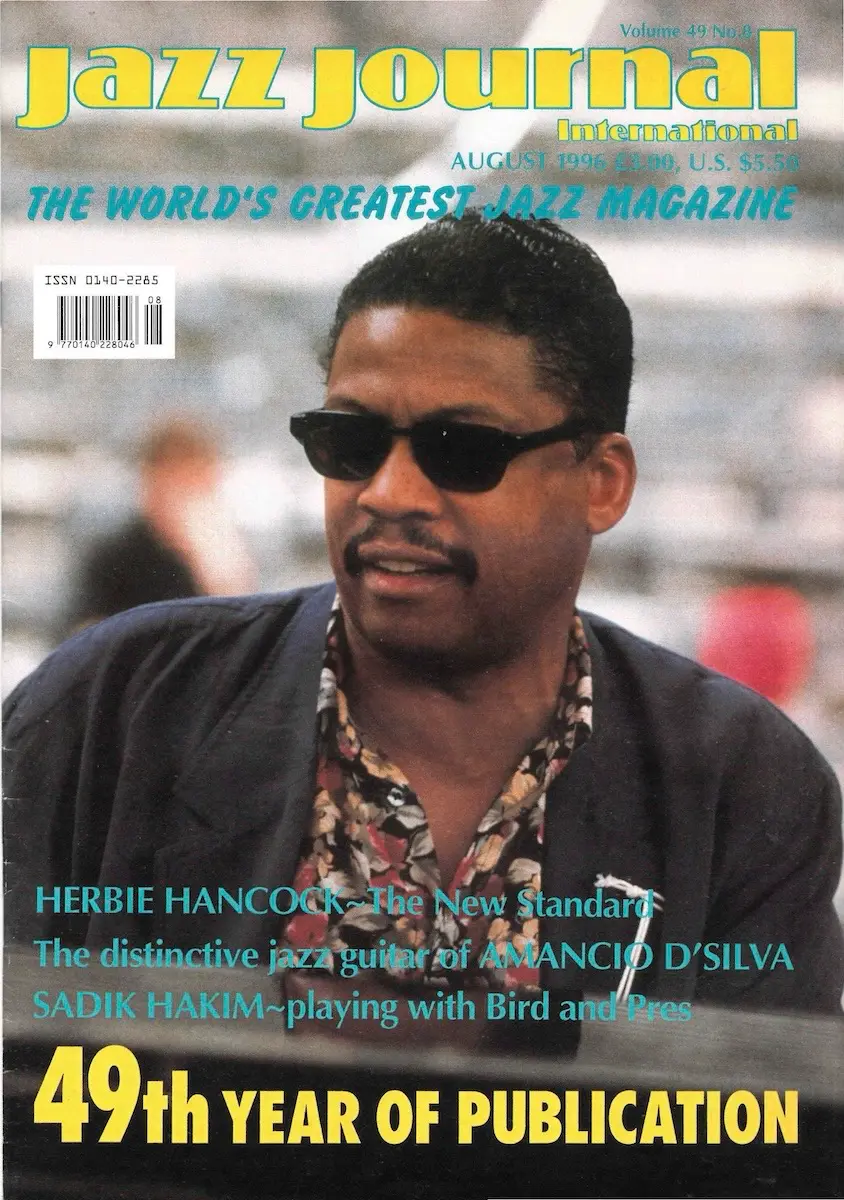
In the mid-1990s, the landscape of jazz stood at a fascinating crossroads. Decades removed from the fertile creative explosions of the 1950s and 1960s, the genre faced an identity crisis born of reverence. The recognized "standards"—the timeless compositions of Cole Porter, George Gershwin, and other architects of the American Songbook—were rapidly approaching a half-century of age, yet they remained the undisputed foundational repertoire for generations of jazz artists. Enter Herbie Hancock, a titan whose fingerprints are permanently etched into the history of modern music. With his 1996 Polygram release, The New Standard, Hancock did not merely cross genre lines; he dynamited them.
The New Standard marked a monumental milestone in Hancock’s storied discography: his first straight-ahead acoustic jazz date under his own name since his celebrated 1981 quartet recording with trumpet luminary Wynton Marsalis. Produced alongside Verve executive Guy Eckstine, the project set out to answer a pressing, systemic question facing contemporary jazz: If the traditional jam-session repertoire is aging out of relevance, where are the new standards going to come from?
By reimagining contemporary pop, rock, and R&B compositions—ranging from Nirvana and Prince to Sade, Steely Dan, and Stevie Wonder—through the sophisticated lens of modern jazz improvisation, Hancock and co-arranger Bob Belden created a blueprint for bridging the widening chasm between popular culture and high-art improvisation. This feature explores the genesis of The New Standard, dissects the intricate mechanics of its arrangements, and dives deep into Hancock’s formative influences, shedding light on the harmonic philosophies of one of the twentieth century’s most vital musical minds.
Detailed Chronology: The Making of The New Standard
The Genesis of a Commercial Experiment
The concept for The New Standard did not initially emerge from an academic desire to rewrite music history, but rather from the pragmatic realities of the modern music business. Guy Eckstine, an executive and co-producer at Verve, approached Hancock with a provocative proposition: record an album entirely composed of contemporary pop tunes.
Initially, Hancock’s instincts recoiled. “I said, ‘Could be interesting, but it smells of commercialism. It smells contrived,’” Hancock recalls. However, rather than dismissing the idea outright, the pianist sat down with Eckstine to unpack the sociological and historical role of repertoire within the jazz community.
Hancock’s mind drifted back to the 1960s, the era when he first ascended onto the national jazz scene. During that golden age, standards served a profoundly utilitarian purpose. They formed a common language that enabled spontaneous musical communion. At countless jam sessions, musicians who had never played together could step onto a stage and immediately communicate because they shared a deeply internalized canon of tunes and bebop structures.
By 1996, however, that landscape had shifted drastically. Younger musicians reported a scarcity of traditional jam sessions, and the generational gap in shared musical vocabulary had widened into a chasm.
"Those tunes are getting to be 60 years old, so we’re going to go another 40 years and still call the same things standards? Or are we going to start looking around for some new ones? Which I think is very important. So then I started thinking, ‘What if we treated tunes by the new pop writers like they were standards?’ We used to do it with the old pop tunes."
Curating the Pop Landscape
Because Hancock admits to being somewhat insulated from contemporary pop culture—famously noting that while he hears modern tunes constantly, he rarely learns their titles—he relied heavily on Eckstine’s generational fluency to curate a shortlist of source material.
Working collaboratively, Hancock and Eckstine filtered through dozens of possibilities, ultimately parashing the tracklist down to a cohesive, highly ambitious selection. To execute the project’s complex sonic architecture, Hancock brought in arranger Bob Belden, a producer and musician known for his deep encyclopedic knowledge of Hancock’s musical catalog and harmonic sensibilities.
The resulting sessions yielded radically transformed versions of familiar tracks. The only piece that remained relatively transparent in its structural origins was Steely Dan’s Your Gold Teeth II.
"Oh yeah, that one already has so many changes in it," Hancock explains. "We just played, and extended the harmonies a little bit. And then we went from playing it in 3/4 to 4/4 and back and forth… We had Michael Brecker improvise over a part on the original where I think there’s a guitar solo, and I just played the voicings in a more modern way. Other than that it’s not changed that much."
Conversely, other tracks underwent radical surgery. Prince’s Thieves In The Temple was filtered through the stylistic ghost of Hancock’s career-launching classic Watermelon Man from his 1962 Blue Note debut, Takin’ Off. Sade’s Stronger Than Pride received subtle harmonic shading, while traditional folk-rock classic Scarborough Fair and The Beatles’ Norwegian Wood were subjected to deliberate re-voicings. Nirvana’s anthem All Apologies was cast in a raw, bluesy light without heavy harmonic augmentation, whereas Don Henley’s New York Minute was dramatically re-envisioned through a 1960s John Coltrane-esque aesthetic.
Perhaps the most intricate collaboration on the album occurred on Stevie Wonder’s You Got It Bad Girl. Bob Belden constructed an ingenious harmonic sequence that maintained the song’s original melodic line while continuously shifting the underlying three-chord sequence. Hancock injected his own modern improvisational twist into the bridge, introducing unique modulations that elevated the pop tune into sophisticated jazz terrain.
Supporting Context & Metrics: A Tradition of Cross-Pollination
While The New Standard felt like a radical departure to mainstream audiences in 1996, it was actually the continuation of a rich, albeit controversial, lineage within jazz history. Jazz has always been a predatory and assimilative art form, feeding hungrily on the popular music of its day. From Benny Goodman swinging Mozart to Charlie Parker quoting pop snippets in his bebop lines, the boundaries between high and low art have always been porous.
This specific subgenre—taking contemporary pop and rock hits and bending them to the rigorous demands of jazz improvisation—has a storied pedigree:
- 1966: Guitar master Joe Pass releases Simplicity, applying jazz theory to the songbook of The Rolling Stones.
- 1990s: A wave of contemporary artists embraces the concept, including Bob Belden with his jazz tributes to Prince and Sting, Marc Copland with his Marvin Gaye-inspired What’s Goin’ On, and pianist Larry Goldings with Whatever It Takes.
The Harmonic Challenge of Pop Music
The fundamental hurdle of turning pop music into jazz lies in structural density. As Hancock astutely observes, modern pop writing is structurally distinct from the golden eras of songwriting:
"Tunes by pop writers today, by and large, are not as harmonically rich. And harmony is one of the things that is part of the structure of improvisation. But I thought that I can use that as an excuse for personalising the structure of these tunes — you know, put my own kind of twist on them."
By taking harmonically lean pop compositions and treating them as malleable canvases, Hancock used their simplicity as an asset rather than a liability. It granted him the creative freedom to impose polychords, alter voicings, and superimpose complex jazz sensibilities onto simple pop hooks.
Official Statements & Artistic Philosophy
Unpacking Hancock’s Harmonic Lineage
Beyond the immediate context of The New Standard, a conversation with Herbie Hancock inevitably circles back to the foundational influences that shaped his idiosyncratic piano style. When asked about his place in the modern piano lineage, Hancock points directly to the masters who came before him: Bill Evans, Wynton Kelly, Horace Silver, Ahmad Jamal, and McCoy Tyner.
Yet, Hancock is quick to differentiate his own harmonic path from that of his contemporaries. While acknowledging McCoy Tyner’s towering influence—particularly his brilliant, driving modal lines—Hancock offers a nuanced critique of Tyner’s harmonic adventurousness on ballads:
"You know, when I hear McCoy play ballads, he’s not very adventurous with harmony, but with his lines he is though. He never got into harmony like I did. It’s just the lines that he plays go through a lot of different changes. I’m influenced by that."
When pressed to identify the specific harmonic elements that distinguish his playing from the standard post-bop vocabulary, Hancock looks far outside the traditional boundaries of jazz, citing the profound impact of classical music masters and unsung contemporaries:
"Ravel, Stravinsky, Bartók; there’s another guy too, named Chris Anderson, who’s from Chicago. He’s a jazz player, and he only has one or two records out… He had different harmonies than things Bill Evans used, and I got a lot from the Hi-Los, especially the arrangements by Clare Fischer. And also Robert Farnon, I used to listen to his records. Phew! Killer stuff!"
Breaking Rules in the Avant-Garde
Hancock’s journey toward harmonic freedom was accelerated significantly during his early days in New York, moving away from the straight-ahead hard bop of his work with Donald Byrd, Kenny Dorham, and Jackie McLean. A critical turning point occurred in December 1962 when he began performing with avant-garde icon Eric Dolphy:
"That started me thinking about other things. I started breaking rules when I started playing with Eric. I’d never even played that way before… But Eric really started to open me up a lot more. I think it was in November and December, a two-month period, something like that. It was very rewarding. I think that was one of the main, final elements that prepared me for my career."
This fearlessness—honed through collaborations with Dolphy, Miles Davis, and master drummer Tony Williams (who exposed Hancock to contemporary classical composition)—paved the way for the fearless experimentation heard on The New Standard.
Future Outlook: Commercial Reception and What Lies Ahead
In concert settings following the release of The New Standard, Hancock observed a fascinating sociological phenomenon. Touring with a powerhouse quartet featuring bassist Dave Holland, drummer Gene Jackson, and saxophonist Craig Handy (whom Hancock enthusiastically praised despite discovering him relatively late due to his West Coast base), the ensemble integrated pop tracks like Thieves in the Temple, Mercy Street, You Got It Bad Girl, and New York Minute directly into their two-hour live sets.
The inclusion of these pop standards acted as a cultural bridge, drawing in audiences who might not have been deeply versed in the intricacies of jazz improvisation, yet found an immediate entry point through melodies they recognized from the radio.
Commercially and critically, The New Standard proved to be a resounding success, demonstrating that high-level jazz could successfully engage with modern pop culture without sacrificing artistic integrity. Naturally, questions immediately arose regarding the possibility of a sequel.
However, given Hancock’s restless creative spirit and his wide-ranging recording contract with Polygram, his future career moves remained deliberately fluid. As Hancock noted at the time:
"The potential for this record seems to be pretty good saleswise and critically too. And I suppose the more the record sells, the more it would make sense to do a sequel. But my contract is with Polygram, so the next record could be in another area — a pop thing for Mercury or a classical, symphonic thing for Deutsche Grammophon. I’m not sure yet."
Ultimately, The New Standard stands as a testament to Herbie Hancock’s enduring philosophy: that jazz is not a museum piece locked behind glass, but a living, breathing, adaptive language. By listening to the music of the present and reshaping it through the lens of harmonic mastery, Hancock proved that the tradition of jazz is built not on preservation alone, but on perpetual reinvention.