
Executive Overview
The live entertainment and ticketing industry is undergoing a structural transformation. For decades, booking a ticket to a concert, sports game, or theater production meant navigating rigid, keyword-based search filters, static seating charts, and frustrating dropdown menus. Today, the operational philosophy of the digital ticketing marketplace is shifting from transactional to conversational.
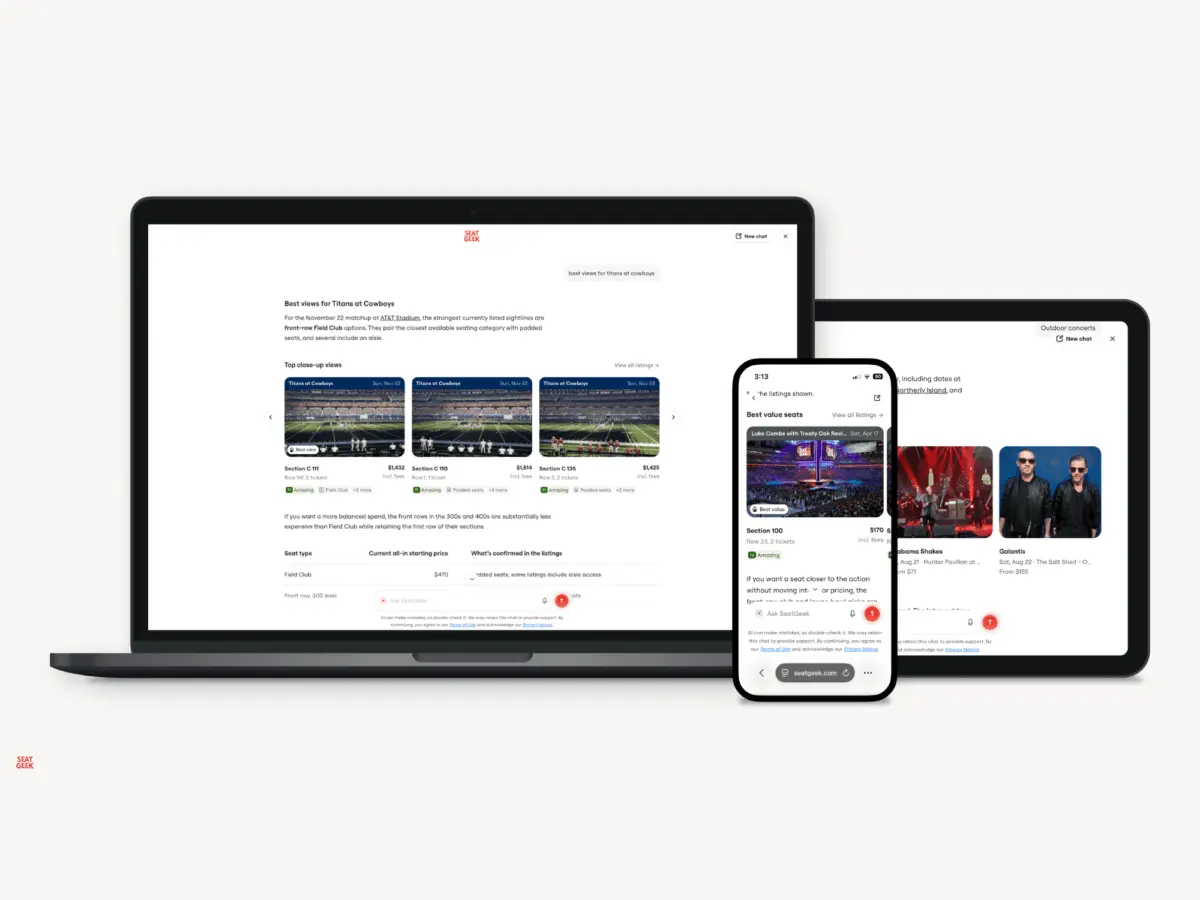
In a decisive move to capture this paradigm shift, major ticketing platforms are integrating artificial intelligence directly into the consumer journey. Leading this charge is SeatGeek, which has officially launched "Ask SeatGeek"—a native, conversational AI search experience embedded directly into its platform’s search architecture. Rather than treating artificial intelligence as an isolated chatbot relegated to a corner of the screen, SeatGeek has woven natural language processing into the core search bar, allowing users to articulate their event preferences as if they were talking to a knowledgeable friend.
This development does not exist in a vacuum. The broader live events ecosystem is experiencing a sweeping AI gold rush. Throughout late 2025 and 2026, major players have rapidly forged alliances with generative AI leaders including OpenAI’s ChatGPT, Anthropic’s Claude, Google’s Gemini, and various smart-speaker ecosystems. By marrying user intent with deep behavioral context—such as past seating preferences, susceptibility to summer heat, or the distinct needs of family outings versus corporate client entertainment—ticketing companies are betting that conversational commerce will redefine how fans discover and purchase live experiences.
This report provides an in-depth analysis of SeatGeek’s recent product launch, tracing its multi-pronged artificial intelligence strategy, examining the technological and commercial implications for event promoters, and forecasting the future of hyper-personalized ticketing over the coming decade.
Detailed Chronology: The Road to Conversational Ticketing
To understand the strategic significance of the "Ask SeatGeek" launch, it is essential to map the accelerated timeline of artificial integration that has swept through the ticketing sector over the past eighteen months.
Late 2025: Entering the Realm of Agentic AI
The foundational groundwork for modern AI-driven discovery in ticketing was laid in December 2025. Facing mounting pressure to reduce friction in the ticket-buying process, SeatGeek joined industry titan Ticketmaster as an inaugural partner in a pioneering "agentic AI-search" pilot launched by Google.
Unlike traditional search engines that simply return a list of links, agentic AI operates with a degree of autonomy. It can execute multi-step tasks on behalf of the user—such as finding an event, cross-referencing availability, comparing pricing tiers, and initiating the checkout sequence based on complex, nuanced prompts. This pilot signaled to the market that ticketing platforms could no longer rely solely on users visiting their native apps; they needed to meet consumers wherever digital assistants lived.
Spring 2026: Expanding Across Ecosystems
Building on the momentum of the Google pilot, SeatGeek aggressively expanded its digital footprint in the spring of 2026. On April 1, 2026, the company officially unveiled a dedicated application for ChatGPT.
This integration allowed millions of OpenAI users to query, browse, and interact with SeatGeek’s inventory without ever leaving the ChatGPT interface. By positioning its inventory within conversational ecosystems controlled by third parties, SeatGeek diversified its acquisition channels. However, company leadership quickly realized that relying entirely on external ecosystems risked disintermediating the brand from its customer base. A native solution was required.
Summer 2026: The Launch of ‘Ask SeatGeek’
Culminating these strategic maneuvers, August 2026 marked the debut of "Ask SeatGeek." Moving away from the isolated sidebar chatbot models popularized by customer service tools in the early 2020s, SeatGeek embedded conversational search directly into its primary search bar.
This chronology illustrates a clear industry trajectory: initial experimentation via third-party agentic search pilots (Google), followed by external ecosystem integration (ChatGPT), and finally, the maturation into native, deeply integrated conversational user interfaces (UI) powered by proprietary behavioral data.
Supporting Context & Metrics: The Mechanics of Natural Language Search
The transition from keyword filters to natural language processing (NLP) addresses one of the most persistent pain points in e-commerce: search friction.
From Keywords to Context
Historically, buying tickets required users to manually parse endless lists of filters: selecting a city, choosing a date range, filtering by price maximums, and toggling seating zones. If a fan wanted "two decent seats near the stage for a summer rock concert where the sun won’t blind us, priced under $200 each," they would previously have had to perform multiple separate searches, cross-reference venue maps, and check weather exposure manually.
With "Ask SeatGeek," that same prompt is ingested, parsed, and executed in a single interaction. The system leverages large language models (LLMs) to unpack multi-variable sentences, translating human intent into structured database queries.
Boosting Promoter Sales Through Contextual Richness
For event promoters, venue operators, and artists, this technological leap offers substantial commercial upside. Traditional ticket listings often reduce premium or unusual seats to cold numbers: a section, a row, and a price. This can deter hesitant buyers who are unsure whether a specific section offers obstructed views, excessive sun exposure, or unfavorable acoustics.
Ask SeatGeek addresses this conversion barrier by surfacing events with full contextual richness. When the AI recommends a ticket, it provides the buyer with comprehensive data points—explaining why a particular seat fits their request. By bridging the information gap between the venue layout and the buyer’s comfort preferences, platforms report higher consumer confidence, leading to improved conversion rates and accelerated sell-through for promoters.
Official Statements and Industry Insights
The race toward conversational commerce is not merely a technical upgrade; it represents a philosophical re-engineering of how digital platforms view their users.
In its official launch documentation, SeatGeek framed the consumer value proposition around familiarity and ease:
"Fans can now turn search into a conversation, describing what they’re looking for the way they’d describe it to a friend."
Rather than forcing users to learn the platform’s internal search syntax or navigate clunky UI elements, the platform adapts to human speech patterns. Furthermore, the company emphasized the architectural uniqueness of its implementation, noting that the feature sits directly within the existing search bar rather than "sitting off to the side as a separate chatbot." This design choice reduces cognitive load, ensuring that users who still prefer traditional filtering can do so seamlessly alongside those using natural language prompts.
Looking toward the future of data architecture, SeatGeek executives have pointed toward hyper-personalization as the ultimate destination for conversational ticketing. In recent statements, the company highlighted the value of historical user data:
"A fan’s history holds real signal: where they sat last time, whether they gravitate toward shade on a summer afternoon, whether they’re buying for a family or for a client."
The company’s long-term vision is that conversational AI will move beyond generic recommendations to become dynamically adaptive. Over time, as the algorithm accumulates context, two different fans typing the exact same query into the search bar will receive completely different, highly curated recommendations tailored to their unique behavioral profiles, purchasing histories, and personal preferences.
Future Outlook: The Next Decade of Conversational Commerce
As the live entertainment industry looks beyond 2026, the integration of conversational AI is poised to expand into deeper realms of automation, predictive analytics, and multimodal interaction.
1. Multimodal and Voice-First Ticketing
While text-based conversational search dominates the current landscape, the next frontier involves seamless multimodal integration. Future iterations of ticketing agents will ingest voice commands via smart speakers, wearable devices, and connected vehicle dashboards. A consumer driving home from work might tell their vehicle’s AI assistant: "Find me floor tickets for the upcoming stadium tour playing in our city next month, and make sure the total price includes parking." The assistant will negotiate, secure, and confirm the purchase entirely through voice authentication.
2. Predictive Group and Corporate Booking
AI agents will increasingly solve complex social logistics. Buying tickets for a large group of friends or organizing corporate entertainment involves managing varying budgets, availability calendars, and seating preferences. Future conversational agents will act as group coordinators—communicating with the members of a party via shared chat threads, polling their preferences, and automatically booking an optimal block of seats that satisfies the collective consensus.
3. Ethical, Privacy, and Monopoly Considerations
As ticketing platforms collect deeper behavioral signals—tracking whether a user prefers shade, VIP amenities, or budget options—regulatory scrutiny regarding data privacy will intensify. Ensuring that consumer data is utilized transparently without violating privacy frameworks (such as GDPR and CCPA) will be paramount. Additionally, industry watchdogs will monitor whether dominant AI-driven ticketing platforms leverage conversational algorithms to preferentially push high-fee inventory or dynamic surge-pricing tickets to unsuspecting consumers.
Conclusion
SeatGeek’s introduction of "Ask SeatGeek," paired with its broader multi-platform AI strategy across Google and ChatGPT, signals a permanent turning point for the ticketing industry. The days of static, rigid search filters are giving way to fluid, conversational, and deeply personalized commerce. For fans, this means less time wrestling with website interfaces and more time enjoying live events. For the industry at large, it marks the dawn of an era where software truly understands human intent.