
Executive Overview
In the mid-1990s, the contemporary jazz landscape was undergoing a quiet, gritty revolution. Amidst a sea of neo-traditionalist acoustic purists looking backward toward the bebop canon, a generation of groove-obsessed innovators was looking sideways—drawing inspiration from deep funk, swamp blues, organ trios, and the jagged-edged fusion of the downtown New York scene. At the vanguard of this movement stood virtuoso guitarist Charlie Hunter.
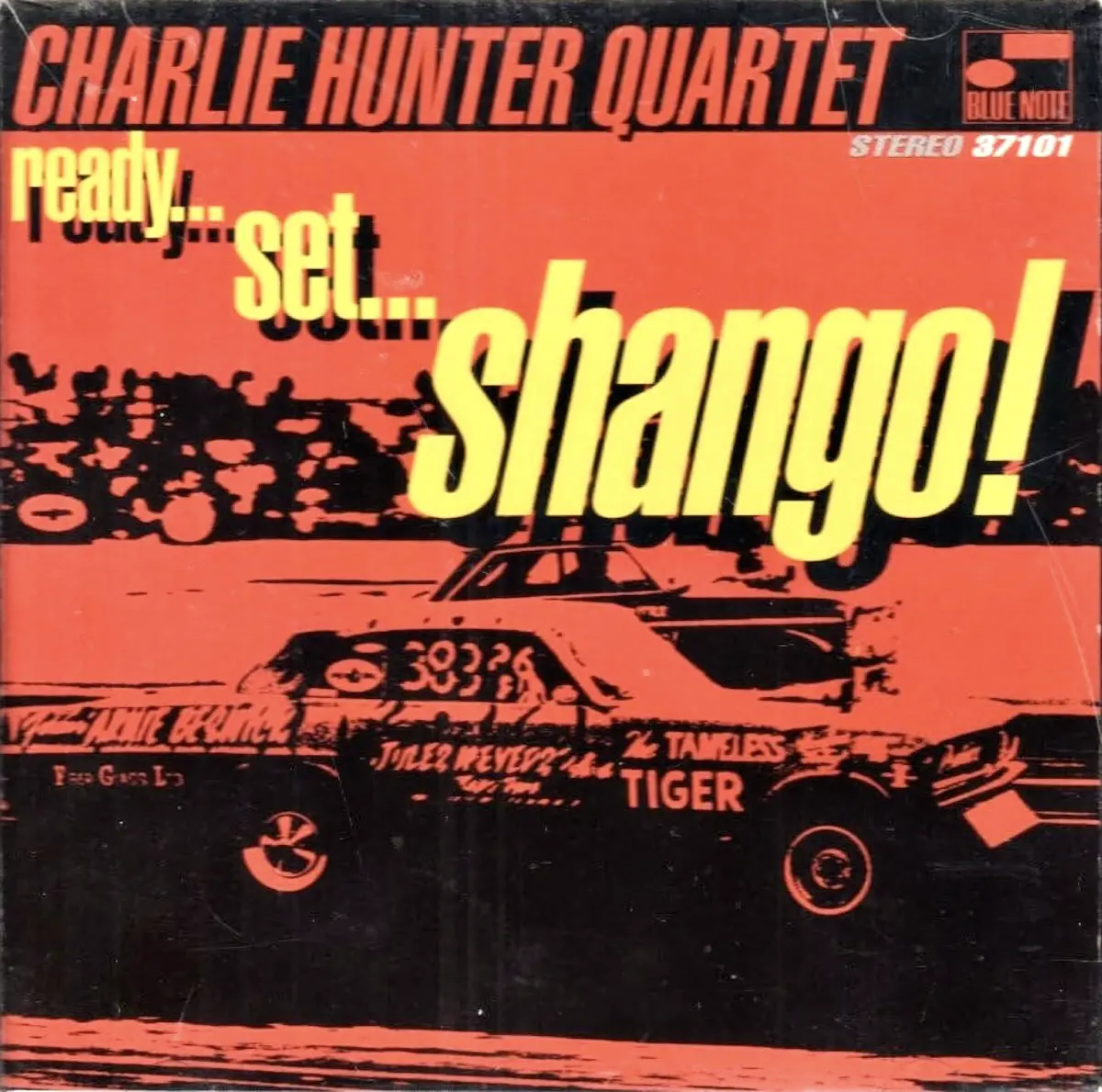
With the release of his sophomore Blue Note album—his third overall project as a leader—Hunter cemented his reputation not merely as a technical anomaly, but as a formidable compositional and improvisational force. Following directly in the footsteps of his critically lauded 1995 breakthrough, Bing, Bing, Bing!, this new release doubles down on Hunter’s signature blend of Scofield-styled swamp boogie, brooding cinematic ballads, and infectious, pocket-driven grooves. Yet, it also marks a crucial evolutionary step for the ensemble. By expanding his foundational trio into a dynamic quartet with the addition of alto saxophonist Calder Spanier, Hunter introduced a fresh melodic sparring partner to join tenor saxophonist Dave Ellis.
At the center of this musical phenomenon remains Hunter’s weapon of choice: a custom eight-string guitar that allows him to execute basslines, rhythm guitar accompaniment, and soaring lead melodies simultaneously. This technical marvel enables Hunter to function as a one-man rhythm section, summoning the rich, rotating-speaker warmth of a Hammond B3 organ while maintaining the percussive attack of an electric guitar.
Produced by industry veteran Lee Townsend—renowned for his foundational work with guitarist John Scofield—the album captures a band operating at the absolute peak of its creative powers. Recorded in Marin County, California, around 1996, the project offers a masterclass in modern groove-jazz. Yet, it also invites deeper critical inquiry regarding stylistic lineage, industry influences, and the delicate balance between virtuosic innovation and stylistic pastiche. This retrospective investigation explores the anatomy of Hunter’s mid-90s masterpiece, examining its personnel, its stylistic debts, its production architecture, and its enduring legacy within the Blue Note catalog.
Detailed Chronology
The Road to Blue Note: From Bay Area Busking to Iconic Imprints
To understand the significance of Hunter’s mid-90s output, one must trace his trajectory from the eclectic streets of the San Francisco Bay Area. Born in Rhode Island and raised in Berkeley, California, Hunter immersed himself in the rich musical melting pot of Northern California. Early on, he recognized the limitations of standard six-string configurations for the kind of dense, polyrhythmic ensemble music he wanted to create. Inspired by pioneering multi-instrumentalists and the heavy low-end demands of funk and soul, Hunter commissioned a custom eight-string guitar from luthier Ralph Novak.
The instrument, featuring extended bass ranges calibrated with fanned frets, became Hunter’s sonic signature. By splitting the signal through multiple amplifiers—directing the lower strings to a bass rig and the upper strings to a guitar amp—Hunter achieved an uncanny simulation of an organ trio. He could lay down a thumping, syncopated bassline with his thumb while simultaneously comping chords and spinning intricate single-note solos across the upper registers.
After cutting his teeth in various Bay Area outfits—including the groove-punk band Disposable Heroes of Hiphoprisy—Hunter formed his own trio featuring saxophonist Dave Ellis and drummer Scott Amendola. The group’s relentless live performances quickly generated a fierce regional buzz, characterized by sweaty clubs, hypnotic grooves, and jaw-dropping displays of physical coordination. This underground momentum caught the attention of Blue Note Records, a label historically revered for its hard-bop golden era but increasingly receptive to contemporary groove-oriented crossovers.
In February 1995, Hunter made his label debut with Bing, Bing, Bing!, a release that stunned critics and jazz aficionados alike. The album proved that instrumental groove music could be both intellectually stimulating and physically irresistible. Eager to capitalize on this momentum, Hunter returned to the studio shortly after to record his follow-up, retaining his core rhythm section while expanding the front line.
Inside the 1996 Sessions: Marin County and the Quartet Expansion
The recording sessions for Hunter’s second Blue Note release took place in the serene, acoustically rich environment of Marin County, California, circa 1996. The decision to record in Northern California—far removed from the high-pressure studios of New York or Los Angeles—allowed the ensemble to preserve the organic, unforced chemistry that defined their live shows.
Crucially, the studio environment captured the interplay of an expanded lineup. While Bing, Bing, Bing! relied heavily on the stark, muscular interplay of Hunter’s guitar-bass hybrid and Dave Ellis’s ferocious tenor saxophone, the new sessions introduced alto saxophonist Calder Spanier. The addition of Spanier fundamentally altered the textural palette of the group. Rather than engaging solely in high-intensity, two-way conversations, Hunter’s arrangements now benefited from rich harmonic counterpoint, dual-horn harmonies, and contrasting improvisational voices. Spanier’s bright, fluid alto cuts cleanly through the dense low-end fog generated by Hunter’s eight-string wizardry, providing a brilliant foil to Ellis’s darker, more muscular tenor phrasing.
Behind the drum kit, Scott Amendola delivered a masterclass in pocket drumming. Operating at the intersection of jazz swing, funk syncopation, and rock power, Amendola’s playing provided the essential anchor for Hunter’s polyrhythmic excursions. Unlike traditional jazz drummers who might float above the meter, Amendola locked in tight with Hunter’s basslines, creating a relentless forward momentum that drove tracks like Ashby Man, Teabaggin’, and Let’s Get Medieval.
Supporting Context & Metrics
Lineup and Tracklisting Overview
The resulting album stands as a comprehensive showcase of Hunter’s compositional range, balancing breakneck funk workouts with moody, cinematic introspection.
Album Personnel:
- Charlie Hunter: Eight-string Electric Guitar (handling basslines and guitar parts simultaneously)
- Dave Ellis: Tenor Saxophone
- Calder Spanier: Alto Saxophone
- Scott Amendola: Drums
Official Tracklisting & Runtime:
- Ashby Man
- Teabaggin’
- Let’s Get Medieval
- The Shango Pt III
- Dersu
- 911
- Shango … The Ballad
- Thursday The 12th
- Sutton
- Total Runtime: 52 minutes, 45 seconds
- Label: Blue Note Records (Catalog No. CDP 7243 8 37101 2 8)
Stylistic Lineage: The Shadow of John Scofield and the 90s Groove Revival
While Hunter’s technical execution on the eight-string guitar is undeniably singular, music critics and historians have long debated the broader stylistic origins of his music. In many respects, Hunter occupies a unique space in late-20th-century jazz: he is not a radical structural innovator in the vein of Ornette Coleman or Cecil Taylor, but rather a master synthesizer of existing vernacular traditions.
The most potent and inescapable stylistic ghost haunting Hunter’s work is master guitarist John Scofield. By the mid-1990s, Scofield was deep into his celebrated groove era, heavily influenced by the earthy, soulful organ-trio and sax-heavy funk explorations of jazz-funk pioneer Eddie Harris. Scofield’s landmark mid-90s recordings—characterized by greasy blues phrasing, angular chromaticism, and deep-pocket rhythms—served as the blueprint for Hunter’s compositional and improvisational aesthetic.
The parallels extend beyond mere sonic resemblance. Both artists utilized the production acumen of Lee Townsend, a visionary producer whose ambient-leaning, atmospheric approach helped define the ECM and Blue Note crossover sounds of the era. Furthermore, explicit nods appear within the song titles: just as Scofield’s acclaimed 1992 album What We Do featured a high-energy track titled Call 911, Hunter’s release includes a tense, driving track simply named 911.
Interestingly, official promotional materials and press notes surrounding Hunter’s release tended to downplay the dominant Scofield connection, instead citing historical guitar influences such as Charlie Christian and Joe Pass. While Hunter undoubtedly absorbed the linear phrasing of Christian and the harmonic sophistication of Pass, these references feel somewhat oblique when measured against the greasy, blues-soaked, Scofield-esque swamp boogie that actually dominates the music. Additional echoes of Paul Motian’s exploratory, rhythmically fluid groups of the era—as well as British guitarist Jim Mullen’s Scofield-indebted playing style—pepper the arrangements, revealing a global network of contemporary guitarists wrestling with the same post-fusion vocabulary.
Technical Prowess vs. Stylistic Fatigue
From a purely physical and technical standpoint, Hunter’s performances on the album are nothing short of breathtaking. The ability to maintain an independent, relentlessly swinging bassline with the thumb while articulating complex chord voicings and rapid-fire single-note solos with the remaining fingers defies conventional logic. On tracks like Dersu and Thursday The 12th, Hunter navigates complex metric shifts and labyrinthine harmonic changes with astonishing ease.
However, critical reception of the album also highlighted the aesthetic risks inherent in Hunter’s chosen sonic palette. By the mid-1990s, a broader retro-sixties organ fad was sweeping through segments of the jazz and acid-jazz scenes. Hammond B3 organs, Leslie speaker cabinets, and vintage tube amplifiers were suddenly de rigueur across clubs and festival stages worldwide. While Hunter’s eight-string setup brilliantly emulated this warm, saturated aesthetic without the physical presence of an actual keyboardist, critics noted that the retro fad occasionally threatened to overshadow the intrinsic originality of the music. When the novelty of the technical setup wore thin, the compositions had to stand entirely on their own merits—a test that Hunter’s writing generally passed with flying colors, though occasional moments skirted dangerously close to stylistic pastiche.
Official Statements & Industry Perspective
In retrospective assessments of this pivotal era, producer Lee Townsend has frequently reflected on the unique challenges and triumphs of capturing groove-based improvisational music in a studio environment.
"When you work with artists who possess such a distinct, physical relationship with their instruments—like Charlie Hunter or John Scofield—the producer’s job isn’t to reinvent the sound," Townsend noted in contemporaneous interviews regarding his production philosophy. "It’s to build a sonic sandbox where the kinetic energy of the live performance can translate onto tape without losing its grit, sweat, and spontaneity. With Charlie, you have a rhythm section unto himself. The recording environment has to breathe, giving the horns enough space to soar above that massive low-end wall of sound without getting swallowed by it."
Industry analysts at the time viewed Hunter’s signing to Blue Note as a strategic masterstroke for the legendary label. Under the guidance of producer and executive Bruce Lundvall, Blue Note was aggressively modernizing its roster, welcoming artists who bridged the gap between jazz improvisation and younger, alternative-rock and funk audiences.
"Charlie Hunter represents a bridge across generational divides," a Blue Note promotional brief from the era observed. "He plays with the harmonic sophistication and improvisational daring demanded by jazz purists, yet he commands the relentless, heavy groove and sonic attitude that resonates deeply with fans of modern funk, blues, and alternative music."
Future Outlook
Looking back at Charlie Hunter’s mid-90s quartet recordings from the vantage point of the modern musical landscape, their true historical importance comes sharply into focus. Far from being a mere historical footnote of the 1990s acid-jazz and groove revival, Hunter’s work laid vital groundwork for the modern boundary-pushing instrumental music scene that thrives today.
The contemporary jazz-fusion and jam-band landscapes—populated by virtuosic acts that seamlessly blend intricate jazz harmony with earth-shattering funk grooves (such as Snarky Puppy, Lettuce, and various modern organ trios)—owe a massive debt of gratitude to pioneers like Hunter who dragged jazz out of the academic ivory tower and back into the sweaty, pulsing environment of the dance club.
Furthermore, Hunter’s relentless commitment to his custom eight-string instrument transformed him into an influential figure among guitar geeks and experimentalists worldwide. He proved that traditional definitions of the rhythm section were malleable, inspiring a new generation of solo artists and multi-instrumentalists to rethink the physical boundaries of their instruments.
As streaming algorithms and contemporary playlist curation continue to blur the artificial boundaries between jazz, funk, soul, and blues, classic releases like Hunter’s sophomore Blue Note offering sound remarkably fresh. The retro-sixties organ fad that once threatened to date the music has long since receded into the rearview mirror, leaving behind what truly matters: top-tier compositional craftsmanship, fearless improvisation, and an unshakeable, bone-deep groove that refuses to let go.