

Executive Overview
For centuries, the theatrical stage has been populated by some of the most luminous human talents in history—actors, singers, and dancers who have brought profound emotional resonance to the Great White Way. Yet, whenever the house lights dim and the orchestra strikes up its overture, another category of performer routinely captures the absolute adoration of the audience: the canine actor. From iconic depictions of scrappy orphans’ best friends to sophisticated hounds treading the boards in contemporary dramatic works, dogs have occupied a uniquely cherished space in theatrical history.
In celebration of Dog Appreciation Day, the theatrical community pauses to honor these furry troupers, whose contributions require a specialized form of stagecraft blending absolute discipline, unwavering trust, and innate charisma. Unlike their human counterparts, canine performers cannot rely on the motivation of dramatic subtext or the comfort of spoken dialogue; instead, they must interpret subtle physical cues, master precise blocking under dazzling theatrical lighting, and remain utterly unfazed by the roar of a thousand-member audience night after night.
This comprehensive report explores the rich history of dogs on the professional stage, examining the rigorous training regimens required to prepare an animal for Broadway, the logistics of animal welfare in modern theatrical productions, and the enduring cultural impact of these remarkable stage companions. Through an investigation of archival records, veterinary standards, and insights from professional animal handlers, this feature sheds light on the unsung heroes of the Broadway menagerie.
Detailed Chronology: A History of Canines on the Great White Way
The integration of live animals into theatrical productions is nearly as old as performance art itself, evolving from ancient traveling spectacles to the highly regulated, sophisticated productions of the modern commercial stage.
Early Precedents and the Melodramatic Era (19th Century)
Long before the contemporary musical theatre era took root in New York City, nineteenth-century melodramas frequently utilized live animals to heighten suspense and emotional stakes. While horses and livestock were common in European spectacles, canine actors quickly emerged as fan favorites due to their expressive capabilities and adaptability. These early productions relied heavily on melodramatic tropes—loyal hounds alerting human protagonists to hidden perils, defending the innocent, or tracking villains across treacherous terrain.
However, nineteenth-century stage environments were markedly different from today’s climate-controlled, technologically advanced playhouses. Gas lighting, pyrotechnics, and unstable stage machinery meant that early canine performers had to possess an exceptional degree of steady nerves. These pioneers paved the way for a more formalized integration of animals into mainstream dramatic and musical works as Broadway developed its commercial identity at the turn of the twentieth century.
The Rise of the Musical and the Iconic Status of Annie (1977–Present)
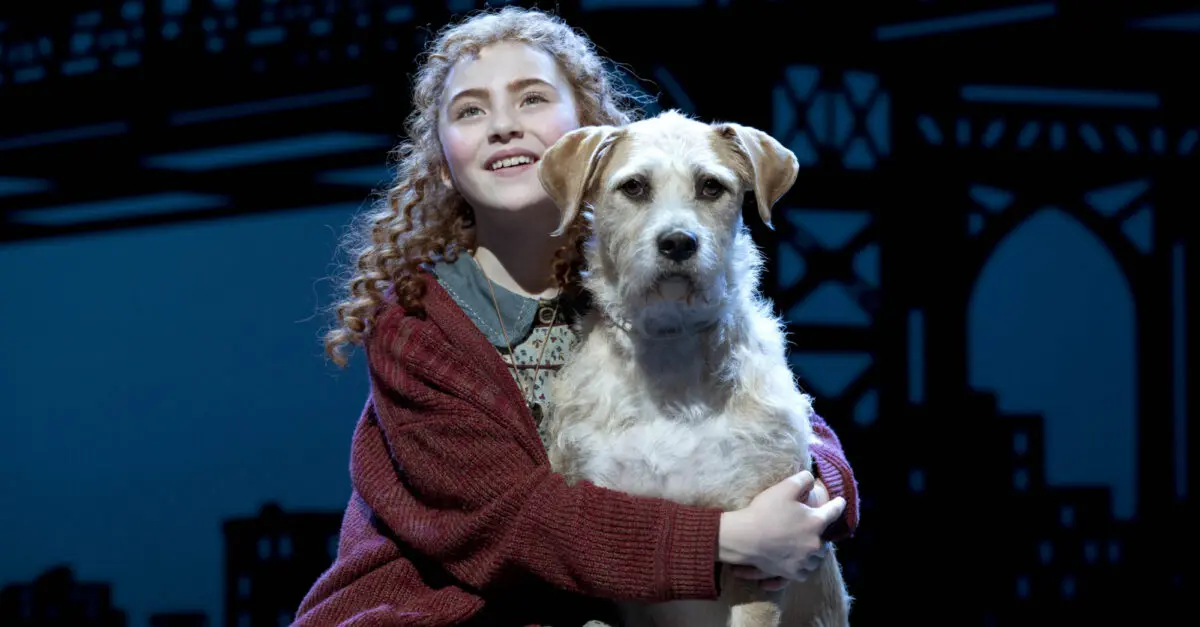
The modern era of Broadway animal performance was fundamentally redefined by the 1977 premiere of Charles Strouse, Martin Charnin, and Thomas Meehan’s smash-hit musical, Annie. Central to the narrative is the title character’s loyal companion, Sandy, an endearing mutt who rescues the orphan from the bleak realities of the New York Municipal Orphanage.
The search for the original Broadway Sandy set a precedent for how theatrical dogs would be sourced, trained, and integrated into high-stakes commercial productions. Rather than utilizing purebred show dogs, the production sought out rescue animals whose resilient backgrounds and eager-to-please temperaments matched the scrappy nature of the character. The success of the original production—and its subsequent revivals and film adaptations—cemented the stage dog as a cultural touchstone, transforming the canine performer from a theatrical novelty into an integral narrative component of major musical theatre productions.
Evolution into the Twenty-First Century
In recent decades, the presence of dogs on Broadway has expanded beyond traditional roles like Annie. Contemporary plays and musicals have incorporated emotional support animals, working dogs, and narrative-driven pets into diverse genres. Shows such as Legally Blonde: The Musical, Sylvia, Finding Neverland, and The Audience have all featured live canines, each production requiring a bespoke approach to animal husbandry, training, and performance execution. As audience expectations regarding animal welfare have evolved, so too has the professionalism of the theatrical animal handling industry, ensuring that every curtain call is met with the highest standards of safety and care.
Supporting Context & Metrics: The Science and Logistics of Broadway Animal Performance
Placing a living, breathing animal on a Broadway stage is an intricate logistical feat that involves a complex network of trainers, stage managers, actors, and veterinary professionals. The metrics governing canine performance reveal a rigorous discipline far removed from casual pet ownership.
Selection and Temperament Assessment
Not every dog is suited for the bright lights of Broadway. Professional animal coordinators evaluate potential stage recruits using a battery of behavioral assessments designed to measure stress resilience, environmental adaptability, and focus. Key selection criteria include:
- Noise Desensitization: Animals must remain calm in the presence of sudden loud noises, brass-heavy orchestrations, and booming theatrical sound design.
- Lighting Adaptation: Canines must navigate moving spotlights, flashing effects, and rapid lighting transitions without startling or freezing.
- Social Compatibility: A stage dog must be comfortable interacting with an ever-changing rotation of human actors, child performers, and backstage crew members in confined backstage quarters.
- Energy Management: The ideal theatrical canine balances high eagerness during performance cues with the ability to rest quietly in a designated green room or dressing space for hours at a time.
Training Methodologies and Positive Reinforcement
Modern Broadway animal training relies exclusively on positive reinforcement techniques—utilizing high-value treats, verbal praise, and play to encourage desired behaviors. Clicker training and marker-based conditioning allow trainers to communicate precise behavioral expectations to the animal without stress or coercion.
A typical training cycle for a Broadway production lasts anywhere from eight to twelve weeks. During this period, the dog is gradually introduced to the rehearsal space, beginning with empty rooms and progressing to full company run-throughs complete with costumes, props, and set pieces. Trainers work meticulously to pair specific verbal cues and visual hand signals with stage blocking, ensuring the dog hits its mark consistently across eight performances a week.

The Working Environment: Regulations and Oversight
The welfare of canine performers on Broadway is governed by a strict framework of union guidelines, municipal laws, and internal animal welfare policies. Organizations such as the American Humane Association (AHA) and local animal control authorities frequently monitor theatrical productions utilizing live animals.
Key operational metrics for a Broadway dog include:
- Work-Hour Limitations: Just as human actors are protected by union contracts (such as Equity rules regarding rehearsal hours and rest periods), canine performers operate under strict time limits. Puppies and young dogs have shorter call times, while adult dogs typically work no more than two to three hours per performance block.
- Understudy Systems: Much like their human counterparts, high-profile Broadway dogs often employ understudies or alternates. Rotating canine performers prevents burnout, reduces fatigue, and ensures that the animal remains enthusiastic and healthy throughout a grueling theatrical run.
- Dedicated Human Liaisons: Every stage dog is accompanied backstage by a licensed, professional animal handler or trainer who remains with the animal from load-in to curtain down, overseeing feeding, walking, hydration, and downtime.
Official Statements: Industry Perspectives on Canine Theatrics
The integration of animals into professional theatre is a collaborative art form that bridges the gap between animal behaviorism and dramatic performance. Industry leaders, trainers, and performers consistently emphasize the profound impact these animals have on the theatrical ecosystem.
"Working with a dog on stage is an exercise in absolute, humbling collaboration. You cannot direct a dog the way you direct an actor; you cannot explain the subtext of a scene or the emotional stakes of a musical number. Instead, you must build a language of trust, consistency, and shared joy. When that connection clicks on stage, it creates an electric, authentic moment that no human actor can replicate."
— A leading Broadway Animal Coordinator and Trainer
Performers who share the stage with these canine stars frequently praise their professionalism and emotional grounding. Cast members of shows featuring animal co-stars note that the presence of a dog introduces a spontaneous, life-affirming energy to the production that keeps human actors perpetually present and responsive in the moment.
Furthermore, theatrical veterinarians and welfare advocates underscore the rigorous standards demanded by modern commercial theatre.
"The standards of care for animals in contemporary entertainment have reached an all-time high. Producers recognize that a stressed or unhappy animal cannot perform safely or effectively. Consequently, the industry has embraced a culture of radical transparency, comprehensive veterinary oversight, and uncompromised animal welfare, ensuring that our four-legged performers live pampered, enriching lives both on and off the stage."
— Representative from a prominent animal welfare and theatrical monitoring agency
Future Outlook: The Next Generation of Stage Paws
As theatrical technology advances and audience tastes evolve, the role of animals on the Broadway stage continues to adapt. The future of canine performance intersects with innovations in animal husbandry, behavioral science, and immersive theatrical design.
Technological Integration and Stage Safety
Modern stage design incorporates sophisticated automation, LED displays, and complex rigging systems. Ensuring the safety of a canine performer in a high-tech environment requires continuous innovation in stage flooring, acoustic dampening, and spatial mapping. Future productions are expected to rely even more heavily on specialized non-slip flooring materials and customized acoustic shielding to protect sensitive canine hearing from excessive decibel levels during rock-infused or heavily orchestrated musical numbers.
Expanding Representation and Rescue Partnerships
A notable trend in modern theatrical casting is the deliberate partnership between Broadway productions and animal rescue organizations. Shows utilizing stage dogs increasingly use their high-profile platforms to advocate for rescue adoption, working hand-in-hand with shelters to find forever homes for retired stage dogs or to highlight the broader mission of animal rescue. This philanthropic synergy transforms entertainment into advocacy, raising public awareness regarding responsible pet ownership and the incredible potential of shelter animals.
The Enduring Magic of the Unscripted Moment
Despite the rise of animatronics, CGI, and digital projection in contemporary entertainment, nothing can replicate the visceral, heartwarming magic of a living creature sharing the stage with human actors. The unscripted wag of a tail, the spontaneous tilt of a head, and the genuine bond between actor and animal anchor theatrical storytelling in a shared emotional reality.
As Broadway looks toward the future, one certainty remains: whether testing theatrical trivia through playful quizzes or charming packed houses night after night, the dogs of Broadway will continue to hold a permanent, celebrated place in the hearts of theatregoers worldwide.