
By David Salazar
Published by OperaWire
Executive Overview
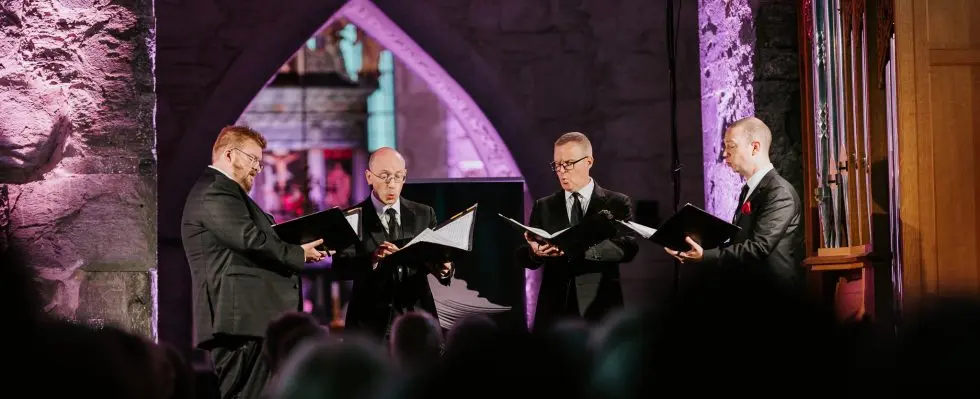
For twenty years, the GRAMMY-nominated vocal quartet New York Polyphony has stood as a beacon of artistic excellence, breathing vibrant, modern life into centuries-old repertoires. Now, as the ensemble approaches its third decade of music-making, it prepares for a monumental homecoming. On September 19 at 7:00 PM, the group will take the stage at the historic Church of St. Mary the Virgin in Times Square—the exact sacred space where they made their public debut nearly two decades ago on September 14, 2006.
Presented by the Gotham Early Music Scene (GEMS) as part of its prestigious GEMS Presents! series, this anniversary concert is far more than a retrospective. It is a living testament to the evolution of a chamber ensemble that redefined the boundaries of early and contemporary classical vocal art. The program bridges the sacred Renaissance polyphony that built their reputation with daring contemporary commissions, offering a comprehensive look at an ensemble that has performed in major concert halls across 19 countries, released ten critically acclaimed commercial albums, and earned two prestigious GRAMMY nominations.
This article explores the trajectory of New York Polyphony: tracing their journey from an ambitious New York debut to global prominence, analyzing the milestones and metrics of their extraordinary catalog, examining the curatorial vision behind their upcoming anniversary program, and evaluating what the next twenty years hold for one of classical music’s most vital vocal ensembles.
Detailed Chronology: From Humble Beginnings to Global Acclaim
The Genesis: September 2006
The story of New York Polyphony begins in the crucible of New York City’s hyper-competitive classical music ecosystem. In the mid-2000s, the landscape for male vocal chamber music was dominated by established European cathedral traditions. Yet, a collective of forward-thinking American musicians envisioned a different approach—one that combined the transparent, rich textures of Renaissance sacred music with a contemporary sensibility regarding tone, phrasing, and dramatic pacing.
On September 14, 2006, that vision crystallized inside the neo-Gothic splendor of the Church of St. Mary the Virgin in Times Square. The debut performance was not merely a concert; it laid the philosophical foundation for the group’s ethos: treating centuries-old masterworks not as museum pieces to be preserved under glass, but as dynamic, living emotional expressions meant to resonate deeply with modern listeners.
International Expansion and Artistic Triumphs
Following their New York debut, the ensemble embarked on a steady, methodical expansion. Rather than relying solely on local audiences, New York Polyphony cast its net internationally. Their unique blend of individual vocal agility and blended ensemble balance quickly caught the attention of international concert promoters.
Over the next twenty years, the group’s passport filled with stamps from across the globe. They secured coveted performance slots at some of the world’s most prestigious cultural capitals and heritage sites, including:
- London: Wigmore Hall and Cadogan Hall.
- Amsterdam: The legendary Concertgebouw.
- Global Festivals: Major early music and chamber festivals spanning Europe, Asia, and the Americas.
Throughout this period of intense touring, the quartet maintained an exhaustive recording schedule. They transitioned from regional curiosity to international standard-bearers for a cappella vocal art, collaborating with renowned record labels and earning critical praise from outlets like Gramophone, BBC Music Magazine, and The New York Times. Their sound—characterized by pristine intonation, crystalline diction, and an absence of excessive vibrato—became a masterclass in modern chamber ensemble execution.
Supporting Context & Metrics: Measuring Two Decades of Excellence
To truly understand the magnitude of New York Polyphony’s 20th-anniversary milestone, one must examine the quantitative and qualitative metrics that define their career.
Discography and Accolades
- 10 Commercial Albums: Spanning centuries of musical development, their recorded output ranges from 12th-century chant and Renaissance masterworks to cutting-edge contemporary commissions written explicitly for their voices.
- 2 GRAMMY Nominations: A rare achievement for an independent, a cappella early music vocal ensemble in the mainstream recording industry, validating both their technical precision and their innovative programming choices.
- 19 Countries Visited: Proof of a truly global footprint, bringing American-led historical performance practice to international audiences.
- Hundreds of Performances: Cultivating a loyal, international base of supporters across continents through relentless, high-caliber live performance.
The Repertoire: Bridging Eras
What sets New York Polyphony apart from many of their contemporaries is their fearless juxtaposition of old and new. While early music ensembles often restrict themselves to a specific century or geographic region, New York Polyphony views musical history as a continuous, unbroken chain.
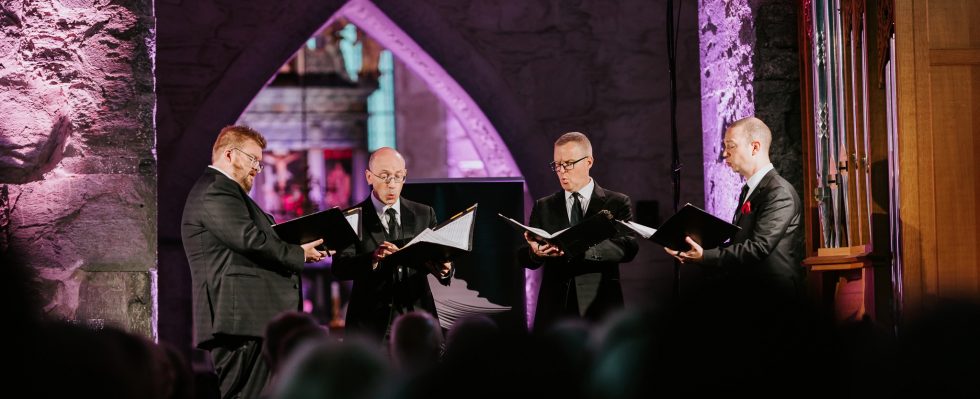
For their upcoming 20th-anniversary concert at St. Mary the Virgin, the ensemble has curated a program that reflects this panoramic artistic vision. The evening’s repertoire features monumental historical figures alongside boundary-pushing contemporary composers:
- William Byrd: The towering English Renaissance master known for his profound emotional depth and complex polyphonic textures.
- Giovanni Pierluigi da Palestrina: The quintessential voice of the Roman School, celebrated for his peerless counterpoint and serene vocal balance.
- Pierre Crecquillon: The Renaissance Franco-Flemish master whose secular and sacred works showcase rich harmonic invention.
- Andrew Smith: A contemporary voice whose modern sensibilities find a natural home within the acoustic and harmonic parameters of a cappella vocal writing.
- Akemi Naito: A contemporary composer known for bridging Eastern and Western aesthetic traditions through striking sonic textures.
By placing Byrd and Palestrina alongside Smith and Naito, New York Polyphony demonstrates how historical performance practice informs contemporary composition, and conversely, how modern ears illuminate the structural brilliance of Renaissance masterpieces.
Official Statements: Honoring the Past, Framing the Future
In an official press release commemorating their milestone anniversary, the members of New York Polyphony reflected candidly on their improbable journey and their vision for the decades ahead:
"Two decades on, New York Polyphony has achieved more than we dreamed possible — hundreds of performances around the country, appearances in 19 different countries, ten commercial album releases, two GRAMMY nominations. To celebrate this milestone, we are returning to where it all began for a 20th anniversary concert that honors our past while looking ahead to the music that will shape our next twenty years."
This statement encapsulates the dual mandate of the ensemble: profound gratitude for the institutions and audiences that nurtured them, paired with an unyielding commitment to innovation. Returning to the Church of St. Mary the Virgin is not a nostalgic retreat; it is a symbolic anchoring point. By planting their feet once more in the venue of their birth, they draw strength from their origins to project their art forward into an uncertain, yet creatively boundless, future.
The presentation of this milestone concert by Gotham Early Music Scene (GEMS) through its GEMS Presents! series further underscores the significance of the event. GEMS has long served as an essential pillar for historical performance in New York City, providing a vital platform for artists who push the boundaries of early music interpretation.
Future Outlook: The Next Twenty Years of New York Polyphony
As New York Polyphony steps across the threshold of its third decade, the classical music landscape looks vastly different than it did in 2006. Digital streaming has transformed how audiences discover music, funding for the arts faces perpetual structural challenges, and chamber ensembles must constantly reinvent their engagement strategies to remain relevant in a fragmented cultural marketplace.
Yet, New York Polyphony is uniquely positioned to navigate these shifts. Their success has never been built on fleeting trends or gimmicks; it is rooted in the timeless, universal appeal of the human voice raised in harmony.
Strategic Priorities for the Next Decade
- Commissioning the Next Generation: The ensemble plans to deepen its commitment to living composers, commissioning new works that challenge the technical and expressive limits of four-part male vocal writing. By expanding the modern a cappella canon, they ensure that future generations of vocalists will have a rich repertoire of 21st-century masterworks to explore.
- Educational Outreach and Mentorship: As recognized leaders in their field, the members of New York Polyphony increasingly dedicate their time to masterclasses, university residencies, and workshops. Cultivating the next generation of ensemble singers is vital to preserving the fragile art of historically informed chamber performance.
- Digital Innovation and Immersive Audio: Building on their extensive catalog of ten commercial releases, the ensemble is exploring high-resolution recording formats and immersive audio technologies (such as spatial audio) that capture the breathtaking acoustics of sacred spaces, bringing the live concert experience directly into listeners’ homes with unprecedented fidelity.
- Deepening Global Partnerships: While maintaining their core presence in New York City and across North America, the quartet continues to forge relationships with international festivals, ensuring that their unique artistic voice remains a bridge for cultural exchange across the globe.
Conclusion
When the first chord rings out inside the Church of St. Mary the Virgin on September 19, it will carry the weight of twenty years of artistic risk, relentless touring, meticulous rehearsal, and transcendent beauty. New York Polyphony has proven that ancient music, when approached with supreme technical mastery and deep emotional intelligence, is entirely contemporary.
As they honor the past and look toward the horizon, one thing is certain: the next twenty years of New York Polyphony will be defined by the same unwavering dedication to sonic purity that made their debut in Times Square unforgettable two decades ago.