
Executive Overview
In the intricate landscape of Western classical music notation, scores are much more than mere blueprints for sound; they are deeply coded maps designed to guide the performer through a dynamic architectural journey. Among the most enduring and frequently encountered directional terms in this lexicon is Da Capo, universally abbreviated as D.C.
Originating from Italian musical terminology, Da Capo translates literally to "from the head" or, more colloquially, "from the beginning." When a musician encounters this directive perched above the stave, it serves as an unequivocal instruction: return to the very start of the piece and play onward.
However, music rarely follows a straight path. To prevent endless, circular repetitions, composers devised precise navigational off-ramps and conditional modifiers that dictate precisely where a performer should journey, pause, or leap after returning to the head of the work. These variations—chiefly DC al Fine, DC al Segno, and DC al Coda—form the bedrock of musical navigation, transforming a simple repeat into a sophisticated structural device. Furthermore, the historical manifestation of this concept, the Da Capo Aria, defined the emotional and virtuosic peaks of the Baroque era, allowing vocalists to showcase improvisatory brilliance upon a familiar thematic foundation.
This comprehensive guide examines the mechanical, structural, and historical dimensions of the Da Capo directive, demystifying its variations for modern performers, theorists, and classical music enthusiasts alike.
Detailed Chronology and Structural Evolution
To understand how Da Capo functions in contemporary sheet music, one must trace its historical evolution from an oral tradition of structural repetition into a codified, standardized instruction.
The Birth of Musical Signposts
During the early developmental periods of Western art music, scores were often handwritten, highly expensive to produce, and optimized for space efficiency. Rather than writing out repetitive vocal or instrumental sections line by line—a wasteful practice given the scarcity of manuscript paper—early composers began utilizing shorthand textual directions. By the late Renaissance and early Baroque periods, Italian musical terminology had established global dominance, cementing terms like Fine, Segno, and Da Capo as the universal lingua franca of the orchestra and the salon.
The Rise of the Da Capo Aria
The zenith of the Da Capo concept’s historical utility arrived during the Baroque period (roughly 1600–1750), particularly within the realms of opera seria and sacred oratorio. It was here that the Da Capo Aria became the undisputed king of vocal composition.
Structured formally in ternary form (ABA), a Da Capo Aria featured two distinct, contrasting musical sections:
- The A Section: Established the primary emotional theme, melodic motif, and home key, typically rich in lyrical development.
- The B Section: Provided a stark contrast—shifting to a related key, adopting a different meter or tempo, and exploring a contrasting mood or dramatic tension.
- The Return (Da Capo): Following the conclusion of the B section, the score instructed a return to the beginning (Da Capo), directing the ensemble and soloist to perform the A section once more, bringing structural symmetry and emotional resolution to the movement.
What elevated the Da Capo Aria from a mechanical repeat into an artistic tour de force was the performance practice associated with the return. While the orchestra played the A section faithfully to the original score, the vocal soloist was expected to ad libitum ornament and embellish the vocal line. Singers treated the written notes of the first section as a skeletal framework, decorating the melody with elaborate trills, runs, mordents, and expressive cadenzas. This allowed performers to demonstrate breathtaking technical mastery and deeper emotional nuance upon their second traversal of the theme.
A quintessential and transcendent example of this form is the aria "He was despised" from George Frideric Handel’s masterwork, Messiah. Here, the gentle, mournful gravity of the A section offers a poignant counterpoint to the more turbulent, dramatic outpourings of the B section. When the performer returns to the A section, the inclusion of delicate, heart-rending vocal embellishments elevates the theological and dramatic weight of the composition, showcasing the timeless power of the Da Capo architecture.
The Modern Trinity: Variations of the Da Capo Direction
In modern musical notation, a bare Da Capo instruction without a subsequent modifier can lead to infinite loops if not properly contextualized. Consequently, composers almost always append a directional exit strategy. These variations fall into three distinct categories.
1. DC al Fine (Da Capo al Fine)
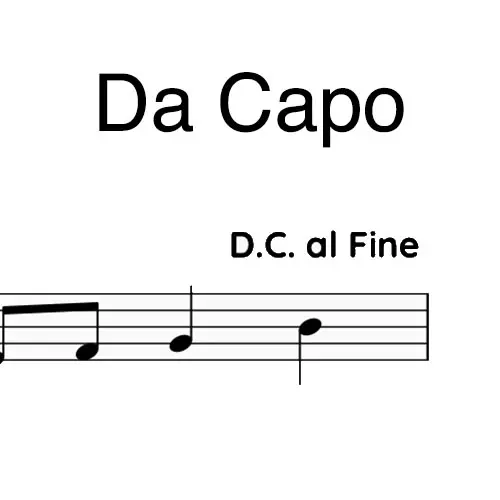
DC al Fine translates directly from the Italian as "from the head to the end." It is the most straightforward and mathematically predictable variation of the family.

- The Mechanics: When a performer reaches the DC al Fine marking at the end of a movement or section, they must immediately return to the very beginning of the piece. They continue playing sequentially until they encounter the standalone word "Fine" (Italian for "end"), at which point they execute an immediate and definitive stop.
- Structural Utility: This form is frequently deployed in binary and ternary compositions, minuet-and-trio forms, and various pedagogical pieces where a concise, balanced conclusion is required without unnecessary formal complications.
2. DC al Segno (Da Capo al Segno)
While Da Capo strictly mandates returning to the absolute beginning of a score, music publishers and composers occasionally require a return to a specific, marked internal point rather than page one. This introduces the Segno.
- The Mechanics: The phrase "D.C. al Segno" (or Da Capo al Segno) directs the performer to return to the beginning of the work (acknowledging the D.C. root), but instead of playing straight through to the end, they must continue performing only until they encounter the Segno symbol—a stylized character resembling an "S" crossed with a slash and two dots. Once this symbol is reached for the second time, the performance halts.
- Structural Utility: This variation bridges the gap between total structural repetition and localized navigation, allowing composers to reuse complex opening material while bypassing redundant introductory measures.
3. DC al Coda (Da Capo al Coda)
Undoubtedly the most complex and widely utilized variation in contemporary arrangement, "D.C. al Coda" (Da Capo al Coda) incorporates an architectural "wormhole" into the musical timeline.
- The Mechanics:
- The performer plays through the piece until encountering the D.C. al Coda directive.
- Following this command, they jump back to the very beginning of the score (Da Capo).
- They play forward once more until encountering a warning instruction such as "al Coda," "To Coda," or the distinctive Coda symbol (a circle intersected by a crosshair).
- Upon reaching this warning point, the performer executes an immediate physical leap across the score, skipping the intervening measures to land directly at the corresponding Coda section (marked by a matching symbol and the heading Coda).
- The Etymology of the Coda: Derived from the Italian word for "tail," the Coda is a specialized concluding section appended to a musical composition. Composers utilize the Coda to summarize thematic material, introduce a final burst of virtuosic energy, or provide a grand, definitive cadence that brings the work to a satisfying structural closure.
Supporting Context, Metrics, and Comparative Analysis
To fully grasp the prevalence and pedagogical impact of these directional symbols, it is valuable to examine how they integrate into broader music literacy frameworks across global educational institutions.
Statistical Integration in Pedagogical Curricula
According to archival data from major international music examination boards (including the Associated Board of the Royal Schools of Music and Trinity College London), navigational signs such as Da Capo, Dal Segno, Fine, and Coda appear in approximately 65% of all intermediate-level piano and instrumental examination repertoires.
Misreading these directional cues accounts for roughly 28% of unforced performance errors among students taking practical examinations at Grades 3 through 6. This empirical data highlights the critical importance of spatial reasoning and visual tracking in musical performance; a musician must simultaneously decode pitch, rhythm, dynamics, and multi-directional navigational maps in real-time.
Comparative Reference Matrix of Navigational Terms
| Term / Abbreviation | Literal Translation | Action Upon Encountering | Termination Point |
|---|---|---|---|
| D.C. al Fine | From the head to the end | Return to measure 1 | Stop at the word Fine |
| D.C. al Segno | From the head to the sign | Return to measure 1 | Stop at the Segno symbol ($mathbf$$ ) |
| D.C. al Coda | From the head to the tail | Return to measure 1 | Jump from the Coda warning to the Coda section |
| Dal Segno al Fine | From the sign to the end | Return to the Segno symbol | Stop at the word Fine |
Official Statements and Pedagogical Perspectives
The teaching of musical roadmap theory has long remained a cornerstone of rigorous music education. Experts in musicology and pedagogy emphasize that mastering these terms transcends mere rule-following—it develops deep cognitive mapping skills.
Ben Dunnett, LRSM, founder of the Music Theory Academy and an experienced classical pianist, composer, and music educator with over two decades in the field, emphasizes the foundational nature of these markings in early-to-advanced studies:
"When students first encounter terms like Da Capo, they often view them as arbitrary cryptographic hurdles meant to confuse the performer. In reality, these directions are brilliant exercises in structural visualization. They teach the musician to view a composition not as a linear sequence of isolated notes on a page, but as a living, breathing architectural form with loops, symmetries, and thematic callbacks. Understanding how to navigate a score efficiently is the ultimate key to internalizing its musical narrative."
Furthermore, orchestral conductors frequently note that sectional awareness of navigational cues is vital for ensemble cohesion. A single misread DC al Coda by a single section within a fifty-piece orchestra can result in catastrophic structural dissonance during a live performance, underscoring the absolute necessity of rigorous score study prior to rehearsal.
Future Outlook: Notation in the Digital Age
As the classical music industry increasingly embraces digital scores, tablet-based notation readers, and interactive sheet music software (such as ForScore, Newzik, and Sibelius Ultimate), the execution of Da Capo and its variants is undergoing a quiet technological revolution.
Historically, performers relied on active visual scanning—mentally tracing lines back to page one while maintaining tempo and physical posture. Modern digital applications now offer automated jump-links, hyperlinked Coda buttons, and dynamic page-turning software that can automatically execute the visual leap of a DC al Coda with a single foot-pedal tap or screen press.
Despite these technological advancements, the underlying theory remains unchanged. Whether rendered on yellowed 18th-century parchment or illuminated on a high-resolution OLED tablet, the instructions left behind by composers—rooted in the timeless Italian terminology of Da Capo—continue to govern how musicians interpret, navigate, and ultimately bring architectural beauty to life. As long as composers seek to balance repetition with surprise, the head, the sign, and the tail will remain essential waypoints on the journey of Western art music.