

Executive Overview
The rapid integration of artificial intelligence into creative education has sparked intense debate among pedagogues, technologists, and artists. In vocal music—a discipline historically reliant on the highly subjective, intimate, and physical relationship between student and master teacher—the rise of AI-driven tutoring tools has met with deep skepticism. Critics argue that an algorithm cannot comprehend the emotional nuance of a performance, let alone diagnose physical tension or guide a singer toward authentic artistic expression.
However, emerging empirical data suggests that while AI may not yet be capable of training the next operatic virtuoso, it is proving remarkably effective at solving the fundamental challenge of singing: pitch accuracy.
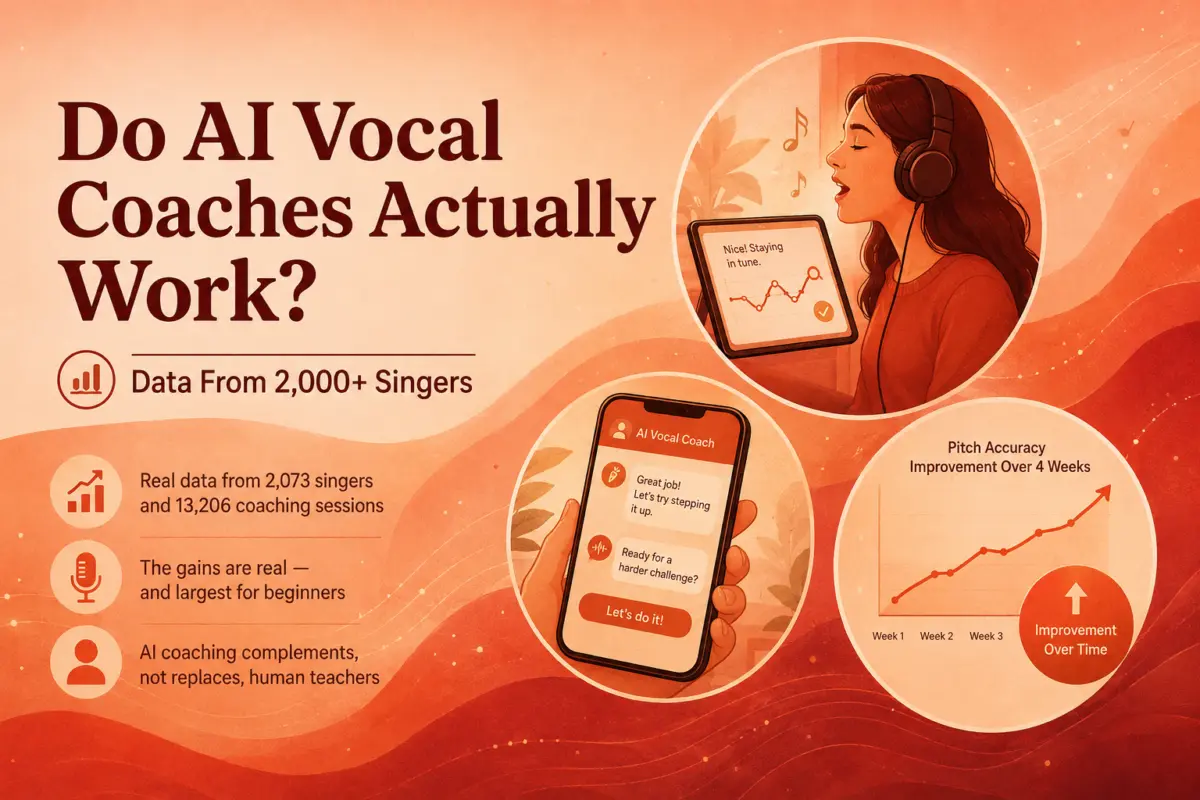
A comprehensive analysis of user data from Singing Carrots, an AI-driven vocal training platform, offers a rigorous look at the capabilities of these digital tutors. Tracking 2,073 singers across 13,206 coaching sessions, the study revealed a baseline pitch accuracy improvement of +5.9 percentage points over a four-week period. Most notably, true beginners—defined as those starting with less than 75% pitch accuracy—experienced an average gain of +16.5 percentage points.
These findings, bolstered by decades of independent academic research on real-time visual pitch feedback, confirm that algorithmic coaching works within specific, quantifiable parameters. Yet, the developers of these tools and independent vocal experts agree on a critical caveat: AI remains a supplement, not a replacement, for the human ear when it comes to advanced technique, physiological health, and artistic interpretation.
+-------------------------------------------------------------------------+
|                  Vocal Pitch Accuracy Improvement                       |
|                      (4-Week Training Period)                           |
+-------------------------------------------------------------------------+
| Overall Average Gain:   [======] +5.9%                                  |
|                                                                         |
| Beginner Singers:       [==================================] +16.5%     |
| (<75% Initial Accuracy)                                                 |
+-------------------------------------------------------------------------+
Detailed Chronology: The Evolution of Vocal Feedback Technology
To understand how modern AI vocal coaches function, it is necessary to trace the technological and pedagogical evolution that paved the way for their development. The journey from analog laboratory experiments to pocket-sized, adaptive software spans nearly four decades.
[1989] Welch, Howard, & Rush Study ──► [2010s] Classroom Software Integration ──► [Present] Adaptive AI Coaches
(First proof of real-time feedback)    (Concurrent-feedback games in schools)     (Dynamic, personalized lesson plans)
Phase 1: The Foundations of Visual Pitch Feedback (1980s)
In 1989, researchers Graham Welch, David Howard, and Cynthia Rush published a landmark study investigating the development of vocal pitch accuracy in singers. Using rudimentary computer systems that could analyze audio signals and output basic visual representations of frequency, they discovered that students who received real-time visual pitch feedback improved their accuracy far more rapidly than those in traditional control groups. Crucially, the study demonstrated that once the visual aid was removed, the improved accuracy persisted, proving that visual feedback helped train internal muscle memory and cognitive pitch matching.
Phase 2: Classroom and Software Integration (2000s–2010s)
For years, the technology required to analyze pitch in real time was confined to expensive academic laboratories and music therapy clinics. By the mid-2010s, however, consumer hardware had advanced to the point where consumer software could execute these calculations on standard desktop computers.
In 2015, researchers A.S. Paney and A.C. Kay evaluated the impact of concurrent-feedback computer games on third-grade music students. Their findings replicated the earlier laboratory results: children using software that provided immediate, gamified visual feedback on their pitch matching improved significantly faster than those receiving standard, non-digital group instruction. The technology was democratizing, but it remained rigid—operating on fixed scripts and predetermined musical exercises that did not adapt to individual vocal ranges or student fatigue.
Phase 3: The Era of Adaptive AI Coaching (2020s)
The current generation of vocal training technology, epitomized by platforms like Singing Carrots, marks a transition from passive "pitch meters" to dynamic, adaptive systems. Rather than simply displaying a pitch line over a static sheet music file, modern AI coaches analyze a user’s comfortable vocal range in real time.
Data reveals that across 349,000 analyzed exercises, the Singing Carrots AI coach successfully placed 91.5% of tasks within each singer’s demonstrated safe and comfortable range. Furthermore, the system employs a dynamic difficulty engine: after a user successfully completes an exercise, the probability of the next exercise being more challenging increases by 31.5%. Conversely, if a user struggles, the probability of a difficulty hike drops to just 3%, representing a 10x operational swing that mimics the adaptive pacing of a human instructor.
Supporting Context & Metrics: Deconstructing the Data
The claims surrounding AI vocal coaching are often obscured by marketing hyperbole. To establish a realistic assessment of what these platforms can achieve, we must analyze the metrics from the Singing Carrots seven-month dataset.
The Quantitative Outcomes
The study analyzed a cohort of 2,073 active singers to determine if the digital coach could produce lasting, measurable improvements in pitch accuracy. The results were segmented by initial skill level, duration of training, and engagement depth.
- Replicated Baseline Progress: In a paired analysis of 358 singers who completed a four-week regimen, pitch accuracy improved by an average of +5.9 percentage points. This closely mirrored an earlier, smaller four-month pilot study that recorded a +6.1 percentage point gain, indicating a stable and replicable learning curve.
- The Beginner Premium: The data strongly indicates that AI coaching is most effective for those at the beginning of their vocal journey. Users who registered a baseline pitch accuracy of below 75% saw an average improvement of +16.5 percentage points. Meanwhile, singers who already possessed high pitch accuracy (above 92%) showed statistically negligible improvement in raw pitch metrics.
+-----------------------------------------------------------------------+
|                 Pitch Accuracy Improvement by Cohort                  |
+-----------------------------------------------------------------------+
| Cohort Group                 | Starting Accuracy | 4-Week Improvement |
+------------------------------+-------------------+--------------------+
| High-Accuracy Singers        | >92%              | Negligible (~0.5%) |
| Average Cohort               | Mixed             | +5.9%              |
| True Beginners               | <75%              | +16.5%             |
+-----------------------------------------------------------------------+- Long-Term Durability: A common criticism of educational apps is the "novelty effect"—the tendency for performance to spike initially due to high engagement, only to crash once the novelty wears off. To test this, researchers tracked 94 singers for more than three months. Even after twelve weeks, the average pitch accuracy gain remained stable at +6.1 percentage points above their baseline, suggesting that the neurological and muscular adjustments made during training had successfully integrated into the singers’ long-term muscle memory.
- The Engagement Correlation: The depth of interaction with the AI tutor directly influenced user outcomes. Users who utilized the interactive chat features and engaged in deeper conversational feedback loops with the coach improved by an average of +6.2 percentage points, compared to a +4.5 percentage point improvement for users who only engaged with the bare-minimum exercise prompts.
The Science of Pitch Correction
To understand why beginners experience such dramatic improvements, it is helpful to look at the cognitive science of singing. A common misconception is that people who sing off-key are "tone deaf." However, research by Sandra Hutchins and Isabelle Peretz (2012) demonstrates that clinical congenital amusia—a genuine cognitive inability to perceive differences in pitch—affects only a tiny minority of the population (roughly 1.5% to 4%, according to studies by Peretz & Vuvan, 2017).
Instead, the vast majority of poor singers suffer from a motor-coordination deficit. They can hear when a note is sung correctly, but they have not yet developed the neuromuscular pathways connecting the auditory cortex to the laryngeal muscles. Real-time visual feedback acts as an external mirror, allowing the brain to instantly correlate the physical sensation in the throat with the visual representation of the sound wave on the screen. This accelerates the calibration of the vocal tract, transforming a coordination problem into a solved motor skill.
Methodological Limitations: A Critical Journalistic Eye
While the data supporting AI vocal coaching is compelling, a rigorous journalistic evaluation requires addressing the limitations of the study and the inherent boundaries of the technology.
1. Lack of an Active Control Group
The primary limitation of the Singing Carrots dataset is the absence of an active control group. While the study proves that users who used the app improved, it cannot prove that they improved more than they would have by simply practicing on their own for the same duration. Part of the recorded improvement is undoubtedly driven by the sheer volume of practice, although proponents argue that the app’s gamified interface is the direct catalyst for that increased practice volume.
2. Self-Selection Bias
The long-term durability data (tracking users past the three-month mark) is subject to self-selection bias. The 94 singers who remained active for over twelve weeks were inherently the most motivated, disciplined, and likely naturally talented users in the larger pool. Those who failed to see progress or found the app frustrating likely abandoned the platform early, meaning the long-term metrics may overrepresent successful outcomes.
3. Statistical Regression to the Mean
For beginners starting with extremely low accuracy scores (e.g., 50%), any subsequent performance is statistically likely to skew closer to the average over time. While the +16.5 percentage point gain for beginners is highly encouraging, a portion of this dramatic leap can be attributed to mathematical regression to the mean rather than pure pedagogical triumph.
Official Statements and Industry Perspectives
The rise of AI in vocal pedagogy has created a complex landscape where developers, academic researchers, and traditional vocal instructors must find common ground.
The Developer’s Stance: Transparency and Limits
In an industry often criticized for over-promising, the creators of Singing Carrots have adopted a notably conservative stance regarding their technology’s capabilities.
In a statement regarding their product’s role, the development team noted:
"We did not build this tool to put vocal coaches out of business. Our data clearly shows that while an AI is excellent at helping a beginner build the muscle memory required for basic pitch accuracy, it cannot teach style, stage presence, or artistic interpretation. The role of the AI is to democratize the baseline mechanics of singing, making the entry point accessible to everyone."
The Traditional Pedagogue’s Perspective: The Human Element
Traditional vocal teachers emphasize that singing is a highly physical, whole-body activity. A smartphone microphone cannot detect if a student is locking their jaw, tensing their tongue, or restricting their rib cage expansion—all of which can lead to vocal strain and long-term physiological damage.
+--------------------------------------------------------------------------+
|                 Complementary Roles in Vocal Education                   |
+--------------------------------------------------------------------------+
|  AI VOCAL COACH                           HUMAN VOCAL INSTRUCTOR         |
|  - Objective pitch tracking               - Diagnostic physiological eye |
|  - Real-time visual feedback              - Artistic & emotional guidance|
|  - Low-cost, daily practice tool          - Prevention of vocal strain   |
|  - Dynamic difficulty adaptation          - Tailored stylistic mentoring |
+--------------------------------------------------------------------------+
Experienced vocal instructors argue that while an app is an excellent tool for daily, objective practice, it lacks the holistic diagnostic eye of a human:
"An AI coach can tell you if you are hitting a C4, but it cannot tell you if you are damaging your vocal cords to get there. It cannot see the tension in your shoulders or hear the lack of breath support that will eventually cause vocal nodules. For safety, posture, and true artistry, there is no substitute for a trained human ear and eye."
The Blended Learning Consensus
Ultimately, the consensus emerging among progressive educators is a hybrid, "flipped classroom" model. In this framework, students use AI tools during the week to manage the tedious, repetitive work of pitch training, scales, and ear training. This allows them to arrive at their weekly lessons with their voices warmed up and their basic pitch calibrated, freeing up the expensive, limited time with a human teacher to focus on vocal health, emotional delivery, and stylistic refinement.
Future Outlook: The Next Stage of Algorithmic Music Education
As artificial intelligence continues to evolve, the capabilities of digital vocal coaches are poised to expand far beyond simple pitch detection. The intersection of computer vision, machine learning, and vocal pedagogy points to several major advancements on the horizon:
[Current State]                [Near Future]                  [Long-term Vision]
Pitch & Range Analysis  ───►  Computer Vision Integration  ───►  Biometric & Timbre Analysis
(Audio processing)            (Detecting physical tension)      (Evaluating vocal resonance)
1. Computer Vision and Posture Analysis
The next major leap in AI coaching will likely involve the integration of mobile device cameras. By utilizing real-time computer vision models, future apps will be able to monitor a singer’s posture, jaw alignment, shoulder tension, and breathing patterns. If a singer tenses their neck muscles to reach a high note, the AI will detect the physical strain and instruct the user to stop, directly addressing one of the primary safety concerns held by human vocal coaches.
2. Advanced Timbral and Resonance Evaluation
While current systems primarily measure fundamental frequency (pitch) and amplitude (volume), future algorithms will be capable of analyzing the complex harmonic spectrum of the human voice. This will allow AI coaches to evaluate vocal tone, resonance, breathiness, and vibrato, moving the technology closer to being able to assist with stylistic control and advanced vocal health diagnostics.
3. Democratization of Global Arts Education
The most profound impact of AI vocal coaching is socioeconomic. Private vocal lessons typically cost between $50 and $150 per hour, rendering professional instruction a luxury reserved for the affluent. By providing a highly effective, evidence-based training tool for a fraction of the cost, AI coaches are democratizing music education. This technology offers millions of aspiring singers in underfunded schools and remote regions the opportunity to develop their voices, proving that while algorithms may not possess a soul, they can certainly help humans find their own.
References
- Welch, G. F., Howard, D. M., & Rush, C. (1989). Real-time visual feedback in the development of vocal pitch accuracy in singing. Psychology of Music, 17(2), 146–157.
- Paney, A. S., & Kay, A. C. (2015). Developing singing in third-grade music classrooms: The effect of a concurrent-feedback computer game on pitch-matching skills. Update: Applications of Research in Music Education, 34(1), 42–49.
- Hutchins, S., & Peretz, I. (2012). A frog in your throat or in your ear? Searching for the causes of poor singing. Journal of Experimental Psychology: General, 141(1), 76–97.
- Peretz, I., & Vuvan, D. T. (2017). Prevalence of congenital amusia. European Journal of Human Genetics, 25(5), 625–630.