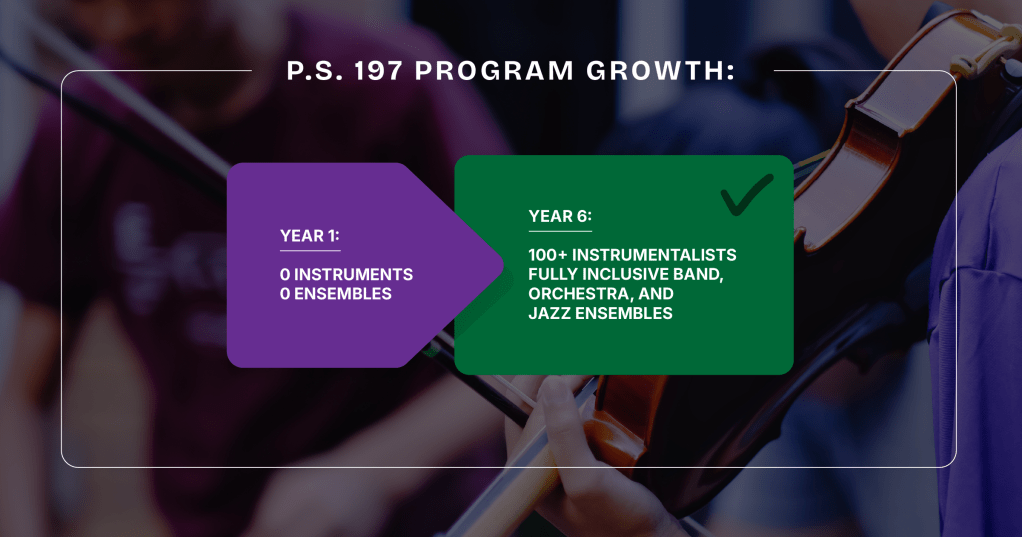
When music educator Kimberly Rosenbaum stepped through the doors of P.S. 197, The King’s Highway Academy, in central Brooklyn six years ago, she faced a daunting mandate from school administration: build an instrumental music program completely from scratch. At the time, the school possessed no foundational band, no budding orchestra, and virtually zero instrumental inventory.
Today, the educational landscape at P.S. 197 looks entirely transformed. The school proudly boasts a vibrant fourth-grade band, a rigorous fifth-grade band, a thriving after-school string orchestra, a dynamic jazz band, and an inclusive philosophy that fully integrates students receiving special education who wish to participate in music-making.
Managing a rapidly expanding school population of roughly 1,200 students spanning grades 3K through 5th grade is an immense operational feat. Amid balancing roughly 15 General Music sections and pulling small groups for compressed 20-minute lunch and recess lessons, Rosenbaum realized she needed a force multiplier in the classroom. By integrating the digital practice platform MakeMusic to act as an automated virtual conductor, Rosenbaum revolutionized her rehearsal space. This case study explores how strategic pedagogy, streamlined municipal procurement through "Sole Source" strategies, and a relentless commitment to universal accessibility enabled a Brooklyn elementary school to scale its instrumental music ecosystem to over 100 student musicians.
Detailed Chronology: The Evolution of P.S. 197’s Music Program
Year One: Laying the Foundation
When Rosenbaum arrived at P.S. 197, her first hurdle was logistical. A blank slate means acquiring physical instruments, establishing rehearsal schedules within a packed elementary school day, and convincing skeptical stakeholders that an instrumental program could flourish in a densely populated urban environment.
With no band or orchestra instruments on hand, the initial phase required grant writing, community outreach, and careful budgeting. Rosenbaum focused heavily on laying the groundwork for general music literacy, setting up the framework for future ensembles while building enthusiasm among third and fourth graders.
Years Two and Three: Launching the Ensembles
As foundational instruments trickled in through district funds and donations, Rosenbaum launched the school’s inaugural fourth-grade band. Teaching raw beginners required innovative scheduling. Because standard pull-out periods during core academic subjects were restricted, Rosenbaum utilized non-traditional windows—such as compressed lunch and recess blocks—to host small-group instrument lessons.
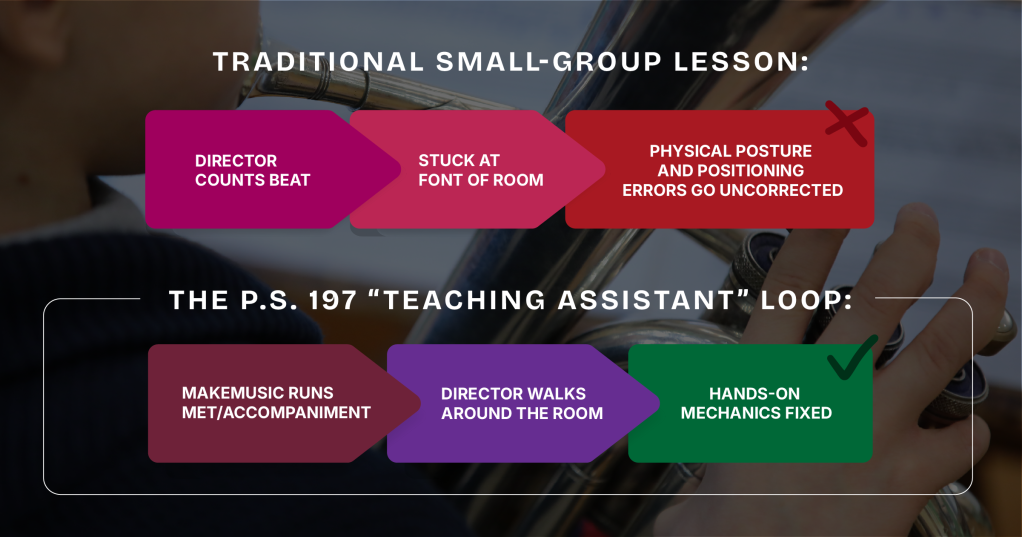
However, teaching a cluster of ten beginner alto saxophones or brass players in a rapid 20-minute window presented a major bottleneck. Traditional instruction required the director to stand at the front of the room, keeping time and counting aloud, making it nearly impossible to address individual physical mechanics like embouchures and hand positions. To solve this, Rosenbaum introduced MakeMusic to automate the rhythm and accompaniment, freeing her to move around the room and provide targeted, one-on-one troubleshooting.
Years Four and Five: Diversification and Expansion
With the band program stabilizing, Rosenbaum expanded her musical footprint. She established a fifth-grade symphonic band to retain older students, founded an after-school string orchestra to cater to violin and cello aspirants, and spun up a jazz band for advanced performers looking for creative improvisation opportunities.
Simultaneously, the program embraced total inclusivity. P.S. 197 successfully integrated special education students into the instrumental tracks, adapting pacing and tools to accommodate diverse learning styles. The total student participation in instrumental music surged past the 100-student milestone.
Year Six and Beyond: Systemic Scaling and Optimization
Today, Rosenbaum manages a massive, multi-faceted music department smoothly. By mastering New York City Department of Education (NYCDOE) procurement processes—specifically leveraging Sole Source vendor pathways—she ensures her software and digital resources are renewed annually without bureaucratic friction. The program stands as a beacon of what is possible in urban public education when visionary teaching meets modern instructional technology.
Building an instrumental program in a diverse, high-density public school environment involves navigating complex systemic challenges. P.S. 197’s success highlights several critical operational metrics and contextual strategies:
Scale of Operations: P.S. 197 serves a bustling student body of 1,200 children across grades 3K through 5th grade. Rosenbaum directly instructs approximately 15 General Music sections weekly, alongside specialized instrumental cohorts.
Time Constraints: Small-group instrumental sessions are often compressed into 20-minute lunch and recess blocks. Maximizing every second of instructional time is vital to student retention and progress.
Linguistic and Cultural Diversity: Centrally located in Brooklyn, P.S. 197 serves a multicultural demographic that includes many English Language Learners (ELL) and multilingual families.
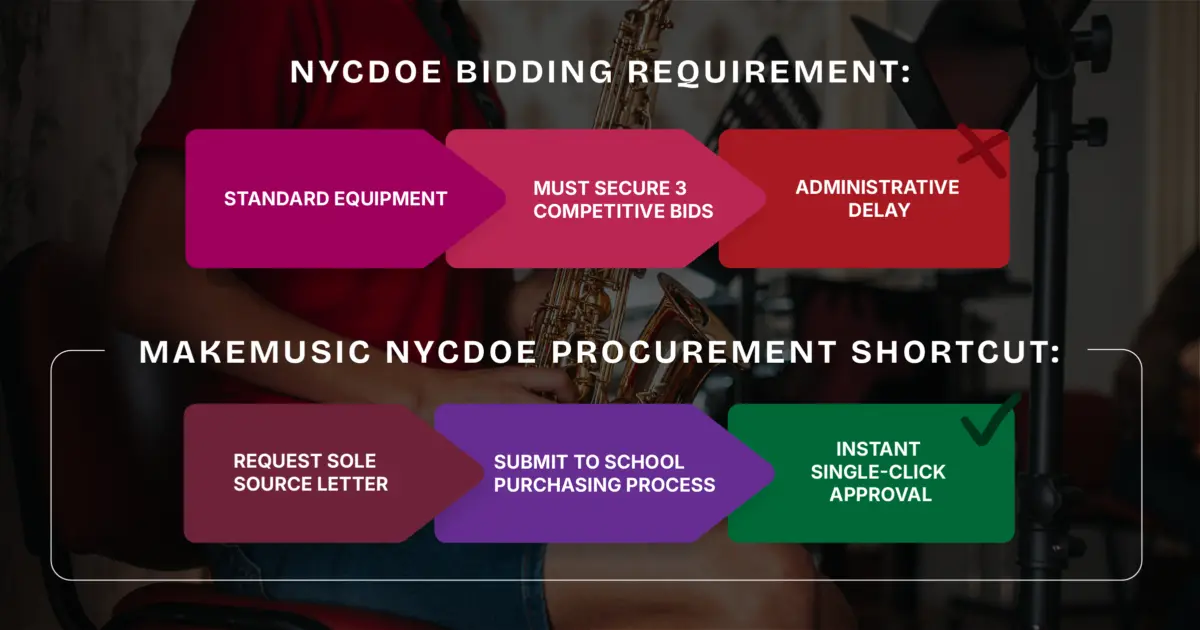
Procurement Efficiency: Navigating municipal procurement portals like FAMIS/ShopDOE typically requires securing three competitive bids from different vendors—a process that can delay software deployment by months. Rosenbaum bypassed this by utilizing a Sole Source Vendor Letter, rendering software acquisitions instantaneous.
Official Statements and Educator Insights
The philosophy driving P.S. 197’s music program centers on empowering students rather than enforcing rigid, archaic pedagogical restrictions. Kimberly Rosenbaum shares her perspective on how technology transforms the classroom dynamic:
"MakeMusic allows me to take a step away from being a conductor and lets me really focus on just being a teacher," Rosenbaum explains. "They know the count-off is coming, the program takes them through, and I can go student-by-student down the line to fix hand position, embouchures, and instrumental positions while they play."
Managing institutional purchases in the nation’s largest school district is notoriously complex, but Rosenbaum unlocked a simple administrative workaround that any NYCDOE music educator can replicate:
"MakeMusic provides a sole-source letter stating you can’t buy this tool anywhere else," notes Rosenbaum. "You give that letter to your purchasing secretary, and they don’t have to ask for three bids because there’s only one source. It’s one of my easiest purchases of the entire year."
Reflecting on the broader mission of music education in urban public schools, Rosenbaum offers advice to educators hesitant about introducing digital practice tools to young ensembles:
"MakeMusic isn’t a rigid curriculum; it’s a flexible tool. You’re giving students access to resources they wouldn’t otherwise have. When you give a kid an instrument and the right tools to practice, they just take off with it. Why wouldn’t you give them that opportunity?"
Universal Access: Bridging Language and Ability Barriers
One of the most remarkable aspects of P.S. 197’s music program is its unwavering commitment to equity and accessibility. In a neighborhood as culturally rich and diverse as central Brooklyn, standardizing instruction on a single linguistic or cognitive baseline simply does not work.
To bridge language barriers, Rosenbaum integrates supplemental digital materials tailored to multi-lingual learners. When teaching non-English-speaking string or wind students, she utilizes the Spanish-translated editions of Alfred Music’s Sound Innovations series directly within the MakeMusic platform. This ensures that language comprehension never acts as a barrier to musical expression.
Furthermore, the platform’s visual red-and-green note feedback engine provides young musicians with an intuitive, non-verbal practice partner at home. For students receiving special education services, this visual reinforcement offers immediate, objective feedback that builds confidence and encourages independent practice outside of school walls.
Future Outlook: A Blueprint for Urban Music Programs
As P.S. 197 looks toward the future, Kimberly Rosenbaum’s journey serves as an invaluable blueprint for music educators nationwide who are tasked with building programs under tight budget constraints and limited instructional hours.
The success at King’s Highway Academy proves that a lack of initial inventory or funding is not a permanent barrier to success. By combining passionate, student-centered pedagogy with modern educational technology that functions as an in-class teaching assistant, music teachers can reclaim lost rehearsal time, cater to diverse learning styles, and scale their programs to unprecedented heights.
For educators seeking to replicate this success in their own classrooms, streamlining small-group lessons and navigating district purchasing hurdles is easier than ever. By leveraging digital platforms and proven administrative shortcuts, the dream of a thriving, 100-plus member instrumental music program is well within reach for schools across the country.