
Executive Overview
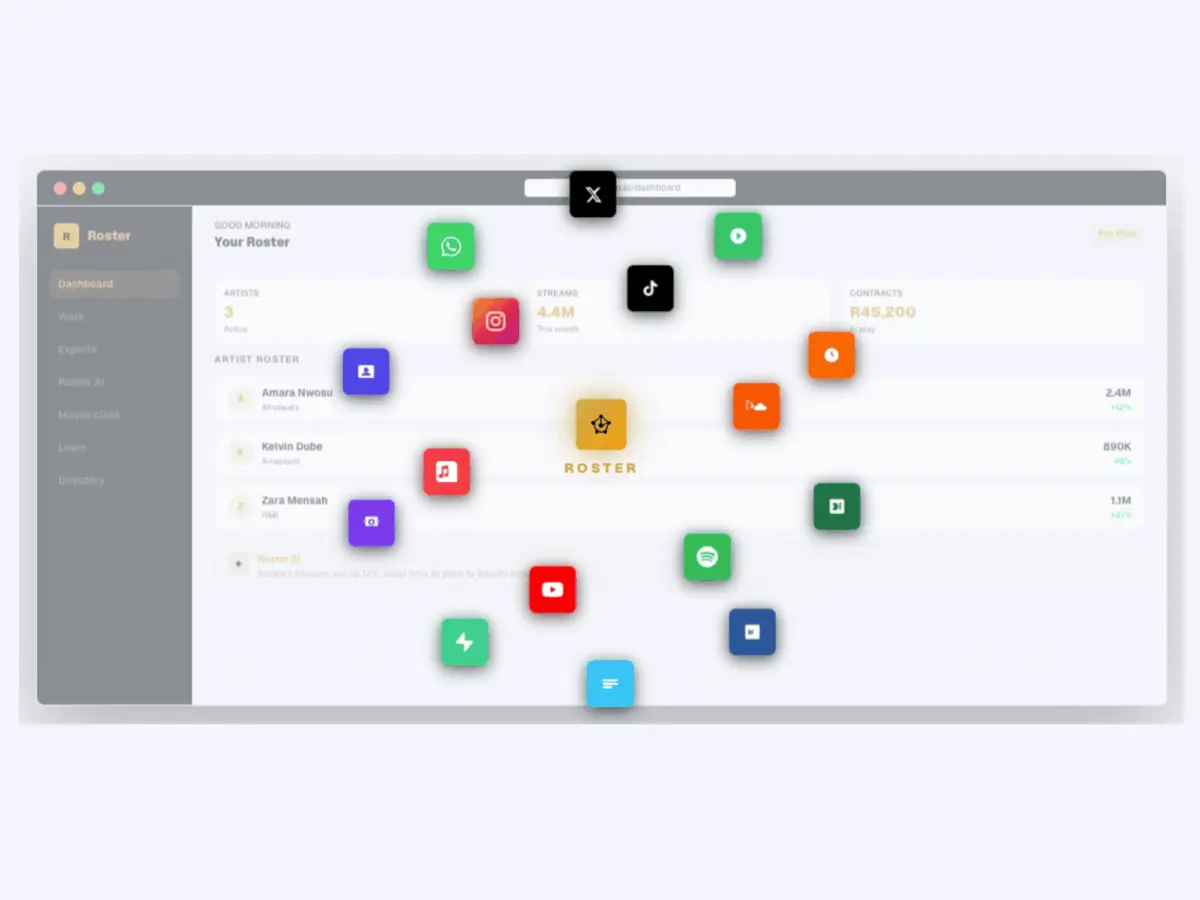
In the rapidly evolving landscape of the modern music industry, independent artists, managers, and boutique labels are increasingly overwhelmed by the administrative friction of running a modern career. Juggling spreadsheets, managing fragmented software applications, tracking multi-tiered royalties, and coordinating global tour logistics have long been operational bottlenecks. Enter Roster, a revolutionary, conversational AI-driven business operating system launched by South African music-tech pioneer JO:LA Labs.
Positioned as an all-in-one digital backbone for the music business, Roster leverages an intuitive conversational AI interface designed to replace disconnected software stacks. Its value proposition is simple yet ambitious: "No spreadsheets. No juggling apps. No guessing. Just ask."
Developed under the visionary leadership of industry veteran Thabiso Khati, Roster aims to democratize access to high-level enterprise management tools. While built with the unique demands of emerging markets like Africa in mind, the platform is engineered to scale globally, offering advanced administrative capabilities that rival established Western music management solutions. Currently rolling out under a freemium business model with a tiered pricing structure, Roster is poised to redefine how independent creators and companies handle releases, royalties, publishing, distribution, touring, marketing, customer relationship management (CRM), contracts, and corporate finance.
Detailed Chronology: From African Roots to Global Ambition
The genesis of Roster is deeply rooted in the practical, on-the-ground challenges faced by music executives operating outside traditional Western power centers.
The Visionary Behind the Tech
Thabiso Khati, a seasoned executive with extensive experience across major music corporations including Universal Music Group (UMG) Africa and the historic Gallo Record Company, as well as managing prominent names within the explosive Amapiano and African hip-hop scenes, witnessed firsthand the administrative pain points plaguing creators. Independent artists and managers often spend more time navigating complex operational logistics—such as split sheets, distribution pipelines, and performance royalties—than focusing on creative output.
Recognizing that existing software solutions were either too expensive, overly fragmented, or poorly tailored to the realities of emerging markets, Khati founded JO:LA Labs to build a solution natively optimized for modern music entrepreneurs.
Development and Early Testing Phase
Following months of development, Roster moved from concept to reality with a strategic, closed beta testing phase. Prior to its broader public rollout, the platform was placed in the hands of 50 early adopters, comprising independent artists, artist managers, and boutique independent labels across South Africa and broader African territories.
This localized initial testing phase was intentional. Africa’s music ecosystem is characterized by rapid digital adoption, mobile-first workflows, and a high volume of independent operators who must navigate complex local and international revenue streams without the backing of legacy corporate infrastructure. By stress-testing Roster within this demanding crucible, JO:LA Labs ensured the platform could handle messy, real-world data, multi-party split agreements, and cross-border distribution tracking before taking aim at the global stage.
Supporting Context & Metrics: The Mechanics and Pricing of Roster
To understand Roster’s potential market disruption, one must examine its technological framework and economic accessibility model.
Core Features: A Conversational AI Command Center
Roster’s core innovation lies in its conversational AI interface, which acts as a virtual chief operating officer for music professionals. Rather than forcing users to manually input data across disparate platforms, users can query the system in natural language to manage a wide array of operational tasks:
- Releases & Distribution: Coordinating timelines, metadata, and delivery schedules to digital service providers (DSPs).
- Royalties & Publishing: Tracking incoming revenue streams, auditing statements, and calculating accurate splits for producers, songwriters, and featured artists.
- Touring & Live Events: Managing itineraries, budgeting, booking contracts, and expense tracking on the road.
- Marketing & CRM: Centralizing fan data, tracking promotional campaigns, and measuring audience engagement metrics.
- Contracts & Finances: Storing legal agreements, tracking invoices, generating financial forecasts, and monitoring cash flow.
Pricing Structure and Economic Accessibility
Recognizing that the independent sector operates on tight, variable margins, JO:LA Labs has structured Roster around a flexible freemium business model. This ensures that emerging creators with zero initial capital can access basic operational tools, while scaling enterprises can unlock heavy-duty automation features.
The platform offers a free tier alongside four distinct paid tiers tailored to different organizational sizes:
- Entry-Level Paid Tier: Starting at 299 ZAR per month (approximately $18.64 USD at current exchange rates), this plan is designed for a single artist manager overseeing one artist.
- Enterprise Management Tier: Scaling up to 1,899 ZAR per month (approximately $87.78 USD), this top-tier plan is built for larger management companies and independent labels overseeing up to 30 active artists simultaneously.
By keeping subscription costs accessible relative to Western software alternatives—while still maintaining robust enterprise-grade capabilities—JO:LA Labs has engineered a pricing strategy capable of capturing high-volume adoption across both emerging and developed music economies.
Official Statements and Industry Perspective
In official communications and project FAQs, JO:LA Labs has been transparent about Roster’s geographic starting point and broader international ambitions:
“It starts in Africa, because the founder is African and the market needs it most, but it’s designed for emerging markets globally and to be competitive in Western markets too.”
This sentiment underlines a broader shift in music-tech innovation. For decades, software solutions for the music industry were built exclusively through the lens of London, Los Angeles, and New York boardrooms. By designing a platform from the ground up in South Africa—a hotbed of vibrant, culturally dominant musical movements like Amapiano—JO:LA Labs has engineered a system resilient enough to handle the complex, multi-faceted realities of modern global music entrepreneurship.
Industry observers and publications, such as SA Music News Magazine, have highlighted the timely nature of Roster’s launch. As the barrier to entry for releasing music continues to drop, the volume of independent releases has skyrocketed. Consequently, administrative burnout has become one of the primary threats to the mental health and financial sustainability of independent artists and managers. Roster’s promise to eliminate spreadsheets and guesswork directly addresses this crisis.
Future Outlook: Can AI Redefine Music Business Infrastructure?
As Roster transitions from its initial closed beta phase into broader commercial availability, several key questions will shape its trajectory:
- Global Interoperability: Can a platform optimized for African markets seamlessly integrate with legacy Western royalty collection societies (such as ASCAP, BMI, PRS, and SAMRO) and major global distribution networks without friction?
- Data Security and Trust: In an industry where financial transparency and intellectual property protection are paramount, how effectively will Roster safeguard sensitive contract data and revenue figures handled via its conversational AI interface?
- Competitive Response: Will legacy artist management platforms and digital distribution giants integrate similar conversational AI workflows into their existing ecosystems, or will specialized newcomers like Roster carve out a permanent, dominant niche?
Conclusion
What JO:LA Labs has built with Roster is more than just another app—it is an ambitious attempt to rewrite the operational operating system of the global music business. By removing the administrative friction that traditionally bogs down independent creators, Roster empowers artists and managers to redirect their energy where it matters most: the music. If Thabiso Khati and his team can successfully scale their vision from the bustling studios of Johannesburg to the boardrooms of the global music capitals, Roster may well become the standard-bearer for the next era of music industry entrepreneurship.