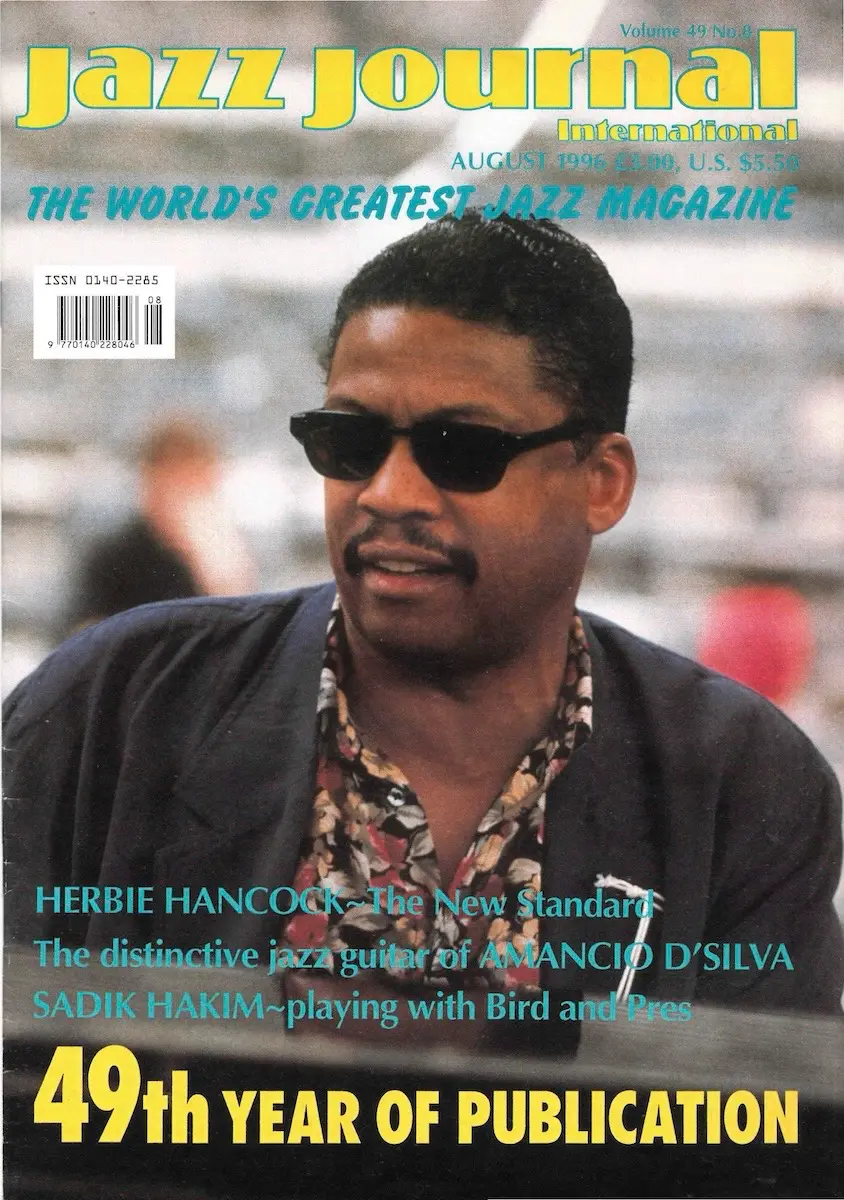

Executive Overview
In the storied landscape of modern American jazz, few figures command the reverence, versatility, and perpetual forward-momentum of Herbie Hancock. Marking a major pivot in his illustrious discography, Hancock’s 1996 Polygram release, The New Standard, represents his first straight-ahead acoustic jazz date under his own name since his celebrated 1981 quartet recording alongside trumpet icon Wynton Marsalis.
For an artist whose footprint spans the hard bop crucible of the early 1960s, the electric fusion revolutions of Head Hunters, and high-profile cinematic scoring, The New Standard is more than just a stylistic exercise. It is a calculated, intellectually rigorous attempt to rescue the contemporary jazz repertoire from stagnation. By taking compositions from modern pop, rock, and R&B luminaries—including Prince, Steely Dan, Nirvana, Sade, and Stevie Wonder—and treating them with the harmonic sophistication traditionally reserved for Cole Porter and George Gershwin, Hancock is asking a provocative question for the twilight of the 20th century: If jazz standards are meant to be timeless, why are we still looking backward to material that is nearly sixty years old?
This comprehensive journalistic feature examines the genesis of The New Standard, tracking its production mechanics, the theoretical challenges of reshaping pop music for elite improvisers, and Hancock’s profound reflections on his own harmonic lineage, avant-garde roots, and the future of the art form.
Detailed Chronology & Production Genesis
The seeds of The New Standard were planted not in a late-night jazz club, but in the executive offices of Verve Records. Guy Eckstine, an executive at Verve and co-producer of the record, approached Hancock with a conceptual angle designed to maximize commercial mileage and market relevance.
"I guess the thing for him was that a record company is a business, so they’re gonna try to think: ‘What kind of angle can we get to get the most mileage out of sales?’ That’s what their job is," Hancock recalls. Eckstine suggested building an entire album around songs written by contemporary pop writers.
Hancock’s initial reaction was cautious skepticism. "I said, ‘Could be interesting, but it smells of commercialism. It smells contrived.’"
However, a deeper philosophical dialogue between Hancock and Eckstine soon shifted the project’s trajectory. They began reflecting on the golden era of the 1960s—the very period when Hancock burst onto the national scene alongside Donald Byrd, Miles Davis, and others. During that era, standards served a vital sociological and artistic function. They formed a common language, a shared repertoire that allowed musicians from diverse backgrounds to sit down at jam sessions and communicate effortlessly.
"Now things are different," Hancock observes, noting that younger musicians report a decline in traditional jam session culture. "So times have changed. But the thing is, we still keep calling those old songs the standards—still the Cole Porter songs, Gershwin, things from the thirties and the forties. And this is 1996. Those tunes are getting to be 60 years old, so we’re going to go another 40 years and still call the same things standards? Or are we going to start looking around for some new ones? Which I think is very important."
This realization unlocked the core thesis of the album: what if modern jazz artists treated contemporary pop compositions the way the bebop pioneers treated the American Songbook of the 1930s and 40s?
Recognizing that pop compositions generally lacked the intricate harmonic scaffolding required for high-level jazz improvisation, Hancock viewed the limitation not as a roadblock, but as a creative invitation. "Tunes by pop writers today, by and large, are not as harmonically rich. And harmony is one of the things that is part of the structure of improvisation," Hancock explains. "But I thought that I can use that as an excuse for personalising the structure of these tunes—you know, put my own kind of twist on them. And it made sense to me then."
With the conceptual framework established, Hancock enlisted Eckstine to curate a list of pop songs, leveraging Eckstine’s fluency in contemporary radio hits. Simultaneously, arranger and producer Bob Belden was brought on board to help flesh out the charts. While Hancock typically prefers to construct his arrangements single-handedly, Eckstine convinced him that Belden’s encyclopedic knowledge of Hancock’s signature voicings and harmonic tendencies made him an ideal collaborator.
The resulting sessions yielded a rich, sprawling collection of tracks, though some stellar recordings—such as a dynamic reinvention of Sting’s Murder By Numbers—were ultimately left off the final tracklist purely due to tempo redundancies.
Supporting Context & Metrics: Deconstructing The New Standard
A close listen to The New Standard reveals that Hancock and Belden did not merely cover pop songs; they subjected them to radical structural, metric, and harmonic surgery. Among the cuts, perhaps the most instantly recognizable remains Steely Dan’s 1973 composition, Your Gold Teeth II.
"Oh yeah, that one already has so many changes in it," Hancock says of the Steely Dan track. "We just played, and extended the harmonies a little bit. And then we went from playing it in 3/4 to 4/4 and back and forth. We did shift that kind of thing. And there’s another part to Gold Teeth that we changed. We had Michael Brecker improvise over a part on the original where I think there’s a guitar solo, and I just played the voicings in a more modern way. Other than that it’s not changed that much."
The rest of the tracklist showcases an eclectic curation of late-20th-century music, each treated with a unique aesthetic strategy:
- Prince’s Thieves In The Temple: Hancock sought a direct stylistic lineage to his own historic debut as a leader, 1962’s Takin’ Off. "I remembered that on my very first album under my own name… I had Watermelon Man, so I thought I wonder if I can find a treatment for Thieves that would be sort of in that direction."
- Sade’s Stronger Than Pride & The Beatles’ Norwegian Wood: Subtle harmonic shifts and contemporary re-voicings brought out hidden colors in these familiar melodies.
- Traditional Folk (Scarborough Fair): Modified chord progressions injected fresh tension into the medieval English ballad.
- Nirvana’s All Apologies: Left remarkably intact structurally. "I didn’t do much to the Nirvana song… I mean, I played it in a bluesy style, but I didn’t add any real chords to it."
- Don Henley’s New York Minute: Dramatically re-imagined through the lens of John Coltrane’s 1960s modal approach.
- Stevie Wonder’s You Got It Bad Girl: A masterpiece of collaborative arranging. Bob Belden devised a brilliant three-chord sequence that rotated underneath a static, repeated melody. Hancock then intervened on the bridge, introducing his own custom modulation sequence to stamp the track with his unmistakable harmonic signature.
This cross-genre pollination is part of a storied, if sometimes controversial, jazz tradition. From Joe Pass’s 1966 jazz interpretations of Rolling Stones hits to late-20th-century thematic tributes by Bob Belden (exploring Prince and Sting), Marc Copland (What’s Goin’ On), and Larry Goldings (Whatever It Takes), jazz has continually tested its elasticity against the popular music of the day.
On tour, Hancock’s quartet—featuring bassist Dave Holland, drummer Gene Jackson, and the sensational newcomer Craig Handy—has integrated these pop adaptations into their live sets. Remarkably, Hancock notes that the experiment is successfully expanding their demographic reach.
"The funny thing is it draws out a few people who really know the pop material," Hancock observes. "They don’t know too much about improvisation, but they come to the concerts and they enjoy it. We’re playing Thieves, Mercy Street, You Got It Bad Girl, New York Minute—I think that’s about it. Our concerts have been two hours and there just isn’t time to get through all those pieces, unless we cut down on the solos!"
Official Statements & Musical Lineage: The Architecture of Hancock’s Harmony
Beyond the pop experiment of The New Standard, a critical conversation with Hancock inevitably uncovers the deep bedrock of his musical philosophy and historical lineage. When discussing his unique place in the pantheon of modern jazz piano, Hancock acknowledges the foundational pillars of the tradition: Bill Evans, Wynton Kelly, Horace Silver, Ahmad Jamal, and McCoy Tyner.
Yet, Hancock offers a nuanced critique of Tyner’s legendary style, drawing a sharp distinction between linear invention and harmonic adventure. "You know, when I hear McCoy play ballads, he’s not very adventurous with harmony, but with his lines he is though. He never got into harmony like I did. It’s just the lines that he plays go through a lot of different changes. I’m influenced by that."
When pressed to identify the specific harmonic elements that separate his playing from his peers—colors absent in Evans or Silver—Hancock points directly outside the traditional jazz canon toward European classical modernism and under-recognized genius:
"Ravel, Stravinsky, Bartók; there’s another guy too, named Chris Anderson, who’s from Chicago. He’s a jazz player, and he only has one or two records out. He’s a very gifted guy, but he had a lot of problems and never did get the opportunities that I had… He had different harmonies than things Bill Evans used, and I got a lot of stuff from him. Oh—also from listening to groups like the Hi-Lo’s. I got a lot from the Hi-Lo’s, especially the arrangements by Clare Fischer. And also Robert Farnon, I used to listen to his records. Phew! Killer stuff!"
Hancock traces his mastery of polychords—complex stacked triads that create rich, polytonal textures—back to his early recordings, noting that his exploration began modestly on tracks like King Cobra from his 1963 sophomore album, My Point Of View. However, it was his tenure in the legendary Miles Davis Quintet, supercharged by the avant-garde rhythmic concepts of drummer Tony Williams, that truly pushed him into the outer stratosphere.
Crucial to this evolution was his brief, intense immersion in the avant-garde scene in late 1962, playing alongside multi-reedist Eric Dolphy.
"Actually, the first time I played with a group that was considered an avant-garde kind of group was 1962 in December, with Eric Dolphy," Hancock recalls. "A bootleg record came out. It’s one with a trumpet player called Eddie Armour, J.C. Moses on drums and Eddie Khan on bass. So that started me thinking about other things. I started breaking rules when I started playing with Eric. I’d never even played that way before… But Eric really started to open me up a lot more. I think it was in November and December, a two-month period, something like that. It was very rewarding. I think that was one of the main, final elements that prepared me for my career."
Future Outlook
As The New Standard gains critical acclaim and strong commercial traction, the immediate horizon looks exceedingly bright for Herbie Hancock. Naturally, commercial viability opens the door to future volume releases.
"The potential for this record seems to be pretty good saleswise and critically too," Hancock reflects. "And I suppose the more the record sells, the more it would make sense to do a sequel."
However, because Hancock’s recording contract is held by Polygram, his artistic movements remain intentionally fluid. Unbound by narrow genre constraints, his next major artistic statement could manifest anywhere across the musical spectrum.
"My contract is with Polygram, so the next record could be in another area—a pop thing for Mercury or a classical, symphonic thing for Deutsche Grammophon. I’m not sure yet."
Whether he chooses to unpack more hidden treasures from the pop songbook, return to symphonic waters, or plunge back into electronic experimentation, Herbie Hancock’s mission remains unchanged. By continually forcing jazz to converse with the broader musical world around it, he ensures that the tradition remains alive, vital, and relentlessly modern.