
Executive Overview
As twilight descended upon the rolling, tree-lined vistas of Larmer Tree Gardens for the opening night of the End of the Road Festival, a seismic shift in contemporary guitar music was already well underway. Against a backdrop of bucolic serenity, an abrasive, high-octane performance tore through the evening air, igniting cavernous mosh pits and signaling a triumphant new chapter for one of the most unpredictable bands on the international circuit.
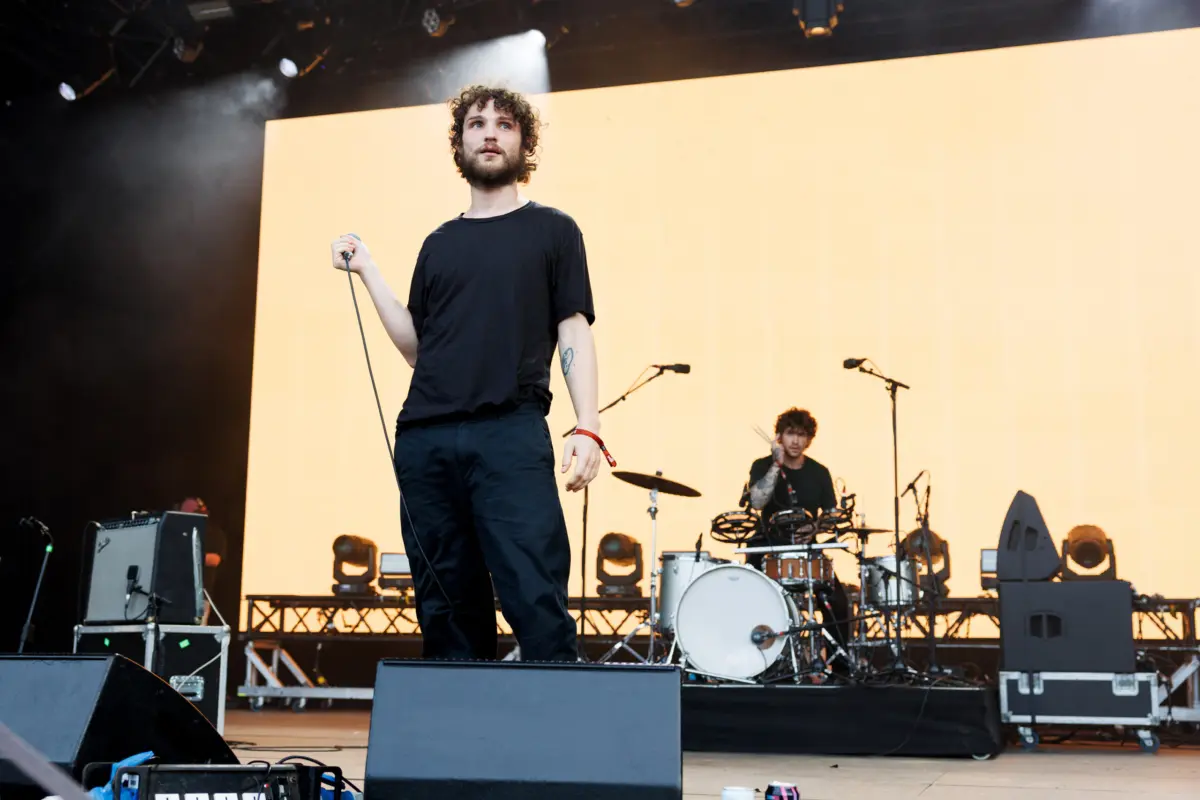
This watershed moment was historic for more reasons than one. It marked the debut of brand-new, cutting-edge visual screens integrated into the festival’s iconic main stage—an upgrade that reflected the growing stature of the acts commanding the space. Yet, the technology served merely as a frame for the raw, volatile energy unleashed by the headlining underground sensation.
The explosive set serves as the latest high-water mark in an incandescent run for the five-piece. Hot on the heels of their critically acclaimed, startlingly concise 11-minute album Magazine—released earlier this summer via esteemed indie powerhouse 4AD—and a chaotic, impromptu guerrilla performance that paralyzed London’s Marble Arch traffic, the band has cemented its reputation as a must-see live entity. Frontman Zack Borzone delivered a masterclass in front-man volatility, gripping the End of the Road audience by the throat and leading them on a breathless, careening journey through both the abrasive soundscapes of Magazine and the foundational angst of their 2025 debut full-length, 45 Pounds.
As the four-day independent music and arts festival presses on, the cultural spotlight remains firmly fixed on the transatlantic invasion of New York’s burgeoning underground scene. With fellow New Yorkers Geese slated for a monumental headline performance on the Woods Stage, this year’s festival is rapidly carving out a legacy as a transatlantic showcase for the most vital, abrasive, and uncompromising guitar music of the decade.
Detailed Chronology: From Marble Arch to the Woods Stage
To understand the magnitude of the performance that rattled the foundations of End of the Road’s opening night, one must retrace the meteoric trajectory that brought the quintet to this precise geographical and artistic coordinate.
The Guerrilla Takeover of Marble Arch
Weeks prior to gracing the festival’s newly upgraded main stage, the band sent shockwaves through the British capital with a textbook display of old-school punk rock disruption. Eschewing traditional PR cycles and standard venue bookings, the five-piece executed a spontaneous guerrilla concert that entirely overtook London’s historic Marble Arch landmark.
With minimal warning disseminated through encrypted messaging channels and burner social media accounts, fans converged on the central London roundabout as amplifiers were yanked from the back of an unmarked van. What followed was a blistering, twenty-minute acoustic-to-electric assault that paralyzed pedestrian traffic and drew a swift response from local authorities, though not before the band had delivered a fierce rendition of tracks from Magazine. This unauthorized urban intervention was not merely a promotional stunt; it was a reclamation of public space for counter-cultural expression, establishing the group as a band entirely unwilling to play by the conventional rules of the modern music industry.
The Sundown Reckoning at End of the Road
That same rebellious spirit was channeled directly into the twilight hours of End of the Road’s first official evening. As the sun dipped below the horizon, casting long shadows across the natural amphitheater of the festival grounds, the band took possession of a stage that, for the first time in the festival’s history, featured high-definition LED screens flanking the performance area.
The inclusion of the screens—historically shunned by the fiercely independent festival in favor of unadorned rustic aesthetics—offered a stark juxtaposition: hyper-modern visual technology amplifying the analog grit of a band operating at the absolute bleeding edge of post-punk. Frontman Zack Borzone stalked the boards with dangerous, unpredictable energy, his vocals cutting through the evening chill like shattered glass.
The setlist was a masterclass in pacing, carefully balancing the dense, concentrated fury of their summer release Magazine with the sprawling, expansive tension of their 2025 breakthrough debut, 45 Pounds. Songs bled into one another with seamless hostility, transforming the polite, cardigan-clad indie festival crowd into a churning mass of limbs, dust, and ecstatic catharsis. By the time the final feedback loop faded into the Dorset night, it was abundantly clear that the festival’s first night belonged entirely to New York’s new vanguard.
Supporting Context & Metrics: The Anatomy of a Modern Indie Phenomenon
The critical and commercial momentum surrounding the band’s current tour dates cannot be understood in a vacuum. It represents the convergence of shrewd label curation, shifting consumer habits favoring brevity and intensity, and a post-lockdown resurgence in visceral live performance art.
The Magazine Phenomenon: Less is More
In an era dominated by bloated streaming strategies and algorithm-friendly 20-track double albums designed to maximize passive background listening, the band’s decision to drop Magazine via 4AD earlier this summer was a radical artistic statement. Clocking in at a brisk, unrelenting 11 minutes total, the release defies modern streaming logic.
| Metric / Attribute | Album Details |
|---|---|
| Release Label | 4AD |
| Total Runtime | 11 Minutes |
| Format | Digital / Limited 10-inch Vinyl |
| Stylistic Anchor | Post-Punk, Noise-Rock, No Wave |
| Companion Release | 45 Pounds (2025 Debut Full-Length) |
Musicologists and industry analysts have pointed to Magazine as a masterclass in economic songwriting. By stripping away structural fat, transitional interludes, and radio-friendly pandering, the band delivers a concentrated dose of adrenaline that translates exponentially harder in a live environment. The record’s physical scarcity—manifested in rapidly sold-out limited vinyl pressings—has transformed ownership of the release into a badge of honor among subterranean music aficionados.
The New York Underground Resurgence
Furthermore, the band’s dominance at End of the Road is part of a broader cultural narrative. Alongside fellow bill-toppers Geese, the collective represents a renaissance of New York City as an incubator for abrasive, guitar-driven music. Much like the garage rock explosion of the early 2000s, this modern wave draws heavily on the city’s gritty industrial history, injecting the nervous energy of contemporary urban alienation into traditional rock instrumentation. The festival’s programming highlights a deliberate curation strategy: bridging the gap between legacy indie credibility and the sharp, jagged edges of the twenty-something avant-garde.
Official Statements and Industry Perspectives
While artists often shy away from the granular dissection of their creative processes, the ethos driving the band’s current tour and recent releases speaks volumes about their collective philosophy. Industry insiders, critics, and festival organizers have weighed in on the cultural impact of this pivotal touring cycle.
The Artistic Mandate
Speaking on the condition of anonymity backstage following their main stage triumph, a representative close to the band’s camp addressed the philosophy behind their uncompromising live shows and brief release cycles:
"We aren’t interested in nursing people through a gentle listening experience. Music right now is far too polite, far too sanitized for the comfort of algorithms. When Zack steps on that stage, or when we set up shop outside Marble Arch, the objective is total disruption. If you walk away unchanged, or merely entertained, we haven’t done our job."
Festival Curation and the Evolution of End of the Road
Festival organizers have similarly defended the introduction of main stage screens—a move that raised eyebrows among purists who treasure the festival’s historically low-fi aesthetic. In an official bulletin addressing site upgrades, production directors emphasized the necessity of bridging physical distance for massive crowds without sacrificing intimacy:
"End of the Road has always stood as a sanctuary for uncompromising independent art. However, as our community grows and the scale of the talent we book expands into acts that command massive physical engagement—such as our opening night headliners—we have a responsibility to ensure every single attendee experiences the visceral impact of the performance. The screens are merely a window; the fire belongs entirely to the artists."
Industry critics have universally praised the gamble. Reviewing the opening night set for prominent European cultural publications, veteran music journalists noted that the juxtaposition of high-definition visual capture and raw, unhinged stagecraft created an electric tension that elevated the entire festival’s opening evening into legendary status.
Future Outlook: What Lies Beyond the Woods Stage
As the dust settles on the opening night pyrotechnics and festival-goers prepare for subsequent nights—highlighted by fellow New Yorkers Geese on the Woods Stage—the horizon looks both blindingly bright and delightfully uncertain for the vanguard of modern post-punk.
The Transatlantic Takeover
The immediate future points toward an expansion of their international footprint. With their current UK and European routing selling out venues well in advance, industry speculation is mounting regarding a potential sophomore full-length effort that might expand upon the volatile template laid down by Magazine. Yet, knowing the unpredictable nature of Zack Borzone and his bandmates, any assumption of a traditional album rollout would be entirely misplaced. The band has consistently subverted expectations, trading predictable release cycles for sudden, destructive bursts of creative output.
Redefining Independent Touring
Ultimately, the band’s performance at End of the Road serves as a case study for the future of independent music. By proving that aggressive, uncompromising art can command major festival main stages—complete with modern production upgrades—without losing an ounce of its subcultural teeth, they have charted a roadmap for their peers.
As the festival grounds fill once more for the weekend ahead, one overarching truth remains glaringly evident: the old guard of rock and roll has officially been put on notice. The future belongs to the volatile, the brief, and the undeniably real.