
Executive Overview
In the intricate geography of sheet music, composers use a specialized shorthand to guide performers through dynamic landscapes of sound. Among the most fundamental yet transformative directional terms found on the staff is Da Capo—an Italian phrase that translates literally to "from the head" or, more contextually, "from the beginning." Universally abbreviated as D.C., this foundational directive instructs musicians to return to the very start of a piece.
However, music is rarely as simple as a straightforward loop. To prevent endless repetitions and to craft sophisticated narrative structures, composers pair Da Capo with secondary directional qualifiers. These extensions create a roadmap for navigation, telling the performer not only when to return to the beginning, but precisely where to stop or how to leap forward to a concluding section.
Understanding these directional cues is essential for musicians of all levels, bridging the gap between historical composition practices and modern performance. This article offers an authoritative exploration of the Da Capo directive, examining its three primary variations—DC al Fine, DC al Segno, and DC al Coda—its historical significance within the Baroque Da Capo Aria, and its enduring legacy in Western classical music.
Detailed Chronology and Structural Mechanics
To master the mechanics of Da Capo, one must first understand how musical notation evolved as a system of concise efficiency. Rather than wasting precious ink and paper—and increasing the physical bulk of scores—to write out repeating sections verbatim, classical and contemporary composers alike rely on directional signs.
The Da Capo instruction acts as a macro-command. When a performer encounters "D.C." at the conclusion of a musical passage, they must visually scan backward to the first measure of the score. Yet, simply returning to the start introduces a new problem: Where does the piece end? Without further instructions, a musician would play straight through to the original final bar, potentially bypassing a newly written conclusion or creating an infinite loop.
To resolve this, composers developed three distinct navigational branches rooted in the Da Capo command:
- DC al Fine: The most direct extension, translating to "from the head to the end."
- DC al Segno: A variation that redirects the flow to a specific internal marker rather than the absolute beginning, though fundamentally tied to the logic of restarting structural blocks.
- DC al Coda: The most complex architectural maneuver, requiring the performer to return to the beginning, play up to a designated navigational warning, and then leap forward to a tail-end concluding section.
[Start of Piece] -------- (Main Body) --------> [D.C. / D.C. al Fine]
      ^                                                  |
      |------------------- (Loop Back) ------------------| (Stops at 'Fine')
The Anatomy of DC al Fine
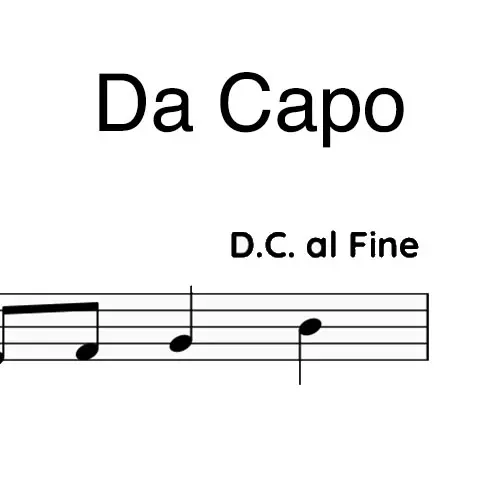
The simplest and most common application of the principle is D.C. al fine (abbreviated from Da capo al fine). Here, "Da capo" means "From the Head," and "al fine" means "to the end."
When a performer encounters this phrase at the end of a middle section, the execution is straightforward:
- Return immediately to the very first measure of the piece.
- Play through the music sequentially as originally written.
- Continue playing until encountering the Italian word Fine (meaning "the end"), which is typically placed midway through the final system or at the conclusion of the initial section.
- Cease playing immediately upon reaching the Fine.
This structure creates a balanced, symmetrical form often utilized in minims, marches, and simple ternary structures, allowing composers to present a primary theme, introduce a contrasting middle idea, and concisely restate the opening material without redundantly reprinting the score.
The Nuances of DC al Segno
While Da Capo always sends the performer back to the absolute beginning of the piece, its close cousin—D.C. al Segno—operates on a similar navigational logic while introducing a specialized marker.
Strictly speaking, Da Capo al Segno instructs the musician to return to the beginning of the piece (Da Capo), but to continue playing only until they encounter the Segno—a stylized Italian sign resembling an "S" crossed with a diagonal slash and two dots. While standard Dal Segno (D.S.) directs a player back to the Segno symbol rather than the very top of the page, the hybrid D.C. al Segno serves as a specialized variant ensuring the performance loops from the absolute top of the chart down to an intermediate signpost within the work.
The Complexity of DC al Coda
Perhaps the most intricate navigation required by standard musical notation is D.C. al Coda (Da Capo al Coda). This instruction is deployed when a composer wants a performer to replay the opening section of a piece, but desires a completely different, dramatic conclusion rather than simply fading out or stopping at the original final bar.
The execution of a DC al Coda requires three distinct steps:

- The Initial Pass: The musician plays the piece from start to finish until encountering the instruction "al Coda", "To Coda", or the distinct Coda symbol (a set of crosshairs inside a circle).
- The Jump Back: Upon reaching this warning flag, the performer immediately leaps back to the very beginning of the piece (Da Capo).
- The Coda Leap: The musician plays through the opening section a second time until they reach the second Coda symbol or a designated signpost. At this exact moment, they abandon the linear progression of the score and jump directly to the Coda—a dedicated concluding section (literally translating to "the tail") written specifically to bring the piece to a grandiose or satisfying close.
Supporting Context and Metrics: The Baroque Da Capo Aria
While directional terms are used across all genres of Western art music, their historical zenith occurred during the Baroque period (roughly 1600–1750), immortalized in the architectural brilliance of the Da Capo Aria.
The Da Capo Aria was the dominant vocal form in operas and oratorios of the 17th and 18th centuries, championed by legendary masters such as George Frideric Handel, Alessandro Scarlatti, and Johann Sebastian Bach. Structurally, these compositions were written in ternary form (A-B-A), reflecting a psychological and dramatic arc:
- Section A: Establishes the primary mood, lyrical theme, and emotional core of the aria. It is sung by a soloist accompanied by an instrumental ensemble or full orchestra.
- Section B: Introduces a contrasting key, a different tempo, and a shift in poetic text. This section presents an opposing emotional state or a narrative complication.
- The Return (Da Capo): At the conclusion of Section B, the score simply reads Da Capo. The performers return to the beginning of Section A, playing and singing the opening music verbatim.
The Art of Baroque Ornamentation
What elevated the Da Capo Aria from a simple mechanical repetition to a pinnacle of performance art was the unwritten rule of Baroque execution: improvisational ornamentation.
When the singer and instrumentalists returned to Section A via the Da Capo instruction, they were strictly expected not to perform the notes exactly as written the second time around. Instead, elite vocalists used the repeat as a canvas to showcase their virtuosic capabilities. They added elaborate trills, turns, scalular runs, dynamic shifts, and expressive embellishments (passaggi) designed to reflect a deeper emotional evolution or maturity gained during the narrative journey of Section B.
A masterclass example of this structure can be found in "He was despised" from G.F. Handel’s legendary oratorio Messiah. In this profoundly moving piece:
- The gentle, lulling gravity of the initial A section establishes a mood of deep sorrow and solemnity.
- The dramatic, agitated B section introduces rhythmic intensity and harmonic tension, portraying grief and rejection with sharp theatricality.
- Upon the Da Capo return to the A section, performers layer in breathtaking vocal ornamentation. Rather than feeling repetitive, the return reinforces the core theme with heightened emotional resonance, transforming simple notation into a profound human experience.
Expert Perspectives and Pedagogical Insights
To understand why these directional symbols remain a cornerstone of music education, one must consult educators and theorists who spend decades decoding scores for developing minds.
Ben Dunnett, an accomplished music teacher, examiner, composer, pianist, and the founder of the Music Theory Academy, emphasizes that mastering directional terms like Da Capo is a critical milestone in musical literacy. According to Dunnett, who holds an LRSM (Licentiate of the Royal Schools of Music) and boasts over twenty years of experience in music education, students often stumble when transitioning from linear reading to non-linear navigation.
"When young musicians first encounter terms like D.C. al Fine or D.C. al Coda, they experience a cognitive shift," notes educational literature from foundational theory frameworks. "Music stops being a straight road from left to right and transforms into a multi-dimensional map. Teaching students to track visual landmarks—such as the Coda symbol, the Segno, and the word Fine—builds essential cognitive flexibility, attention to detail, and spatial awareness on the page."
Furthermore, music examiners frequently test students on these exact abbreviations during practical and theoretical assessments. Misinterpreting a DC al Coda jump can result in catastrophic performance errors during high-stakes recitals or orchestral rehearsals. Consequently, rigorous training in navigational markings ensures that ensemble players remain synchronized, maintaining a unified understanding of where the structural road signs lie.
Future Outlook: The Evolution of Musical Navigation
As we look toward the future of composition and musicology, the fundamental mechanics of Da Capo continue to bridge the gap between physical manuscript traditions and digital innovation.
In the modern era of digital audio workstations (DAWs), score-writing software, and interactive tablet-based sheet music (such as Forscore and Newzik), traditional Italian directional terms are more relevant than ever. While digital playback engines in software like Sibelius or Finale must be explicitly programmed with playback rules to interpret DC al Coda and DC al Fine correctly, human musicians rely on these centuries-old visual cues to instantly parse complex structural layouts.
As contemporary composers continue to experiment with non-linear narrative forms, aleatoric (chance-based) music, and interactive digital scores, the historical precedent set by the Da Capo framework remains foundational. Whether reading a standard 18th-century Handel manuscript off aged parchment or swiping through a digital PDF on a modern tablet during a live concert, performers continue to rely on these elegant, concise Italian directions to navigate the boundless landscape of musical expression.