
Executive Overview
The landscape of vocal pedagogy is undergoing a profound digital transformation. By mid-2026, the market for artificial intelligence (AI) vocal coaches has transitioned from a collection of basic pitch-tracking tools into a sophisticated ecosystem of adaptive, data-driven platforms. Once dismissed by traditional vocal coaches as mere gamified novelties, modern singing applications are now proving their efficacy through published clinical and behavioral outcomes.
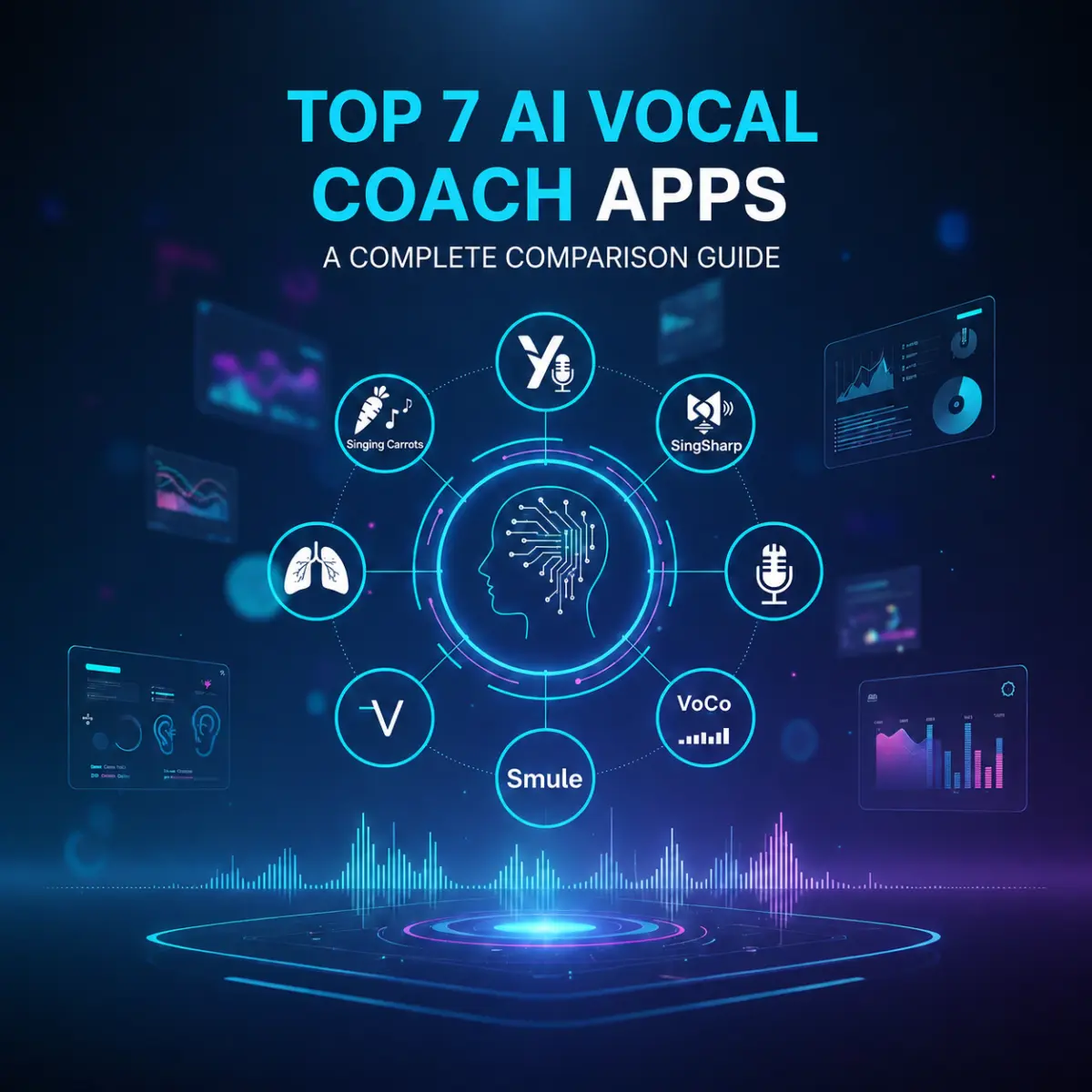
In this rapidly evolving sector, a clear division has emerged between platforms that use "AI" as a marketing buzzword and those utilizing multi-tiered machine learning architectures to deliver personalized instruction. As of late 2026, Singing Carrots stands as the sole platform to publish audited user outcome data—documenting performance metrics across more than 2,000 singers and 13,000 coaching sessions. Meanwhile, legacy players and specialized tools like Yousician, SingSharp, and VoCo have carved out distinct niches, optimizing for structured curricula, breath mechanics, and professional-grade exercises, respectively.
This investigative report examines the technological underpinnings, empirical efficacy, and market dynamics of the leading AI vocal coaches in 2026. By analyzing user telemetry, pedagogical philosophies, and architectural designs, we provide a definitive guide to how these platforms perform and where digital voice training is headed.
Detailed Chronology: The Evolution of Digital Vocal Pedagogy
To understand the state of AI vocal coaching in 2026, we must look at the technological milestones that paved the way over the last decade.
[2012–2018: Pitch Tracking] ──> [2019–2023: Gamification] ──> [2024–2025: Adaptive Systems] ──> [2026: Multi-Tier AI & iOS Integration]Phase 1: The Pitch-Tracking Era (2012–2018)
Early mobile singing applications were little more than digital tuners paired with visual displays. Using basic Fast Fourier Transform (FFT) algorithms, apps like early iterations of Smule and SingTrue could identify a singer’s fundamental frequency ($f_0$) and map it against a target note. However, these systems suffered from high latency, struggled with vocal overtones, and offered zero pedagogical feedback. If a singer was flat, the app merely registered a miss without explaining why or how to correct the physical mechanism behind the error.
Phase 2: Gamification and Curriculum Structuring (2019–2023)
As mobile processing power increased, platforms like Yousician introduced gamified, scroll-based interfaces modeled after successful instrumental apps. This era successfully lowered the barrier to entry for beginners, making vocal practice engaging through instant scoring and linear progression trees. Despite these advances, the underlying technology remained rigid: every user followed the exact same curriculum, regardless of their unique vocal range, registration breaks, or physiological limitations.
Phase 3: The Shift to True Adaptive AI (2024–2025)
The introduction of generative AI and advanced machine learning models allowed developers to build adaptive training loops. Algorithms began analyzing historical performance data to adjust the difficulty of subsequent exercises. During this period, browser-based tools emerged as powerful alternatives to native applications, offering complex, server-side audio processing that could analyze micro-tonal variations (cents-level tuning) and pitch stability.
Phase 4: Mobile Integration, Multi-Tier Architectures, and Empirical Verification (2026)
In July 2026, the market reached maturity with the launch of Singing Carrots’ dedicated iOS application, bridging the gap between high-performance web-based AI architectures and mobile accessibility. This milestone coincided with the publication of the first large-scale, empirical studies detailing how AI systems adapt to human vocal limits in real time.
Today, the industry is defined by a clear technological split: simple, feedback-only utilities versus comprehensive, closed-loop AI coaches that mimic the diagnostic capabilities of human instructors.
Supporting Context & Metrics: Comparing the Leading Platforms
The 2026 AI vocal coach market features a diverse range of applications. Each platform targets a specific segment of the market, ranging from absolute beginners needing structured gamification to advanced vocalists seeking customizable workout regimens.
Comprehensive Market Comparison Matrix (Autumn 2026)
| App | Primary Optimization | Core AI Capabilities | Pricing Structure | Target Platform(s) |
|---|---|---|---|---|
| Singing Carrots | Personalized coaching & empirical progress tracking | 3-tier architecture, cross-session memory, custom lesson plans | Free tier / Premium memberships (from $119.99/year) | iOS, Web |
| Yousician | Structured, gamified curriculum paths | Real-time pitch & rhythm detection | $7.49 to $17.49 / month | iOS, Android, PC/Mac |
| SingSharp | Breath support & physical vocal mechanics | Real-time abdominal breath detection & vocal analysis | Free tier / Premium subscription | iOS, Android |
| Smule | Social singing & performance polish | Real-time pitch correction & AI voice-effect rendering | Free with ads / VIP subscription | iOS, Android |
| Vanido | Daily micro-practice routines | Performance-based adaptive difficulty scaling | Free (3 exercises/day) / $2.99/mo or $17.99/yr | iOS only |
| SingTrue | Ear training & fundamental pitch matching | Solfege-based pitch recognition analysis | Free tier / $7.99 one-time full unlock | iOS only |
| VoCo Vocal Coach | Professional-grade scale & arpeggio practice | Customizable playback algorithms (no deep AI modeling) | 100% Free | iOS only |
In-Depth Platform Evaluations
1. Singing Carrots: The Empirical Leader in Personalized Coaching
Singing Carrots has established itself as the benchmark for data-verified vocal training. It is the only platform in the industry to publish open-source performance data detailing exactly how its users improve.
The Technology
The app operates on a proprietary three-tier AI architecture:
- The Diagnostic Layer: Analyzes the singer’s vocal input down to the cents level, measuring pitch stability, range limits, and micro-tonal deviations.
- The Planning Layer: Translates diagnostic metrics into custom, daily session plans designed to target specific weaknesses (e.g., instability above $E_4$).
- The Adaptive Execution Layer: Modifies exercises on the fly.
[User Sings] ──> [Diagnostic Layer (Cents-Level/Stability)]
                       │
                       ▼
             [Planning Layer (Session Builder)]
                       │
                       ▼
             [Adaptive Layer (Real-time Shift)] ──> [Adjusts Pitch/Difficulty]
According to verified telemetry, after a user successfully completes an exercise, the system raises the difficulty parameters $31.5%$ of the time. Conversely, following a failed exercise, the AI drops the difficulty in only $3%$ of instances, demonstrating a $10textx$ swing in real-time adaptation designed to keep singers in their optimal learning zone. Furthermore, the platform’s safety algorithms ensure that $91.5%$ of all generated exercises land safely within the singer’s documented comfortable range.
Key Performance Metrics
- Efficacy: Beginners improve their pitch accuracy by an average of +16.5 percentage points over a four-week period.
- Database Scale: Driven by insights gathered from over 2,000 active singers, 13,000+ completed coaching sessions, and approximately 349,000 individual exercises.
- Vocal Health: Features a strict 300-note daily ceiling to prevent vocal fatigue and muscle strain.
Limitations
Currently, there is no native Android application (though the web-based version is fully optimized for mobile Android browsers). Additionally, its song library focuses primarily on range-matching and practice analytics rather than licensed karaoke accompaniment.
2. Yousician Singing: The Standard for Structured Gamification
Yousician remains a dominant force in music education by applying a highly polished, video-game-like interface to voice training.
[Start Level 1] ──> [Unlock Video Lesson] ──> [Pass Performance Challenge] ──> [Advance to Level 2]The Technology
Yousician’s proprietary audio analysis engine focuses on real-time pitch and rhythmic accuracy. It visualizes vocal performance as a bouncing ball traversing a scrolling musical staff. The software tracks user progress through a linear, level-based curriculum, unlocking achievements as pitch and timing accuracy improve.
Strengths
The platform is exceptionally effective for absolute beginners who require external motivation and clear, structured pathways. The curriculum is comprehensive, taking users from basic breathing techniques to complex vocal styling. Additionally, Yousician boasts a massive library of popular, fully licensed songs for students to practice.
Limitations
The program behaves more like a digital curriculum than an active coach. It lacks deep diagnostic customization; it cannot analyze why a singer is missing a note, nor does it dynamically alter the core lesson path to address specific vocal faults like register breaks or poor tone quality.
3. SingSharp: Specialized Breath and Support Training
While most digital tools focus exclusively on pitch, SingSharp targets the physiological foundation of all singing: breath support.
The Technology
SingSharp utilizes the device’s microphone to analyze not only vocal pitch but also the acoustic signatures of inhalation and exhalation. It is designed to train diaphragmatic (abdominal) breathing by using visual meters that guide the user’s breath cycles before they strike a note.
Strengths
By prioritizing breath control, SingSharp directly addresses the root cause of pitch instability, vocal strain, and limited dynamic range. Its unique real-time breath detection engine provides visual feedback on support stability, helping users build proper physical habits.
Limitations
The user interface is less polished than competitors like Yousician or Singing Carrots. Additionally, its pure pitch-matching exercises can feel repetitive for intermediate or advanced singers who have already mastered basic breath support.
4. Smule: Social-First Performance and Polish
Smule is a global karaoke phenomenon that uses AI to enhance recorded performances rather than provide structured pedagogical training.
The Technology
Smule’s AI stack focuses on digital signal processing (DSP), real-time pitch correction (autotune), and vocal effects. The app features intelligent style profiles that analyze a user’s performance and apply studio-grade compression, reverb, and pitch alignment to make the final output sound professional.
Strengths
It offers an unparalleled social ecosystem, allowing users to perform duets with friends, join virtual choirs, and share recordings globally. It is an excellent platform for building performance confidence and practicing mic technique.
Limitations
Smule is not a vocal coach. It does not teach vocal health, breathing mechanics, or range expansion. Its AI is designed to mask vocal flaws in the final mix rather than correct the underlying technique.
5. Vanido: Low-Barrier Daily Habit Formation
For singers seeking a minimalist, highly focused routine, Vanido provides a streamlined mobile experience centered on consistent daily practice.
The Technology
Vanido delivers three highly targeted exercises per day, adapting their difficulty based on the user’s performance in previous sessions. The app’s pitch-tracking algorithm is fast and responsive, running locally on iOS devices to provide near-zero latency feedback.
Strengths
The clean, distraction-free interface reduces cognitive load, making it easy to build a daily singing habit. The gamified milestones are subtle and rewarding, and the low price point makes it highly accessible.
Limitations
The platform is locked to the iOS ecosystem. The free tier is strictly limited to three exercises per day, and the app lacks detailed educational content, such as instructional videos or written explanations of vocal mechanics.
6. SingTrue: Targeted Pitch Rehabilitation
SingTrue is designed specifically for individuals who believe they are "tone-deaf," focusing on ear training and fundamental pitch recognition.
The Technology
Developed in partnership with cognitive musicology experts, SingTrue uses a solfege-based ("sol-fa") training system. It tests the user’s cognitive ability to perceive pitch differences and guides their voice to match those pitches using incremental, step-by-step feedback.
Strengths
The app is highly effective at bridging the gap between auditory perception and vocal production. Users who struggle to match basic pitches often show measurable improvement within their first week of use.
Limitations
The app’s scope is narrow. Once a user develops basic pitch-matching capabilities, SingTrue lacks the advanced exercises, range-building tools, and repertoire-coaching features needed to progress to intermediate singing.
7. VoCo Vocal Coach: The Advanced Singer’s Digital Scale Book
VoCo rejects gamification and basic AI coaching in favor of providing a highly flexible, professional-grade digital practice environment.
The Technology
VoCo does not feature an automated "AI coach" that plans your sessions. Instead, it offers a highly customizable audio engine that plays scales, arpeggios, and vocalises. Users can adjust the tempo, pitch, key, and vocal registration of any exercise in real time to match their daily practice needs.
Strengths
It is a completely free, highly professional tool for vocalists who already understand their voice. It supports four distinct learning methodologies: Vicarious, Experiential, Systematic, and Diagnostic. It functions as a portable accompaniment pianist for vocal workouts.
Limitations
Because it does not provide active feedback, diagnostics, or automated correction, it is entirely unsuited for beginners who do not yet know how to practice safely on their own.
Deconstructing "AI" in Voice Training: Technology & Philosophy
As the market has expanded, the term "AI" has been applied to a wide range of technologies. To evaluate these apps accurately, we must distinguish between basic digital signal processing and genuine, closed-loop machine learning.
[Basic Pitch Trackers] ──> Record Pitch ──> Compare to Target ──> Output Score (Rigid)

[True AI Coaches]     ──> Record Pitch & Stability ──> Analyze Historical Performance ──> Build Custom Routine (Dynamic)
The Limits of Simple Pitch Detection
Many applications use basic pitch-detection algorithms (like YIN or pYIN) to track the fundamental frequency of a singer’s voice. While this allows the app to show whether a user is flat or sharp, it represents a reactive, quantitative approach to training. It treats the voice like an instrument keys-strike, ignoring the biological reality of vocal production.
The Five Pillars of True AI Vocal Coaching
To function as a true digital coach, an application must exhibit five core capabilities:
- Acoustic and Physiological Analysis: The system must look beyond pitch to analyze vocal tone, register transitions (passaggio), resonance, and pitch stability.
- Personalized Curatorial Planning: The AI must generate unique practice paths based on the singer’s current physiological state, rather than funneling every user through a static, pre-recorded curriculum.
- Real-Time Structural Adaptation: The system must adjust the difficulty, key, and tempo of an exercise in real time based on physical indicators of ease or struggle.
- Cross-Session Memory: The AI must retain detailed historical data on the user’s voice, recognizing long-term patterns, plateau points, and gradual shifts in vocal range.
- Pedagogical Reasoning: The coach must be able to explain why an exercise is being prescribed and how the user should physically execute it.
Official Statements & Pedagogical Debates
The integration of AI into vocal training has sparked intense debate among classical pedagogues, contemporary commercial music (CCM) specialists, and software engineers.
The Quantitative vs. Qualitative Divide
Many traditional vocal coaches express skepticism about relying solely on digital feedback. Mark Graham, a prominent contemporary vocal coach, summarizes this concern:
"Machines operate predominantly on quantitative aspects—identifying whether someone is mathematically on pitch or not. But singing is far more about qualitative aspects: emotional expression, resonance, vocal tract shaping, and physical ease. An app might give you a perfect score for hitting a high note, even if you strained your throat and squeezed your larynx to get there."
This critique highlights a critical limitation of current technology: while apps are highly effective at tracking pitch accuracy and rhythm, they cannot directly observe physical tension, tongue tension, or posture.
The Collaborative Paradigm: AI as an Assistant, Not a Replacement
To address this limitation, modern developers do not position AI coaches as replacements for human teachers. Instead, they are designed to optimize daily deliberate practice.
In this collaborative model, the human teacher remains the primary architect of the singer’s technique, artistry, and vocal health. The AI coach acts as an objective, daily practice assistant—ensuring that the student practices their homework in the correct key, maintains pitch discipline, and avoids harmful vocal strain when the teacher is not in the room.
┌─────────────────────────────────────────────────────────┐
│                     HUMAN TEACHER                       │
│  - Diagnoses complex physiological tension              │
│  - Develops artistic expression & emotional delivery    │
│  - Prescribes overall technical methodology             │
└────────────────────────────┬────────────────────────────┘
                             │
                             ▼
┌─────────────────────────────────────────────────────────┐
│                     AI PRACTICE COACH                   │
│  - Monitors daily practice for pitch & rhythm accuracy  │
│  - Adapts daily exercises to keep practice safe         │
│  - Collects objective performance data for review       │
└─────────────────────────────────────────────────────────┘
Future Outlook: The Next Wave of Voice Tech
As we look toward the late 2020s, several emerging technologies are poised to reshape the AI vocal coaching landscape.
1. Multi-Modal Feedback Integration
The next major leap in digital vocal pedagogy will involve combining audio analysis with computer vision. By utilizing the front-facing cameras on modern smartphones, future AI coaches will be able to monitor a singer’s posture, jaw release, shoulder tension, and embouchure in real time. This will directly address the qualitative concerns raised by traditional voice teachers.
2. Real-Time Vocal Fold Modeling
Using advanced neural networks, researchers are developing systems that can estimate the physical configuration of a singer’s vocal folds based purely on acoustic output. This technology will allow apps to detect glottal fry, breathy phonation, and excessive subglottal pressure, alerting users to potentially damaging habits before vocal strain occurs.
3. Deep Integration with Human Studio Workflows
We anticipate a tighter integration between consumer-facing AI coaches and professional studio management software. In this ecosystem, a student’s daily practice telemetry from apps like Singing Carrots or Yousician will flow directly into their human teacher’s dashboard. This will allow teachers to arrive at lessons with objective data on exactly how much, how long, and how accurately their students practiced during the week.
Summary: Choosing Your Digital Coach
Ultimately, the choice of an AI vocal coach depends on your specific training goals:
- For measurable, data-verified progress tracking and highly adaptive daily workouts, Singing Carrots is the industry standard.
- For a highly structured, gamified learning path with popular songs, Yousician remains the premier choice.
- For building diaphragmatic breath support, SingSharp offers unmatched physiological tracking.
- For experienced singers needing a highly customizable, free digital practice environment, VoCo provides the ultimate utility.
Whichever tool you choose, the empirical data from 2026 confirms that consistent, daily deliberate practice with an objective digital assistant is one of the fastest ways to build a more confident, accurate, and healthy singing voice.