
Executive Overview
As the holiday season approaches, musicians, educators, and piano enthusiasts continually search for fresh ways to engage with timeless seasonal repertoire. In response to this perennial demand, experienced music educator, composer, and pianist Ben Dunnett (LRSM) has released a sophisticated, contemporary piano arrangement of the beloved English Christmas folk carol, "The Holly and the Ivy."
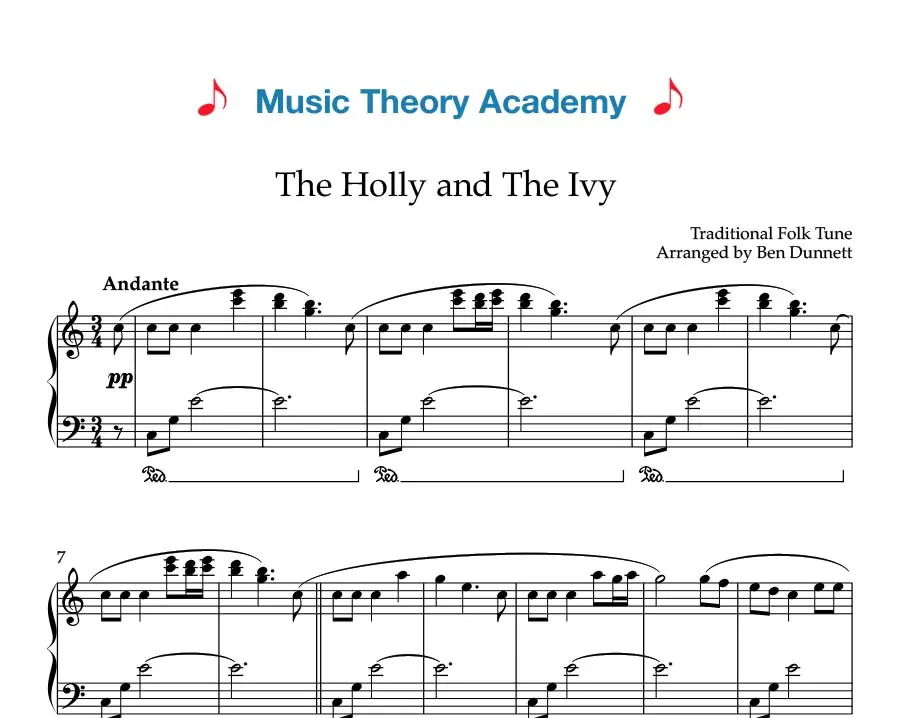
Designed specifically for intermediate pianists looking to elevate their technical proficiency while exploring expressive holiday music, this arrangement bridges the gap between accessible key signatures and demanding modern performance techniques. Written in the straightforward key of C major, the piece deceptively masks a series of intricate pedagogical challenges. These include the nuanced application of the sustain pedal to achieve a rich, cathedral-like resonance, and a demanding middle section that pairs long, sustained octave notes with alternating quavers (eighth notes) in the right hand.
This comprehensive release includes an embedded performance video, four pages of meticulously engraved sheet music, complete lyrics, and a historical overview of the carol itself. Published through the Music Theory Academy, this educational package serves as both a performance resource and a masterclass in phrasing, texture, and independent hand coordination. This report provides an in-depth review of the arrangement, examining its technical demands, structural composition, historical significance, and the broader pedagogical philosophy of its creator.
Detailed Chronology and Educational Context
The genesis of this release stems from decades of classroom and studio teaching experience. Ben Dunnett, founder of the Music Theory Academy and an active music examiner, has spent over twenty years navigating the nuances of music education. Throughout his career, Dunnett has observed a recurring pedagogical hurdle: intermediate students often plateau when attempting to transition from simple harmonic accompaniments to texturally dense, multi-layered arrangements.
Identifying the Pedagogical Gap
In the early stages of piano instruction, holiday music is frequently over-simplified, reducing rich folk melodies to basic single-note right-hand lines supported by elementary left-hand triads. Conversely, advanced concert arrangements often introduce complex chromaticism, dense chord clusters, and remote keys that alienate intermediate players.
Recognizing this gap, Dunnett engineered "The Holly and the Ivy" arrangement to utilize C major—a key familiar to nearly all pianists—as a canvas for advanced touch, tone, and rhythmic independence. By removing the cognitive load of navigating sharps and flats, the pianist can direct their full attention toward physical technique, dynamic contrast, and pedal control.
The Release and Digital Integration
The roll-out of the sheet music resource was designed with modern digital pedagogy in mind. Rather than relying solely on static paper scores, Dunnett integrated a multi-sensory learning approach:
- Auditory Demonstration: An embedded YouTube performance allows students to listen to the stylistic intent, tempo, and rubato of the piece before reading a single note.
- Visual Mapping: The four-page score is hosted online in high-resolution format, enabling students to study the layout, phrasing marks, and dynamic shifts.
- Direct Accessibility: A direct PDF download link ensures that educators and students worldwide can instantly incorporate the piece into their winter recital repertoires.
Supporting Context and Musical Metrics
To fully appreciate the craftsmanship of Dunnett’s arrangement, one must examine the musical architecture of both the traditional tune and the specific pianistic devices employed in this score.
Historical and Lyrical Background of "The Holly and the Ivy"
"The Holly and the Ivy" is one of the most enduring traditional English Christmas carols. Its roots stretch deep into British folklore, bearing associations with pre-Christian winter solstice celebrations where evergreen plants symbolized life and endurance during the darkest days of the year.
Lyrically, the carol seamlessly blends these rustic, naturalistic images with Christian theology. The text, preserved in Dunnett’s release, contrasts the masculine symbolism of the holly with the feminine representation of the ivy:
The holly and the ivy when they are both full grown,
Of all the trees that are in the wood the holly bears the crown.
Subsequent verses draw vivid parallels between the physical characteristics of the holly tree and the life of Jesus Christ:

- The Blossom: "As white as the lily flower," representing purity and the birth of Christ via the Virgin Mary.
- The Berry: "As red as any blood," foreshadowing the crucifixion and redemption of sinners.
- The Prickle: "As sharp as any thorn," marking the crown of thorns worn during the passion.
- The Bark: "As bitter as any gall," recalling the bitter drink offered to Christ on the cross.
The famous refrain—mentioning the rising sun, the running deer, the merry organ, and the choir—infuses the piece with a pastoral, celebratory energy that translates directly into Dunnett’s rhythmic choices in the piano score.
Technical Breakdown of the Piano Arrangement
While the key signature of C major suggests simplicity, a bar-by-bar examination reveals a sophisticated web of technical hurdles suitable for developing pianists:
1. The Art of the Sustain Pedal
In a diatonic setting like C major, excessive or unmanaged sustain can quickly muddy the harmonic texture, turning a clean folk melody into an unpolished wash of sound. Dunnett’s arrangement requires precise, rhythmic pedal changes. Students must master fractional pedaling and clear damper lifts to allow the harmonic changes to breathe, particularly when transitioning between the modal-sounding folk harmonies embedded within the C major framework.
2. The Challenging Middle Section: Octaves and Quavers
The centerpiece of the technical challenge occurs in the middle movement of the piece. Here, the pianist’s right hand is tasked with a complex polyphonic division of labor:
- The Long Octave Notes: Sustained dotted notes or tied values anchor the melodic peak, requiring finger-independence and flexible wrists to maintain tone quality without forcing the instrument.
- The Alternating Quavers (Eighth Notes): Weaved around or beneath the sustained octaves, these steady, moving eighth notes provide rhythmic momentum, mimicking the "running of the deer" or the steady pulse of a traditional folk dance.
Executing this section cleanly requires rigorous slow-practice, targeted articulation exercises, and a deep understanding of weight transfer from one finger to the next within the same hand.
3. Phrasing and Dynamic Architecture
Because the melody is universally recognized, the performer cannot rely on the listener discovering the tune; instead, the success of the performance hinges entirely on rubato, phrasing, and dynamic shading. Dunnett’s score provides dynamic markers that guide the performer from quiet, reflective verses reminiscent of a wintry woodland to soaring, organ-like crescendos during the choral refrains.
Official Statements and Pedagogical Philosophy
Ben Dunnett’s approach to music education is rooted in accessibility paired with uncompromising musical integrity. As an LRSM (Licentiate of the Royal Schools of Music) diploma holder, Dunnett has long advocated for teaching materials that challenge students without overwhelming them.
"When arranging traditional folk carols for the piano, the primary challenge is avoiding two extremes: making the piece so childishly simple that it bores the student, or over-arranging it to the point where the soul of the original folk melody is lost," notes Dunnett in his foundational teaching philosophy.
"By anchoring ‘The Holly and the Ivy’ in C major, we remove the intimidation factor of complex key signatures. This allows the pianist to focus entirely on what truly matters at an intermediate level: tone production, pedal awareness, hand independence, and expressive storytelling through music."
Industry peers have frequently praised Dunnett’s pedagogical output through the Music Theory Academy for its clarity, professional engraving, and practical applicability in private studio lessons. By offering these arrangements freely or accessibly online, Dunnett aims to support piano teachers worldwide who are seeking high-quality, seasonal repertoire for their studio recitals and holiday concerts.
Future Outlook and Repertoire Expansion
The publication of "The Holly and the Ivy" piano arrangement marks another milestone in the ongoing expansion of the Music Theory Academy’s digital resource library. As digital-first music education continues to grow, educators are increasingly turning to curated, multimedia-supported learning packages that combine audio, visual, and textual components.
Looking Ahead
- Expanded Seasonal Catalogs: Following the positive reception of his Christmas folk arrangements, Dunnett plans to release further intermediate-to-advanced reinterpretations of traditional British and European carols, focusing on modal folk melodies that offer unique harmonic lessons.
- Interactive Digital Formats: Future developments from the academy are expected to incorporate interactive practice tools, MIDI accompaniment files, and slowed-down breakdown tutorials to further assist self-taught musicians and classroom educators.
- Masterclass Integration: Plans are underway to host virtual piano masterclasses examining the technical mechanics of pieces like "The Holly and the Ivy," giving students a direct avenue to ask questions regarding fingering, pedaling, and stylistic interpretation.
Conclusion
Ben Dunnett’s arrangement of "The Holly and the Ivy" successfully transforms a centuries-old folk tune into a modern pedagogical masterpiece. By balancing technical rigor—such as pedal management and octave-quaver coordination—with an approachable key signature and rich historical resonance, Dunnett has provided the global piano community with an invaluable holiday resource. Whether used in a formal conservatory studio, a school recital, or played quietly at home beside a crackling fire, this arrangement ensures that the timeless tradition of holiday music-making continues to thrive with grace, elegance, and technical vitality.