
Music has long held an unparalleled power to evoke emotion, shape narrative arcs, and communicate complex psychological states without the aid of a single spoken word. At the heart of this communicative prowess lies the leitmotif—a short, recurring musical phrase, rhythm, or harmonic progression specifically designed to represent a character, object, location, or abstract concept. Deriving from the German leitmotiv, meaning "leading motive," this compositional device functions as an auditory anchor. Whenever the associated entity reappears or is subtly referenced within a narrative, its corresponding musical signature sounds, often evolving in harmony, rhythm, or orchestration to mirror the unfolding plot developments.
While precursors to the concept can be traced through the works of classical and early Romantic composers such as Carl Maria von Weber, Christoph Willibald Gluck, and Hector Berlioz—whose Symphonie Fantastique utilized a pioneering idée fixe—the leitmotif reached its artistic zenith in the monumental operatic works of Richard Wagner. Wagner weaponized the leitmotif across his 13 operas, most notably within his massive four-part cycle Der Ring des Nibelungen, transforming isolated melodies into intricate, symphonic tapestries that dictated the psychological undercurrents of the stage.
Today, the legacy of the leitmotif extends far beyond the opera house. It serves as the structural backbone of modern cinematic scoring. Legendary film composers like John Williams, Howard Shore, and Hans Zimmer have harnessed the psychological potency of the leitmotif to forge cinematic masterpieces. From the two-note terror of a lurking great white shark in Jaws to the tragic foreshadowing of Darth Vader within an innocent child’s theme in Star Wars, the leitmotif remains one of the most effective tools in artistic storytelling. This comprehensive analysis explores the historical evolution, structural mechanics, operatic mastery, and modern cinematic applications of the leitmotif, examining how a handful of notes can define an entire cultural legacy.
Detailed Chronology: From Classical Roots to Cinematic Dominance
To fully comprehend the cultural impact of the leitmotif, one must trace its development across centuries of Western art music. The journey from rudimentary recurring themes to complex webs of character motifs is a testament to the evolution of narrative composition.
1. Precursors and Early Experiments (Late 18th to Early 19th Century)
Long before Richard Wagner codified the practice, early Romantic and Classical composers recognized the dramatic utility of associating specific musical ideas with theatrical elements.
- The Classical Foundation: Composers like Gluck and Mozart occasionally used brief melodic cells to recall dramatic plot points or divine interventions, though these were sporadic rather than systemic.
- Weber and the Supernatural: Carl Maria von Weber heavily influenced the young Wagner by employing distinct tonal colors and recurring motives to represent supernatural elements and moral struggles in German Romantic operas like Der Freischütz (1821).
- Berlioz and the Idée Fixe (1830): In his groundbreaking programmatic symphony, Symphonie Fantastique, French composer Hector Berlioz introduced the idée fixe (fixed idea). This recurring melody represents the artist’s obsessive love for his beloved, mutating across the symphony’s five movements to reflect her changing states of reality, madness, and eventual damnation.
2. The Wagnerian Revolution (Mid-to-Late 19th Century)
Richard Wagner took the conceptual seeds planted by his predecessors and engineered a monumental compositional framework.
- The Flying Dutchman (1843): Wagner began structuring his operas around distinct, recurring thematic ideas, contrasting the positive, uplifting "Dutchman motif" with the terrifying, tritone-laden "Ghost motif."
- Tristan und Isolde (1865): Pushing harmonic boundaries to their absolute breaking point, Wagner introduced the infamous "Tristan chord"—a leitmotif of agonizing ambiguity that established a permanent state of harmonic yearning and deferred resolution.
- The Ring Cycle (1848–1874): Across Das Rheingold, Die Walküre, Siegfried, and Götterdämmerung, Wagner deployed over a hundred interrelated leitmotifs. These motifs weave together, contradict one another, and comment on the narrative subtext, realizing the ultimate integration of music and drama.
3. The Golden Age of Hollywood and Beyond (20th Century to Present)
When European émigré composers fled to the United States during the rise of fascism in the 1930s and 40s—artists such as Erich Wolfgang Korngold and Max Steiner—they brought the Wagnerian leitmotif tradition straight into the heart of Hollywood studio filmmaking.
- The Symphonic Revival: 1970s cinema saw a massive resurgence of traditional leitmotif scoring, spearheaded by John Williams with Jaws (1975) and Star Wars (1977).
- Modern Complexities: Contemporary film scoring has expanded the definition of the leitmotif. Modern composers frequently use micro-motifs, ambient soundscapes, and warped harmonic progressions (such as Hans Zimmer’s work in Gladiator and Inception) to achieve the exact psychological resonance that Wagner achieved with brass and strings.
Supporting Context & Metrics: The Anatomy of a Motif
A leitmotif is fundamentally an economy of means: it packs maximum narrative information into minimal musical real estate. Understanding how these musical cells operate requires examining their structural components and psychological mechanics.
Structural Forms of a Leitmotif
While the public often envisions a leitmotif as a hummable tune, musicologists categorize them into three distinct structural types:
- The Melodic Idea: A short, memorable succession of pitches. Prime examples include the flowing, wave-like "Rhine motif" from Wagner’s Das Rheingold or the menacing, two-note alternation of Jaws.
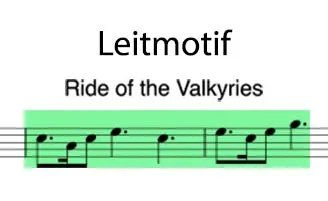
- The Rhythmic Motif: A distinct rhythmic pattern that commands attention independently of pitch. The driving, dotted rhythms of Wagner’s Ride of the Valkyries instantly signal military precision, hoofbeats, and airborne fury.
- The Harmonic Progression: A specific chord or chord sequence that carries inherent emotional weight. The "Tristan chord" is a masterclass in this category, utilizing an augmented fourth, diminished seventh, and altered intervals to project perpetual psychological unrest.
The Mechanics of Transformation
A static leitmotif risks becoming monotonous. The true genius of a master composer lies in how a leitmotif evolves alongside the narrative. Techniques commonly applied include:
- Augmentation and Diminution: Stretching out the notes of a motif to make it feel sluggish and tragic, or compressing them to create breathless panic.
- Instrumentation and Orchestration: Playing a noble character’s theme on a warm horn initially, then shifting it to a cold, metallic bass clarinet when that character falls from grace.
- Harmonic Recontextualization: Taking a joyful, major-key theme and forcing it into a minor key or dissonant harmonic environment to signal tragedy or corruption.
Official Statements & Critical Analysis: The Academic Consensus
The scholarly and critical reception of the leitmotif highlights its enduring significance in music history. Musicologists and lexicographers have long debated the exact terminology and psychological impact of these recurring themes.
The definitive weight of Wagner’s contribution is summarized by The Oxford Dictionary of Music (edited by Michael Kennedy, 1984), which notes that Wagner’s "subtle combinations of leitmotiv create symphonic textures." Rather than merely acting as an audible cue card for the audience—a crude method pejoratively termed "Mickey-Mousing" in early cinema—Wagnerian leitmotifs converse with one another in the orchestra pit, expressing thoughts and tragedies that characters on stage are either unwilling or unable to voice.
Eminent musicologist Deryck Cooke, in his seminal analyses of Wagnerian harmony, asserted that the leitmotif system is essentially a musical language with its own grammar and syntax. When a listener hears a familiar motif return in a new context, their brain subconsciously recalls every prior narrative association, triggering a profound emotional synthesis.
In contemporary film studies, film music scholar Claudia Gorbman emphasizes that leitmotifs serve to suture the viewer into the cinematic narrative. By establishing a reliable auditory code, the film score guides audience empathy, often manipulating our loyalties before we consciously realize whose perspective a scene is championing.
Future Outlook: The Evolution of the Leitmotif in Modern Media
As storytelling mediums evolve past traditional cinema and opera into interactive spaces, the leitmotif faces both unprecedented challenges and exciting new frontiers.
Video Games and Adaptive Music
The most significant evolution of the leitmotif in the 21st century is occurring within the video game industry. Unlike a static film score, video games require adaptive or interactive music that responds in real-time to player agency.
- Horizontal and Vertical Layering: Modern game composers write leitmotifs that can dynamically weave in and out of the active mix. If a player merely explores a peaceful forest, a gentle woodwind iteration of a character’s theme plays. If the player enters combat, the game engine seamlessly layers percussion and brass onto that exact same leitmotif without skipping a beat.
- Player-Driven Association: In sprawling open-world titles like The Legend of Zelda or The Elder Scrolls, leitmotifs serve as geographic and narrative anchors, ensuring players retain a cohesive emotional thread despite non-linear exploration.
Virtual Reality and Immersive Environments
As Virtual Reality (VR) and spatial audio technologies mature, leitmotifs are transitioning from flat stereo planes into three-dimensional acoustic spaces. Composers can now anchor a character’s leitmotif to a specific physical location or virtual object within a 360-degree environment, allowing users to "walk past" a musical representation of a memory or hidden threat.
Conclusion
From the candlelit opera houses of 19th-century Germany to the sprawling digital landscapes of modern interactive media, the leitmotif remains one of humanity’s most sophisticated artistic inventions. By bridging the gap between abstract sound and concrete narrative meaning, it proves that music is not merely an accompaniment to storytelling—it is the very soul of the narrative itself. Whether through the terrifying simplicity of two alternating notes in Jaws or the complex, symphonic architecture of Wagner’s Ring cycles, the leitmotif continues to orchestrate our deepest cinematic and emotional memories.