We stand at a profound inflection point in the evolution of voice science—a historic juncture where artificial intelligence (AI) and machine learning are fundamentally rewriting the parameters of research, data analysis, and clinical patient care. For centuries, the human voice has served as our most intimate instrument of connection, identity, and emotional expression. Yet, despite its universality, the physiological and neurobiological mechanisms governing speech have remained intensely complex, often eluding the limits of human perception.
Today, that barrier is dissolving. Driven by exponential leaps in computational power and algorithmic sophistication, researchers can now decode microscopic acoustic variations that the human ear cannot consciously register. At the epicenter of this transformation is The Voice Foundation and its premier publication, the Journal of Voice. Far from being a recent bandwagon, the integration of AI into voice research has a surprisingly deep history spanning over three decades.
However, the velocity of this evolution has recently shifted from gradual progress to explosive, exponential growth. With over 60% of all AI-related papers in the Journal of Voice published within the last three years alone, the field is transitioning from theoretical experimentation to vital, real-world clinical applications. From identifying early-stage neurodegenerative disorders like Parkinson’s disease to evaluating conversational AI in surgical decision-making, artificial intelligence is expanding the horizons of otolaryngology, speech-language pathology, and systemic medicine. This article explores the rich legacy, the staggering data metrics, the groundbreaking clinical milestones, and the ethical road ahead for voice science in the age of intelligent machines.
A Legacy of Interdisciplinary Bridges: The Voice Foundation
To understand the current technological renaissance in voice science, one must look back to its foundational roots. In 1969, Dr. Wilbur James Gould established The Voice Foundation in New York City. At a time when the interdisciplinary care of the human voice was virtually non-existent, Dr. Gould possessed the visionary foresight to break down traditional academic silos. He successfully united a diverse cohort of professionals—physicians, scientists, speech-language pathologists, performing artists, and vocal pedagogues—to pool their expertise in service of the professional voice user.
In 1972, the Foundation hosted its inaugural Annual Symposium: Care of the Professional Voice, a premier gathering that continues to draw hundreds of international medical, academic, and artistic minds to Philadelphia every year. A year later, the organization introduced its first Gala, later celebrated as "Voices of Summer."
Since 1989, the Foundation has been under the distinguished leadership of Dr. Robert Thayer Sataloff, an internationally renowned otolaryngologist, professional singer, and conductor. Dr. Sataloff has authored more than 1,200 publications, including 79 textbooks. Under his stewardship, the organization relocated its headquarters to Philadelphia, cementing its status as the global hub for voice research and education. Central to this mission is the Journal of Voice, the peer-reviewed gold standard dedicated exclusively to the science, medicine, and artistry of human phonation.
Detailed Chronology: 30 Years of AI Research in Voice Science
A common misconception in academic circles is that artificial intelligence in medicine is a phenomenon born of the 2020s generative AI boom. In reality, the Journal of Voice has been pioneering AI and neural network research for over thirty years.
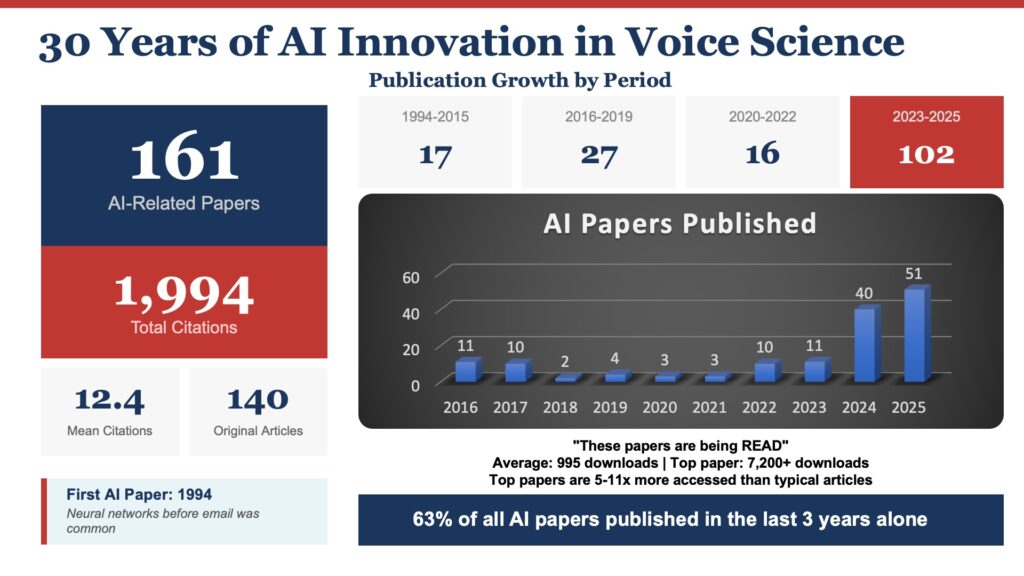
The journey began in 1994—the exact same year the World Wide Web was emerging into public consciousness, and long before everyday communication relied on email. In that year, Rihkanen and colleagues published a landmark paper entitled "Spectral Pattern Recognition of Improved Voice Quality." This pioneering study utilized early neural networks to analyze voice signatures, planting the seeds for what would become an algorithmic revolution.
The Exponential Timeline of Publication
For the first two decades following that initial spark, AI publications in voice science trickled in steadily as researchers tested the limits of early computing architecture:
2016–2019: 27 papers marking the dawn of deep learning and advanced cepstral vector analysis.
2020–2022: 16 papers navigating the challenges of remote diagnostics during the global pandemic.
2023–2025: 102 papers—representing an astounding 63% of all AI-related literature in the journal’s history.
In the year 2025 alone, the Journal of Voice published 51 AI-related papers. This single-year output eclipses the total volume of AI research published during the first twenty years of the movement combined. This trajectory underscores a dramatic shift: the field is no longer dabbling in computational tools; it is undergoing total structural transformation.
Supporting Context & Metrics: Real-World Impact and Global Reach
Academic citations are often treated as insular metrics, but in the case of AI research within the Journal of Voice, download and usage statistics paint a picture of aggressive, practical implementation by frontline clinicians.
The average AI-focused paper published in the journal has been downloaded nearly 1,000 times. More telling, however, are the standout studies that have captured global attention. For instance, research investigating machine learning models for COVID-19 detection via vocal cord characteristics has been downloaded over 7,200 times—eleven times the median readership for articles in its issue.
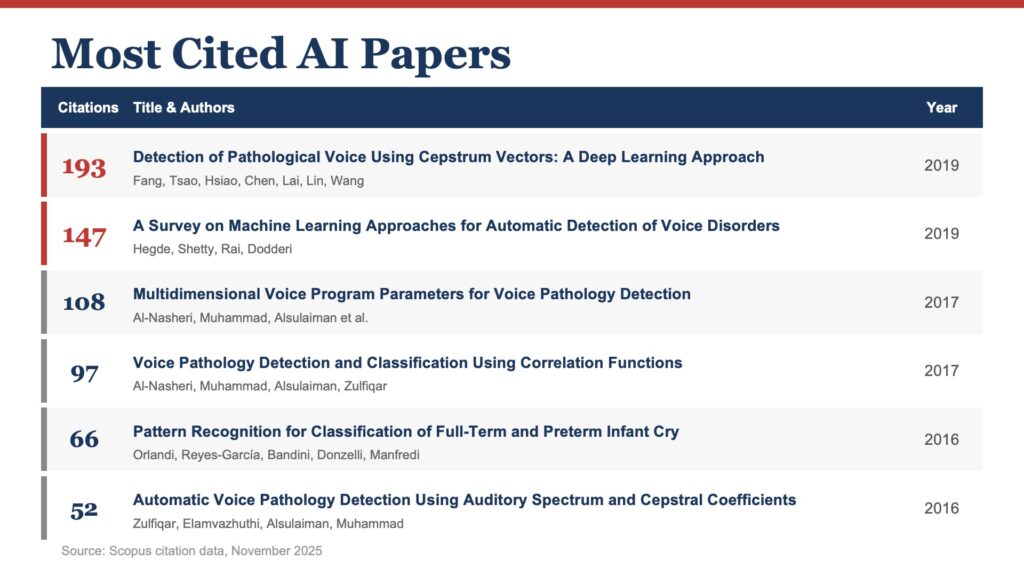
Similarly, structural heavyweights in the literature—such as Fang and colleagues’ 2019 deep learning study (yielding 193 citations) and Hegde’s comprehensive machine learning survey (147 citations)—have each amassed close to 5,000 downloads. These massive engagement metrics confirm that the audience consuming this data extends far beyond computer science laboratories. They represent practicing otolaryngologists, speech-language pathologists, and clinical researchers actively seeking actionable, digital diagnostics to elevate patient care.
A Borderless Community
This scientific crusade is spearheaded by a deeply collaborative global network. Leading contributors to the Journal of Voice’s AI footprint include prominent researchers such as Jérôme René Lechien, Dimitar Deliyski, Stephanie Zacharias, Ahmed Yousef, Paavo Alku, Leonardo Wanderley Lopes, and Maryam Naghibolhosseini. Representing institutions across every inhabited continent, these scholars demonstrate that the digital transformation of voice science is a truly borderless endeavor.
Landmark Research Reshaping the Field
Deep Learning for Voice Pathology Detection
The cornerstone of modern AI voice diagnostics is the ability to identify anomalies before they manifest audibly to the human ear. Fang and colleagues’ 2019 study, "Detection of Pathological Voice Using Cepstrum Vectors: A Deep Learning Approach," remains the most-cited AI paper in the journal’s history. By feeding cepstrum vectors into deep neural networks, the researchers proved that algorithms could isolate subtle pathological markers with unprecedented accuracy.
This groundwork paved the way for advanced methodologies. Hegde’s survey paper mapped out the burgeoning taxonomy of machine learning models for voice disorder detection. Subsequent studies—such as Chen and Chen’s deep neural network classifications, Fujimura’s exploration of one-dimensional convolutional neural networks (CNNs), and Cho and Choi’s comparative analysis of CNN models applied to laryngoscopic imagery—have systematically pushed the boundaries of diagnostic precision.
The Voice as a Digital Biomarker
Perhaps the most paradigm-shifting concept to emerge from this computational wave is the establishment of the human voice as a non-invasive digital biomarker for systemic health.
Neurological tracking has seen monumental strides. Hemmerling and Wójcik-Pędziwiatr’s 2022 study on predicting the severity of Parkinson’s disease using acoustic voice signals garnered 29 citations in a mere three years, accelerating the path toward real-world clinical monitoring tools. Beyond neurology, systematic reviews now position vocal quality metrics as digital sentinels for mental health conditions, including clinical depression and bipolar disorder. The clinical implications are immense: routine vocal analysis could soon flag early shifts in psychological well-being, facilitating proactive interventions and alleviating overburdened healthcare infrastructure.
AI Chatbots and Conversational Decision-Making
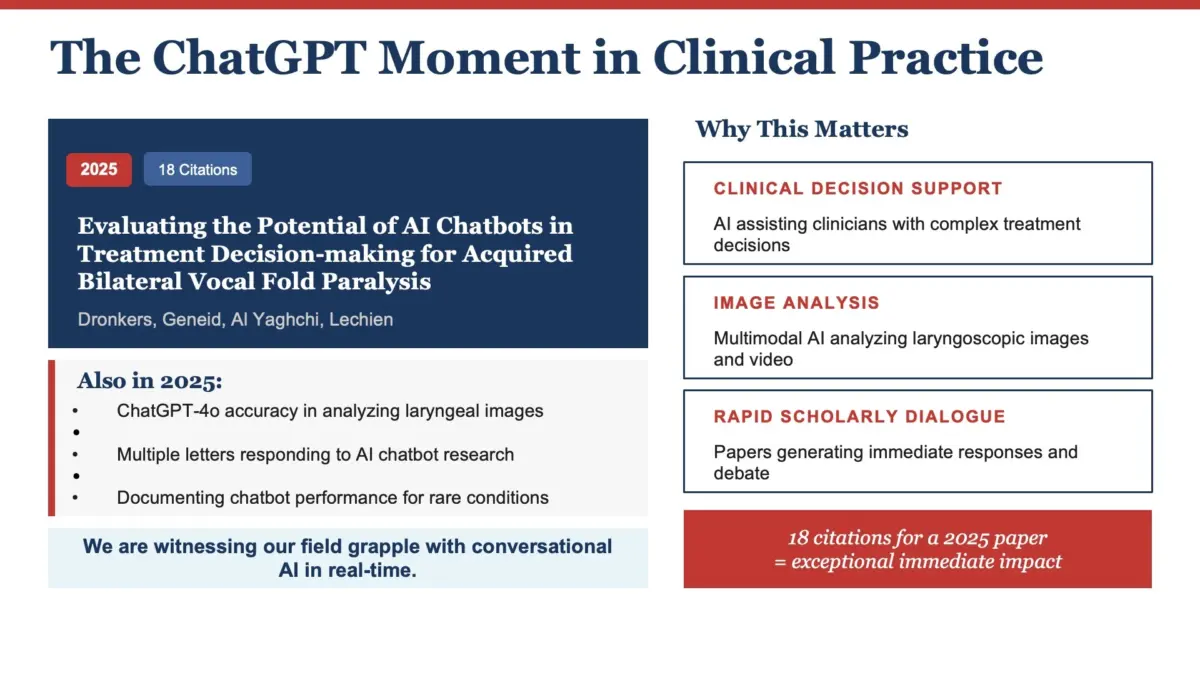
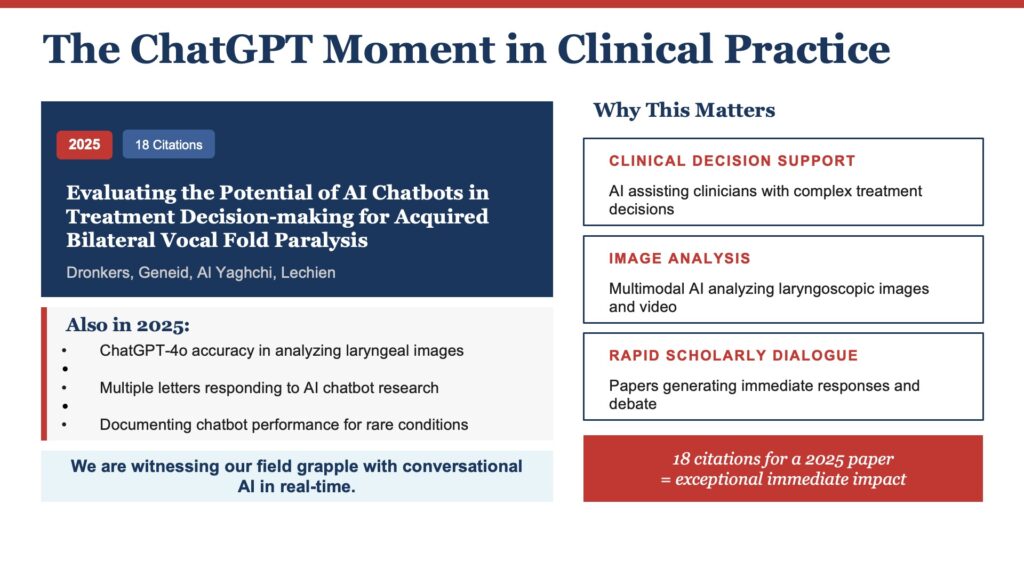
Reflecting the cutting edge of contemporary technology, the Journal of Voice has rapidly adapted to evaluate generative AI and conversational agents in clinical settings. A prime example is Dronkers and colleagues’ 2025 study on "Evaluating the Potential of AI Chatbots in Treatment Decision-making for Acquired Bilateral Vocal Fold Paralysis." Accumulating 18 citations almost immediately upon release, the paper sparked vibrant scholarly discourse, including companion research analyzing ChatGPT-4o’s precision in diagnosing laryngeal imagery. The medical community is actively—and publicly—grappling with the integration of conversational AI into patient management workflows.
Official Statements & Expert Perspectives
To navigate this brave new world, the voice science community relies on thought leaders who bridge computational science, clinical practice, and institutional governance.
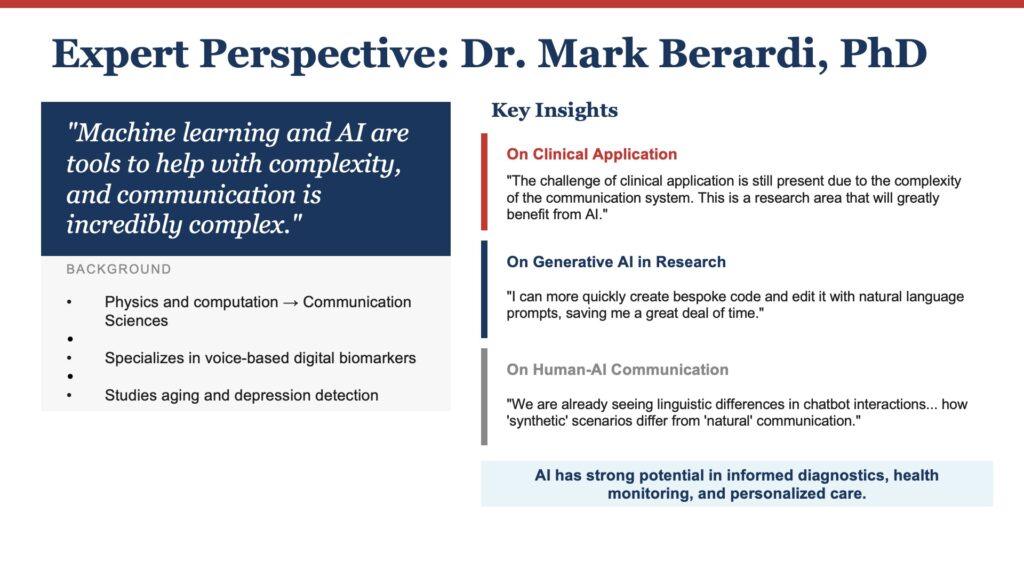
Dr. Mark Berardi: Managing Neurobiological Complexity
Dr. Mark Berardi, whose academic roots span physics and computation, views artificial intelligence primarily as an indispensable instrument for managing vast complexity.
"Machine learning and AI are tools to help with complexity, and communication is incredibly complex in its neurobiological and physiological processes. So I think the application is warranted," Dr. Berardi explains.
Focusing his research on voice-based digital biomarkers for aging and depression, Dr. Berardi notes that while capturing voice signals has become technologically frictionless, decoding the underlying biological web remains challenging—making AI an ideal partner. Furthermore, he utilizes generative AI to eliminate traditional research bottlenecks, leveraging natural language prompts to rapidly generate and refine bespoke code.
Intriguingly, Dr. Berardi’s work also examines the mechanics of human-AI communication itself. As humanity pivots toward hybrid interactions—ranging from Zoom conferences to conversational chatbots—linguistic adaptations are emerging. Voice science, he suggests, must now encompass not only pure human speech, but human phonation in constant dialogue with synthetic entities.
Dr. Eric Hunter: Embracing Change with Ethical Clarity
Addressing the institutional and academic realities of the digital shift, Dr. Eric Hunter issues a pragmatic call for systemic adaptation.
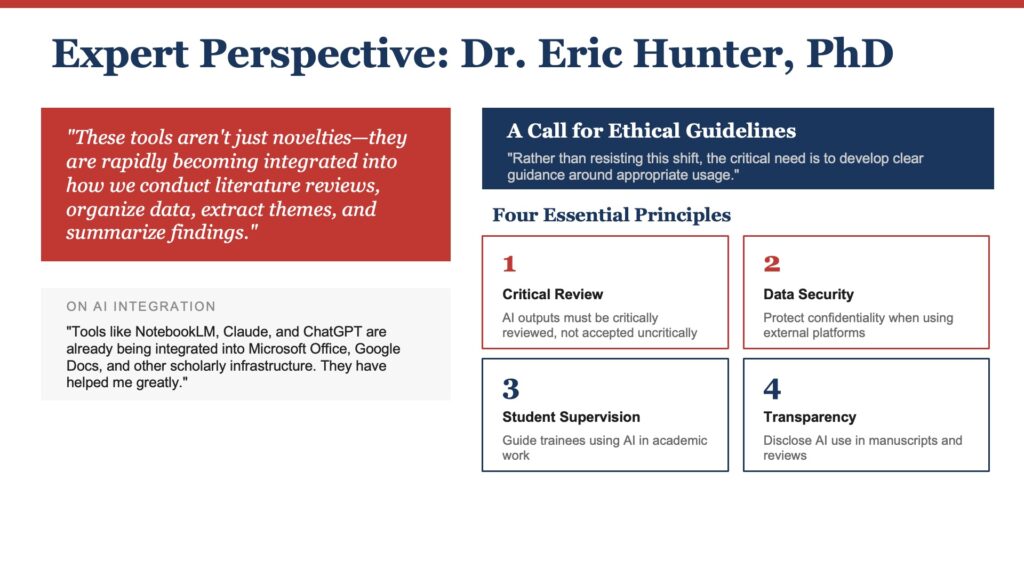
"These tools aren’t just novelties," Dr. Hunter observes. "They are rapidly becoming integrated into how we conduct literature reviews, organize data, extract themes from large bodies of text, and even summarize findings."
With platforms like NotebookLM, Claude, and ChatGPT weaving themselves seamlessly into productivity suites and scholarly infrastructure, Dr. Hunter stresses that resistance is futile. Instead, the academic community must proactively develop ethical guardrails. He outlines four vital pillars for responsible AI integration in research and publishing:
Transparency: Clear disclosure of where and how AI tools were utilized in manuscript preparation and data analysis.
Human Accountability: Authors and reviewers maintaining absolute responsibility for the veracity of generated content and scholarly conclusions.
Data Integrity: Rigorous vetting of training datasets to prevent algorithmic bias and protect patient privacy.
Collaborative Governance: Establishing cross-institutional frameworks to standardize ethical AI usage across global scientific journals.
"Our field will benefit most," Dr. Hunter concludes, "if we embrace the productivity these tools offer while also building a shared ethical framework for their responsible use."
Future Outlook: The Path Forward
As the Journal of Voice marches into its next decade of publication, its overarching mission remains resolute: to publish rigorous, boundary-pushing research while upholding the absolute highest standards of scientific integrity. However, the maturation of artificial intelligence demands a unified, tripartite commitment from the global research community:
Thoughtful Engagement: Researchers and clinicians must view AI not as a replacement for human clinical intuition, but as an amplifier of expertise designed to navigate profound systemic complexity.
Ethical Harmonization: The community must coalesce around shared frameworks—answering Dr. Hunter’s call for standardized guidelines that govern authorship, review processes, and patient data safety.
Continued Collaboration: With 161 AI papers marking only the tip of the iceberg, clinicians, educators, and data scientists must continue sharing insights to accelerate collective progress.
We stand at an extraordinary historical crossroads. For hundreds of thousands of years, the human voice has quietly carried the weight of our emotions, our neurological health, and our deepest identities. Today, for the very first time, we possess analytical instruments sophisticated enough to truly comprehend that complexity. By marrying decades of interdisciplinary clinical wisdom with the limitless potential of artificial intelligence, we are unlocking non-invasive windows into human health, expanding the reach of expert care, and democratizing vocal wellness on a global scale.
The next decade promises breakthroughs that were once confined to science fiction. The Journal of Voice and The Voice Foundation remain proud to stand at the very center of this revolution, chronicling the future of human sound.
About the Author: Ian DeNolfo is Executive Director of The Voice Foundation, which publishes the Journal of Voice. A graduate of The Juilliard School and The Curtis Institute of Music, he formerly performed as a leading tenor at opera houses worldwide before transitioning to arts administration and scientific leadership.