
Executive Overview
The landscape of contemporary choral music is undergoing a significant transformation, driven by an increased demand for culturally diverse compositions, adaptable voicing options, and works that bridge the gap between rigorous pedagogy and artistic expression. A recent publishing showcase highlighting the works of Mexican conductor-composer Julio Morales and American composer-educator David von Kampen offers a compelling lens through which to examine these broader industry shifts.
Released through Graphite Publishing and featured across national choral networks such as ChoralNet, this new collection of vocal scores spans an expansive technical range—from entry-level two-part treble literature to highly complex, eight-part a cappella divisi compositions. By making these works accessible to elementary, secondary, collegiate, and professional ensembles, the publication initiative underscores a growing movement among modern publishers to democratize contemporary repertoire without sacrificing artistic integrity.
This comprehensive report examines the compositional frameworks, technical specifications, institutional contexts, and broader pedagogical implications of the newly published works by Morales and von Kampen. Through detailed musicological breakdown and institutional profiling, this analysis evaluates how these additions to the modern catalog address crucial gaps in contemporary choral programming.
Detailed Chronology of Catalog Integration and Composer Trajectories
The emergence of these new works reflects the distinct yet intersecting professional trajectories of Julio Morales and David von Kampen. Both figures represent a generation of composers whose creative output is deeply rooted in active performance, academic leadership, and community engagement.
       COMPOSER TRAJECTORIES & CATALOG INTEGRATION

   JULIO MORALES                           DAVID VON KAMPEN
   (Veracruz, Mexico)                      (Lincoln, Nebraska)
   ------------------                      -------------------
   • UTEL / Tito Puente Univ.              • Univ. of Kansas (DMA) / UNL
   • Instituto Veracruzano                 • UNL Jazz Singers Director
   • Interkultur World Choir Council       • Christ Lutheran Church Coordinator
             |                                       |
             +-------------------+-------------------+
                                 |
                                 v
                     GRAPHITE PUBLISHING RELEASE
                     ---------------------------
                     • Pedagogical Spectrum: Diff 1 to 5
                     • Multi-Voicing Adaptability (SATB, SAB, SA, 2-Part)
                     • Cross-Genre Synthesis (Sacred, Secular, Jazz, Folklore)
The Trajectory of Julio Morales
Based in Veracruz, Mexico, Julio Morales has built an extensive career as a choral conductor, arranger, pianist, and educator. A graduate of the Universidad Veracruzana with a Bachelor’s Degree in Music Education, Morales subsequently earned a Master’s Degree in Composition from Tito Puente University and a Master’s Degree in Education and Teaching from UTEL University.

Morales’s institutional footprint in Mexico is substantial:
- Director of Community Choirs at the Instituto Veracruzano de la Cultura, overseeing regional youth vocal initiatives.
- Staff Accompanist for Voces del Mar, a children’s ensemble operating under Mexico’s Sistema Nacional de Fomento Musical.
- Professor of Choral Conducting at the Instituto Superior de Música Esperanza Azteca.
- Conductor and Arranger for the Vox A Cappella Band (famously known as the Vox Populi Project).
- International Delegate, serving as Mexico’s representative composer on Interkultur’s World Choir Council.
- Active Vocalist, performing as a tenor with the US-based Exigence vocal ensemble and Los Bordershop Quartet.
Morales’s catalog additions reflect his commitment to community music-making and rhythmic complexity, drawing directly from his background in vocal jazz, Mexican folk traditions, and pedagogical practice.
The Trajectory of David von Kampen
Operating from Lincoln, Nebraska, Dr. David von Kampen represents a quintessential American crossover composer whose work bridges classical choral traditions, modern jazz harmony, and liturgical music. Von Kampen earned his Doctorate of Musical Arts (DMA) in Composition from the University of Kansas, following Master’s and Bachelor’s degrees from the University of Nebraska–Lincoln (UNL).
Von Kampen’s structural roles include:
- Lecturer of Music Theory and Literature at the University of Nebraska–Lincoln.
- Director of the UNL Jazz Singers, an award-winning collegiate vocal jazz ensemble.
- Music Coordinator for Sanctuary Worship at Christ Lutheran Church in Lincoln.
- Active Clinician and Pianist, working regularly across vocal and instrumental jazz festivals nationwide.
Von Kampen’s contributions to this catalog release demonstrate his technical command of vocal polyphony, modern voice-leading, and the reinterpretation of historic sacred texts for contemporary choir tiers.

Supporting Context & Technical Metrics: Pedagogical and Musicological Analysis
To understand the strategic value of these new publications, directors and curators evaluate metrics such as difficulty grading (scored on a standard 1–5 continuum), duration, voicing flexibility, and instrumental demands. Below is a systematic breakdown of the six newly highlighted compositions.
Comprehensive Metric Matrix
| Composition Title | Composer | Difficulty (1–5) | Voicing Options | Instrumentation | Duration | Primary Pedagogical Focus |
|---|---|---|---|---|---|---|
| Un Jardín | Julio Morales | 1 | 2-Part Treble | Piano (Opt. Double Bass) | 3–5 min | Pitch accuracy, introductory ensemble blending |
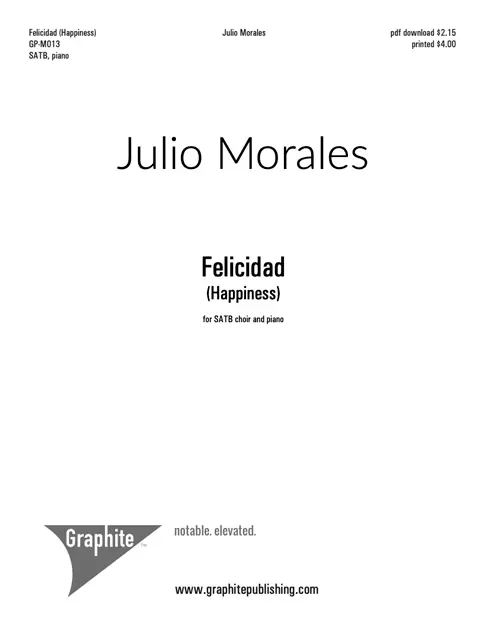
| Felicidad (Happiness) | Julio Morales | 2 | SATB, SAB | Piano | 3–5 min | Expression, expressive phrasing, flexible voicing |
| Lovely Appear | David von Kampen | 2 | SATB, SA | Piano | 3–5 min | Unison line delivery, dynamic control, sacred text |
| Swimming | David von Kampen | 3 | SATB | Piano | < 3 min | Text painting, piano-choral rhythmic alignment |
| In the Long Grass | David von Kampen | 4 | SATB | A Cappella | 3–5 min | Advanced intonation, spatial voice-leading |
| Week Week | Julio Morales | 5 | SATB div. | A Cappella | 3–5 min | Virtuosic rhythmic independence, vocal percussion |
Detailed Analysis of Julio Morales’s Works
              JULIO MORALES: COMPOSITIONAL SPECTRUM

  [Un Jardín] -----------> [Felicidad] -----------> [Week Week]
  Difficulty: 1            Difficulty: 2            Difficulty: 5
  2-Part Treble            SATB / SAB               SATB Divisi A Cappella
  Pedagogical/Beginner     Accessible Expressive    Virtuosic/Rhythmic
1. Un Jardín (Difficulty Level: 1)
- Voicing: 2-Part Treble
- Accomp.: Piano with optional Double Bass
- Duration: 3–5 minutes
- Musicological Profile: Designed specifically for young voices or developing community choirs, Un Jardín establishes foundational vocal independence through accessible two-part counterpoint. The addition of an optional double bass provides a grounding harmonic anchor, allowing young singers to develop acoustic awareness and intonation relative to a low-frequency root.
2. Felicidad (Happiness) (Difficulty Level: 2)
- Voicing: Available in SATB and SAB editions
- Accomp.: Piano
- Duration: 3–5 minutes
- Musicological Profile: Addressing themes of emotional resilience and finding joy amidst adversity, Felicidad utilizes accessible harmonic language coupled with lyrical melodic lines. The dual availability in SATB and SAB configurations makes it a practical selection for middle school, high school, or small community choruses facing uneven voice distribution (such as a shortage of tenors).
3. Week Week (Difficulty Level: 5)
- Voicing: SATB divisi
- Accomp.: A cappella
- Duration: 3–5 minutes
- Musicological Profile: Occupying the highest difficulty tier in the new release, Week Week demands exceptional rhythmic precision, vocal stamina, and pitch accuracy. Drawing heavily on Morales’s experience with vocal jazz and percussive vocal arranging (Vox Populi Project), the piece utilizes complex polyrhythms, rapid-fire text delivery, and multi-layered divisi textures. It serves as a showcase piece for advanced collegiate and professional chamber choirs.
Detailed Analysis of David von Kampen’s Works
            DAVID VON KAMPEN: COMPOSITIONAL SPECTRUM

  [Lovely Appear] ---------> [Swimming] ---------> [In the Long Grass]
  Difficulty: 2              Difficulty: 3         Difficulty: 4
  SATB / SA + Piano          SATB + Piano          SATB A Cappella
  Adapted Sacred Text        Modern Impressionism  Complex Vocal Polyphony
1. Lovely Appear (Difficulty Level: 2)
- Voicing: SATB and SA editions
- Accomp.: Piano
- Duration: 3–5 minutes
- Musicological Profile: Based on Charles Gounod’s classical adaptation of Isaiah 52, von Kampen reimagines the sacred text within a mostly unison and simplified harmonic structure. By relying on prolonged unison passages that blossom into simple harmonic closures, the work allows directors to focus on tone quality, breath management, and clear diction without overwhelming the choir with contrapuntal density.
2. Swimming (Difficulty Level: 3)
- Voicing: SATB
- Accomp.: Piano
- Duration: Less than 3 minutes
- Musicological Profile: A brief, highly descriptive secular piece that showcases von Kampen’s skill in text painting. The piano accompaniment features fluid, undulating figures that mimic aquatic movement, requiring precise rhythmic coordination between the pianist and the choir. The vocal writing balances modern modal shifts with familiar voice-leading paths.
3. In the Long Grass (Difficulty Level: 4)
- Voicing: SATB
- Accomp.: A cappella
- Duration: 3–5 minutes
- Musicological Profile: An unassisted choral work that challenges choirs to maintain structural center and precise tuning across subtle harmonic modulations. Utilizing contemporary art-song aesthetics, von Kampen constructs rich, atmospheric textures that demand mature dynamic control and sophisticated phrase shaping from all four vocal sections.
Official Statements and Industry Context
Industry analysts and choral literature directors note that the joint publication of works by Morales and von Kampen highlights an intentional move toward catalog diversification by independent publishers like Graphite Publishing.
Commenting on the pedagogical philosophy underlying his compositions, Julio Morales has consistently emphasized accessibility and emotional resonance across learning tiers:
"Music must remain an accessible sanctuary for singers at every stage of their development. Whether writing a simple two-part piece for young children in regional Mexico or a complex divisi work for professional ensembles, the core goal is to remind performers and audiences that expression and light can be reclaimed even in challenging contexts."
In discussing his approach to textual adaptations and stylistic versatility, Dr. David von Kampen noted the importance of functional adaptability in modern choral composition:

"When setting historic sacred literature or contemporary secular poetry, the objective is to make the voice feel natural. Creating works that offer flexible voicings—such as SATB alongside SA options—allows ensembles with varying balances to engage with high-quality literature without sacrificing the artistic intent of the music."
Editorial and Publishing Context
Graphite Publishing’s digital distribution model plays a crucial role in enabling composers like Morales and von Kampen to reach international markets directly. By offering immediate digital access, score preview videos, and tiered difficulty ratings, independent publishers circumvent traditional print distribution bottlenecks, allowing choral conductors to quickly source repertoire tailored to their specific roster capabilities.
Future Outlook: Implications for Choral Curricula and Ensemble Programming
The publication of these six works points toward broader structural trends within the global choral movement:
                  FUTURE INDUSTRY TRENDS

  INCLUSION OF LATIN AMERICAN COMPOSERS & TEXTS
  • Expanding non-English & bilingual repertoire choices
  • Integration of regional rhythmic patterns into standard concert music

  ADAPTABLE VOICING AS AN INDUSTRY STANDARD
  • SATB/SAB and SATB/SA parallel releases to accommodate shifting demographics
  • Solutions for choirs experiencing tenor/bass shortages post-pandemic

  BRIDGING EDUCATIONAL (GRADES 1-2) AND PROFESSIONAL (GRADES 4-5) REPERTOIRE
  • Single-composer catalogs spanning elementary to collegiate skill levels
• Direct pedagogical continuity for music educators-
Expansion of Latin American Choral Literature:
The formal distribution of Morales’s compositions through mainstream North American publishing channels reflects a sustained effort to incorporate authentic Latin American perspectives into concert programming. This movement extends beyond traditional arrangements of folk songs, positioning Latin American composers as vital creators of original secular and educational works. -
Mitigation of Post-Pandemic Ensemble Roster Challenges:
Choral programs worldwide continue to navigate fluctuating enrollment numbers and voice-part imbalances—particularly within lower voice sections (tenor and bass). By routinely issuing dual editions (such as SATB alongside SAB or SA), publishers provide practical solutions that keep choirs singing high-quality music regardless of membership shifts.
-
Synthesis of Vernacular and Classical Aesthetics:
Both Morales (through vocal jazz and Latin rhythmic structures) and von Kampen (through American jazz theory and modern church music) exemplify the modern composer-educator who resists strict genre siloing. Their additions to the catalog reinforce a future where jazz-inflected harmonies, rhythmic percussiveness, and traditional sacred counterpoint exist harmoniously on the same concert stage.
As conductors build future performance seasons, the expanded catalogs of Julio Morales and David von Kampen offer a diverse suite of programmatic options. From elementary school choruses taking their first steps in Un Jardín to elite university choirs tackling the rhythmic demands of Week Week, these new publications represent a vital, forward-looking addition to twenty-first-century choral music.