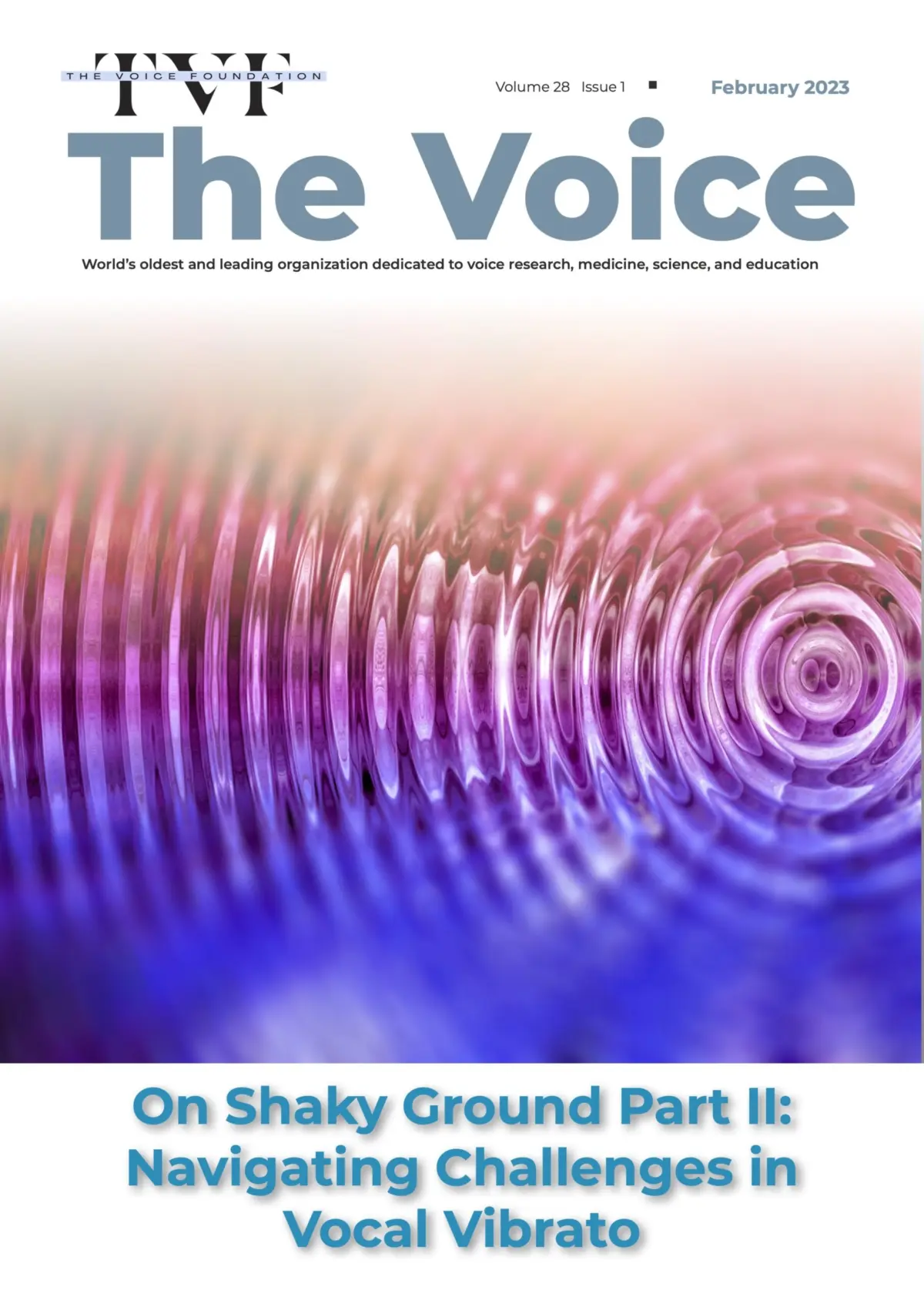

PHILADELPHIA, PA — In the ever-evolving landscape of vocal pedagogy, scientific research, and clinical otolaryngology, few topics command as much nuance, fascination, and debate as vocal vibrato. As part of its ongoing mission to advance the science and care of the human voice, The Voice Foundation officially published its comprehensive newsletter for February 2023. Authored and curated under the editorial guidance of Ian DeNolfo, the late-winter dispatch turned its primary spotlight toward the second installment of a compelling multi-part series entitled On Shaky Ground Part II.
This edition dives deep into the physiological, pedagogical, and therapeutic dimensions of vibrato, bringing together multidisciplinary perspectives to demystify one of the most distinctive ornaments of human vocalization. For vocal scientists, educators, speech-language pathologists, and professional performing artists alike, the publication serves as an essential resource bridging the gap between rigorous laboratory research and practical, studio- or clinic-based applications.
Executive Overview
The February 2023 newsletter of The Voice Foundation captures a pivotal moment in contemporary vocal arts and sciences. Titled On Shaky Ground Part II, the centerpiece article of this edition extends an ongoing exploration into the mechanical instabilities, acoustic properties, and artistic functions of vibrato.
Vibrato—traditionally defined as a slight, rapid, and regular fluctuation in pitch (and, to a lesser extent, intensity and timbre)—has long been a hallmark of trained Western classical singing, as well as various global folk and popular traditions. However, the exact physiological mechanisms that govern its production, the pedagogical methods used to cultivate or correct it, and the clinical treatments applied when it becomes pathological continue to generate profound academic discussion.
By framing the issue under the provocative heading On Shaky Ground, the authors and contributors of this edition do not merely examine vibrato as a static acoustic phenomenon; rather, they interrogate the delicate physiological balances required to maintain it, the thin line separating healthy expressive vibrato from vocal tremor or wobble, and the pedagogical anxieties often associated with teaching it. Through a synthesis of cutting-edge research, clinical insights, and pedagogical best practices, the February 2023 newsletter offers a robust framework for understanding how the human instrument navigates this complex sonic territory.
Detailed Chronology: The Evolution of Voice Science and the Genesis of On Shaky Ground Part II
To fully appreciate the significance of the February 2023 publication, it is necessary to examine the broader timeline of voice science and how modern research has transformed our understanding of laryngeal mechanics.
Historical Context of Vocal Vibrato Research
For centuries, vibrato was largely viewed through an aesthetic lens—a natural embellishment born of emotional expression. Early 20th-century pioneers in voice science, such as Carl Seashore in the 1930s, began utilizing early recording and acoustic measuring devices to quantify vibrato, discovering that most professional singers operate with a frequency modulation rate of approximately 6 to 7 cycles per second (Hz), coupled with a pitch fluctuation of roughly a quarter to a half-tone.
As technology progressed into the late 20th and early 21st centuries, methodologies evolved dramatically. Researchers gained access to high-speed digital laryngeal videostroboscopy, electromyography (EMG) of the intrinsic and extrinsic laryngeal muscles, and advanced computer-based acoustic modeling. These tools allowed scientists to move past mere observation and begin mapping the exact neural, muscular, and aerodynamic interactions responsible for producing and sustaining vibrato.
The Buildup to Part II
The publication of On Shaky Ground Part II in February 2023 was not an isolated event; it represents a continuation of an ongoing dialogue initiated within previous issues of The Voice Foundation’s communications. Part I established the baseline premises: exploring whether vibrato is an involuntary neurological oscillation, a conscious laryngeal adjustment, or an inevitable byproduct of a balanced, resonant vocal tract.
By early 2023, the discourse had matured. Voice scientists and clinicians recognized that while healthy vibrato indicates optimal laryngeal relaxation and breath support, deviations from this norm—such as a wide, slow wobble, a strained narrow tremolo, or a complete absence of vibrato (straight tone)—often signal underlying technical inefficiencies or neuromuscular pathologies.
The February 2023 newsletter arrived precisely to address these clinical and pedagogical gray areas. It synthesized contemporary studies examining how teachers identify foundational flaws in vibrato development and how medical professionals differentiate between stylistic preference and dystonic vocal tremors.
Supporting Context & Metrics: The Anatomy and Acoustics of Vibrato
To understand the weight of the findings discussed in the February 2023 newsletter, one must examine the intricate anatomical and physical variables that govern vocal oscillation.
The Physiological Triad: Respiration, Phonation, and Resonance
Vibrato is not generated by a single isolated muscle; rather, it is the emergent property of a finely tuned dynamic equilibrium among three primary systems:
- The Respiratory System: Provides the steady, controlled subglottic air pressure necessary to activate the vocal folds. Fluctuations or micro-pulsations in respiratory muscle activity (including the diaphragm and intercostals) can influence vibrato rates.
- The Phonation System (Larynx): The thyroarytenoid and cricothyroid muscles work in tandem to regulate vocal fold tension and length. Minor, rhythmic oscillations in muscle tension create the cyclical frequency shifts perceived as vibrato.
- The Vocal Tract (Resonance): The pharynx, oral cavity, and nasal passages act as acoustic filters that reinforce specific harmonics, shaping the warm, resonant quality characteristic of a healthy vibrato.
Quantitative Metrics of Vibrato
Voice scientists typically evaluate vibrato across several standardized quantitative parameters:
- Rate (Frequency of Fluctuation): Typically ranges between 5.5 Hz and 7.5 Hz in healthy, trained adult voices. Rates dropping below 5 Hz are often perceived as a "wobble," while rates exceeding 8 Hz are frequently categorized as a "tremor."
- Extent (Depth of Fluctuation): Measures the pitch variance from peak to trough. In classical singing, an extent of approximately $pm 50$ cents (a semitone total span) is standard, though this varies across genres.
- Regularity (Jitter and Shimmer Stability): Measures the consistency of the waveform cycles. While raw human voices naturally exhibit microscopic cycle-to-cycle variations (jitter), a well-regulated vibrato displays a smooth, predictable sinusoidal or quasi-sinusoidal frequency envelope.
When these metrics fall outside normative ranges, singers often experience vocal fatigue, pitch instability, and a loss of expressive control—themes that sit at the very heart of the On Shaky Ground series.
Official Perspectives: Research, Teaching, and Clinical Treatment
The February 2023 newsletter uniquely bridges three distinct professional pillars: the empirical researcher, the studio voice teacher, and the clinical voice specialist (otolaryngologist and speech-language pathologist).
1. The Research Perspective: Unraveling Neurological and Acoustic Realities
Researchers contributing to the discourse emphasize that vibrato is deeply tied to the central nervous system. Rather than being manufactured purely through conscious muscular manipulation, a vibrant, fluid sound is often the result of optimal neuromuscular efficiency. When the laryngeal posture is free of excessive antagonistic muscle tension (such as hyperfunction of the extrinsic suprahyoid muscles), the intrinsic laryngeal muscles can achieve a state of dynamic micro-oscillation. Modern acoustic analyses featured in the broader Voice Foundation network continue to use spectrograms and harmonics-to-noise ratios to illustrate how a balanced vibrato enhances vocal projection and harmonic richness without straining the mucosal tissues.
2. The Pedagogical Perspective: Guiding the Developing Instrument
For voice educators, teaching vibrato—or rectifying a faulty one—is one of the most delicate tasks in the studio. Forcing vibrato artificially can lead to catastrophic vocal habits, including manufactured operational tremors or breathy instability. The insights highlighted in the February 2023 publication reinforce the pedagogical consensus that vibrato should not be taught as a mechanical trick. Instead, teachers must focus on establishing foundational alignment, efficient breath management, and laryngeal release. When coordination is correct, vibrato emerges naturally as a byproduct of a healthy, uninhibited vocal mechanism.
3. The Clinical Perspective: Differentiating Art from Pathology
From a medical standpoint, clinicians must carefully distinguish between stylistic vibrato variations and true vocal pathologies. Conditions such as spasmodic dysphonia, essential tremor, or vocal fold paresis can manifest as erratic pitch fluctuations that mimic an uncontrolled vibrato. Otolaryngologists and laryngologists utilizing the diagnostic frameworks discussed in foundational literature rely on stroboscopic imaging and neurological evaluations to determine whether a singer’s "shaky ground" is the result of temporary vocal fatigue, poor technique, or a localized neuromuscular disorder requiring medical intervention.
Future Outlook: The Ongoing Journey of Voice Science
As the vocal community moves further away from the February 2023 publication date, the implications of On Shaky Ground Part II continue to ripple across educational curricula and clinical practices.
Technological Integration in Voice Training and Therapy
The future of voice science lies in the increasing accessibility of real-time biofeedback tools. Software applications capable of visually mapping vibrato rate and extent in real-time are becoming standard fixtures in advanced voice studios and speech pathology clinics. These tools allow singers and patients to visualize their acoustic output, bridging the gap between kinesthetic sensation and measurable physical reality. By integrating the theoretical concepts explored in The Voice Foundation’s newsletters with modern biofeedback technology, practitioners can diagnose and correct instability faster and more safely than ever before.
Interdisciplinary Collaboration
Perhaps the most enduring takeaway from the February 2023 newsletter is the absolute necessity of interdisciplinary dialogue. Historically, voice teachers, scientific researchers, and medical doctors often operated in isolated silos. Organizations like The Voice Foundation have successfully championed a unified approach, where laryngologists consult with pedagogues, and scientists ground their hypotheses in the practical realities of the performance hall.
As future installments and companion studies continue to build upon On Shaky Ground, the collective understanding of the human voice will only deepen. For performers seeking artistic mastery, teachers striving for pedagogical safety, and clinicians dedicated to vocal health, publications like the February 2023 newsletter remain indispensable milestones on the path toward total vocal wellness and expressive freedom.
For further information, access to archived newsletters, and details regarding upcoming symposia, please visit the official portal of The Voice Foundation.