
Executive Overview
The contemporary Christian music (CCM) community is in mourning following the passing of Steve Camp, a foundational pillar of modern Christian artistry, prophetic songwriting, and theological advocacy. Camp entered eternity on Wednesday, November 11, 2026, at the age of 71, following a courageous battle with heart failure. A two-time CCM Magazine cover artist—including a memorable and defining appearance in November 1986—Camp’s career spanned more than five decades. He left an indelible mark not only through his rich baritone vocals and melodically complex compositions, but through his unyielding commitment to orthodox biblical theology and his prophetic calls for reform within both the institutional Church and the commercial Christian music industry.
Camp’s ministry was defined by a rare duality: he possessed the artistic craftsmanship required to achieve commercial radio success while simultaneously maintaining the theological precision of a seasoned apologist. Whether performing for thousands in packed arenas, pastoring local congregations, or authoring sharp critiques of industry trends that he felt compromised spiritual integrity for commercial viability, Camp remained remarkably consistent. His life was anchored by two overarching scriptural directives: Acts 20:24 and 2 Corinthians 4:5. These verses guided his decades-long crusade to "make much of the Lord Jesus Christ."
As the broader music world processes this profound loss, this retrospective examines Camp’s trajectory—from his formative years in the burgeoning California Jesus Movement to his decades as a vital prophetic voice, his enduring musical catalog, and the profound legacy he leaves behind for his family, peers, and generations of believers.
Detailed Chronology: The Life and Times of Steve Camp
Formative Years and the Jesus Movement Roots
Born in 1955, Steve Camp came of age during a turbulent yet spiritually vibrant era in American history. The late 1960s and early 1970s played host to the Jesus Movement—a widespread spiritual awakening that swept across the West Coast of the United States, synthesizing contemporary rock and folk culture with historic evangelical Christianity. Immersed in this fertile ground of acoustic guitars, open-air baptisms, and radical discipleship, Camp developed an early, fervent passion for the Gospel.
Unlike many of his peers who viewed music merely as a vocation or an avenue for self-expression, Camp viewed songwriting as an extension of pastoral care and theological discourse. His early musical explorations merged the singer-songwriter vulnerability of artists like James Taylor and Paul Simon with the rich theological depth of classical hymnody and historic Protestant creeds.
Rise to Prominence and the 1980s Breakthrough
By the late 1970s and early 1980s, Camp had established himself as a formidable talent within the nascent Christian music ecosystem. As the industry transitioned from a localized ministry-oriented subculture into a sophisticated, Nashville-centered commercial machine, Camp emerged as one of its most distinctive vocalists and lyricists.
His breakthrough releases set a new standard for lyrical substance in CCM. Albums such as Startled by the Holy Ghost (1978), Whisper Softly (1983), and Execute the Messengers (1985) showcased a writer who was unwilling to trade biblical truth for palatable platitudes. Camp possessed an uncanny ability to craft hook-driven melodies that carried weighty theological themes, addressing topics ranging from personal sanctification and corporate repentance to social justice and the cost of true discipleship.
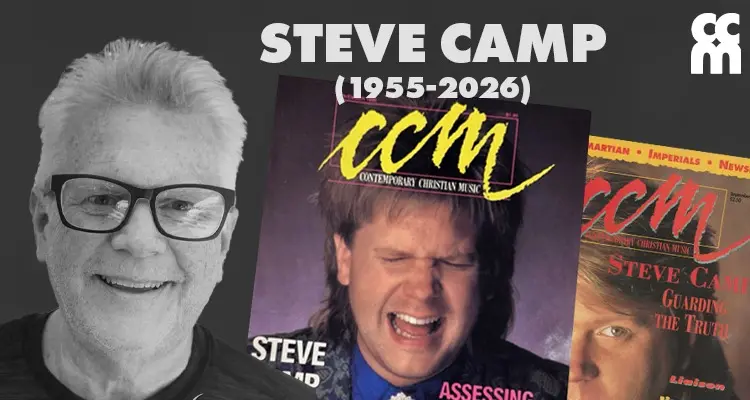
His cultural footprint expanded significantly in November 1986, when he was featured on the cover of CCM Magazine. By this point, Camp was not merely a charting artist; he was an acknowledged leader of a creative vanguard that challenged the Christian subculture to look inward, examine its motives, and align itself more closely with historic orthodox Christianity.
The Prophetic Voice and Industry Critique
As the 1980s rolled into the 1990s, Steve Camp earned a reputation as one of the most outspoken critics of the commercialization of Christian music. In an era marked by crossover aspirations and an increasing emphasis on upbeat, commercially viable pop formulas, Camp famously penned open letters and delivered impassioned speeches urging the industry to return to its spiritual roots.
His most famous public critique, often cited as a watershed moment in industry self-reflection, called for a return to doctrinal purity, artistic integrity, and vertical worship rather than horizontal entertainment. While these prophetic warnings occasionally sparked controversy among record executives and radio programmers, they earned Camp the deep respect of theologians, pastors, and fellow musicians who shared his burden for the purity of the Church.
Pastoral Ministry, Theological Education, and Later Years
In the later phases of his life, Camp’s vocational focus naturally evolved. While he continued to record and perform, his energies increasingly gravitated toward pastoral ministry, theological training, and intensive local church discipleship. He served as a pastor and actively participated in life-on-life ministry, pouring his theological convictions into younger generations of believers and aspiring church leaders.
Even as health challenges began to mount in his later years—culminating in his battle with heart failure—Camp’s zeal for the Word of God never wavered. To the very end, his life remained a testament to endurance, finishing his earthly race with the same theological clarity and spiritual fervor that defined his earliest days on the scene.
Supporting Context & Metrics: Camp’s Indelible Footprint
To fully understand Steve Camp’s impact, one must evaluate both his qualitative cultural footprint and his quantitative achievements within the Christian music landscape.
- Over Five Decades of Ministry: Camp’s career spanned more than 50 years, making him one of the longest-tenured and most consistent recording artists in the history of the genre.
- Two-Time CCM Magazine Cover Artist: His November 1986 cover story remains a landmark artifact of the golden era of CCM journalism, documenting an artist at the height of his creative and cultural influence.
- Chart Success and Radio Staples: Camp secured numerous radio hits throughout the 1980s and 1990s, including enduring anthems like "Run to the Battle," "Bad Boy," "Love That Covers a Multitude of Sins," and "He’s Everything."
- Theological Rigor: Unlike artists who relied on vague, positive-sounding lyrics designed for broad secular crossover appeal, Camp’s catalog is estimated to contain hundreds of explicit biblical references, making his albums functional teaching tools for youth groups, Bible studies, and personal devotion.
Official Statements and Tributes
The announcement of Camp’s passing sent shockwaves through the Christian music community, prompting an outpouring of grief, gratitude, and remembrance from peers, industry veterans, and family members alike.
The Camp Family Statement
The Camp family released a deeply moving statement underscoring both their profound sorrow and their unshakable Christian hope:
"It is with heavy hearts, yet great hope in Christ, that we share the passing of our beloved husband, father, and grandfather, Steve Camp.
On Wednesday, November 11, 2026, after a battle with heart failure, the Lord called Steve Home.
For over 50 years, Steve dedicated his life to proclaiming the Gospel through music, preaching, and life on life ministry. His greatest desire was to make much of the Lord Jesus Christ!
Two passages that shaped his life and ministry were Acts 20:24 and 2 Corinthians 4:5… Though our hearts are broken, we rejoice in knowing that Steve has finished his race. The One he spent his life proclaiming is the One he now worships face to face, in His unfiltered presence, for all eternity."
Industry and Peer Reflections
Fellow artists, producers, and ministry leaders took to social media and industry platforms to pay tribute to Camp’s uncompromising character. Many recalled his fierce loyalty to biblical truth, noting that behind his intense prophetic posture lay a deeply compassionate pastor who cared profoundly for the spiritual well-being of individuals.
"Steve Camp was a warrior for truth," shared one long-time industry contemporary. "He never cared about being the most popular guy in the room; he cared about being faithful to the Master. His music challenged us, stretched us, and ultimately drove us deeper into the Scriptures. The industry has lost a true giant."
Future Outlook: Preserving a Priceless Legacy
As the Christian music community prepares to honor Steve Camp’s memory in the days and weeks ahead, the question turns to how his legacy will be preserved for future generations.
- Catalog Preservation: There is a renewed call among digital streaming curators and catalog managers to ensure that Camp’s extensive body of work—much of which captured the theological wrestling of the late 20th-century church—remains accessible, remastered, and introduced to younger demographics of believers.
- Theological Influence: Camp’s written essays, open letters, and spoken messages on the intersection of faith, art, and commerce are anticipated to be compiled into academic and devotional retrospectives, serving as a blueprint for contemporary Christian artists seeking to navigate the modern media landscape without compromising their faith.
- The Continuing Resonance of His Mission: Ultimately, Camp’s legacy is not merely bound to vinyl records, compact discs, or digital playlists. It lives on in the hearts and minds of the countless believers, pastors, and musicians whom he mentored, challenged, and pointed toward the cross of Christ.
Steve Camp ran his race with unmatched vigor, unyielding courage, and a singular, burning passion to make much of Jesus. As he enters his eternal reward, the refrain of his life echoes the timeless words of the Apostle Paul: "I have fought the good fight, I have finished the race, I have kept the faith."
Steve Camp (1955–2026)
To God alone be the glory.