
Executive Overview
In the high-stakes, hyper-competitive ecosystem of contemporary Broadway, few transformations are as jarring—or as wildly successful—as the one executed nightly by Tony Award winner Ali Louis Bourzgui. To the thousands of screaming fans who pack the historic Palace Theatre to witness Broadway’s musical adaptation of The Lost Boys, Bourzgui is a terrifying, electrifying apparition. Sporting Billy Idol-grade bleach-blonde hair, razor-sharp leather, and an aura of feral magnetism, he embodies David, the legendary cinematic alpha-vampire who prowls the neon-soaked, fictitious boardwalk town of Santa Carla, California, searching for angsty adolescent recruits.
Yet, step backstage, peel away the opalescent cheekbone highlighter, brush off the smudged nocturnal eyeliner, and you will find a completely different person. By his own admission, Bourzgui is fundamentally "shy, introverted… a lightweight in real life"—the latter moniker serving as a literal nod to Resident Lightweight, his indie-rock side project alongside bandmate Joey D’Amore.
This profound dichotomy—between the reclusive, deeply grounded artist and the towering, gravity-defying rock god—defines the artistic renaissance of Ali Louis Bourzgui. It is a duality that propelled him to mainstream theatrical superstardom at the 2026 Tony Awards, where he captured the industry’s highest honors not merely for his virtuosic vocal acrobatics and high-flying stage combat, but for a fearless, politically charged acceptance speech that linked the ancient, predatory mythology of the undead with the modern, systemic cruelty of global power structures.
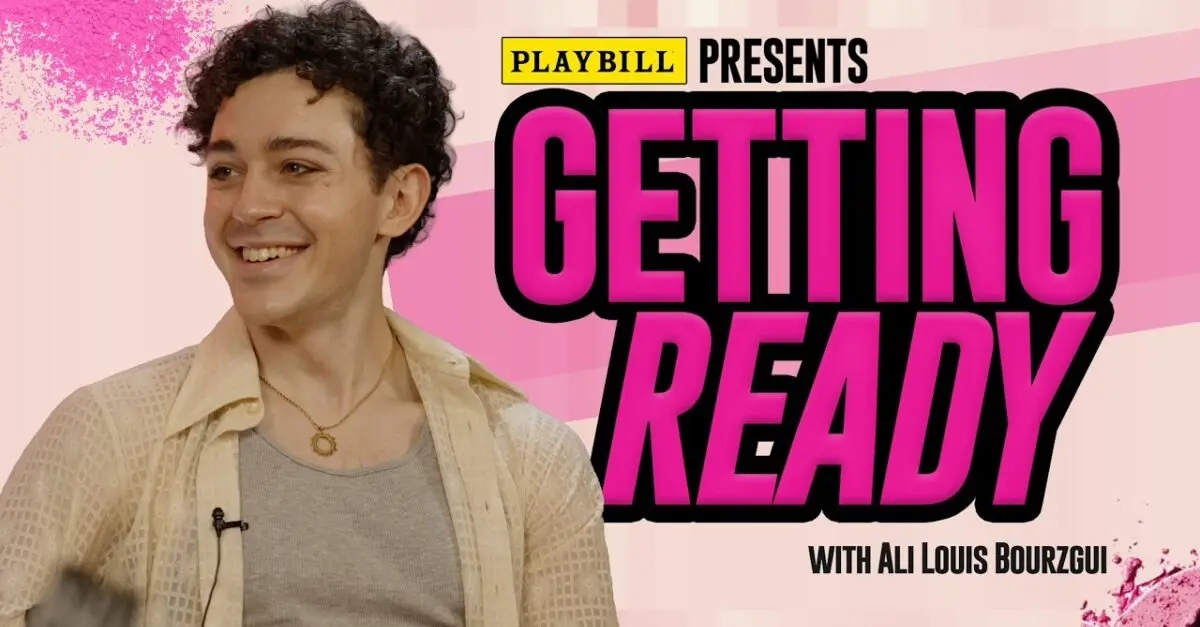
As captured in a recent, revealing installment of Playbill’s Getting Ready series, Bourzgui balances this monumental theatrical platform with a refreshing degree of self-awareness, humility, and philosophical depth. Whether he is playfully analyzing his ultimate backstage pet peeve ("getting stuck in a corner with an energy vampire"), deconstructing the limitations of traditional musical theatre tropes, or anchoring his creative output in the enduring Arabic traditions of his heritage, Bourzgui represents a new archetype for the modern Broadway star: fiercely political, radically authentic, and profoundly grateful.
Detailed Chronology: From Underground Indie Rock to the Palace Theatre Stage
The Making of a Reluctant Rockstar
Long before he was commanding the upper tiers of The Palace Theatre or fielding interviews about vampiric manicures, Ali Louis Bourzgui’s artistic foundation was forged in the quiet spaces of introspection. Raised with a deep appreciation for culture and storytelling—owing significantly to his identity as the son of a Moroccan immigrant—Bourzgui gravitated toward music and performance as a vehicle for emotional processing rather than a desperate bid for public adoration.
His musical sensibilities found an early home in the indie-rock project Resident Lightweight, where he and collaborator Joey D’Amore crafted intimate, textured soundscapes. To understand Bourzgui’s performance style in The Lost Boys is to understand this indie-rock lineage; his David is less a traditional operatic villain and more a bruised, charismatic frontman whose vocal delivery marries theatrical precision with the raw, guttural immediacy of 1980s alternative rock.
The Phenomenon of The Lost Boys on Broadway
When The Lost Boys was announced as a musical adaptation of the iconic 1987 Joel Schumacher cult-classic film, anticipation among musical theatre purists and cinephiles alike reached a fever pitch. Adapting a cinematic narrative heavily reliant on atmospheric dread, punk-rock aesthetics, and youthful rebellion into a viable stage musical presented massive logistical and creative hurdles.
Enter Bourzgui. Cast as David—the role originally immortalized on screen by Kiefer Sutherland—Bourzgui immediately understood that replicating a cinematic performance frame-by-frame would spell doom for the production. Instead, he leaned into the mercurial, unstable nature of live theatre.
"I strive to never have the same show every night," Bourzgui notes, pausing briefly during his pre-show ritual of applying stage cosmetics. "David likes to mess with the mundane. And his ambiguity works because the audience can project onto him."
This intentional ambiguity is a masterclass in modern character work. Bourzgui points out a fundamental truth about theatrical vampires: unlike traditional musical theatre protagonists who routinely halt the narrative machinery to deliver soaring, introspective "I Want" songs explaining their deepest psychological motivations, the undead operate on a different frequency. With a wry smile, Bourzgui mimics the cringeworthy, overly literal song structures that have historically doomed lesser fantasy musicals: "I am a vampire and here’s what I’m thinking!"
By refusing to over-explain David, Bourzgui allows the audience’s own anxieties, desires, and rebellions to fill the dark spaces between the notes.
Supporting Context & Metrics: The 2026 Tony Awards and the Cultural Watershed
The pinnacle of Bourzgui’s ascent arrived at the 2026 Tony Awards, an evening that will long be remembered in Broadway lore not just for the caliber of the nominated productions, but for the profound cultural resonance of its speeches. Winning the coveted award for Best Featured Actor in a Musical for his work in The Lost Boys, Bourzgui stepped up to the microphone and delivered remarks that transcended the standard Hollywood-style laundry list of theatrical thank-yous.
Art, Politics, and the Undead
In his acceptance speech, Bourzgui drew a direct, unyielding parallel between the thematic core of The Lost Boys and the sociopolitical realities of the modern world. Vampires, by definition, survive by draining the life force of others, entirely untethered from human empathy, mortality, or consequence. Bourzgui weaponized this mythology, comparing the predatory isolation of the undead to the "sense of superiority" that routinely powers contemporary billionaires, ruthless colonizers, and rising authoritarian regimes.
The speech sent immediate shockwaves through the Dolby Theatre and ignited viral discussions across digital media landscapes. It was a rare, uncompromising moment where commercial Broadway art intersected seamlessly with urgent global discourse. Yet, for Bourzgui, the political was deeply personal.
As the proud son of a Moroccan immigrant, he utilized his moment in the global spotlight to honor "the beautiful tapestry of immigrant families who make this country really special," while pausing to explicitly uplift and validate the contributions of Arab theatre makers—a community historically underrepresented in the upper echelons of mainstream American musical theatre.
Official Statements & Philosophical Foundations: Gratitude, Inshallah, and Bismillah
Behind the bleach-blonde hair, the leather wardrobe, and the biting political commentary lies a deeply spiritual framework that anchors Bourzgui against the turbulent, high-pressure undertow of Broadway stardom. In conversation, the actor opens up about the linguistic and philosophical anchors passed down through his extended family—specifically, the enduring weight of foundational Arabic phrases.
The Power of Inshallah
Consider the phrase Inshallah ("God willing"). To many Western observers, the phrase can occasionally be misconstrued as a passive dismissal of future planning. To Bourzgui, and the family members—including his father—who use it to punctuate every conversation about tomorrow, it is quite the opposite. It is an active exercise in radical humility.
"[Arabic] is based in gratitude," Bourzgui explains. "So, when you say Inshallah, you’re telling your brain that what you’re going to do is not always promised: I should be really grateful that, hopefully, God willing, I’ll be able to do that."
This philosophy extends directly into his daily life, whether his family is discussing a complex international journey or simply planning to brave New York City traffic to watch him perform at The Palace Theatre.
Bismillah and the Daily Ritual of Awareness
This thread of mindfulness continues with Bismillah ("In the name of God"), traditionally spoken before consuming food or embarking on significant endeavors. For Bourzgui, the habitual integration of these phrases creates an inescapable psychological loop of appreciation.
"It creates a sense of constant gratitude for things," he reflects, "the things you have, and the things that you get to have."
This perspective fundamentally alters how he views his current career trajectory. While millions of theatergoers view a Tony-winning Broadway lead role as a permanent elevation to theatrical royalty, Bourzgui treats it with the transient, precious fragility of a sandcastle facing an incoming tide.
Future Outlook: Sustaining the Magic Before the Final Curtain Falls
Every night at The Palace Theatre follows a rigorous, predictable choreography. Bourzgui sits in his dressing room, transforming his introverted reality into an extroverted nightmare; he laces up his boots, steps onto the stage, and trades raw, kinetic energy with thousands of adoring fans. None of these ticket-holders, he jokes, appear to be the "energy vampires" he so deeply fears running into at post-show mixers.
Instead, the exchange is pure, symbiotic electricity. Yet, Bourzgui and his castmates share a solemn, grounding pact regarding the temporary nature of this magic.
"This show is just a fun show to do," Bourzgui says, a genuine smile breaking through his vampire makeup. "The rest of the cast and I try to speak it out as much as possible: This eventually will end. Let’s be really grateful that we have this right now. I really revel in this, and speaking that out into existence keeps us really grateful for it."
As The Lost Boys continues its dominant run on Broadway, Ali Louis Bourzgui stands as living proof that an artist does not need to sacrifice their soul—or their humanity—to play a monster. By anchoring his soaring career in the bedrock of family heritage, political integrity, and relentless daily gratitude, Bourzgui ensures that whether he is playing a rock-and-roll predator under the stage lights or reflecting quietly in his dressing room, his light is one the theatrical world will not easily extinguish.