
Executive Overview
In the bustling urban landscape of central Brooklyn, music education faces a compounding set of systemic challenges: shrinking budgets, massive student populations, language barriers, and a lack of baseline resources. Yet, against these formidable odds, P.S. 197—The King’s Highway Academy—has emerged as a beacon of what is possible when visionary leadership meets the right technological tools.
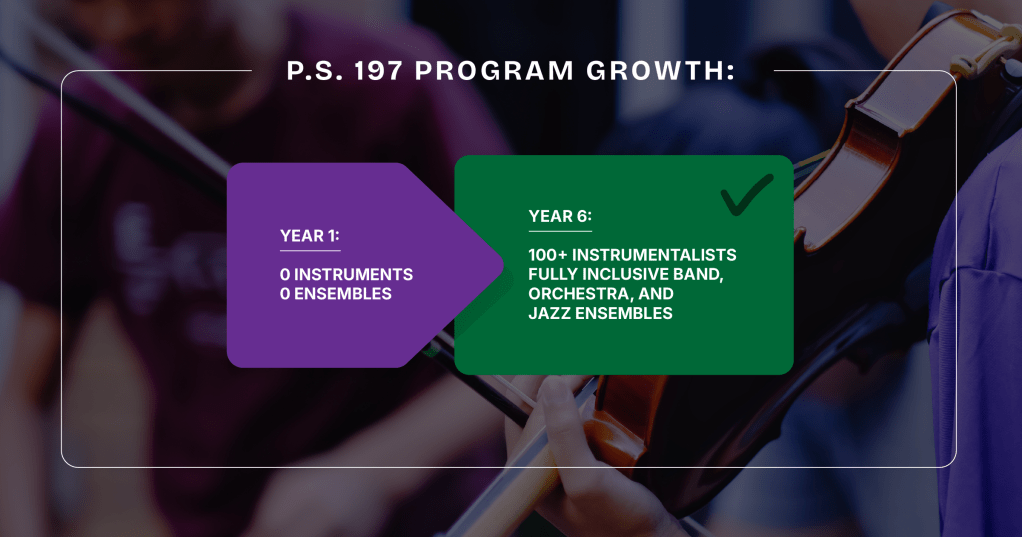
Six years ago, when music educator Kimberly Rosenbaum stepped through the doors of P.S. 197, she inherited a blank slate. There was no band, no orchestra, no sheet music library, and not a single instrument housed within the building. Today, that narrative has been completely rewritten. P.S. 197 now hums with the energy of a thriving, multi-faceted music department boasting a dedicated fourth-grade band, a fifth-grade band, an after-school string orchestra, and a specialized jazz band. Crucially, this program champions radical inclusivity, actively integrating students receiving special education services alongside their general education peers.
Managing a school population that has swelled to 1,200 students across grades 3K through 5th requires a masterclass in operational efficiency. Rosenbaum balances roughly 15 General Music sections while orchestrating small-group instrumental lessons squeezed into compressed 20-minute lunch and recess periods. To solve the logistical bottleneck of instructing beginner brass, woodwind, and string players in high-pressure, short-duration blocks, Rosenbaum integrated the digital practice platform MakeMusic. Serving as an automated in-class conductor, the platform has freed Rosenbaum to transition from a traditional front-of-the-room timekeeper to a hands-on technical coach.
This case study explores Rosenbaum’s journey from zero inventory to a 100-plus student instrumental ecosystem, examining how she leveraged bureaucratic workarounds like New York City Department of Education (NYCDOE) Sole Source procurement, utilized digital tools to bridge language divides for English Language Learners (ELL), and built a sustainable, equitable music program that serves as a blueprint for urban music educators nationwide.
Detailed Chronology: From Ground Zero to a Thriving Department
Year One: The Blank Canvas
When Rosenbaum arrived at P.S. 197 six years ago, her mandate from the school administration was clear: build a comprehensive instrumental music program from the ground up. However, the physical reality did not match the ambition. The school possessed zero musical instruments, no institutional history of an instrumental program, and no existing curriculum roadmap for band or orchestra instruction.
The initial phase was defined by resource acquisition and foundational planning. Rosenbaum worked alongside the administration to secure grants, community donations, and baseline starter instruments. At the same time, she mapped out a curriculum that would eventually feed students from general music classrooms into dedicated instrumental ensembles.

Years Two and Three: Establishing the Ensembles
As instruments trickled in and student interest surged, Rosenbaum established the foundational performance groups. The first milestones were the formation of a beginner fourth-grade band and a transitional fifth-grade band. Recognizing the diverse artistic interests of the student body, she also launched an after-school string orchestra.
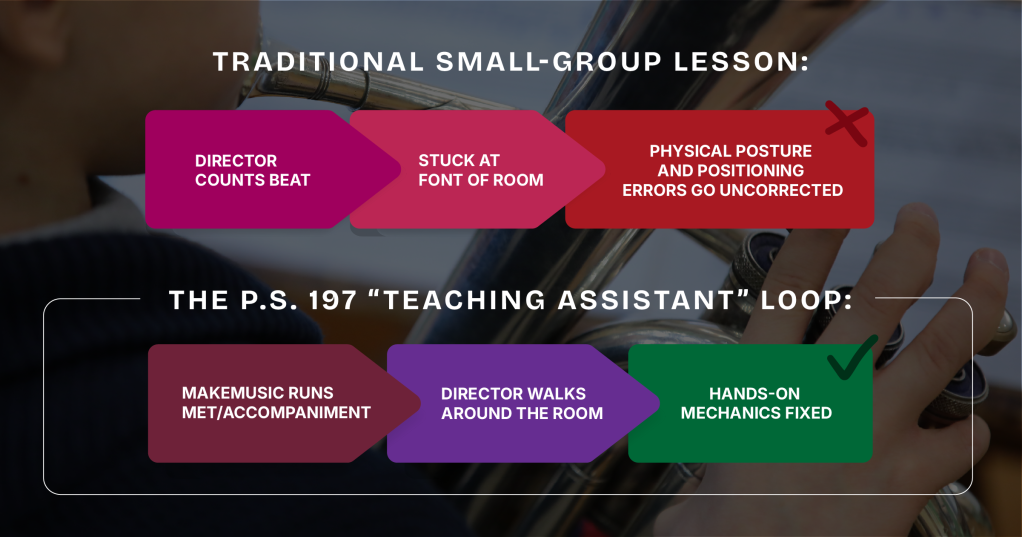
During this growth phase, logistical friction became the primary obstacle. With a school population booming toward 1,200 students, Rosenbaum’s schedule became an intricate web of 15 General Music sections interspersed with small-group instrumental pull-out lessons. Instruction time was brutally compressed—often limited to 20-minute windows during lunch and recess. Teaching a group of 10 beginner alto saxophones or trumpet players in 20 minutes left virtually no room for individualized attention. If Rosenbaum was busy counting off measures or maintaining ensemble tempo from the front of the room, she could not monitor individual hand placements, posture, or embouchures.
Years Four and Five: Integrating the Digital Assistant
To reclaim instructional time, Rosenbaum introduced MakeMusic into her daily rehearsals and small-group lessons. By utilizing the platform as an automated conductor—handling count-offs, tempo maintenance, and accompaniment tracks—Rosenbaum fundamentally altered her teaching methodology.
No longer chained to the podium to keep time, she was able to move physically around the room, engaging in rapid-fire, student-by-student diagnostic checks. This technological intervention stabilized the program’s quality even as enrollment numbers skyrocketed past 100 active instrumentalists.
Year Six and Beyond: Expansion and Inclusivity
Today, P.S. 197’s music program is an institutional cornerstone of the school community. Beyond the standard concert bands and string orchestra, the department now features a dynamic jazz band that encourages improvisation and stylistic exploration. Furthermore, the program has achieved true equity through the comprehensive inclusion of students receiving special education support. By pairing adaptable software with differentiated instruction, Rosenbaum has ensured that music-making is accessible to every child at P.S. 197, regardless of learning style or physical capability.
Supporting Context & Metrics: Overcoming Urban Education Hurdles
Building an instrumental program of this scale within the NYCDOE framework involves navigating complex bureaucratic and demographic landscapes. Two major hurdles—district procurement rules and multilingual student populations—stand out as critical friction points that Rosenbaum successfully dismantled.
Navigating NYCDOE Procurement: The Sole Source Shortcut
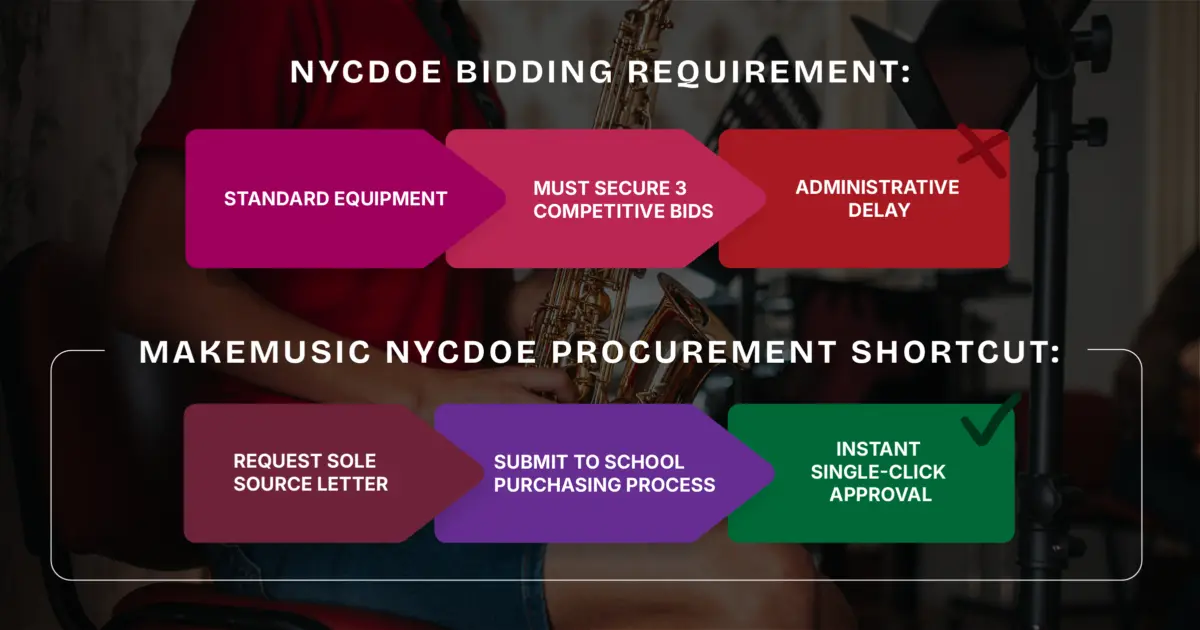
For educators operating within large public school districts like New York City, purchasing educational software through portals such as FAMIS and ShopDOE can easily derail a project. Standard district guidelines typically mandate securing three competitive bids from distinct vendors for software and supply purchases exceeding specific financial thresholds. For a busy music teacher, compiling three viable bids for specialized music education software is a time-consuming administrative burden that can delay implementation by months.
Rosenbaum circumvented this systemic roadblock by utilizing a strategic administrative tool: The Sole Source Vendor Letter.
[Traditional Route]
Identify Software -> Secure Bid 1 -> Secure Bid 2 -> Secure Bid 3 -> District Review (Months of Delay)

[Rosenbaum's Sole Source Route]
Identify Software -> Obtain Sole Source Letter -> Submit to Purchasing Secretary -> Instant Approval
By requesting a sole-source documentation letter directly from MakeMusic—certifying that the specific digital practice ecosystem and its proprietary pedagogical tools cannot be procured through alternative vendors—Rosenbaum streamlined the entire transaction.
"MakeMusic provides a sole-source letter stating you can’t buy this tool anywhere else," Rosenbaum notes. "You give that letter to your purchasing secretary, and they don’t have to ask for three bids because there’s only one source. It’s one of my easiest purchases of the entire year."
Bridging Language and Ability Barriers in Central Brooklyn
Central Brooklyn is a vibrant cultural mosaic, but its public schools frequently serve high concentrations of English Language Learners (ELL) and multilingual families. In a traditional instrumental music classroom, language barriers can create an invisible wall between the instructor’s verbal directions and the student’s comprehension, particularly during complex music-theory explanations or rhythm-reading exercises.
To dismantle this barrier, Rosenbaum integrated multilingual resources directly into her digital workflow. When working with non-English-speaking string or wind students, she utilizes Spanish-translated editions of Alfred Music’s Sound Innovations method series embedded directly within the MakeMusic platform.
This integration is complemented by the platform’s visual feedback engine. The real-time red-and-green note assessment display provides an intuitive, non-verbal communication channel. Young musicians do not need to rely solely on spoken English to understand whether they have played the correct pitch or rhythm; the visual interface provides immediate, self-correcting feedback that guides home practice sessions without requiring parental translation assistance.
Official Statements and Pedagogical Philosophy
The success of P.S. 197’s music program is deeply rooted in Kimberly Rosenbaum’s teaching philosophy, which prioritizes student empowerment, physical technique, and psychological safety over rigid, traditionalist pedagogy.
Reflecting on the transformation of her small-group rehearsals, Rosenbaum emphasizes the psychological shift enabled by technology:
"MakeMusic allows me to take a step away from being a conductor and lets me really focus on just being a teacher. They know the count-off is coming, the program takes them through, and I can go student-by-student down the line to fix hand position, embouchures, and instrumental positions while they play."
This shift addresses one of the most persistent flaws in elementary instrumental education: the inability to correct bad habits before they become ingrained. When a beginner alto saxophonist develops tension in their right thumb or an improper lower-lip embouchure, leaving them unchecked for a 20-minute session cements poor muscle memory. By delegating time-keeping and accompaniment to a digital assistant, Rosenbaum acts as a physical therapist for developing musicians, optimizing their posture and technique in real time.
When asked what advice she would offer to fellow music educators who may be skeptical about introducing digital practice tools into elementary or urban settings, Rosenbaum’s stance is resolute and visionary:
"MakeMusic isn’t a rigid curriculum; it’s a flexible tool. You’re giving students access to resources they wouldn’t otherwise have. When you give a kid an instrument and the right tools to practice, they just take off with it. Why wouldn’t you give them that opportunity?"
Future Outlook: Scaling the P.S. 197 Blueprint
The accomplishments at P.S. 197—The King’s Highway Academy—offer a scalable, reproducible model for urban arts education across the United States. As school districts continue to grapple with uneven resource distribution and post-pandemic learning gaps, the intersection of targeted human instruction and supportive educational technology proves that high-level music programs can be built anywhere.
Looking ahead, Rosenbaum aims to further expand the reach of P.S. 197’s music department, exploring avenues to introduce digital composition tools and collaborative remote ensemble projects that connect her Brooklyn students with peers across the globe. By proving that a school can transition from zero inventory to a thriving, 100-plus member instrumental program in under six years, Rosenbaum has not only enriched the hallways of a central Brooklyn elementary school—she has provided a masterclass in modern music advocacy.
For educators seeking to replicate this success, streamline their small-group workflows, and simplify district-level procurement, the path forward is clear. By embracing flexible digital ecosystems as in-class teaching assistants, music directors can reclaim their classrooms, empower their students, and turn the ambitious goal of universal music education into an everyday reality.