
By Francisco Salazar
Published by Special Arrangement with Classical Music & Opera Journal
Executive Overview
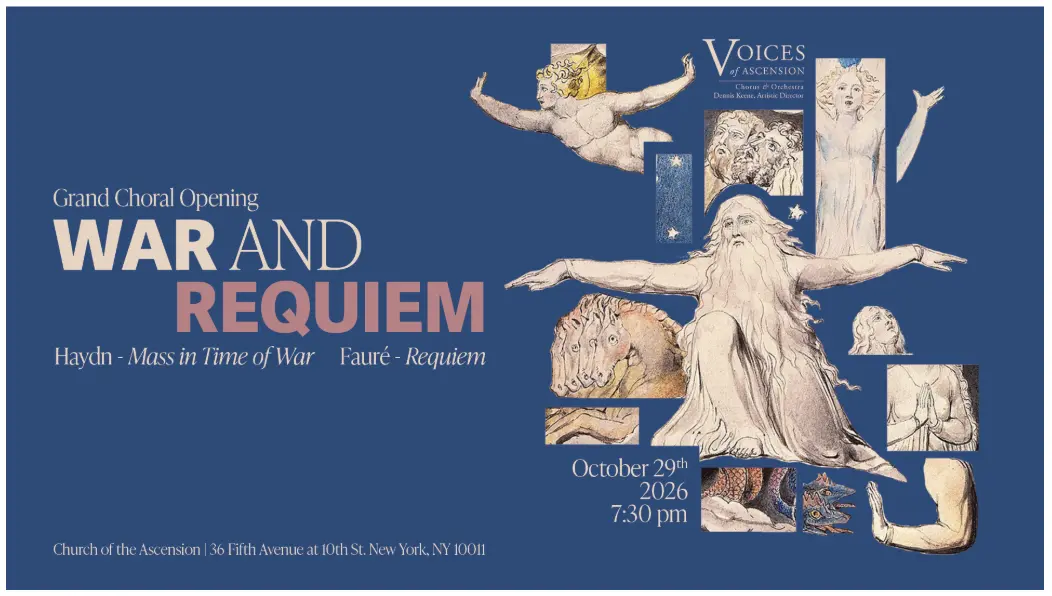
New York City’s premier professional vocal ensemble, Voices of Ascension, has officially announced the launch of its landmark 2026–27 concert season. Marking its 37th consecutive year of artistic excellence, the ensemble is set to open its upcoming calendar with a sweeping, emotionally resonant program entitled Grand Choral Opening: War & Requiem.
Scheduled for October 29, 2026, at the historic Church of the Ascension in Greenwich Village, this inaugural concert juxtaposes two towering masterpieces of the sacred and secular choral canons: Joseph Haydn’s Mass in Time of War (Paukenmesse) and Gabriel Fauré’s Requiem, Op. 48.
Far more than a standard season opener, this production is conceived as a profound meditation on the human condition—exploring the tension between societal conflict and spiritual deliverance. By pairing Haydn’s urgent, timpani-punctuated plea for peace against the backdrop of the Napoleonic Wars with Fauré’s luminous, comforting vision of the afterlife, Voices of Ascension establishes an ambitious curatorial tone for its 37th year.
The performance will showcase an extraordinary roster of celebrated guest soloists, including sopranos Meredith Wohlgemuth and Sarah Frei, mezzo-soprano Lucia Bradford, tenor Matthew Swensen, and baritone Joseph Parrish. Together with the fully professional chorus and period-informed instrumentalists, these artists will anchor an evening designed to interrogate the boundaries of past and present musical traditions.
This expansive preview report provides a comprehensive examination of the upcoming production, detailing the historical and musical significance of the featured masterworks, profiling the stellar cast of vocalists, evaluating the institutional trajectory of Voices of Ascension entering its fourth decade, and exploring the broader cultural resonance of choral music in contemporary society.
Detailed Chronology: The Making of Grand Choral Opening: War & Requiem
To fully appreciate the weight of Voices of Ascension’s upcoming season opener, one must trace the chronological and thematic trajectory that led to the pairing of Haydn and Fauré. The genesis of this program lies in a deliberate curatorial effort to bridge two distinct eras of classical music history while addressing universal themes of existential peril and eternal grace.
Phase I: Conceptualization and Repertoire Selection
Planning for the 2026–27 season began over eighteen months prior to the public announcement, spearheaded by the artistic leadership of Voices of Ascension. The core objective was to design an opening event that would immediately command critical attention while reinforcing the ensemble’s reputation for tackling intellectually rigorous, emotionally demanding repertoire.
The decision to anchor the first half of the concert with Haydn’s Mass in Time of War (Missa in tempore belli), composed in 1796, stems from its striking contemporary relevance. Written as French revolutionary armies marched across Europe, Haydn infused the traditional Latin Ordinary of the Mass with an unmistakable sense of military urgency—most famously characterized in the Agnus Dei, where the sudden, ominous thundering of timpani and muted trumpets shatters the liturgical calm.
Conversely, the second half of the program pivots toward internal peace and transcendence with Fauré’s Requiem. Completed in its final orchestration in 1900, Fauré’s setting deliberately eschews the terrifying apocalyptic judgment of the Dies Irae found in works by Mozart or Verdi. Instead, it offers a gentle, luminous contemplation of death as a passage into peaceful slumber.
By placing these two works in direct dialogue, Voices of Ascension creates a narrative arc that moves from the external noise of conflict to the internal sanctuary of divine mercy.
Phase II: Securing the Artistic Roster
With the repertoire locked, the administrative and artistic teams initiated the complex process of securing top-tier guest soloists capable of navigating the stylistic demands of both late-18th-century Classical and late-19th-century Romantic vocal writing.
- Sopranos Meredith Wohlgemuth and Sarah Frei: Known for their stylistic versatility and pristine tone, Wohlgemuth and Frei will divide the soaring soprano lines, bringing nuanced phrasing to Fauré’s ethereal Pie Jesu and the soaring ensemble passages of the Haydn Mass.
- Mezzo-Soprano Lucia Bradford: A critically acclaimed artist celebrated for her rich timbre and commanding stage presence, Bradford brings immense dramatic weight to the alto and mezzo solos.
- Tenor Matthew Swensen: Renowned for his lyricism and agility across operatic and concert stages, Swensen is uniquely equipped to handle the demanding tenor flights in Haydn’s sacred writing.
- Baritone Joseph Parrish: A rising star in the vocal world, Parrish’s velvety baritone will anchor the baritone solos in the Fauré Requiem, bringing profound warmth and solemnity to the Libera Me.
Phase III: The Venue and Acoustic Integration
The logistical framework for the concert centers on the Church of the Ascension, located at Fifth Avenue and Tenth Street in New York City. The venue is far more than a convenient performance space; it is an active participant in the sonic architecture of the evening.
With its resonant acoustic profile, neo-Gothic interior, and historic John LaFarge murals, the church provides an immersive environment where vocal polyphony can bloom. The spatial dynamics of the venue are expected to play a crucial role in how the audience experiences the dynamic contrast between the martial timpani rolls of Haydn and the whispered, consoling harmonies of Fauré.
Supporting Context & Metrics: Voices of Ascension at 37
As Voices of Ascension enters its 37th season, it stands as a pillar of New York City’s vibrant classical music ecosystem. Founded in 1990, the organization has carved out a distinct niche by championing the pinnacle of choral literature—ranging from Renaissance polyphony to cutting-edge contemporary commissions—performed with a level of precision and expressive depth that few ensembles worldwide can match.
Historical Legacy and Institutional Growth
Over nearly four decades, Voices of Ascension has achieved international acclaim through its rigorous performance standards, critically lauded commercial recordings on labels such as Delos, and its ongoing commitment to education and community engagement.
- Repertoire Breadth: The ensemble has performed hundreds of masterworks, championing both standard repertoire by Bach, Brahms, and Handel, and lesser-known historical gems.
- Acoustic Identity: Dedicated to maintaining the purity of vocal blend and text-driven interpretation, the chorus utilizes professional singers drawn from New York’s elite pool of freelance classical vocalists.
- Cultural Impact: The organization has consistently sought to position choral music not merely as a museum art form, but as a living, breathing medium capable of addressing contemporary emotional and spiritual needs.
Programmatic Philosophy for the 2026–27 Season
The overarching theme of the 2026–27 season is an exploration of "profound creativity that shapes choral music’s legacy and future." According to institutional framing documents, the upcoming season is designed to invite listeners into radiant musical landscapes where sound becomes a space for discovery, and the boundary between past and present begins to dissolve.
This philosophy is particularly evident in the Grand Choral Opening. By juxtaposing a work written during the chaos of the Napoleonic Wars with one written on the cusp of the 20th century—an era of profound industrial and social transformation—the ensemble subtly prompts contemporary audiences to reflect on their own turbulent historical moment. Music, in this context, functions as both an archive of human suffering and a vehicle for communal healing.
Official Statements and Artistic Insights
While formal press releases have outlined the broad strokes of the October 29, 2026 concert, institutional representatives and collaborating artists have shared deeper insights into the conceptual framework driving the production.
In a recent preview statement released by the administration, the curatorial team emphasized the timeless nature of the selected texts:
"When Haydn set the words of the Mass in 1796, Europe was tearing itself apart in ideological and territorial warfare. When Fauré composed his Requiem a century later, he sought to strip away the terror of divine retribution, replacing it with an image of ultimate rest. Today, as our world grapples with renewed conflicts and deep societal fractures, these masterworks speak with a startling, immediate urgency. They remind us that the human voice is our oldest and most powerful instrument of reconciliation."
Guest baritone Joseph Parrish, speaking on his involvement in the production, highlighted the unique collaborative energy required for a season-opening concert of this magnitude:
"Performing the Fauré Requiem in a space as acoustically and historically rich as the Church of the Ascension is always a transformative experience. But doing so alongside colleagues of the caliber of Meredith Wohlgemuth, Sarah Frei, Lucia Bradford, and Matthew Swensen—backed by the peerless precision of Voices of Ascension—elevates the music into something truly transcendent. This is not just a concert; it is a shared ritual for performers and audience members alike."
Future Outlook: The Road Ahead for Voices of Ascension
The announcement of Grand Choral Opening: War & Requiem serves as the starting gun for what promises to be one of Voices of Ascension’s most ambitious seasons to date. As the organization looks toward its milestone 40th anniversary in the coming years, its current programming strategy demonstrates a keen understanding of how to balance reverence for the past with bold, imaginative curation.
Upcoming Season Highlights
Following the October 29 season opener, Voices of Ascension will roll out the remainder of its 2026–27 calendar, which is expected to feature:
- Acapella Masterpieces of the Renaissance and Baroque: Deep-dive programs exploring the intricate counterpoint of the 16th and 17th centuries.
- Contemporary Choral Explorations: Commissioned works and modern settings that push the boundaries of vocal writing, showcasing the ensemble’s commitment to living composers.
- Holiday and Lenten Traditions: The continuation of the ensemble’s beloved seasonal offerings, which have become a staple of the New York holiday calendar.
The Broader Landscape of Choral Music in New York City
As New York continues to reassert its position as a global capital for the performing arts post-pandemic, professional ensembles like Voices of Ascension face both unprecedented opportunities and operational challenges. Rising production costs, venue availability, and the imperative to attract diverse, multigenerational audiences require strategic vision.
By anchoring its season in universally resonant themes—such as war, peace, grief, and solace—Voices of Ascension demonstrates a masterclass in audience engagement. The juxtaposition of Haydn’s dramatic orchestral coloring with Fauré’s serene vocal lines guarantees a program with wide crossover appeal, drawing both seasoned classical connoisseurs and newcomers seeking emotional resonance in live performance.
Conclusion
The 2026–27 season opener of Voices of Ascension promises to be a watershed moment in New York City’s classical music calendar. Through the brilliant pairing of Joseph Haydn’s Mass in Time of War and Gabriel Fauré’s Requiem, the ensemble has curated an evening that honors the historical weight of two sacred masterworks while speaking directly to the anxieties and aspirations of the modern world.
With an elite roster of guest soloists—Meredith Wohlgemuth, Sarah Frei, Lucia Bradford, Matthew Swensen, and Joseph Parrish—guiding the vocal interpretations, and the historic Church of the Ascension providing an acoustically sublime home, the performance on October 29, 2026, is unreservedly positioned as a must-attend cultural event.
As Voices of Ascension celebrates its 37th season, it reaffirms its status as a vital custodian of the choral art form—proving that when human voices unite in harmony, sound truly becomes a space for discovery, bridging the chasms between past and present, conflict and peace.